If you have ever been involved in a disagreement over money, property, a faulty product, or an unpaid salary, chances are someone told you: "Send a legal notice." But what does that actually mean? Is it a court case? Is it a threat? Do you need a lawyer? Does the other person go to jail?
The short answer is: a legal notice is none of those things. It is simply a formal letter that says, "Hey, you owe me something (or you did something wrong), and if you do not fix it, I will take legal action." That is it. No court, no police, no jail — at least not yet.
This guide explains everything about legal notices in plain English, with zero jargon left unexplained. Whether you are thinking of sending one, have just received one, or simply want to understand what the fuss is about, this article will walk you through every aspect — what a legal notice is, why it exists, when you legally must send one, when it is optional, and how the entire process works under Indian law.
What Is a Legal Notice? The Simple Version
Think of a legal notice as a formal warning letter. It is a written document where you tell the other person (or company, or government body) three things: (1) what they did wrong, (2) what you want them to do about it, and (3) what will happen if they do not act — which is usually that you will file a case in court.
Here is a real-world analogy. Imagine your neighbour borrows Rs. 50,000 from you and promises to return it in three months. Six months later, they have not paid despite your phone calls and WhatsApp messages. A legal notice is basically a formal, written, legally documented version of saying: "You owe me Rs. 50,000 as per our agreement. Pay within 15 days, or I will file a court case to recover the amount."
The difference between this and a regular angry message? A legal notice is written in a specific format, cites the relevant laws, is sent through registered post (so there is proof you sent it and they received it), and can be used as evidence in court later. It is not just a letter — it is a legal step.
The Legal Definition
For those who want the technical version: the General Clauses Act, 1897 — which is the law that defines basic legal terms used across all Indian statutes — defines "notice" in broad terms. Under Section 2(51), the expression "served" or "given" when used in connection with a notice means that the notice has been delivered or tendered to the person concerned, or sent by post to the person at their last known address.
In practical terms, a legal notice under Indian law is a formal written communication from one party to another, typically drafted by an advocate (though this is not mandatory), conveying a grievance, demanding specific action within a stated deadline, and warning of legal consequences in case of non-compliance. It is governed not by one single law but by several statutes depending on the context — the Code of Civil Procedure, 1908, the Negotiable Instruments Act, 1881, the Indian Contract Act, 1872, the Transfer of Property Act, 1882, and many others.
In One Sentence
A legal notice is a formal, written demand that puts the other party on record that you have a grievance, you want it resolved within a specific time frame, and you are prepared to go to court if it is not.
Why Do Legal Notices Exist?
You might wonder: why bother with a notice? Why not just file a case directly? There are four important reasons why the Indian legal system values legal notices, and understanding them will help you see why sending one is almost always a smart move.
It Creates a Formal Record
Verbal complaints, phone calls, and even WhatsApp messages can be denied or disputed. A legal notice sent by registered post creates an official paper trail. India Post gives you a receipt, a tracking number, and an acknowledgement card signed by the person who received it. This means you have proof that the other person was told about the problem, was given time to fix it, and chose not to. If the case goes to court, this proof is invaluable.
It Shows You Are Serious
There is a big difference between saying "I will take legal action" over the phone and actually sending a formal legal notice on an advocate's letterhead, citing specific sections of law, and giving a 15-day deadline. The first can be brushed off. The second cannot. Many people and businesses who ignore phone calls and emails suddenly respond the moment they receive a legal notice, because it signals that you are genuinely prepared to go to court.
Some Courts Require It
In certain types of cases, Indian law says you cannot file a case in court unless you have sent a legal notice first and waited for a specific period. If you skip the notice, the court can reject your case outright. We will cover these mandatory scenarios in detail in the next section.
It Is a Negotiation Tool
Court cases in India can take years and cost a fortune. Neither party usually wants that. A legal notice opens the door for negotiation and settlement without the burden of litigation. According to various bar council estimates, nearly 40-50% of disputes in India get resolved after a legal notice, without ever reaching a courtroom. The notice essentially says: "Let us resolve this now, or we are both going to spend the next few years in court." That is a powerful motivator.
Think of It This Way
A legal notice is the legal equivalent of a "last warning" before things get serious. It gives the other person one final, documented chance to make things right. Most people take that chance.
When Is a Legal Notice Legally Mandatory?
In most disputes, sending a legal notice is optional — you can go straight to court if you want. But there are specific situations where Indian law says: "You must send a notice first, or the court will not entertain your case." Here are the most important ones.
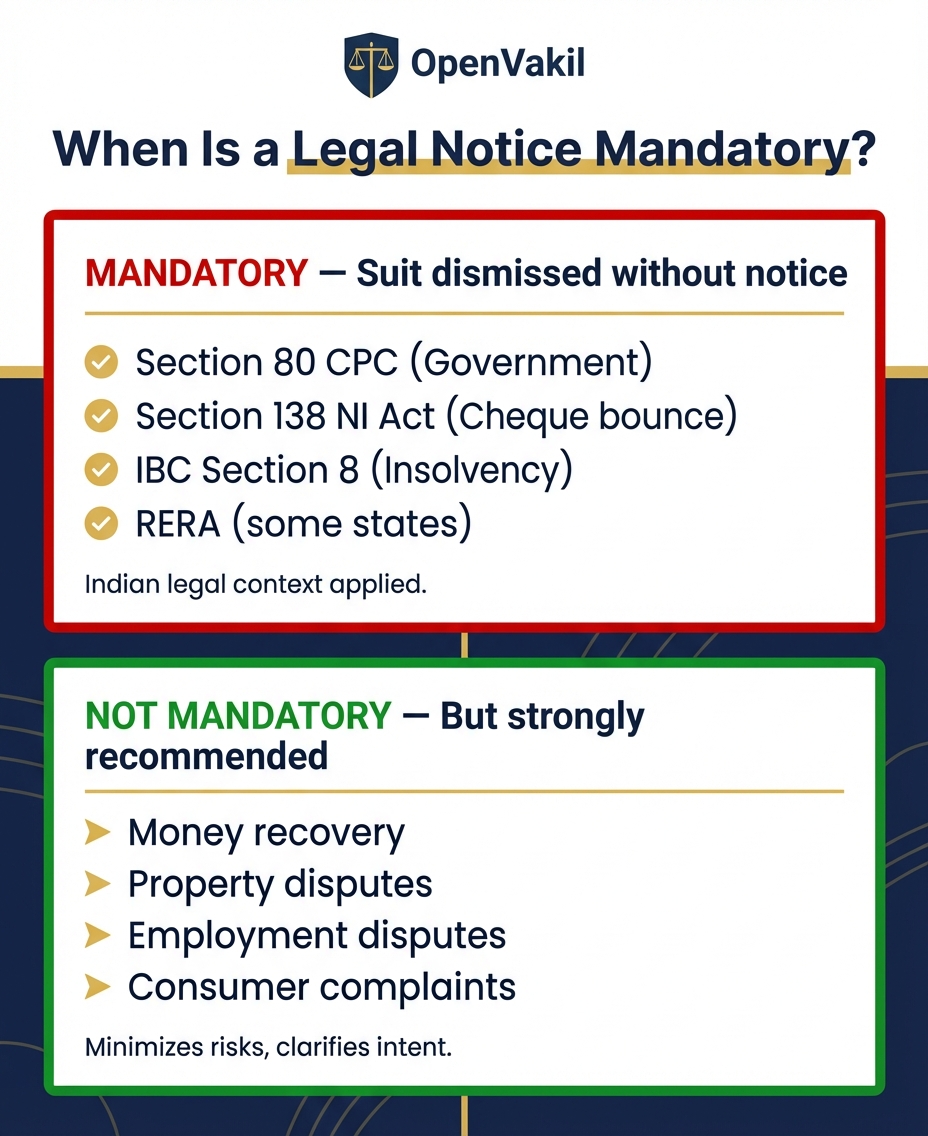
Suing the Government (Section 80 CPC)
If you want to file a civil suit against the Central Government, any State Government, or any public officer acting in their official capacity, Section 80 of the Code of Civil Procedure (CPC), 1908 makes it mandatory to send a legal notice at least two months before filing the suit.
What does this mean in plain language? Suppose a government hospital caused you harm through negligence, or a municipal corporation demolished your wall without proper authority, or a public officer wrongfully seized your property. Before you can file a court case for compensation or any other relief, you must first send a written notice to the relevant government authority. You then have to wait for two full months to give them time to respond or settle the matter. If they do not respond or reject your claim, only then can you file your suit.
The notice must include: your full name and address, the cause of action (what they did wrong), the relief you are seeking (what you want), and the name and address of your advocate (if any). Courts have been very strict about this requirement. In numerous cases, including judgments by the Supreme Court of India, suits have been dismissed outright because the plaintiff failed to send a proper Section 80 notice or did not wait the full two months.
Do Not Skip This Step
If your dispute is with any government body or public officer, a Section 80 CPC notice is not just a good idea — it is a legal requirement. Filing a suit without it, or with a defective notice, can get your entire case thrown out. The two-month waiting period is strict, and courts allow no exceptions except in cases of genuine urgency (which must be proved).
Cheque Bounce Cases (Section 138 NI Act)
This is probably the most common situation where a legal notice is mandatory. If someone gives you a cheque and it bounces (gets dishonoured by the bank due to insufficient funds or any other reason), Section 138 of the Negotiable Instruments Act, 1881 lays out a very specific process you must follow. Here is the step-by-step timeline, simplified:
- The cheque bounces. Your bank gives you a "return memo" or "dishonour memo" stating why the cheque was not honoured.
- You must send a demand notice within 30 days of receiving the return memo. This notice tells the cheque issuer: "Your cheque bounced. Pay the amount within 15 days."
- The cheque issuer gets 15 days to pay. If they pay within 15 days of receiving your notice, the matter ends there.
- If they do not pay within 15 days, you can file a criminal complaint under Section 138, but you must do so within one month of the expiry of the 15-day period.
Here is the critical part: if you do not send the notice within 30 days, or if the notice is defective, you lose the right to file a criminal complaint entirely. The Supreme Court has been very clear about this in multiple rulings, including Kusum Ingots & Alloys Ltd. v. Pennar Peterson Securities Ltd. and Dashrath Rupsingh Rathod v. State of Maharashtra. There is no way around the notice requirement for cheque bounce cases.
Other Statutes That Require a Notice
Beyond Section 80 CPC and Section 138 NI Act, several other Indian laws require a notice before certain legal actions can be taken:
- Insolvency and Bankruptcy Code, 2016 (Section 8): If a company owes you money (an operational debt), you must send a formal demand notice before you can start insolvency proceedings against them.
- Transfer of Property Act, 1882 (Section 106): A landlord must give the tenant a notice of termination of tenancy before filing an eviction suit. The notice period depends on the type of tenancy — for example, 15 days for a month-to-month tenancy.
- Companies Act, 2013 (Section 271): A creditor can issue a statutory demand notice to a company for an unpaid debt exceeding Rs. 1 lakh, which can trigger winding-up proceedings if not paid within 21 days.
- State Rent Control Acts: Most states require landlords to issue a specific notice period before initiating eviction proceedings, with the exact period varying by state.
The common thread is simple: wherever the law requires a notice, skipping it or getting it wrong can destroy your case before it even begins. This is why getting the notice right matters so much.
Not Sure If Your Situation Requires a Legal Notice?
Tell OpenVakil about your dispute in plain language, and our AI will identify whether a legal notice is mandatory, recommended, or unnecessary in your situation — along with the exact laws that apply. Takes just a few minutes.
Describe Your SituationWhen Is a Legal Notice Optional but Recommended?
In the vast majority of civil disputes, the law does not require you to send a legal notice before filing a case. You could go straight to court. But in practice, sending a notice first is almost always the smarter move. Here is a category-by-category look at common situations where a legal notice is optional but highly advisable.
Money Disputes
Someone owes you money and will not pay. Maybe it is a friend who borrowed Rs. 2 lakh, a client who has not paid your invoice, or a business partner who owes you your share. Under the Indian Contract Act, 1872, you have the right to recover any debt owed to you under a valid agreement. A legal notice demanding repayment within 15 or 30 days does two things: it creates a documented record of the debt (useful if the person later claims they never owed you anything), and it often shocks the debtor into paying because they realise you are serious. No one wants to deal with a court case over a sum they know they owe.
Property Disputes
Property disputes are among the most common reasons people send legal notices in India. These include: a builder delaying possession of your flat, a tenant refusing to vacate after the lease has ended, someone encroaching on your land, a seller backing out of a sale agreement, or a co-owner refusing to cooperate in partition. While you can file a property suit directly, a legal notice under the Transfer of Property Act, 1882 or the Real Estate (Regulation and Development) Act, 2016 (RERA) often resolves the matter faster. Builders, in particular, tend to respond quickly to legal notices because they are already dealing with multiple regulatory requirements.
Employment Issues
Were you fired without proper notice? Is your employer not paying your salary or provident fund? Did they refuse to give you your experience letter? Employment disputes are stressful, and most employees feel powerless against their employer. A legal notice citing the relevant employment laws — the Payment of Wages Act, 1936, the Payment of Gratuity Act, 1972, or the Industrial Disputes Act, 1947, depending on your situation — levels the playing field. Companies take employment-related legal notices seriously because they do not want the matter to escalate to the labour commissioner or a court, both of which can be embarrassing and expensive for the employer.
Consumer Complaints
Bought a defective laptop? Booked a service that was never delivered? Got charged for something you never ordered? The Consumer Protection Act, 2019 gives you strong rights, and you can file a complaint with the Consumer Disputes Redressal Commission without sending a notice first. But sending a notice before filing often works better. Why? Because companies know that consumer forum cases are public, can result in compensation awards, and damage their reputation. A well-worded legal notice gives the company a chance to resolve the issue quietly, and many do.
Family and Personal Disputes
Legal notices are also common in family disputes — maintenance claims, disputes over ancestral property, recovery of stridhan (wife's personal property), and even as a preliminary step before filing for divorce. In defamation cases, where someone has made false statements damaging your reputation, a notice demanding a retraction and apology can resolve the matter without a long court battle. Similarly, in neighbour disputes over boundaries, noise, or shared facilities, a formal notice often brings the other party to the negotiation table.
The Bottom Line
Even when the law does not require a legal notice, sending one is usually the fastest, cheapest, and most effective first step in resolving a dispute. It costs a fraction of a court case, takes days instead of years, and resolves nearly half of all disputes without any further action needed.
Who Can Send a Legal Notice?
Here is a fact that surprises most people: anyone can send a legal notice. You do not need a lawyer. There is no law in India that says a legal notice must be drafted or sent through an advocate.
The Advocates Act, 1961 gives advocates the exclusive right to "practise" before courts and tribunals. But sending a legal notice is not "practising" before a court — it is a pre-litigation communication, which is a fundamental right of every citizen. You can write a legal notice yourself, on plain paper, in your own name, and it is completely valid under Indian law.
That said, there is a practical difference between can and should. A notice sent on an advocate's letterhead carries more weight with the recipient because it signals that a legal professional is involved and you have already invested money in pursuing the matter. For straightforward disputes (clear debts, simple consumer complaints), a self-drafted notice or an AI-drafted notice can work perfectly well. For complex or high-value matters (property title disputes, criminal complaints, government-related issues), having a lawyer draft or at least review the notice is strongly recommended.
There is also a third option that did not exist a few years ago: AI-powered legal platforms like OpenVakil, which generate professional-quality legal notices based on your inputs, cite the correct laws, and use proper legal formatting — all at a fraction of what a traditional lawyer charges. This gives you the quality of a lawyer-drafted notice without the cost, which is especially useful for disputes involving smaller amounts.
What Does a Legal Notice Contain?
A legal notice follows a fairly standard structure. While there is no one mandatory format prescribed by law (except for specific statutory notices), a well-drafted notice typically contains the following elements:
- Your details (the sender): Full name, address, and contact information. If a lawyer is sending it on your behalf, it goes on the lawyer's letterhead with their name, enrolment number, and office address.
- The other party's details (the recipient): Full name and address of the person or company you are sending the notice to. For companies, this should be the registered office address.
- The facts: A clear, chronological description of what happened. Dates, amounts, agreements, transactions — all the relevant events laid out in order.
- The legal basis: Which laws support your claim. For example: "Under Section 73 of the Indian Contract Act, 1872, the aggrieved party is entitled to compensation for any loss caused by breach of contract."
- Your demand: What exactly you want the other party to do. Pay Rs. 5 lakh, vacate the property, return your documents, issue a public apology — whatever your specific demand is.
- A deadline: How many days the other party has to comply. Typically 15 or 30 days from the date they receive the notice.
- Consequences: What you will do if they do not comply. This is usually a statement that you will initiate civil and/or criminal proceedings, and the costs will be borne by them.
That is the basic anatomy of every legal notice. The language should be firm, factual, and professional — not emotional, not threatening, and not vague. Think of it as a business document, not a complaint letter.
A legal notice should read as though a judge might see it someday — because if the dispute goes to court, a judge will. Every fact should be accurate, every legal citation should be correct, and every demand should be reasonable and specific.
— Legal Drafting Best Practices, Bar Council of India
Does a Legal Notice Mean You Are Going to Court?
This is one of the biggest misconceptions, so let us address it head-on: receiving or sending a legal notice does NOT mean you are going to court.
A legal notice is a pre-litigation step. It happens before any court case. It is an attempt to resolve the dispute without going to court. In fact, the entire point of a legal notice is to avoid court by giving the other party a final opportunity to settle the matter amicably.
Here is what actually happens after a legal notice is sent, in the real world:
- Scenario 1 — They comply: The recipient pays the money, returns the property, fixes the issue, or does whatever the notice demanded. Matter closed. No court.
- Scenario 2 — They negotiate: The recipient responds (either directly or through their own lawyer) and negotiations begin. Both sides compromise, reach a settlement, and the matter is resolved. No court.
- Scenario 3 — They send a reply notice: The recipient sends a formal reply denying your claims or raising their own. This is common. It opens a back-and-forth that often leads to settlement.
- Scenario 4 — They ignore it: The recipient does nothing. After the deadline passes, you decide whether to file a case. Even at this point, many people choose mediation or further negotiation instead of going to court.
- Scenario 5 — You file a case: Only if all else fails does the matter actually go to court. This happens in a minority of cases.
The data bears this out. As noted earlier, an estimated 40-50% of disputes are resolved at the legal notice stage itself. A legal notice is designed to prevent court cases, not start them.
What Happens When You Receive a Legal Notice?
If you are on the receiving end of a legal notice, the first thing to do is not panic. A legal notice is not a court order. No one is coming to arrest you. You have not been "sued." Here is what you should actually do:
- Read it carefully: Understand exactly what the sender is claiming and what they are demanding. Note the deadline they have given you.
- Do not ignore it: Ignoring a legal notice does not make it go away. If anything, it strengthens the sender's position because they can tell the court: "I sent a notice, they did not even bother to respond."
- Assess the claims: Are the claims valid? Do you actually owe the money? Did you actually do what they are saying you did? Be honest with yourself.
- Send a reply: You have the right to send a formal reply, either accepting the claims and offering to settle, or denying the claims and presenting your side of the story. A reply shows that you are engaging with the matter in good faith.
- Consult a professional if needed: If the notice involves a complex legal matter, a large sum, or a potential criminal complaint (like Section 138 NI Act for cheque bounce), it is wise to consult a lawyer or use a platform like OpenVakil to draft your reply.
- Keep all records: Preserve the notice, the envelope, the postal receipt, and any correspondence. These may be needed later.
Key Point for Recipients
Receiving a legal notice is not the end of the world. It is the beginning of a conversation. How you respond — or whether you respond at all — significantly affects what happens next. A thoughtful, timely reply can resolve the matter before it escalates.
How Much Does a Legal Notice Cost?
The cost of a legal notice in India varies widely depending on how you choose to get it drafted:
- Self-drafted (DIY): Free (plus Rs. 50-150 for postal charges). But carries the risk of legal errors that can hurt your case.
- Traditional lawyer: Rs. 1,500 to Rs. 50,000 or more, depending on the lawyer's experience, city, and the complexity of the dispute.
- Online legal platform (like OpenVakil): Starting from Rs. 299 for AI-assisted drafting, with optional lawyer review available at higher tiers. This is the sweet spot for most people — professional quality at an accessible price.
The important thing to remember is that a legal notice is almost always far cheaper than a court case. A court case can cost you lakhs in legal fees over several years. A legal notice costs a few hundred to a few thousand rupees and resolves the matter in days or weeks. For a detailed breakdown of costs by city, dispute type, and lawyer experience, see our comprehensive guide to legal notice costs in India.
Common Myths About Legal Notices
Legal notices are surrounded by misconceptions, largely because most people only encounter them during stressful situations. Let us clear up the most common myths.
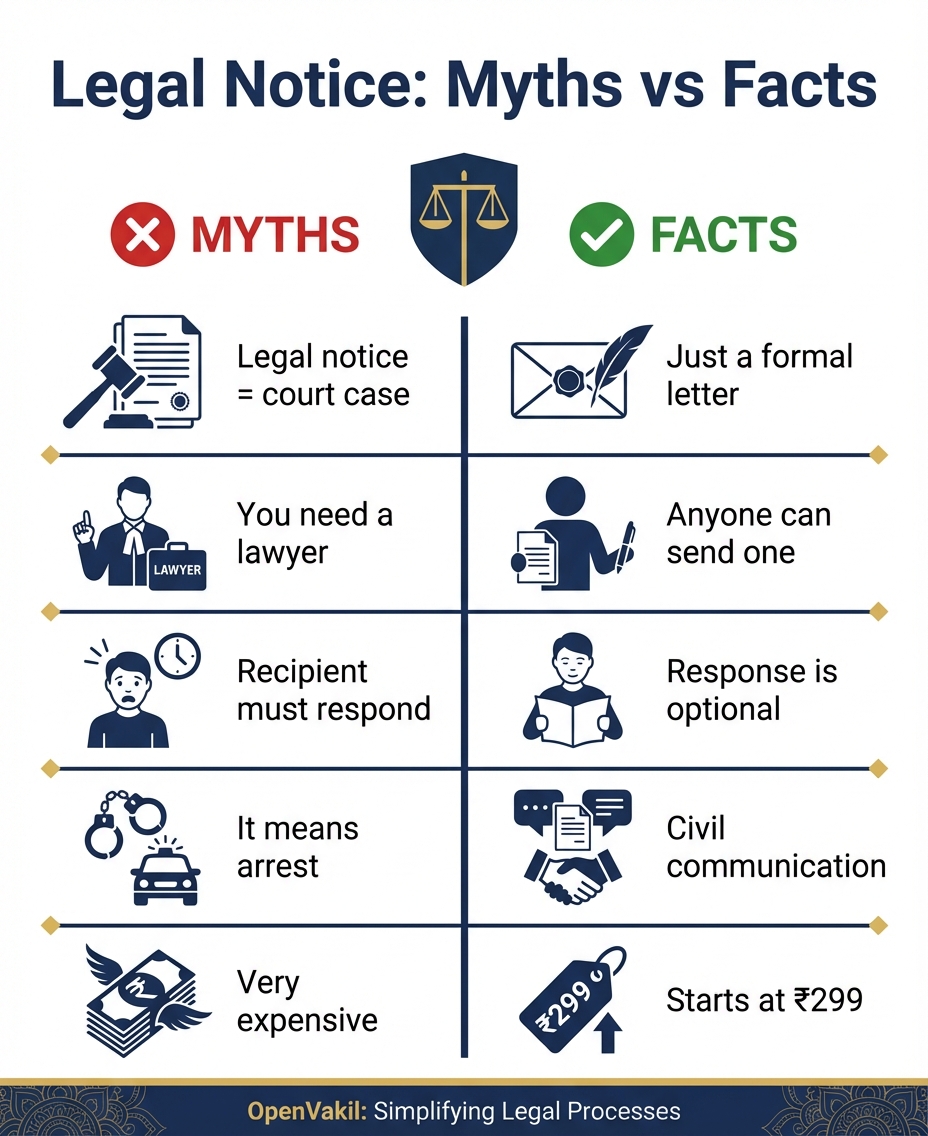
Myth 1: "A legal notice means I am being taken to court."
As we discussed above, this is false. A legal notice is a pre-court step. It is an attempt to resolve the dispute without going to court. Most disputes end at the notice stage. No case is filed just because a notice was sent.
Myth 2: "Only a lawyer can send a legal notice."
False. Any individual can draft and send a legal notice in their own name. There is no provision in the Advocates Act, 1961 or any other law that restricts this right. Having a lawyer helps with credibility and accuracy, but it is not a legal requirement.
Myth 3: "If I ignore a legal notice, nothing will happen."
Dangerous assumption. Ignoring a legal notice does not make the claim disappear. If anything, it strengthens the sender's case. The sender can tell the court that they gave you ample notice and opportunity to resolve the matter, and you chose to ignore it. Courts view this unfavourably.
Myth 4: "A legal notice needs to be on stamp paper."
Completely false. A legal notice does not require stamp paper. It is typically drafted on plain paper or on an advocate's letterhead. Stamp paper is required for certain documents like affidavits, agreements, and deeds under the Indian Stamp Act, 1899, but not for legal notices.
Myth 5: "Sending a legal notice is aggressive and will ruin the relationship."
This is a matter of perspective. A legal notice is not aggressive — it is formal. It is the civilised way to tell someone that they have a legal obligation they are not meeting. In fact, many relationships are better preserved through a clear, formal communication than through months of angry phone calls and passive-aggressive messages. A notice draws a line and says: "Let us resolve this properly."
Myth 6: "Legal notices are only for big disputes involving lakhs of rupees."
Not true at all. Legal notices are sent for amounts as small as a few thousand rupees. If a mobile repair shop refuses to return your phone after taking payment, or an online seller will not process your refund of Rs. 3,000, a legal notice is a perfectly valid and proportionate response. With platforms like OpenVakil offering notices from Rs. 299, the cost of the notice is proportionate even for smaller claims.
How OpenVakil Makes It Simple
If you have read this far, you understand what a legal notice is, why it matters, and when you need one. The next question is: how do you actually get one drafted and sent? This is where OpenVakil comes in.
OpenVakil is an AI-powered legal notice platform built specifically for India. It is designed for people who are not lawyers, have never dealt with legal matters before, and just want to resolve their problem quickly and affordably. Here is how it works:
- Tell us what happened: Describe your situation in your own words — no legal jargon needed. "My landlord won't return my security deposit of Rs. 1.5 lakh" or "A client has not paid my invoice of Rs. 80,000 for three months" is all we need to get started.
- We identify the law: Our AI maps your situation to the relevant Indian laws and provisions. Whether it is the Indian Contract Act, the Consumer Protection Act, Section 138 of the NI Act, or any other statute, the platform identifies and cites the correct legal basis automatically.
- Your notice is drafted: Within minutes, you receive a complete, professionally formatted legal notice with all the mandatory elements — your details, the recipient's details, the facts, the legal basis, the demand, the deadline, and the consequences.
- Review and send: You review the draft, make any changes, and when you are satisfied, we handle dispatch via registered post. You get tracking details and delivery confirmation.
- Affordable: Starting from just Rs. 299 — a fraction of what a traditional lawyer charges.
- Fast: AI-generated drafts in minutes, not days.
- Accurate: Cites the correct Indian laws and follows established legal notice formats reviewed by practising advocates.
- No legal knowledge required: The platform guides you through every step in plain English.
- Optional lawyer review: For added confidence, you can have a qualified advocate review and refine the AI-generated draft.
Whether your dispute involves Rs. 5,000 or Rs. 50 lakh, whether you are a student, a freelancer, a homeowner, or a business owner, the first step is the same: a well-drafted legal notice that puts the other party on record. OpenVakil makes that first step accessible to everyone.
Ready to Send Your First Legal Notice?
You do not need to be a lawyer. You do not need to spend thousands. Just tell us what happened, and OpenVakil will draft a professional legal notice that cites the right laws, uses proper language, and gets taken seriously. Start now.
Draft Your Legal NoticeA legal notice is one of the simplest and most effective tools available to ordinary people in India. It is not a court case, it is not a threat, and it is not only for the wealthy. It is a formal, documented way to say: "I have a legitimate grievance, here is the law that supports me, and I expect you to make it right." Understanding this tool — what it is, when you need it, and how to use it — is the first step toward protecting your rights in any dispute.
If you are dealing with a situation where someone owes you money, has broken a promise, delivered a faulty product, withheld your salary, encroached on your property, or wronged you in any other legally actionable way, a legal notice is very likely your best first move. It is quick, it is affordable, and in nearly half of all cases, it is the only move you will need to make.