The number one question people ask before sending a legal notice in India is: "Do I need a lawyer?" Whether it is a tenant refusing to vacate, a borrower who will not repay a loan, or a company that delivered a defective product, the instinct is to search for an advocate first. But here is the short answer — no, you do not need a lawyer to send a legal notice in India.
Indian law does not require a legal notice to be drafted or sent through an advocate. Any person can write and send a notice in their own name, and it carries the same legal validity as one sent through a lawyer. That said, whether you should send one without professional guidance depends on the complexity of your dispute, the stakes involved, and your comfort with legal language and procedure.
This comprehensive guide explains your legal rights, breaks down when you can confidently go it alone, when you genuinely need a lawyer, and how modern AI-powered legal platforms like OpenVakil have created a powerful middle ground that gives you professional-quality notices without the traditional cost of hiring an advocate.
The Legal Position: Can Anyone Send a Legal Notice?
Under Indian law, there is no statutory requirement for a legal notice to be drafted or sent through an advocate. The Advocates Act, 1961 grants advocates the exclusive right to "practise" in courts and before tribunals, but sending a legal notice is not the same as practising before a court. A legal notice is a pre-litigation communication — it is a letter demanding action or compliance, and it does not involve any court proceeding.
The distinction is critical. When you send a legal notice, you are not filing a case, arguing before a judge, or representing someone in a tribunal. You are simply communicating your legal position and intention to seek remedies if the other party does not comply. This is a fundamental right available to every citizen.
Section 30 of the Advocates Act, 1961 states that advocates shall have the right to practise in any court or before any authority or tribunal. However, the Act does not restrict any individual from sending communications, including legal notices, in their own capacity. A legal notice is a pre-litigation tool, not a court proceeding.
— Advocates Act, 1961 — Section 30, read with Bar Council of India Rules
Indian courts have consistently upheld the validity of legal notices sent by individuals without the involvement of an advocate. What matters is the content, accuracy, and proper service of the notice — not who drafted it. A notice sent by an individual is as legally valid as one sent on the letterhead of a law firm, provided it meets the substantive requirements of the relevant law.
Key Takeaway
There is no law in India that mandates a legal notice must be sent through an advocate. You have every right to draft and send a legal notice in your own name. The notice is valid as long as it is factually accurate, clearly states the legal basis, and is properly served on the recipient.
When a Lawyer Is NOT Required
While hiring a lawyer is always an option, there are many everyday situations where the facts are straightforward enough that you can send a legal notice yourself with confidence. If the dispute is simple, the amount is clear, and the law is well-settled, a self-drafted or AI-drafted notice can be just as effective.
Simple Disputes and Clear-Cut Claims
- Clear-cut money recovery: If someone owes you money based on a written agreement, promissory note, UPI transfer, or bank transaction, and they have simply refused to pay, the facts are straightforward. A notice demanding repayment with a clear deadline is something you can handle yourself.
- Demand for payment of dues: Unpaid freelance invoices, pending salary, or unreturned security deposits are common scenarios where the debtor knows they owe money but is stalling. A firm, well-structured notice often resolves such disputes without any court involvement.
- Return of personal property: If someone is holding your belongings — such as a former employer retaining your documents or a friend refusing to return borrowed items — a notice demanding their return is simple to draft.
- Warranty and refund claims: If a product or service did not meet the promised standards and the company refuses to honour its warranty or refund policy, a notice citing the Consumer Protection Act, 2019 can be effective and straightforward.
Consumer Complaints and Tenant Issues
- Consumer complaints: Under the Consumer Protection Act, 2019, consumers have strong rights. If a company has sold you a defective product, provided substandard service, engaged in unfair trade practices, or refused a legitimate refund, you can send a notice yourself. Consumer forums are specifically designed to be accessible without lawyers.
- Tenant-landlord disputes: Whether you are a tenant demanding the return of your security deposit or a landlord asking a tenant to vacate after the lease has expired, tenant notices follow well-established formats under the relevant state Rent Control Act and the Model Tenancy Act, 2021.
- Noise or nuisance complaints: If a neighbour or business is causing persistent nuisance, a legal notice citing relevant provisions of the CPC and local municipal laws can be drafted without legal complexity.
Rule of Thumb
If you can explain your entire dispute in 2-3 sentences and the facts are not in dispute, you can likely handle the legal notice yourself — especially with the help of an AI legal drafting tool. The simpler the facts, the less you need a lawyer.
When You SHOULD Hire a Lawyer
While many situations do not require a lawyer, there are circumstances where professional legal counsel is not just helpful but genuinely important. Recognising these scenarios can save you from costly mistakes.
- Complex property disputes with multiple parties: If your dispute involves joint ownership, ancestral property, partition claims, or multiple opposing parties, the legal issues can be intricate. An advocate who specialises in property law can navigate the complexities of the Transfer of Property Act, 1882, the Registration Act, 1908, and state-specific revenue laws.
- Cases involving criminal provisions: If your notice relates to an offence under the Indian Penal Code — such as Section 138 of the Negotiable Instruments Act (cheque bounce), Section 420 (cheating), or Section 406 (criminal breach of trust) — the legal requirements for the notice are specific and technical. Getting these wrong can undermine your criminal complaint.
- Disputes with large corporations: When the other party is a well-resourced company with its own legal team, a notice from an advocate carries more weight and signals that you are prepared for litigation. Corporate legal teams are more likely to take a lawyer-drafted notice seriously and respond promptly.
- Cases approaching the limitation deadline: If the statute of limitations is about to expire on your claim, you need a lawyer to ensure the notice is drafted, sent, and followed up correctly — and to file the case immediately if the notice does not yield results. There is no room for error when time is running out.
- High-value disputes: When the amount at stake is significant — typically above Rs. 10-20 lakh — the cost of a lawyer is a small fraction of what you stand to recover or lose. Professional drafting and strategy become essential.
- Notices involving government bodies (Section 80 CPC): While you can technically send a Section 80 CPC notice yourself, the mandatory requirements (two-month waiting period, specific format, naming the correct government entity) are strict. A defective notice can lead to your suit being dismissed on a technicality.
Important
If your dispute involves criminal provisions like Section 138 NI Act or Section 420 IPC, the legal notice itself has specific mandatory requirements that differ from a general civil notice. Sending a deficient notice can bar you from filing the criminal complaint. Consult a lawyer or use a specialised AI platform that understands these requirements.
Risks of Sending a Legal Notice Without Professional Help
Sending a legal notice yourself is perfectly legal, but doing it poorly can be worse than not sending one at all. Here are the most common pitfalls that self-drafted notices fall into:
- Wrong legal sections cited: Referencing incorrect provisions of law — or worse, citing repealed or irrelevant sections — immediately undermines the credibility of your notice. The recipient (or their lawyer) will spot the error and may dismiss the notice as unserious.
- Improper format reducing credibility: While there is no single mandatory format, a legal notice that reads like a casual letter or an angry email will not carry the same weight as one that follows the established professional structure. Recipients are less likely to respond to a notice that does not look or feel authoritative.
- Missing mandatory elements: Certain types of notices have specific requirements. For example, a notice under Section 80 CPC to a government body must include the cause of action, the relief sought, the name and address of the sender, and must allow a two-month window. A Section 138 NI Act notice must be sent within 30 days of the cheque return. Missing any mandatory element can invalidate the notice entirely.
- Vague or emotional language: One of the most common mistakes in self-drafted notices is letting emotion take over. Accusations, threats, abusive language, or vague statements weaken the notice legally. Courts look for factual, measured language that clearly states the grievance, the legal basis, and the remedy sought.
- Sending to the wrong address or person: A notice must be served on the correct legal entity at the correct address. Sending a notice to a company's branch office instead of its registered office, or addressing it to the wrong person in a partnership, can create service issues that the recipient exploits to claim non-receipt.
A poorly drafted legal notice does not just fail to achieve its purpose — it can actively harm your position by revealing your misunderstanding of the law, giving the other party ammunition to dismiss your claim, and creating a false sense of security that you have taken "legal action" when you have not done so effectively.
Self-Drafted vs Lawyer-Drafted vs AI-Drafted: A Comparison
To help you decide the right approach for your situation, here is a practical comparison of the three methods across the factors that matter most:
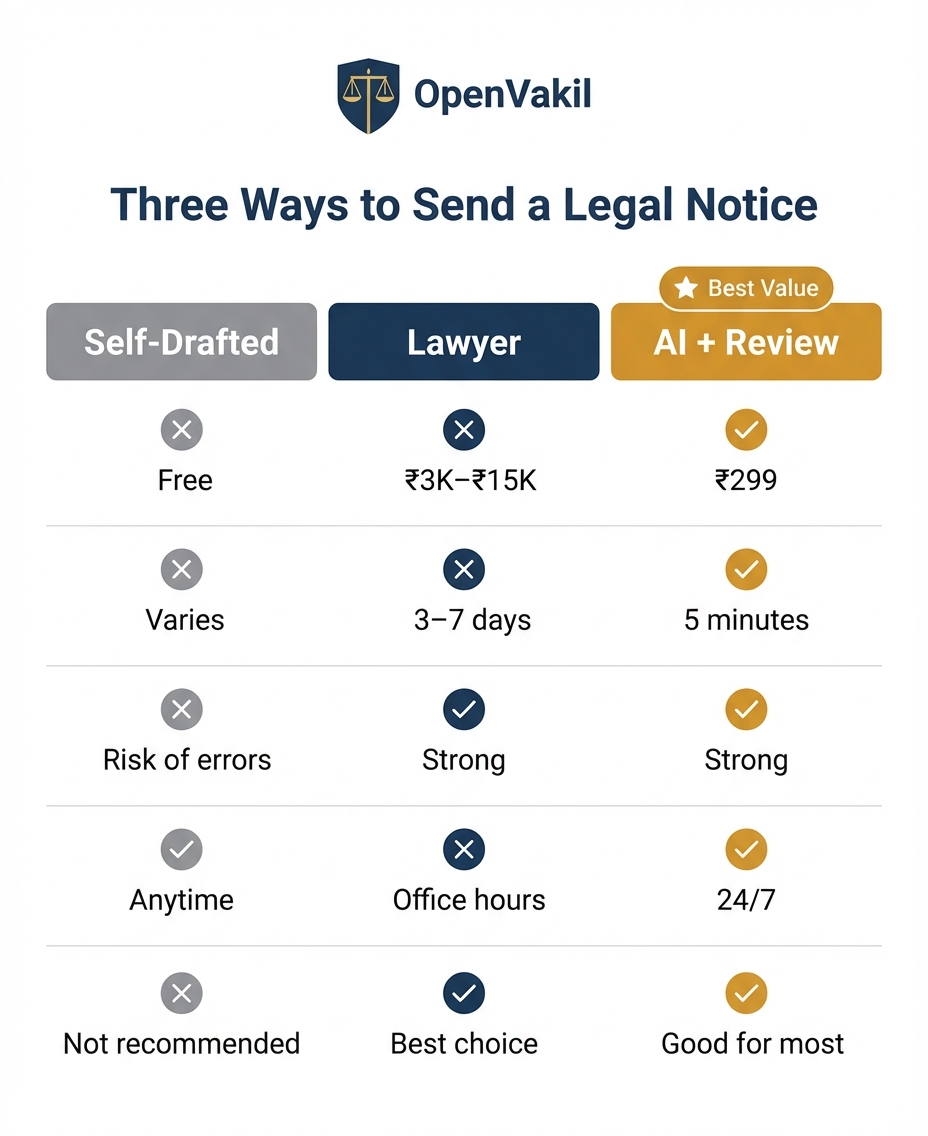
- Cost: Self-drafted notices cost nothing beyond the postage. Lawyer-drafted notices typically range from Rs. 3,000 to Rs. 15,000 or more depending on the lawyer's experience and the complexity of the matter. AI-drafted notices through platforms like OpenVakil cost a fraction of lawyer fees — typically Rs. 500 to Rs. 2,000 — making them the most affordable professional option.
- Speed: A self-drafted notice can be written in a few hours if you know what to include, but research and iteration can stretch this to days. A lawyer-drafted notice usually takes 3 to 7 working days, depending on the lawyer's availability. An AI-drafted notice can be generated in minutes — you answer questions, review the draft, and it is ready.
- Legal accuracy: Self-drafted notices carry the highest risk of legal errors — wrong sections, missing elements, or procedural mistakes. Lawyer-drafted notices are typically accurate, though quality varies with the lawyer's expertise and attention to your specific case. AI-drafted notices from specialised legal platforms are trained on legal frameworks and consistently cite the correct provisions, though complex edge cases may still benefit from human review.
- Credibility with the recipient: A notice on a lawyer's letterhead unquestionably carries the most psychological weight — it signals that you have invested money and are serious. A self-drafted notice may be taken less seriously, especially by corporate recipients. An AI-drafted notice, when well-structured and citing correct law, carries strong credibility because the recipient cannot tell whether a lawyer was involved or not.
- Customisation: A lawyer can tailor the notice to unusual facts and provide strategic advice beyond the notice itself. Self-drafted notices are fully customised to your situation but may miss legal nuances. AI-drafted notices offer strong customisation through guided questions, and the best platforms adapt the language, tone, and legal provisions to your specific dispute type.
The Best of Both Worlds
AI-drafted legal notices combine the affordability and speed of a DIY approach with the legal accuracy and professional structure of a lawyer-drafted notice. For straightforward disputes, an AI-drafted notice is often the optimal choice. For complex matters, you can use the AI draft as a starting point and have a lawyer review it — saving significant time and cost.
Draft Your Legal Notice in Minutes — No Lawyer Needed
OpenVakil's AI understands Indian legal frameworks and drafts notices that cite the right provisions, use proper legal language, and follow the professional format recipients take seriously. Try it now.
Create Your Legal NoticeHow AI Legal Platforms Bridge the Gap
The traditional choice was binary: either pay a lawyer thousands of rupees or attempt to draft a notice yourself and hope for the best. AI legal platforms like OpenVakil have fundamentally changed this equation by offering a third path — professional-quality legal notices generated through intelligent, guided conversations, at a fraction of the cost.
These platforms use AI models trained on Indian legal frameworks, statutory provisions, established notice formats, and thousands of real-world legal scenarios. The result is a system that understands the type of dispute you are facing, identifies the applicable laws, and generates a notice that is structurally sound, legally accurate, and professionally worded.
How the AI Conversation Works
When you use a platform like OpenVakil, the process is designed to be as simple as having a conversation:
- Describe your situation: You start by explaining what happened in plain, everyday language. There is no need for legal jargon. For example: "My landlord is not returning my security deposit of Rs. 2 lakh even though I vacated two months ago."
- The AI asks clarifying questions: Based on your description, the AI identifies the type of dispute and asks targeted follow-up questions — the exact amount, the date of the agreement, the landlord's full name and address, any prior communication, and the specific outcome you want.
- Applicable laws are determined: The AI maps your facts to the relevant legal provisions. For a security deposit issue, it would identify the applicable state Rent Control Act, the Model Tenancy Act, 2021, and relevant sections of the Indian Contract Act, 1872. For a cheque bounce, it would apply Section 138 of the Negotiable Instruments Act, 1881.
- The notice is generated: Within minutes, you receive a complete, professionally formatted legal notice that includes all mandatory elements — party details, factual background, legal basis, demand, deadline, and consequences. The language is formal, measured, and legally precise.
- You review and customise: You can review the draft, suggest edits, add details, or adjust the tone. The platform allows you to iterate until the notice is exactly right.
The key advantage is that the AI does not simply fill in a template. It understands the legal context, adapts the provisions to your specific facts, and generates language that would hold up to scrutiny from the recipient's lawyer. This is what separates AI-powered legal drafting from basic form-filling or template downloads.
Pro Tip
When using an AI legal platform, provide as much detail as possible in your initial description. The more context the AI has — dates, amounts, names, prior communication attempts — the more precise and effective the generated notice will be. Do not hold back relevant facts.
Key Elements Your Notice Must Have (With or Without a Lawyer)
Regardless of whether you draft the notice yourself, hire a lawyer, or use an AI platform, every legal notice must contain certain essential elements to be effective and legally sound. Missing any of these can weaken your position or even invalidate the notice for certain statutory requirements.
- Sender's details: Your full legal name, address, and contact information. If you are sending the notice on behalf of a company, include the company's registered name, CIN, and registered office address.
- Recipient's details: The full legal name and correct address of the person or entity you are sending the notice to. For companies, use the registered office address as listed on the MCA portal. For individuals, use their residential or last known address.
- Factual background: A clear, chronological narration of the facts that led to the dispute. Include dates, amounts, descriptions of agreements or transactions, and relevant events. This section should be objective and precise — not argumentative or emotional.
- Legal basis: The specific laws, sections, and provisions that support your claim. For example, reference the Indian Contract Act for breach of contract, the Consumer Protection Act for consumer disputes, or the relevant Rent Control Act for tenancy matters. This is where many self-drafted notices fall short.
- Demand or relief sought: A clear and specific statement of what you want the recipient to do — pay a specific amount, return property, cease an activity, comply with a contractual obligation, or provide some other remedy. Be precise about the demand.
- Timeline for compliance: A reasonable deadline, typically 15 to 30 days from the date of receipt, within which the recipient must comply with your demand. For certain statutory notices (such as Section 138 NI Act), the timeline is fixed by law at 15 days.
- Consequences of non-compliance: A statement that if the recipient fails to comply within the specified deadline, you will initiate appropriate legal proceedings — civil suit, criminal complaint, consumer forum case, or other applicable remedy. This should be firm but professional, not threatening or aggressive.
Watch Out for Statutory Notices
If your notice is a statutory prerequisite for filing a case — such as a Section 80 CPC notice to a government body or a Section 138 NI Act demand notice for cheque bounce — it must strictly comply with the specific requirements of that provision. A defective statutory notice can be grounds for dismissal of your case. When in doubt, use a specialised platform or consult a lawyer.
Tips for Sending a Strong Legal Notice on Your Own
If you have decided to send a legal notice without a lawyer — whether you are drafting it yourself or using an AI platform — these practical tips will help ensure your notice is taken seriously and achieves its purpose.
- Be factual, not emotional: This is the single most important rule. Your notice is a legal document, not a letter of complaint to a friend. Stick to facts, dates, and figures. Avoid language like "you cheated me" or "this is outrageous." Instead, say "despite repeated requests dated [date], the amount of Rs. [amount] remains unpaid, constituting a breach of the agreement dated [date]."
- Cite specific laws and sections: Referencing the applicable legal provisions — even briefly — signals that you understand your legal rights and are prepared to pursue them. For money recovery, cite the Indian Contract Act, 1872; for consumer issues, cite the Consumer Protection Act, 2019; for cheque bounce, cite Section 138 of the Negotiable Instruments Act, 1881.
- Always use registered post with AD: Send the notice via Registered Post with Acknowledgment Due (AD) through India Post. This provides proof of dispatch and receipt. Speed post with tracking is also acceptable. Courier services are used in practice but may be challenged. Always retain the postal receipt and the AD card.
- Keep copies of everything: Retain a copy of the notice as sent, the postal receipt, the tracking number, and the AD card when returned. If you also send the notice by email or WhatsApp, keep screenshots with timestamps. These become evidence if the matter goes to court.
- Set a clear and reasonable deadline: Give the recipient 15 to 30 days to respond or comply. Too short a deadline (7 days) may be seen as unreasonable by a court. Too long a deadline (60 days) wastes time and suggests you are not serious. For statutory notices, use the period specified by law.
- Do not make threats beyond legal remedies: Your notice should state that you will pursue "appropriate legal proceedings" or "civil and/or criminal remedies available under law." Never threaten personal harm, social humiliation, media exposure, or any action that goes beyond legitimate legal channels. Such threats can expose you to criminal liability.
- Address it correctly: Verify the recipient's full legal name and current address. For companies, check the MCA (Ministry of Corporate Affairs) portal for the registered office address. For individuals, use the address from the contract or agreement. Sending to the wrong address gives the recipient grounds to claim non-receipt.
- Use a professional structure: Follow the standard legal notice format: header with "LEGAL NOTICE" prominently displayed, sender and recipient details, subject line, factual paragraphs, legal basis, demand, deadline, consequences, and sign-off. A well-structured notice conveys seriousness regardless of who drafted it.
The tone of your legal notice matters more than most people realise. A measured, confident, fact-driven notice commands respect. An angry, rambling, or threatening notice is easily dismissed. Write as though a judge will read this notice someday — because if the matter goes to court, they will.
Frequently Asked Questions
Here are answers to the most common questions people ask about sending legal notices without a lawyer in India:
Is a legal notice valid without a lawyer's letterhead?
Yes, absolutely. There is no requirement in Indian law for a legal notice to be printed on an advocate's letterhead. A notice sent on plain paper in your own name is completely valid, provided it contains all the necessary elements — party details, facts, legal basis, demand, and deadline. Many courts have upheld notices sent by individuals directly. The letterhead adds a layer of psychological credibility, but it is not a legal requirement.
Does the recipient know whether a lawyer sent the notice?
If you send the notice in your own name, the recipient will know it did not come through a lawyer. However, if you use an AI legal platform like OpenVakil that generates professionally structured notices with correct legal citations, the quality of the notice itself conveys seriousness. In practice, what matters to the recipient is the content of the notice and the credibility of the legal claims made, not whether it came from a law firm.
Can the recipient refuse to accept the legal notice?
The recipient can physically refuse to accept registered post, but this does not invalidate the notice. Under Indian law, if a notice is sent by registered post to the correct address and is returned with the endorsement "refused" or "not claimed," it is deemed to have been served. The postal receipt and the returned envelope serve as proof of attempted delivery. This is why registered post with AD is the recommended method — it creates a clear record regardless of whether the recipient accepts it.
Is a legal notice sent via email or WhatsApp valid without a lawyer?
The legal position on electronic notices is evolving. While registered post remains the gold standard, Indian courts have increasingly recognised electronic communication as valid notice in certain contexts, especially when the underlying contract or agreement specifies email as a mode of communication. However, relying solely on email or WhatsApp carries risks — the recipient can claim they never saw it, and proof of delivery is less robust. The recommended practice is to send the notice by registered post and follow up with an email or WhatsApp copy for additional documentation.
Electronic Notice Tip
If your original agreement or contract specifies email as an accepted mode of communication between the parties, an email notice carries stronger legal standing. Even so, always send a physical copy by registered post as your primary mode of service, and treat the electronic copy as a supplementary record.
How OpenVakil Empowers You to Send Notices Without a Lawyer
OpenVakil was built on a simple belief: access to justice should not depend on how much you can afford to pay a lawyer. The platform combines AI-powered legal drafting with optional professional review and multi-channel dispatch to give every Indian the tools to assert their legal rights effectively.
- AI-powered drafting: Describe your situation in plain language, and OpenVakil's AI generates a complete, professionally structured legal notice in minutes. The AI identifies the applicable laws, cites the correct sections, uses formal legal language, and includes all mandatory elements — without you needing to know any law yourself.
- Optional lawyer review (Premium plan): For added confidence, the Premium plan includes a review by a practising advocate who checks the AI-generated draft for accuracy, suggests improvements, and ensures it accounts for any nuances specific to your case. This gives you the best of both worlds — AI speed and affordability with human legal expertise.
- Multi-channel dispatch: OpenVakil can handle the dispatch of your notice via registered post, speed post, and email — ensuring proper service and maintaining the delivery records you need as evidence. You do not have to visit the post office or worry about the logistics.
- Affordable pricing: At a fraction of the cost of a traditional lawyer consultation, OpenVakil makes professional legal notices accessible to individuals, freelancers, small businesses, and anyone who has been priced out of the legal system. Justice should not have a financial barrier.
- Guided process: The platform walks you through the entire process, from understanding your rights to gathering the right information, reviewing the draft, and sending the notice. You are never left guessing about the next step.
Whether you are a tenant fighting for your security deposit, a freelancer chasing an unpaid invoice, a consumer demanding a refund, or anyone else with a legitimate legal grievance, OpenVakil gives you the power to take the first legal step confidently — without needing a lawyer, but with the same professional quality.
Ready to Send Your Legal Notice?
You do not need a lawyer to assert your rights. OpenVakil's AI drafts professional legal notices in minutes, citing the right laws and using the language that gets results. Take the first step today.
Get Started Now