If you are considering sending a legal notice in India, one of the first questions that comes to mind is: how much will it cost? The answer, unfortunately, is not straightforward. Legal notice costs in India vary dramatically depending on the type of dispute, the lawyer you hire, the city you are in, and the method you choose to send the notice. A simple cheque bounce notice might cost you as little as ₹299 on an online platform, while a complex property dispute notice drafted by a senior advocate in Mumbai could set you back ₹50,000 or more.
In this comprehensive guide, we break down every component of legal notice fees in India, compare traditional lawyer costs with online platforms, explain the hidden charges most people overlook, and show you how to get a professionally drafted legal notice without breaking the bank. Whether you are an individual dealing with a personal dispute or a business owner facing a commercial conflict, understanding these costs will help you make an informed decision and protect your legal rights effectively.
Why Understanding Legal Notice Costs Matters
Many people in India delay sending a legal notice simply because they are unsure about the costs involved. This hesitation can be costly in itself. Under several Indian statutes, there are strict timelines for sending a legal notice. For example, under Section 138 of the Negotiable Instruments Act, 1881, a demand notice must be sent within 30 days of receiving the cheque dishonour memo. Missing this deadline means you lose the right to file a criminal complaint entirely.
Similarly, Section 80 of the Code of Civil Procedure, 1908 mandates that a notice must be served at least two months before filing any suit against the Government or a public officer. Under Section 8 of the Insolvency and Bankruptcy Code, 2016, an operational creditor must issue a demand notice before initiating the Corporate Insolvency Resolution Process (CIRP). In each of these cases, delay caused by cost confusion can result in the permanent loss of legal remedies.
Understanding the true cost of a legal notice empowers you to act quickly and decisively. It also helps you avoid being overcharged by lawyers who may quote inflated fees, especially if you are unfamiliar with the market rates. According to various bar council estimates and legal industry surveys, nearly 40-50% of disputes in India are resolved at the legal notice stage itself, without the matter ever reaching court. This means a legal notice costing a few hundred or a few thousand rupees can potentially save you lakhs in litigation expenses.
Key Insight
A legal notice is often the most cost-effective legal action you can take. The cost of sending a notice is a fraction of what you would spend on a full-blown court case, and it resolves nearly half of all disputes before they reach the courtroom.
Beyond just the financial aspect, understanding costs helps you evaluate the return on investment of sending a legal notice. If someone owes you ₹50,000 and the legal notice costs ₹299 to ₹2,000, the decision is straightforward. But if the dispute involves ₹10,000 and a lawyer quotes ₹15,000 for drafting, you need to weigh your options carefully. This guide will equip you with the knowledge to make these calculations confidently.
Traditional Lawyer Fees for Legal Notices
The largest component of legal notice cost is typically the advocate's fee for drafting and reviewing the notice. Unlike court fees, which are fixed by statute, lawyer fees are determined by market forces and vary widely across India. There is no standardised fee schedule prescribed by the Bar Council of India for drafting legal notices, which means fees depend on the advocate's reputation, experience, location, and the complexity of the matter.
Fees by City Tier
The city in which you hire a lawyer has a significant impact on the legal notice charges you can expect to pay. Here is a general breakdown based on city tiers:
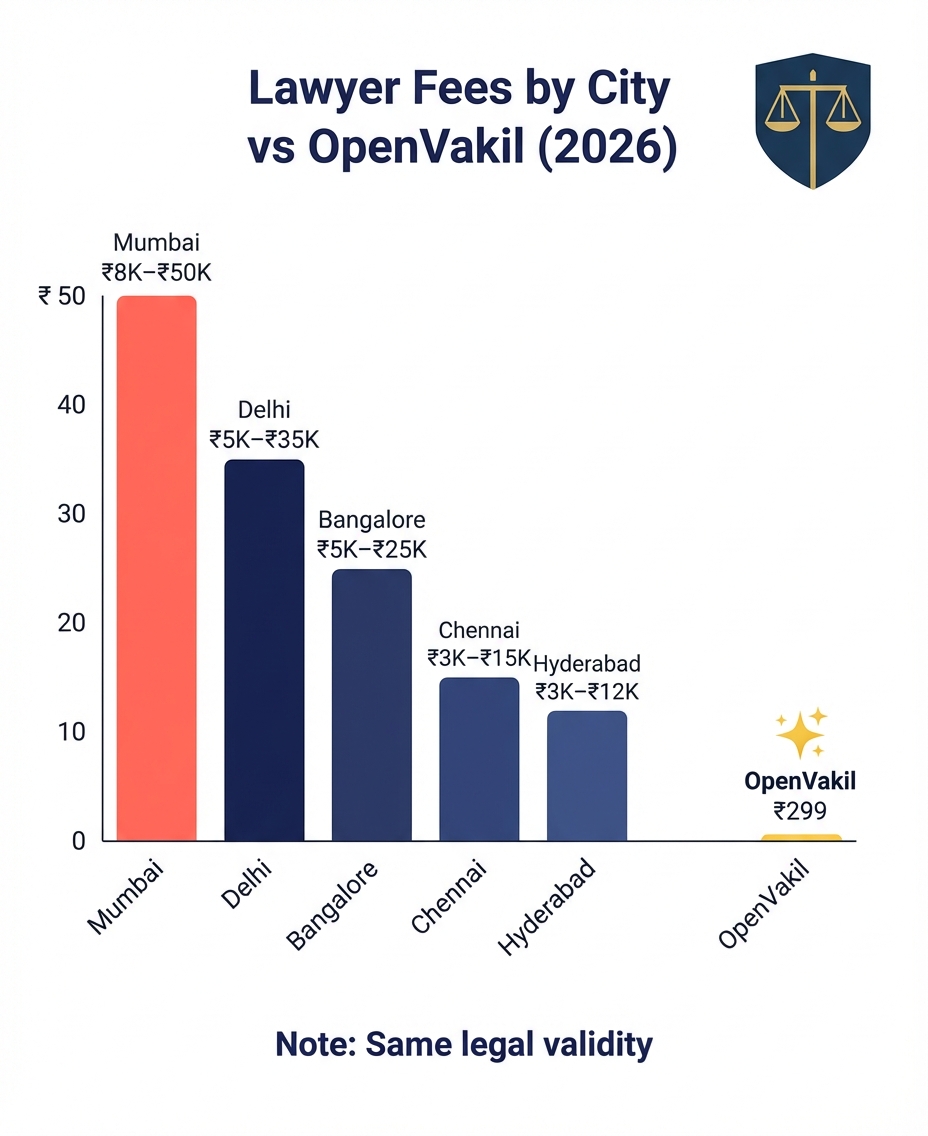
- Metro cities (Mumbai, Delhi, Bangalore, Chennai, Hyderabad, Kolkata): Lawyer fees for a standard legal notice typically range from ₹3,000 to ₹25,000. Senior advocates or those practising in High Courts and the Supreme Court may charge ₹25,000 to ₹1,00,000 or more, particularly for complex commercial or property disputes.
- Tier-2 cities (Pune, Ahmedabad, Jaipur, Lucknow, Chandigarh, Kochi, Indore): Fees generally range from ₹2,000 to ₹15,000 for a standard legal notice. Experienced practitioners may charge up to ₹25,000 for complex matters.
- Tier-3 cities and towns (smaller district headquarters, mofussil areas): Fees are typically lower, ranging from ₹1,000 to ₹7,000 for a standard notice. However, availability of specialised lawyers may be limited in certain areas, which can sometimes push fees higher for specific types of disputes.
Watch Out for Location-Based Overcharging
Some lawyers in metro cities charge premium rates not because the notice is more complex, but simply because of their office location and overheads. A simple cheque bounce notice under Section 138 NI Act requires the same legal content whether drafted in Mumbai or Indore. Online platforms like OpenVakil eliminate this geographic price disparity entirely.
Fees by Type of Dispute
The nature and complexity of the dispute directly affect lawyer fees for legal notice drafting. Notices involving straightforward statutory requirements tend to cost less, while those requiring detailed factual narration, multiple legal provisions, or strategic considerations cost more.
- Simple/standard notices (cheque bounce, basic money recovery, rent default): ₹1,500 to ₹5,000
- Moderate complexity notices (consumer complaints, employment disputes, breach of contract): ₹3,000 to ₹15,000
- Complex notices (property disputes involving title issues, multi-party commercial disputes, intellectual property matters, RERA complaints): ₹10,000 to ₹50,000
- High-value corporate notices (insolvency demand notices under IBC, large commercial arbitration demands, joint venture disputes): ₹25,000 to ₹1,00,000+
Fees by Lawyer Experience
The seniority and reputation of the advocate also play a major role in determining the legal notice price:
- Junior advocates (0-5 years of practice): ₹1,000 to ₹5,000. These advocates are often supervised by senior partners and offer competitive rates. For straightforward matters, they can be an excellent choice.
- Mid-level advocates (5-15 years of practice): ₹5,000 to ₹20,000. These advocates have developed specialisations and a track record, and their notices often carry more weight with recipients.
- Senior advocates and partners at law firms (15+ years): ₹15,000 to ₹1,00,000+. Their involvement is generally warranted only for high-stakes disputes where the notice itself has significant strategic importance, or where the opposing party is likely to scrutinise every word.
It is worth noting that a more expensive lawyer does not always mean a better legal notice. For routine matters such as cheque bounce notices or straightforward money recovery demands, a well-drafted notice by a competent junior advocate or a reputable online platform can be just as effective as one drafted by a senior counsel.
Get a Professional Legal Notice from ₹299
Why pay thousands to a traditional lawyer for a routine legal notice? OpenVakil's AI-powered platform drafts your notice in minutes, with optional lawyer review. Start now and save up to 90% on legal notice costs.
Draft Your Legal NoticeComponents of Legal Notice Cost
To truly understand how much a legal notice costs in India, you need to look beyond just the lawyer's fee. There are several distinct components that make up the total cost of sending a legal notice.
Drafting Fees
This is the fee charged by the advocate (or platform) for researching the legal issues, drafting the notice, and incorporating the relevant facts, legal provisions, and demands. As discussed above, this is typically the largest single component. On traditional platforms, drafting fees range from ₹1,500 to ₹50,000 depending on complexity and the advocate's standing. On online platforms like OpenVakil, drafting can start from as low as ₹299 for AI-assisted notices with optional lawyer review.
Drafting fees generally cover one round of revisions. Some lawyers charge additional fees for subsequent revisions or modifications. It is advisable to clarify the revision policy upfront to avoid unexpected charges later.
Consultation Charges
Before drafting a legal notice, most advocates conduct a consultation to understand the facts of the case and advise on the legal options. Some lawyers charge a separate consultation fee, which typically ranges from ₹500 to ₹5,000 for a 30-60 minute session in person or over phone/video call. In many cases, especially with traditional lawyers, the consultation fee may be adjusted against the drafting fee if you proceed with their services.
Senior advocates in metros may charge ₹5,000 to ₹25,000 or more for a detailed initial consultation, particularly for complex commercial or property matters. Online platforms like OpenVakil typically include an initial assessment as part of their service package, eliminating the need for a separate consultation fee.
Stamp Paper and Court Fees
A common question people ask is whether a legal notice needs to be executed on stamp paper. The answer is generally no. Under Indian law, a legal notice is a communication between private parties and does not require stamp paper. It is typically drafted on the advocate's letterhead and signed by the advocate.
There are no court fees associated with sending a legal notice, as it is a pre-litigation step. Court fees only become applicable if and when you file a suit or complaint in court after the notice period expires. Some people confuse notarial fees with stamp paper charges, but these are separate (discussed below). The only scenario where stamp paper might be relevant is if the notice is accompanied by an affidavit, which may require stamp paper of ₹10 to ₹100 depending on the state.
Postal and Courier Charges
The cost of physically dispatching the legal notice is a necessary component. Here is a breakdown of typical dispatch costs:
- Registered Post with Acknowledgement Due (AD): ₹50 to ₹150 per notice, depending on weight and destination. This is the most legally recognised method and is preferred for most disputes.
- Speed Post: ₹50 to ₹200 per notice. Offers faster delivery with online tracking and is widely accepted by Indian courts.
- Private courier (Blue Dart, DTDC, Delhivery): ₹100 to ₹300 per notice. While courts accept courier delivery, registered post via India Post is preferred for statutory notices such as those under Section 80 CPC and Section 138 NI Act.
- Email dispatch (supplementary): Free. However, email alone is generally not sufficient for statutory notices and should always be accompanied by physical dispatch.
If the notice needs to be sent to multiple parties or to multiple addresses (for example, both the registered office and the correspondence address of a company), the postal charges multiply accordingly. For a notice sent to three addresses by registered post, expect to pay ₹150 to ₹450 in postal charges alone.
Notarisation Charges
Notarisation of a legal notice is not mandatory under Indian law in most cases. However, some advocates recommend getting the notice notarised for added authenticity, particularly in high-value disputes or when dealing with parties who may later dispute receipt. Notarisation fees in India typically range from ₹100 to ₹500 per document, depending on the notary and the city.
In certain specific scenarios, such as notices related to international transactions or notices that may need to be presented before foreign courts or authorities, notarisation or apostille may be required. In such cases, the costs can be significantly higher, ranging from ₹1,000 to ₹5,000.
Cost Variation by Type of Notice
Different types of legal notices involve different levels of complexity, research, and legal expertise, which directly affects the cost. Below is a detailed breakdown of legal notice charges by the type of dispute.
Cheque Bounce Notice Cost
A cheque bounce notice under Section 138 of the Negotiable Instruments Act is one of the most standardised types of legal notices in India. The format is well-established, the legal requirements are clearly defined by the statute and by extensive Supreme Court jurisprudence (including landmark decisions such as Dashrath Rupsingh Rathod v. State of Maharashtra and Meters and Instruments Pvt. Ltd. v. Kanchan Mehta), and most advocates can draft one relatively quickly. This makes it one of the most affordable types of legal notices.
- Traditional lawyer: ₹1,500 to ₹5,000 (simple cases); ₹5,000 to ₹10,000 (multiple cheques or complex facts)
- Online platform (OpenVakil): Starting from ₹299 (AI-drafted with lawyer review option)
- Postal charges: ₹50 to ₹150
- Total estimated cost (traditional): ₹2,000 to ₹10,000
- Total estimated cost (OpenVakil): ₹299 to ₹1,500
Time-Critical: Do Not Delay
Remember that under Section 138 of the NI Act, you must send the demand notice within 30 days of receiving the dishonour memo from the bank. If you miss this deadline, you lose the right to file a criminal complaint. The drawer then has 15 days from receipt of the notice to make payment. Only after the 15-day period expires can you file a complaint, and this must be done within one month. OpenVakil can draft and dispatch your cheque bounce notice within 24-48 hours.
Property Dispute Notice Cost
Property dispute notices tend to be more expensive because they often involve complex facts, multiple legal provisions (the Transfer of Property Act, 1882; the Registration Act, 1908; the Real Estate (Regulation and Development) Act, 2016 (RERA); state-specific Rent Control Acts), and high-value claims. The advocate may need to review title documents, sale agreements, builder-buyer agreements, or tenancy agreements before drafting.
- Traditional lawyer: ₹5,000 to ₹30,000 (tenant eviction, boundary disputes); ₹15,000 to ₹50,000+ (title disputes, builder disputes with RERA components)
- Online platform (OpenVakil): Starting from ₹999 (standard property notices); ₹1,999 to ₹4,999 (complex property matters with document review)
- Total estimated cost (traditional): ₹5,500 to ₹50,000+
- Total estimated cost (OpenVakil): ₹999 to ₹5,000
Employment Dispute Notice Cost
Employment-related legal notices cover a range of issues including wrongful termination, unpaid wages, gratuity claims under the Payment of Gratuity Act, 1972, non-compete violations, and workplace harassment under the Sexual Harassment of Women at Workplace (Prevention, Prohibition and Redressal) Act, 2013 (POSH Act). The costs vary depending on the nature of the employment relationship and the specific claims involved.
- Traditional lawyer: ₹3,000 to ₹15,000 (wrongful termination, salary disputes); ₹10,000 to ₹30,000 (non-compete violations, ESOP disputes)
- Online platform (OpenVakil): Starting from ₹499 (standard employment notices); ₹999 to ₹2,999 (complex employment matters)
- Total estimated cost (traditional): ₹3,500 to ₹30,000
- Total estimated cost (OpenVakil): ₹499 to ₹3,000
Consumer Complaint Notice Cost
Legal notices under the Consumer Protection Act, 2019 are sent to businesses for defective products, deficient services, unfair trade practices, or misleading advertisements. While the Act does not mandate a pre-litigation notice before filing a complaint with the Consumer Disputes Redressal Commission, sending one often leads to faster resolution. Many companies have internal legal and escalation teams that respond to legal notices promptly to avoid negative publicity and the cost of defending proceedings before consumer forums.
- Traditional lawyer: ₹2,000 to ₹10,000 (defective product, service deficiency); ₹5,000 to ₹20,000 (unfair trade practices, large e-commerce disputes)
- Online platform (OpenVakil): Starting from ₹299 (standard consumer complaints); ₹999 to ₹2,499 (complex consumer matters)
- Total estimated cost (traditional): ₹2,500 to ₹20,000
- Total estimated cost (OpenVakil): ₹299 to ₹2,500
Money Recovery Notice Cost
Money recovery notices are among the most frequently sent legal notices in India. They are used to demand repayment of loans, outstanding invoices, unpaid dues, or any other financial obligation arising under the Indian Contract Act, 1872. The complexity depends on the amount involved, the nature of the underlying agreement (written contract, oral agreement, promissory note under the NI Act), and whether there are multiple debtors or guarantors.
- Traditional lawyer: ₹2,000 to ₹8,000 (straightforward debt recovery); ₹8,000 to ₹25,000 (complex commercial recovery involving multiple parties or agreements)
- Online platform (OpenVakil): Starting from ₹299 (simple recovery); ₹999 to ₹2,999 (complex commercial recovery)
- Total estimated cost (traditional): ₹2,500 to ₹25,000
- Total estimated cost (OpenVakil): ₹299 to ₹3,000
Defamation Notice Cost
Defamation notices, whether for civil defamation under the law of torts or criminal defamation under Section 499 read with Section 500 of the Indian Penal Code, 1860 (now Section 356 of the Bharatiya Nyaya Sanhita, 2023), require careful drafting. The notice must clearly identify the defamatory statement, establish how it has caused harm to the reputation of the aggrieved party, and demand specific remedies such as a public retraction, written apology, compensation for damages, and removal or takedown of the offending content.
- Traditional lawyer: ₹5,000 to ₹20,000 (individual defamation, social media posts); ₹15,000 to ₹50,000 (corporate defamation, media publications, online reputation matters)
- Online platform (OpenVakil): Starting from ₹999 (standard defamation); ₹1,999 to ₹4,999 (complex or corporate defamation)
- Total estimated cost (traditional): ₹5,500 to ₹50,000
- Total estimated cost (OpenVakil): ₹999 to ₹5,000
Hidden Costs People Don't Expect
When budgeting for a legal notice, most people focus only on the lawyer's drafting fee. However, there are several hidden costs that can significantly increase the total expense:
- Multiple revisions: Many lawyers include only one round of revisions in their fee. If you need changes to the draft after the first revision, you may be charged ₹500 to ₹2,000 per additional revision. Some lawyers charge on a per-hour basis for revisions, which can add up quickly.
- Follow-up notices: If the first notice does not elicit a response, you may need to send a second or even a third follow-up notice. Each additional notice typically costs 50-100% of the original drafting fee.
- Reply to counter-notice: If the opposing party responds with a reply or counter-notice, you may need your lawyer to draft a suitable response or a rejoinder. This is essentially another legal document and is charged separately, often at the same rate as the original notice.
- Document review charges: For complex matters, the lawyer may need to review agreements, contracts, correspondence, title deeds, or other documents before drafting. Some advocates charge separately for document review, typically ₹1,000 to ₹5,000 depending on the volume of documents.
- Travel and meeting costs: If you need to visit the lawyer's office for in-person consultations, factor in travel expenses, especially if the lawyer is in a different city. Some lawyers also charge for travel if they need to visit a notary, post office, or your location.
- Translation costs: If the notice needs to be translated into a regional language (for example, Hindi, Marathi, Tamil, or Telugu) for the recipient's benefit, translation charges can range from ₹500 to ₹3,000 depending on the length and languages involved.
- Urgent or rush charges: If you need the notice drafted and dispatched on an emergency basis (for example, to meet a statutory deadline under Section 138 NI Act), some lawyers charge a premium of 25-50% above their standard fee.
- Multiple recipient copies: If the notice needs to be sent to multiple parties (e.g., all partners in a partnership firm, or both the company and its directors personally), postal and printing costs increase. Some lawyers also charge extra for customising the notice for each recipient.
Ask for a Complete Fee Estimate Upfront
Before engaging a lawyer, always ask for a comprehensive fee estimate that includes drafting, revisions, document review, dispatch, and any potential follow-up. This prevents unpleasant surprises and helps you compare options accurately. Online platforms like OpenVakil provide transparent, all-inclusive pricing with no hidden charges.
Transparent Pricing, No Hidden Costs
OpenVakil believes in complete pricing transparency. Our legal notice packages include drafting, review, and dispatch -- all at one clear price starting from ₹299. No consultation fees, no revision surcharges, no surprises.
See Our PricingOnline Legal Notice Platforms vs Traditional Lawyers
The emergence of legal technology platforms has fundamentally changed how people access legal services in India. When it comes to the cost of sending a legal notice online versus through traditional channels, the differences are substantial. Here is a detailed comparison across key parameters:
- Cost: Traditional lawyers charge ₹2,000 to ₹50,000+ for a legal notice. Online platforms like OpenVakil start from ₹299 for AI-assisted drafting and ₹999 to ₹4,999 for complex notices with full lawyer review. This represents savings of 70-95% in most cases.
- Turnaround time: Traditional lawyers may take 3-7 business days or longer, depending on their workload and court schedule. Online platforms typically deliver a draft within 24-48 hours, with some offering same-day service for urgent matters.
- Accessibility: Traditional lawyers require you to visit their office during working hours, which can be inconvenient if you are in a different city, work full-time, or have mobility constraints. Online platforms allow you to initiate and complete the entire process from your phone or computer, from anywhere in India, at any time of day.
- Transparency: Traditional lawyer fees are often negotiated verbally and may not include all components upfront. This leads to billing disputes. Online platforms display their pricing clearly on their website, with detailed breakdowns of what is included in each package.
- Quality: The quality of a legal notice depends on the expertise behind it, not the medium. Reputable online platforms employ experienced advocates who review every notice, ensuring the same quality as a traditional law office. On OpenVakil, all notices are either AI-drafted and lawyer-reviewed, or directly drafted by qualified advocates from our empanelled panel.
- Follow-up support: Some traditional lawyers provide ongoing guidance, which can be valuable for complex disputes. Online platforms are increasingly offering follow-up services, including assistance with filing complaints and connecting you with litigation lawyers if the dispute escalates.
- Record-keeping: Online platforms maintain digital records of your notice, dispatch details, tracking information, and delivery confirmation in your account, which can be accessed anytime. With traditional lawyers, you may need to rely on physical copies and your own record-keeping.
The best legal notice is one that is legally sound, factually accurate, and delivered on time. Whether it is drafted by a traditional lawyer or an online platform, the effectiveness depends on the quality of the content, not the price tag.
— Indian Legal Tech Industry Report, 2024
It is worth mentioning that online platforms are not a replacement for traditional lawyers in every situation. For highly complex, high-value disputes or matters requiring personal court appearances and ongoing litigation strategy, a traditional lawyer relationship remains important. However, for the vast majority of legal notices -- particularly those involving cheque bounce, money recovery, consumer complaints, and standard employment disputes -- online platforms offer a compelling combination of affordability, speed, and quality.
How OpenVakil Keeps Costs Low
OpenVakil is India's affordable online legal notice platform, offering professionally drafted legal notices starting at just ₹299. But how do we maintain quality while keeping costs so dramatically lower than traditional lawyers? Here is a look at our approach:
- AI-powered drafting: Our proprietary AI technology analyses your inputs -- the type of dispute, the facts of the case, the parties involved, and the relief sought -- and generates a comprehensive first draft of the legal notice. This draft incorporates the correct legal provisions, case law citations, and formatting based on thousands of previously reviewed legal notices. AI dramatically reduces the time and manual effort required for initial drafting, which directly translates to lower costs for you.
- Lawyer review available: While the AI generates the initial draft, every notice can optionally be reviewed and refined by a qualified advocate from our panel. Our lawyers verify the legal accuracy, strengthen the language where needed, and ensure compliance with all statutory requirements. This hybrid approach -- AI for efficiency, lawyers for accuracy -- allows us to offer premium quality at a fraction of traditional costs.
- No physical office overheads: Unlike traditional law firms that maintain expensive offices in prime commercial locations in metros like Nariman Point (Mumbai), Connaught Place (Delhi), or MG Road (Bangalore), OpenVakil operates primarily online. We do not pass the costs of high rent, large support staff, and office infrastructure on to our clients.
- Standardised templates for common notices: For frequently drafted notices such as cheque bounce demand notices under Section 138 NI Act, money recovery notices, consumer complaint notices, and tenant eviction notices, we have developed highly optimised templates that capture all essential legal requirements. These templates accelerate the drafting process while maintaining full legal rigour.
- End-to-end digital process: From intake to drafting to dispatch, our entire workflow is digital. You submit your details through our online form, receive the draft for review via email or your dashboard, approve the final version, and we handle dispatch via registered post. No unnecessary printing, no courier trips, no manual coordination.
- Volume efficiencies: Because we handle a high volume of legal notices across India, we benefit from economies of scale in postal charges, legal research resources, and operational processes. These savings are passed directly to our customers.
- Transparent pricing with no hidden fees: Our pricing is listed clearly on our platform. There are no consultation fees, no surprise revision charges, and no ambiguous miscellaneous costs. What you see is what you pay.
OpenVakil Pricing at a Glance
AI-Drafted Legal Notice: Starting from ₹299 | Standard Legal Notice with Lawyer Review: Starting from ₹999 | Complex Legal Notice with Document Review: Starting from ₹2,499 | All packages include dispatch via registered post and digital tracking.
Tips to Reduce Legal Notice Costs
Whether you choose a traditional lawyer or an online platform, here are practical ways to minimise your legal notice cost without compromising on quality or legal effectiveness:
- Organise your documents before consulting a lawyer: The more organised and complete your documentation is, the less time the lawyer needs to spend understanding and researching your case. Prepare a clear chronological summary of events and gather all relevant documents (contracts, invoices, correspondence, bank statements, cheque copies, return memos) before your first interaction. This alone can reduce drafting time by 30-50%.
- Be clear about your objectives: Know exactly what outcome you want from the legal notice before you engage a lawyer. Do you want the money repaid? The property vacated? A public apology? Compensation for damages? The clearer you are about your demands, the faster the drafting process and the lower the cost.
- Use online platforms for standard notices: For routine matters like cheque bounce, simple money recovery, rent defaults, and basic consumer complaints, online platforms offer the best value. Reserve traditional lawyers for truly complex or high-stakes matters where strategic nuance is essential.
- Negotiate fees upfront: If you choose a traditional lawyer, do not hesitate to discuss and negotiate fees before engaging them. Ask for a fixed fee rather than an hourly rate, and clarify what is included (number of consultations, revisions, dispatch, follow-up).
- Avoid unnecessary complexity: A legal notice does not need to be a 20-page document citing every law under the sun. A clear, concise, and well-structured notice of 3-5 pages is often more effective than an overly verbose one, and costs less to draft.
- Consider the proportionality of cost to claim: If the disputed amount is ₹20,000, spending ₹15,000 on a legal notice does not make financial sense. Use an affordable platform like OpenVakil for smaller claims and reserve expensive legal counsel for high-value disputes.
- Bundle multiple notices: If you need to send notices to multiple parties for the same or related disputes, ask for a package deal. Most lawyers and online platforms offer discounts for multiple notices drafted simultaneously.
- Act quickly to avoid urgency premiums: Do not wait until the last day of a statutory deadline to seek help. Acting early gives you more time to compare options and avoids the rush charges that many lawyers levy for urgent work.
Is a Cheap Legal Notice Worth It?
This is a question many people ask, and rightly so. After all, a legal notice is a formal document that may be produced as evidence in court. Is it wise to go for the cheapest option available? The answer requires nuance.
Price does not always correlate with quality. A ₹25,000 notice drafted by a prestigious law firm in South Mumbai is not necessarily more effective than a ₹999 notice drafted by a competent advocate on an online platform. What matters is whether the notice: (a) correctly states the facts; (b) cites the applicable legal provisions accurately; (c) makes clear, specific, and enforceable demands; (d) is sent within statutory timelines; and (e) is dispatched through a legally recognised method with proof of delivery.
That said, extremely cheap or free templates available on random websites can be problematic. They are often generic, outdated (some still cite repealed provisions of the IPC instead of the Bharatiya Nyaya Sanhita), and not tailored to your specific facts or the applicable state-specific laws. Using such templates without professional review can result in notices that are legally deficient, factually inaccurate, or missing critical demands. This can weaken your position if the matter goes to court, and in some cases (such as cheque bounce under Section 138 NI Act), a defective notice can be fatal to your entire case.
The Smart Approach: Affordable + Professional
The sweet spot is to use a platform that combines technological efficiency (to keep costs low) with professional legal expertise (to ensure quality). OpenVakil's AI-powered drafting with optional lawyer review offers exactly this combination -- professional-grade legal notices at a fraction of traditional costs. You get the benefit of both worlds without overpaying.
Here are some red flags to watch out for when choosing any legal notice service, whether cheap or expensive:
- No lawyer involvement at any stage: If the service does not involve any qualified advocate at any stage of the process, the notice may lack legal rigour. At minimum, a lawyer should have designed the templates or reviewed the AI output.
- Generic templates with no customisation: If the service simply fills in your name and address in a template without tailoring the content to your specific dispute, facts, and applicable law, the notice may be ineffective or even counterproductive.
- No dispatch service: Some cheap services only provide a draft PDF and leave it to you to print, sign, and dispatch. Proper dispatch via registered post with AD is critical for legal validity, and mishandling it can undermine the entire purpose of the notice.
- No follow-up or support: If the service provider disappears after delivering the draft and offers no guidance on what to do if the recipient responds, objects, or ignores the notice, you may be left without direction at a critical juncture.
- Suspiciously low prices with aggressive upselling: Some providers advertise extremely low starting prices but then charge extra for every component -- revisions, dispatch, lawyer review, urgency, document attachment, etc. Always check the total cost before committing.
In summary, a cheap legal notice in India can absolutely be worth it if it comes from a reputable platform that combines technological efficiency with professional legal oversight. The key is to evaluate the service on the basis of quality, transparency, and completeness -- not just the headline price. A ₹299 notice from OpenVakil that is legally sound and properly dispatched is infinitely more valuable than a free template that is defective and never delivered.
Quality Legal Notices, Honestly Priced
OpenVakil delivers legal notices that are AI-drafted, lawyer-reviewed, and dispatched via registered post -- starting at just ₹299. No compromises on quality, no hidden fees. Join thousands of Indians who have protected their legal rights with OpenVakil.
Get Started for ₹299Frequently Asked Questions
Q1: What is the minimum cost to send a legal notice in India?
The minimum cost to send a legal notice in India depends on the method you choose. If you draft the notice yourself and send it via registered post, the cost can be as low as ₹50 to ₹150 (postal charges only). However, self-drafted notices carry significant risks of legal deficiency. On online platforms like OpenVakil, you can get a professionally drafted legal notice starting from ₹299, which includes AI-assisted drafting with the correct legal provisions and formatting. With a traditional lawyer, expect to pay a minimum of ₹1,500 to ₹3,000 in most cities.
Q2: Do I need a lawyer to send a legal notice?
No, you do not legally need a lawyer to send a legal notice in India. Any person can draft and send a legal notice on their own behalf. However, a notice drafted on an advocate's letterhead carries significantly more weight and credibility with the recipient. It also ensures that the correct legal provisions are cited and the demands are properly framed. For statutory notices (such as those under Section 138 NI Act or Section 80 CPC), professional drafting is strongly recommended to avoid technical defects that could invalidate the notice or bar you from filing proceedings.
Q3: Is stamp paper required for a legal notice?
No, stamp paper is not required for a legal notice in India. A legal notice is typically drafted on plain paper or on the advocate's letterhead. Stamp paper is required for certain other legal documents like affidavits, agreements, and deeds under the Indian Stamp Act, 1899, but not for a communication such as a legal notice. There are also no court fees payable for sending a legal notice, as it is a pre-litigation step.
Q4: How much does a lawyer charge for a cheque bounce notice?
A traditional lawyer typically charges ₹1,500 to ₹5,000 for drafting a standard cheque bounce notice under Section 138 of the Negotiable Instruments Act. In metro cities like Mumbai and Delhi, the cost may go up to ₹10,000 depending on the lawyer's experience, the number of cheques involved, and the total amount. On OpenVakil, a cheque bounce notice starts from just ₹299 with AI-assisted drafting and optional lawyer review.
Q5: Can I send a legal notice for free?
Technically, you can draft a legal notice yourself at no cost (other than postal charges of ₹50-150 for registered post). However, a free, self-drafted notice without legal expertise carries substantial risks. It may contain legal errors, miss statutory requirements, use improper or imprecise language, or fail to include necessary citations and demands. These defects can undermine your case if the matter reaches court. Even if budget is a primary concern, investing a small amount in a professionally reviewed notice from an affordable platform like OpenVakil (starting at ₹299) is a much safer and more effective approach.
Q6: What is included in OpenVakil's ₹299 legal notice package?
OpenVakil's starting package at ₹299 includes AI-powered drafting of the legal notice based on the details you provide about your dispute. The AI generates a comprehensive notice incorporating the relevant legal provisions, factual narration, demands, and deadline for compliance. You can review the draft and request modifications. For an additional fee, you can opt for a qualified advocate to review and refine the notice. Dispatch via registered post with acknowledgement due is available as an add-on. The platform also provides tracking information and delivery confirmation.
Q7: How long does it take to draft and send a legal notice?
On OpenVakil, an AI-drafted legal notice can be generated within minutes of submitting your details. If you opt for lawyer review, the reviewed draft is typically ready within 24-48 hours. Dispatch via registered post takes an additional 1-2 business days from our end, after which India Post delivery timelines apply (typically 3-7 days within India). So the entire process -- from submitting your details to the notice being posted -- can be completed within 2-3 business days. Traditional lawyers may take 3-7 business days or longer depending on their schedule and workload.
Q8: Are online legal notices as effective as those sent by traditional lawyers?
Yes, when drafted by a competent platform that involves qualified advocates in the process. The effectiveness of a legal notice depends entirely on its content, legal accuracy, and proper dispatch -- not on whether it was generated online or in a physical office. Indian courts do not distinguish between notices drafted using AI-assisted tools versus those drafted manually, as long as the notice is properly signed by the advocate (if applicable) and dispatched through recognised channels such as registered post. OpenVakil's notices are drafted using AI and reviewed by experienced advocates, ensuring the same legal quality as traditional law firms.
Q9: What happens if the recipient ignores my legal notice?
If the recipient does not respond to or comply with the legal notice within the stipulated deadline (typically 15 or 30 days), you can proceed with filing appropriate legal action. This could include a civil suit for recovery or specific performance, a criminal complaint (e.g., under Section 138 NI Act for cheque bounce), a consumer complaint before the Consumer Disputes Redressal Commission under the Consumer Protection Act 2019, or other remedies depending on the nature of the dispute. The legal notice itself serves as crucial evidence that you gave the other party a fair opportunity to resolve the matter before approaching the court. OpenVakil can guide you on the next steps and connect you with litigation lawyers if needed.
Q10: Can I negotiate the cost with a lawyer for drafting a legal notice?
Yes, lawyer fees for legal notices are negotiable in India. There is no fixed fee schedule prescribed by the Bar Council of India for drafting legal notices, so fees are determined entirely by mutual agreement between the client and the advocate. It is advisable to discuss fees upfront, ask for a fixed-fee quote rather than hourly billing, and clarify what is included (number of revisions, dispatch, follow-up consultation). If the lawyer's quote exceeds your budget, you can always explore online platforms like OpenVakil for a more affordable alternative without compromising on quality.
Understanding the true cost of a legal notice in India empowers you to make informed decisions and take timely legal action to protect your rights. Whether you are dealing with a bounced cheque, an unpaid debt, a property dispute, a defective product, or any other grievance, the cost of sending a well-drafted legal notice is invariably a fraction of what you would spend on prolonged litigation in Indian courts.
With platforms like OpenVakil making professional legal notices accessible from just ₹299, there is no reason to delay asserting your legal rights. The traditional barriers of high lawyer fees, geographic limitations, and opaque pricing are being dismantled by technology. Whether your claim is for ₹10,000 or ₹10 crore, the first step is the same: a well-drafted, properly dispatched legal notice.
Remember: a legal notice is not just a letter -- it is a strategic legal document that can resolve disputes, recover money, protect property, and safeguard your interests without the time, cost, and stress of stepping into a courtroom. Choose the right service, act within statutory timelines, and ensure your notice is legally sound. The investment, however modest, is almost always worth it.