A legal notice is one of the most powerful tools available to individuals and businesses in India before approaching a court of law. Whether you are dealing with a bounced cheque, an unpaid debt, a defective product, or a property dispute, sending a well-drafted legal notice can often resolve the matter without the time and expense of litigation. In this comprehensive guide, we explain everything you need to know about how to send a legal notice in India, including the correct format, legal provisions, dispatch methods, costs, and common pitfalls.
What Is a Legal Notice?
A legal notice is a formal written communication sent by one party (or their advocate) to another party, informing them of a grievance and demanding specific action within a stipulated time frame. It serves as an official warning that the sender intends to pursue legal proceedings if the recipient fails to comply with the demands outlined in the notice.
Legal notices are typically drafted on the letterhead of an advocate and sent via registered post or speed post to create a verifiable record of delivery. While any person can draft and send a legal notice on their own, having it prepared by a qualified advocate lends it credibility and ensures that the legal language, citations, and demands are accurate.
Why Legal Notices Matter
- Mandatory prerequisite: In many cases under Indian law, sending a legal notice is a compulsory step before filing a suit. For instance, Section 80 of the Code of Civil Procedure (CPC) requires a notice before suing a government body, and Section 138 of the Negotiable Instruments Act requires a demand notice within 30 days of cheque dishonour.
- Creates a formal record: A legal notice establishes a documented timeline of events and the sender's intent to seek redress, which can be produced as evidence in court.
- Opportunity to settle: Many disputes are resolved at the notice stage itself, saving both parties the cost and stress of prolonged litigation.
- Shows seriousness: Receiving a notice from an advocate signals that the sender is serious about enforcing their legal rights, often prompting the other party to negotiate or comply.
Did You Know?
According to various bar council estimates, nearly 40-50% of disputes in India are resolved after the legal notice stage without ever reaching the courtroom. A well-drafted notice is often the fastest and most cost-effective way to enforce your rights.
When to Send a Legal Notice
A legal notice can be sent in almost any civil or criminal dispute where you want to formally assert your rights. Below are some of the most common scenarios in which individuals and businesses send legal notices in India.
Cheque Bounce Cases
Under Section 138 of the Negotiable Instruments Act, 1881, if a cheque issued by a person is dishonoured due to insufficient funds or if it exceeds the amount arranged to be paid, the payee must send a written demand notice to the drawer within 30 days of receiving the bank's memo of dishonour. The drawer then has 15 days to make the payment. If the payment is not made, the payee can file a criminal complaint within one month of the expiry of the 15-day period. Failure to send this notice within the prescribed time will bar the payee from filing a complaint under Section 138.
Money Recovery and Debt Disputes
If someone owes you money and has failed to repay despite repeated verbal reminders, a legal notice for money recovery puts the debtor on formal notice. It clearly states the amount owed, the basis of the claim (loan agreement, invoice, promissory note, etc.), and a deadline for repayment. This notice is not strictly mandatory before filing a civil suit for recovery, but it demonstrates good faith and can be used as evidence that the debtor was given a fair opportunity to settle the obligation.
Property Disputes
Property-related legal notices are common in cases involving illegal encroachment, breach of sale agreements, delayed possession by builders, boundary disputes, tenant eviction, and title disputes. For example, if a builder has failed to deliver possession of a flat within the agreed timeline under a sale agreement, the buyer can send a legal notice demanding delivery or a refund along with compensation. Similarly, a landlord may send a notice to a tenant for eviction under the applicable state Rent Control Act, which often requires a prescribed notice period before initiating proceedings.
Consumer Complaints
Under the Consumer Protection Act, 2019, consumers can send a legal notice to a business for defective products, deficient services, unfair trade practices, or misleading advertisements. While the Act does not mandate a legal notice before filing a complaint with the Consumer Disputes Redressal Commission, sending one can expedite a resolution. Many companies have internal escalation teams that respond to legal notices quickly to avoid negative publicity and litigation costs.
Employment and Workplace Issues
Employees and employers alike use legal notices in workplace disputes. Common scenarios include wrongful termination, unpaid wages or gratuity, breach of employment contract, non-compete violations, sexual harassment complaints, and intellectual property disputes. For instance, an employee who has been terminated without following due process under the Industrial Disputes Act, 1947, or without the notice period specified in their appointment letter, may send a legal notice demanding reinstatement or compensation.
Need to Send a Legal Notice?
OpenVakil helps you draft and send professionally crafted legal notices online. Get started in minutes with our AI-assisted platform and verified advocate review.
Draft Your Legal NoticeLegal Basis Under Indian Law
While there is no single unified statute governing all legal notices, several Indian laws contain specific provisions that make sending a legal notice either mandatory or highly advisable.
Section 80 of the Code of Civil Procedure
Section 80 of the CPC mandates that no suit shall be instituted against the Government (Central or State) or against a public officer acting in their official capacity unless a written notice has been delivered to, or left at the office of, the appropriate authority at least two months before the suit is filed. The notice must contain the name, description, and place of residence of the plaintiff, the cause of action, the relief sought, and the name and address of the advocate sending the notice. Non-compliance with Section 80 can result in the suit being dismissed at the threshold.
Important: Section 80 CPC Compliance
If you are planning to file a suit against any government body, municipal corporation, or public officer, you must ensure that the legal notice strictly complies with Section 80 CPC. The two-month waiting period is mandatory, and courts have dismissed suits for even minor defects in the notice. Always have your advocate verify the notice before dispatch.
Section 138 of the Negotiable Instruments Act
As discussed earlier, Section 138 read with Section 142 of the NI Act establishes a strict timeline for cheque bounce cases. The payee must: (a) present the cheque within its validity period; (b) receive the bank's dishonour memo; (c) send a written demand notice to the drawer within 30 days of receiving the memo; and (d) wait 15 days for the drawer to make payment. Only after the drawer fails to pay within 15 days can the payee file a complaint, and this complaint must be filed within one month of the expiry of the 15-day period. The Supreme Court of India has held in multiple decisions, including Kusum Ingots & Alloys Ltd. v. Pennar Peterson Securities Ltd., that strict compliance with these timelines is mandatory.
Other Statutory Requirements
- Transfer of Property Act, 1882: Section 106 requires a landlord to give the tenant a notice of termination of tenancy. The notice period depends on the type of tenancy (e.g., 15 days for month-to-month tenancy).
- Specific Relief Act, 1963: Before seeking specific performance of a contract, a legal notice demanding compliance is advisable to demonstrate that the other party was given an opportunity to perform.
- Companies Act, 2013: Section 271 allows a creditor to issue a statutory demand notice to a company for an unpaid debt exceeding one lakh rupees, which can trigger winding-up proceedings if not satisfied within 21 days.
- Insolvency and Bankruptcy Code, 2016: Under Section 8, an operational creditor must issue a demand notice for an unpaid operational debt before filing an application for initiation of the Corporate Insolvency Resolution Process (CIRP).
- Information Technology Act, 2000: Legal notices related to cyber defamation, data breaches, and online fraud are increasingly common and are typically sent under provisions of this Act along with the Indian Penal Code.
Step-by-Step Process to Send a Legal Notice
Sending a legal notice involves careful preparation, drafting, and dispatch. Follow these steps to ensure your notice is effective and legally sound.
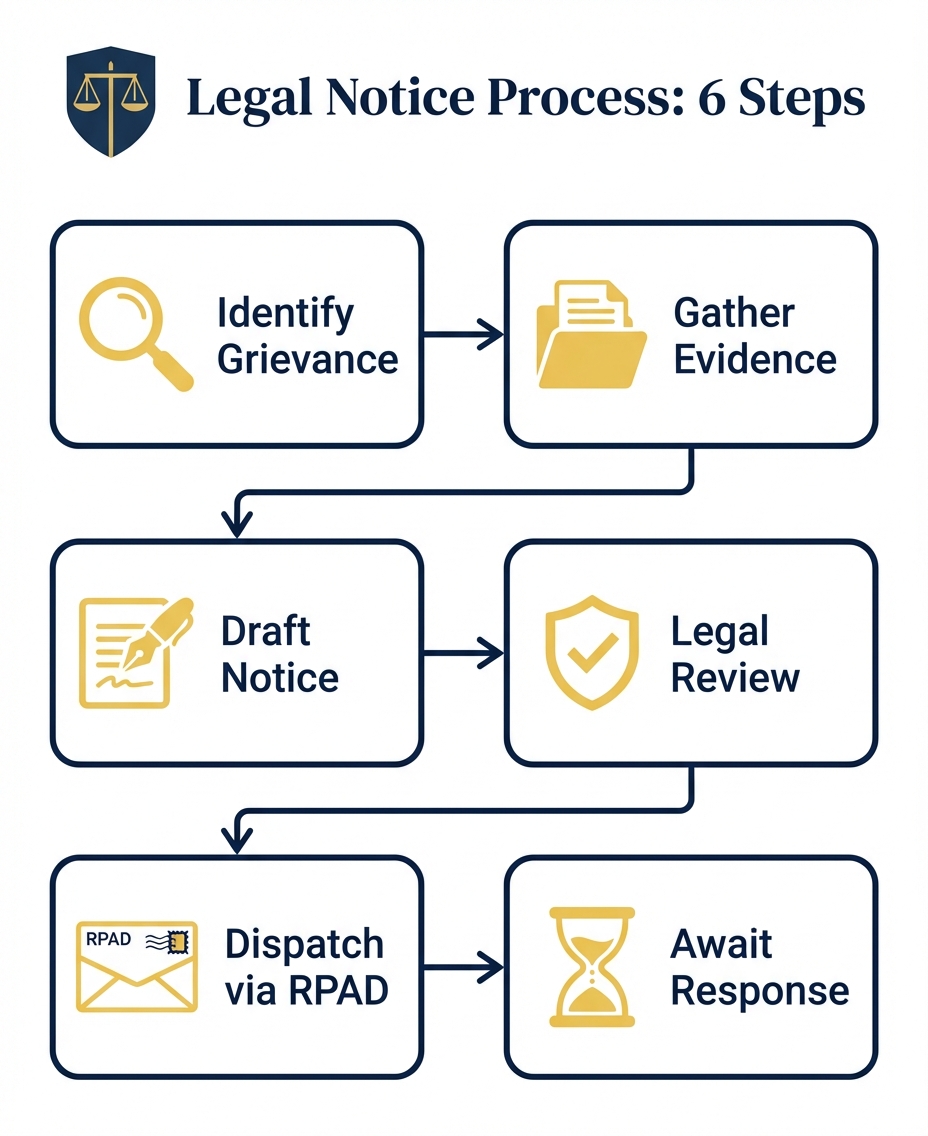
- Identify the grievance and gather evidence: Before drafting a notice, clearly define the issue and collect all supporting documents such as contracts, agreements, invoices, bank statements, cheque return memos, email correspondence, photographs, or any other evidence relevant to your claim.
- Consult a qualified advocate: While you can send a legal notice without a lawyer, consulting an advocate ensures that the notice is legally sound, cites the correct provisions of law, and is drafted in a manner that strengthens your position in case the matter proceeds to court.
- Draft the legal notice: The notice should be drafted on the advocate's letterhead (if sent through an advocate) and should contain all essential elements including the facts of the case, the legal basis for the claim, the specific relief demanded, and a deadline for compliance.
- Review and finalise: Carefully review the notice for factual accuracy, legal correctness, and clarity. Ensure that all names, dates, amounts, and addresses are correct. Even a small error can weaken your position.
- Dispatch the notice: Send the notice via registered post with acknowledgement due (AD) or speed post to create proof of delivery. Retain a copy of the notice, the postal receipt, and the acknowledgement card.
- Wait for the response: After the notice is delivered, the recipient typically has 15 to 30 days to respond (depending on the nature of the dispute and the deadline mentioned in the notice). If the recipient responds with a willingness to resolve the matter, negotiations can proceed. If there is no response or the response is unsatisfactory, you can proceed with filing the appropriate legal action.
Pro Tip: Maintain a Paper Trail
Always keep at least three copies of the legal notice: one for the recipient, one for your own records, and one for the court (in case you eventually file a suit). Also retain the postal receipt, tracking number, and delivery acknowledgement as these serve as proof of service.
Essential Elements of a Legal Notice Format
A well-structured legal notice format should include the following components to be effective and legally compliant:
- Advocate's letterhead: The notice should be printed on the letterhead of the advocate, containing their name, enrolment number, address, phone number, and email address.
- Date and place: The date of drafting and the city or town from which it is being sent.
- Recipient details: Full name, address, and designation (if applicable) of the person or entity to whom the notice is addressed. If you are sending to a company, include the registered office address.
- Subject line: A brief description of the matter, e.g., "Legal Notice for Recovery of Rs. 5,00,000/- under Cheque Dishonour (Section 138 NI Act)".
- Facts of the case: A clear, chronological narration of the events leading to the dispute. Include dates, amounts, agreements, and any other pertinent details.
- Legal basis: The specific sections of law that apply, such as Section 138 of the NI Act, Section 80 of the CPC, or relevant provisions of the Indian Contract Act, Consumer Protection Act, etc.
- Demand or relief sought: Clearly state what you want the recipient to do, whether it is paying a specific sum, vacating a property, fulfilling a contractual obligation, or ceasing an infringing activity.
- Deadline for compliance: Specify a reasonable time frame (usually 15 or 30 days from receipt of the notice) within which the recipient must comply.
- Consequences of non-compliance: State that if the recipient fails to comply within the stipulated period, you will initiate appropriate civil or criminal proceedings, and that the costs of such proceedings will be borne by the recipient.
- Sender's details and signature: The notice should conclude with the name and signature of the advocate, along with the name of the client on whose behalf it is being sent.
A legal notice is not merely a letter -- it is a strategic document that lays the foundation for any future legal proceedings. Every sentence should be precise, factual, and legally defensible.
— Legal Drafting Best Practices, Bar Council of India
How to Dispatch a Legal Notice
The method of dispatch is critical because you must be able to prove that the notice was sent and delivered. Indian courts recognise several methods of service, each with its own advantages.
Registered Post and Speed Post
Registered post with Acknowledgement Due (AD) is the most widely accepted and legally recognised method of sending a legal notice in India. The postal department provides a tracking number and returns an acknowledgement card signed by the recipient as proof of delivery. Speed post is also accepted by courts and has the advantage of faster delivery along with online tracking. The cost of sending a legal notice by registered post typically ranges from Rs. 50 to Rs. 150, depending on the weight and destination.
It is important to note that under Indian postal law, a notice sent by registered post is deemed to have been served even if the recipient refuses to accept it. The Supreme Court has upheld this principle in several judgments, including Jagdish Singh v. Natthu Singh, holding that refusal to accept a registered letter amounts to deemed service.
Courier Services
Private courier services such as DTDC, Blue Dart, and Delhivery are commonly used for sending legal notices. While courts generally accept courier delivery as valid service, it is advisable to use a reputed courier that provides a signed proof of delivery. Some courts have expressed a preference for India Post over private couriers, particularly in government-related matters under Section 80 CPC.
Email and Electronic Dispatch
With the recognition of electronic records under the Information Technology Act, 2000 and the increasing acceptance of digital communication by Indian courts, sending a legal notice by email has become common. The Delhi High Court and other High Courts have accepted email notices in several matters, particularly in commercial disputes. If you send a notice by email, ensure that: (a) you use the recipient's official or known email address; (b) you retain a copy of the sent email and any read receipts; and (c) you also send a physical copy by registered post as a backup.
Some advocates also send legal notices via WhatsApp in addition to registered post, as it provides delivery and read receipts (blue ticks). While WhatsApp notices alone may not suffice in all jurisdictions, they serve as supplementary evidence of communication. The key is to always have at least one physical mode of dispatch to ensure legal validity.
Best Practice: Use Multiple Dispatch Methods
For maximum legal protection, send the notice through at least two channels -- registered post (primary) and email or WhatsApp (secondary). This creates multiple layers of proof and makes it harder for the recipient to claim that they never received the notice.
Common Mistakes to Avoid
Many legal notices fail to achieve their purpose because of avoidable errors. Here are the most common mistakes people make when sending a legal notice in India:
- Incorrect or incomplete address: Sending the notice to the wrong address or an outdated address can mean the recipient never receives it. Always verify the current address of the recipient through official records, company filings, or recent correspondence.
- Missing statutory timelines: In cheque bounce cases, failing to send the notice within 30 days of the dishonour memo is a fatal error that bars you from filing a complaint. Always be aware of applicable limitation periods.
- Vague or emotional language: A legal notice must be factual, specific, and professional. Avoid emotional outbursts, threats, or defamatory statements. Using abusive or threatening language can expose you to a counter-claim for criminal intimidation under Section 503 of the Indian Penal Code.
- Incorrect legal citations: Citing the wrong sections of law or misquoting statutory provisions undermines the credibility of the notice. Ensure that all citations are accurate and relevant to the dispute.
- No clear demand or deadline: A notice that does not specify what you want the recipient to do and by when is ineffective. Always include a clear demand and a specific timeline.
- Not retaining proof of dispatch: Failing to keep the postal receipt, tracking details, and acknowledgement card means you cannot prove that the notice was sent and delivered, which is essential for any subsequent legal proceedings.
- Sending without a lawyer (in complex matters): While simple notices can be self-drafted, complex matters involving multiple parties, large sums, or intricate legal issues benefit enormously from professional drafting. A poorly drafted notice can inadvertently weaken your legal position.
- Making false or exaggerated claims: The contents of a legal notice can be produced as evidence in court. Making false claims or exaggerating the facts can damage your credibility and even expose you to liability for perjury or defamation.
Avoid Costly Mistakes
Our experienced legal team at OpenVakil reviews every notice for accuracy, completeness, and legal compliance before dispatch. Do not risk your case with an improperly drafted notice.
Get Expert Help NowCost of Sending a Legal Notice in India
The cost of sending a legal notice in India varies depending on whether you hire an advocate, the complexity of the matter, and the method of dispatch. Here is a general breakdown:
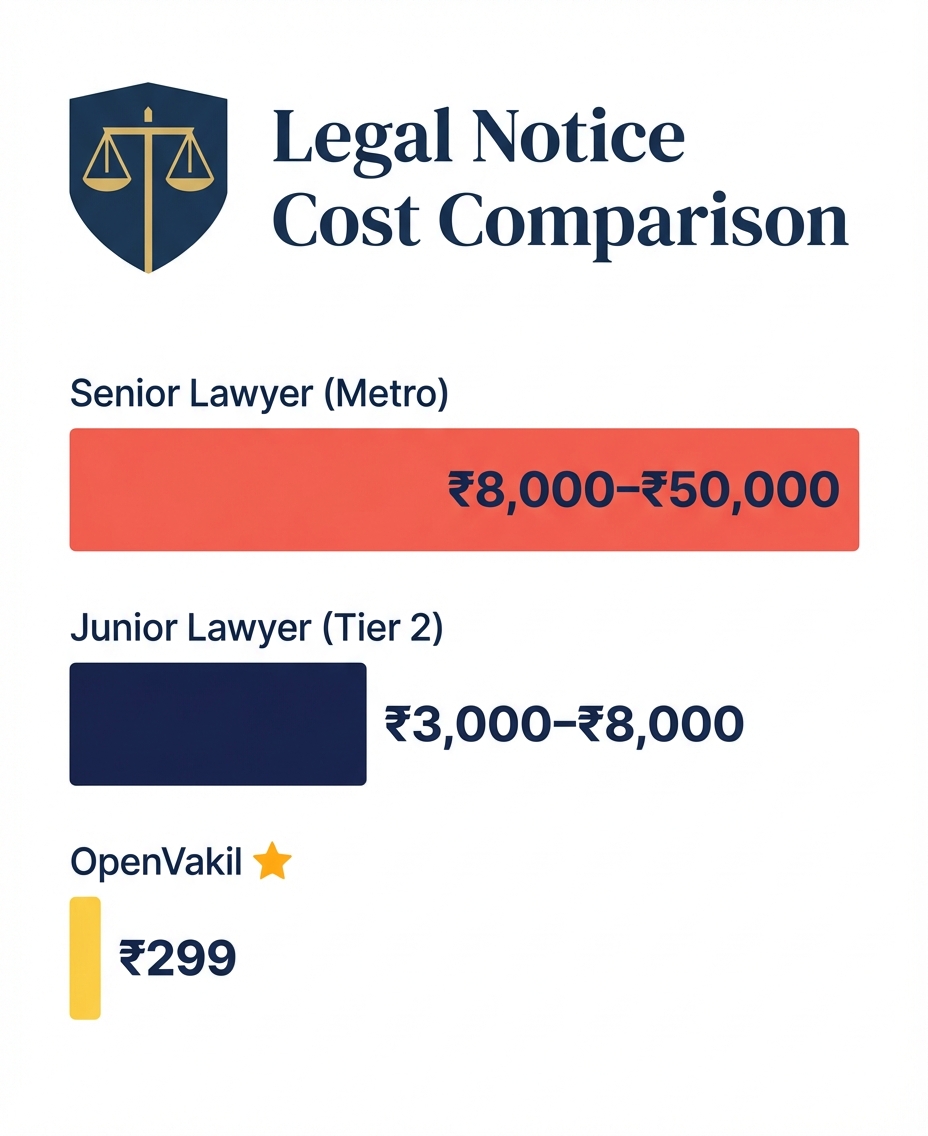
- Advocate fees: Advocate charges for drafting a legal notice typically range from Rs. 1,000 to Rs. 50,000 or more, depending on the complexity of the matter, the experience and reputation of the advocate, and the city. In metropolitan cities like Mumbai, Delhi, and Bangalore, fees tend to be higher. For straightforward matters like cheque bounce or simple money recovery, fees usually range from Rs. 1,500 to Rs. 5,000.
- Postal charges: Sending the notice by registered post with AD costs approximately Rs. 50 to Rs. 150. Speed post charges are similar. If you need to send multiple copies to multiple parties, the costs multiply accordingly.
- Miscellaneous costs: These may include printing, photocopying, notarisation (if required), and courier charges, typically adding Rs. 100 to Rs. 500.
- Online legal notice services: Platforms like OpenVakil offer legal notice drafting and sending services at competitive rates, often starting from Rs. 1,499, which includes drafting by an experienced advocate, review, and dispatch via registered post.
Cost Comparison
While hiring a senior advocate at a traditional law firm for a legal notice can cost Rs. 10,000 to Rs. 50,000, online legal platforms like OpenVakil provide the same quality of service starting from Rs. 1,499 -- making professional legal notices accessible to everyone.
What Happens After Sending a Legal Notice?
Once a legal notice is dispatched, one of several outcomes typically follows:
- Compliance: The recipient fulfils the demands made in the notice (pays the money, vacates the property, delivers the goods, etc.). This is the ideal outcome.
- Counter-notice or reply: The recipient responds with their own legal notice or a reply, disputing some or all of the claims. This opens the door for negotiation and potential settlement.
- Negotiation and settlement: Both parties engage in discussions, possibly through their advocates, and arrive at a mutually acceptable resolution. Many disputes are resolved this way.
- No response: The recipient ignores the notice entirely. In this case, you may proceed with filing the appropriate legal action (civil suit, criminal complaint, consumer complaint, etc.) after the expiry of the deadline mentioned in the notice.
- Partial compliance: The recipient fulfils some demands but not others. You can then decide whether to accept the partial compliance, negotiate further, or proceed with legal action for the remaining claims.
It is important to keep a record of all communications following the notice, as these may be relevant in subsequent legal proceedings. If you do not receive a response within the stipulated period, consult your advocate on the next steps and applicable limitation periods for filing a suit or complaint.
How OpenVakil Can Help
OpenVakil is an online legal services platform that makes it simple, affordable, and efficient to send a legal notice in India. Whether you need a cheque bounce notice, a money recovery demand, a consumer complaint notice, or any other type of legal notice, our platform connects you with experienced advocates who draft, review, and dispatch your notice promptly.
- AI-assisted drafting: Our technology helps generate an initial draft based on your inputs, which is then reviewed and refined by a qualified advocate to ensure accuracy and legal soundness.
- Experienced advocates: Every notice is reviewed by advocates with expertise in the relevant area of law, ensuring that your notice is legally compliant and strategically effective.
- End-to-end service: From drafting to dispatch, we handle the entire process. Your notice is sent via registered post with AD, and you receive tracking details and proof of delivery.
- Affordable pricing: Our services start at just Rs. 1,499, making professional legal notices accessible to individuals and small businesses across India.
- Quick turnaround: Most notices are drafted, reviewed, and dispatched within 2 to 3 business days, so you never miss a statutory deadline.
- Follow-up support: If the recipient responds or if you need to proceed with legal action, our team can guide you on the next steps, including filing a suit or complaint.
Ready to Send Your Legal Notice?
Get your legal notice drafted, reviewed by an experienced advocate, and dispatched via registered post -- all from the comfort of your home. Start your legal notice on OpenVakil today.
Start Your Legal NoticeSending a legal notice is a critical first step in asserting your legal rights. Whether you are an individual dealing with a personal dispute or a business facing a commercial conflict, a properly drafted and timely dispatched legal notice can make the difference between a swift resolution and prolonged litigation. By understanding the process, legal requirements, and best practices outlined in this guide, you can approach the matter with confidence and ensure that your interests are protected.