When you leave a job — whether by resignation, retirement, or termination — your employer is legally obligated to settle all your pending dues, including Provident Fund (PF) contributions, gratuity, and the full and final (F&F) settlement. These are not discretionary benefits; they are statutory entitlements backed by some of the most protective labour legislation in India. Yet, thousands of employees across the country face situations where employers delay, withhold, or outright refuse to pay these dues.
If your employer has failed to deposit your PF contributions, refused to pay gratuity after you have completed the required service period, or delayed your full and final settlement beyond a reasonable timeframe, you have the legal right to demand payment through a formal legal notice. This notice is the first and most effective step in compelling your employer to comply with the law, and it creates a documented record that strengthens your case if you need to escalate the matter to the EPFO, Labour Commissioner, or courts.
This comprehensive guide covers every aspect of recovering unpaid PF, gratuity, and F&F settlement — the applicable laws, your eligibility, the components of each entitlement, how to draft and send a legal notice, the complaint-filing process, limitation periods, and practical tips to maximise your chances of a successful recovery. Whether you are an IT professional, factory worker, sales executive, or senior manager, this guide will equip you with the knowledge and tools to recover what is rightfully yours.
Understanding PF, Gratuity and Full and Final Settlement
Before you draft a legal notice, it is essential to understand what each of these entitlements means, how they are calculated, and why employers sometimes default on them. Each serves a distinct purpose in the framework of employee social security and compensation in India.
What Is Provident Fund (PF)?
The Employees' Provident Fund (EPF) is a mandatory retirement savings scheme governed by the Employees' Provident Funds and Miscellaneous Provisions Act, 1952. Under this scheme, both the employee and the employer contribute 12% of the employee's basic wages plus dearness allowance (DA) every month to a PF account managed by the Employees' Provident Fund Organisation (EPFO). The employer's 12% contribution is split — 8.33% goes to the Employees' Pension Scheme (EPS) and 3.67% goes to the EPF account. The accumulated corpus, along with interest (currently 8.25% per annum), is available to the employee upon retirement, resignation, or under specific withdrawal circumstances.
The most serious violation occurs when an employer deducts the employee's 12% share from the salary but fails to deposit it with EPFO. This is not merely a civil wrong — it is a criminal offence under Section 14 of the EPF Act, punishable with imprisonment of up to three years and a fine of up to Rs. 10,000. The employer is essentially appropriating the employee's money, and the law treats this with the gravity it deserves.
What Is Gratuity?
Gratuity is a lump-sum payment made by the employer to an employee as a reward for long and meritorious service. It is governed by the Payment of Gratuity Act, 1972. An employee becomes eligible for gratuity upon completing five years of continuous service with the same employer (with certain exceptions for death or disablement). Gratuity is payable on superannuation, retirement, resignation, or death/disablement of the employee. The formula for calculating gratuity is: Last drawn salary (basic + DA) x 15 x number of years of service / 26. The maximum gratuity payable under the Act is Rs. 20,00,000 (as per the 2018 amendment).
Gratuity is a statutory right, not a benefit at the employer's discretion. Once an employee meets the eligibility criteria, the employer is legally bound to pay gratuity within 30 days of it becoming payable. Failure to pay within this period attracts simple interest on the amount from the date it becomes payable until the date of actual payment. The employer cannot forfeit or deny gratuity except in very specific circumstances involving proven misconduct (and even then, only to the extent of the loss caused to the employer).
What Is Full and Final Settlement?
The full and final settlement (F&F) is the comprehensive process of settling all financial dues between the employer and employee when the employment relationship ends. While there is no single statute that exclusively governs F&F settlement, the obligation arises from a combination of the employment contract, company policy, and various labour statutes. The F&F settlement typically includes all pending salary, earned leave encashment, notice period pay or recovery, bonus, gratuity, reimbursements, and any other contractual dues.
Under Section 5 of the Payment of Wages Act, 1936, when an employee is terminated, all wages must be paid before the expiry of the second working day from the date of termination. For employees who resign, while the Act does not prescribe a specific deadline, the accepted industry practice and judicial precedent require settlement within 30 to 45 days of the last working day. Unreasonable delays — particularly when employers withhold settlement for months or use it as leverage — are actionable under labour law.
PF, Gratuity, and F&F Are Independent Entitlements
Each of these three entitlements is governed by separate legislation and can be claimed independently. Even if your employer pays your F&F settlement, you can still pursue unpaid PF contributions with EPFO. Similarly, gratuity can be claimed separately before the Controlling Authority under the Payment of Gratuity Act. You do not need to wait for all three to be resolved together.
When Should You Send a Legal Notice?
A legal notice should be sent when informal attempts to recover your dues have failed and the employer shows no intention of paying. You should consider sending a legal notice in the following situations:
- PF not deposited: You have checked your EPFO Member Passbook (through the UAN portal at unifiedportal-mem.epfindia.gov.in) and found that the employer has not deposited PF contributions for one or more months, despite deducting the employee's share from your salary.
- Gratuity not paid after separation: You have completed five or more years of continuous service and your employer has not paid gratuity within 30 days of your last working day, or has denied your gratuity claim without valid legal grounds.
- F&F settlement delayed beyond 45 days: Your employment has ended (by resignation, termination, or otherwise) and the employer has not processed your full and final settlement within 30 to 45 days, or has processed only a partial settlement without explanation.
- Employer imposing unjust deductions: The employer has made unauthorised deductions from your F&F settlement — such as deducting for alleged notice period shortfall beyond contractual terms, imposing training cost recovery without a valid bond, or withholding amounts for fictitious "damages."
- Employer conditioning payment on signing waivers: The employer is withholding your PF transfer, gratuity, or F&F settlement until you sign a non-compete agreement, a full and final waiver, or other documents that you are not legally obligated to sign.
- Employer has shut down or is non-responsive: The company has closed its operations, the HR department is unreachable, or the employer simply refuses to respond to your emails and calls regarding pending dues.
In each of these scenarios, a formal legal notice sent through a lawyer (or through a platform like OpenVakil) carries significantly more weight than informal reminders. It puts the employer on statutory notice that you intend to pursue legal remedies, and creates a documented trail that courts and tribunals view favourably.
Do Not Wait Too Long
Different claims have different limitation periods. Gratuity claims must be filed within the prescribed period, PF complaints should be lodged promptly, and civil suits for F&F recovery must be filed within three years under the Limitation Act, 1963. Delaying your legal notice only weakens your position and risks missing critical deadlines. Act as soon as your employer defaults.
Legal Basis: EPF & Miscellaneous Provisions Act, 1952
The Employees' Provident Funds and Miscellaneous Provisions Act, 1952 is the primary legislation governing provident fund contributions in India. It applies to every establishment employing 20 or more persons (and can be voluntarily adopted by smaller establishments). The key provisions relevant to a legal notice for unpaid PF are:
- Section 6 — Contributions: The employer must contribute 12% of the employee's basic wages plus DA to the EPF, and must also deposit the employee's matching 12% contribution deducted from salary. The employer's contribution is split between EPF (3.67%) and EPS (8.33%).
- Section 7A — Determination of moneys due: The Central Provident Fund Commissioner (or an authorised officer) can conduct an inquiry and determine the amount of contributions due from the employer, including arrears, interest, and damages. This is a quasi-judicial proceeding where the employer must show cause for the default.
- Section 7Q — Interest on delayed deposits: If the employer does not deposit PF contributions by the 15th of the following month, simple interest at 12% per annum is payable on the overdue amount from the date it became due until the date of actual payment.
- Section 14 — Criminal penalties: Non-payment or late payment of PF contributions is a criminal offence. The employer (and every person responsible for the conduct of business) can be punished with imprisonment of one to three years and a fine of up to Rs. 10,000. For subsequent offences, the imprisonment extends to five years.
- Section 14B — Damages for default: In addition to interest, the Central Provident Fund Commissioner can levy damages on the defaulting employer at rates ranging from 5% to 25% per annum of the arrears, depending on the period of default.
- Section 8 — Recovery as arrears of land revenue: Amounts determined under Sections 7A or 7Q can be recovered as arrears of land revenue, which is one of the most powerful recovery mechanisms in Indian law. The District Collector can attach and sell the employer's property to recover the PF dues.
The non-payment of provident fund contributions is a serious matter. The amount deducted from the employee's wages towards provident fund is a trust money in the hands of the employer, and its non-deposit amounts to criminal breach of trust.
— Regional Provident Fund Commissioner v. Hooghly Mills Company Ltd., (2012) 2 SCC 489
Legal Basis: Payment of Gratuity Act, 1972
The Payment of Gratuity Act, 1972 applies to every factory, mine, oilfield, plantation, port, railway, shop, or establishment employing 10 or more persons. Once the Act applies to an establishment, it continues to apply even if the number of employees falls below 10. The key provisions for your legal notice are:
- Section 4 — Payment of gratuity: Gratuity is payable to an employee on termination of employment after five years of continuous service, on superannuation, retirement, resignation, death, or disablement. The gratuity amount is calculated as 15 days' wages for every completed year of service (or part thereof in excess of six months), based on the last drawn wages. For piece-rated employees, the calculation is based on average wages for the last three months.
- Section 4(6) — Forfeiture of gratuity: Gratuity can be forfeited wholly or partly only if the employee's services are terminated for (a) riotous or disorderly conduct or any act of violence, or (b) any act constituting an offence involving moral turpitude, provided the act was committed during the course of employment. This is a narrow exception, and the employer bears the burden of proving the misconduct.
- Section 7 — Controlling Authority: Every state government appoints a Controlling Authority (typically the Assistant Labour Commissioner) for the purposes of the Act. An employee who is denied gratuity can file an application before this authority, who has the power to determine and direct payment of the gratuity amount with interest.
- Section 7(3A) — Interest on delayed payment: If gratuity is not paid within 30 days of it becoming payable, the employer must pay simple interest on the amount from the date it became payable until the date of payment. The rate of interest is notified by the Central Government.
- Section 8 — Recovery: If the employer fails to comply with the Controlling Authority's order, the amount can be recovered as an arrear of land revenue.
- Section 9 — Penalties: An employer who makes a false statement to avoid payment, or contravenes any provision of the Act, is punishable with imprisonment of up to one year, or a fine of up to Rs. 10,000, or both. For non-payment of gratuity after it becomes payable, the imprisonment can extend to two years (minimum six months).
Gratuity for Fixed-Term Contracts
Under the Industrial Employment (Standing Orders) Central Amendment Rules, 2018, fixed-term employees are entitled to gratuity on a pro-rata basis, even if they have not completed five years of service. This is a significant protection for contract workers and project-based employees. If you were employed on a fixed-term contract, verify whether you are eligible for pro-rata gratuity.
Legal Basis: Payment of Wages Act, 1936
The Payment of Wages Act, 1936 is directly relevant to F&F settlement claims because it governs the timely payment of all wages owed to an employee. The Act applies to employees drawing wages up to Rs. 24,000 per month (though many states have raised this threshold). Key provisions include:
- Section 3 — Employer's responsibility: Every employer is personally responsible for ensuring that wages are paid to employees in accordance with the Act.
- Section 5 — Time of payment of wages: On termination of employment, all wages must be paid before the expiry of the second working day from the date of termination. This provision effectively requires employers to process at least the salary component of F&F within two days of the last working day.
- Section 7 — Permissible deductions: The Act limits deductions from wages to specified categories — fines, absence from duty, damage to property (after a show-cause inquiry), housing accommodation, income tax, PF contributions, and certain other authorised deductions. Any deduction not falling within these categories is unlawful and can be challenged.
- Section 15 — Claims for recovery: An employee can file an application for recovery of wages due, including delayed wages and wrongfully deducted amounts. The authority can award compensation of up to ten times the amount of the delayed or deducted wages.
- Section 20 — Penalties: Non-payment or delayed payment of wages is punishable with a fine of Rs. 1,500 to Rs. 7,500. Repeat offences attract higher fines or imprisonment of one to six months.
The Payment of Wages Act is particularly powerful for F&F settlement claims because Section 5's two-day deadline for payment on termination creates a clear statutory violation that employers cannot easily defend. Even if the employer argues that "processing takes time," the law mandates a specific deadline, and non-compliance is a punishable offence.
Legal Basis: Industrial Disputes Act, 1947
The Industrial Disputes Act, 1947 provides a powerful mechanism for employees classified as "workmen" (essentially all non-managerial, non-supervisory employees) to recover unpaid dues. The most relevant provisions are:
- Section 33C(2) — Recovery of money due: A workman can file an application before the Labour Court for the computation and recovery of any money due from the employer. This includes unpaid salary, gratuity, leave encashment, bonus, and any other benefit to which the workman is entitled. The Labour Court can calculate the dues and issue an enforceable order for payment. There is no court fee for this application, making it an accessible remedy.
- Section 2A — Individual dispute deemed as industrial dispute: The dismissal, discharge, or retrenchment of an individual workman is deemed to be an industrial dispute. This allows the workman to directly approach the Labour Court without going through the conciliation process.
- Section 25F — Conditions for retrenchment: An employer retrenching a workman who has completed one year of continuous service must pay retrenchment compensation equal to 15 days' average pay for every completed year of service. Non-payment of retrenchment compensation makes the retrenchment itself illegal.
- Section 25FF — Transfer of undertakings: If the employer's business is transferred to a new entity, the workman's service is deemed continuous, and all entitlements (including gratuity and PF) carry over to the new employer.
Recover Your Unpaid PF, Gratuity & F&F Settlement
OpenVakil helps you draft a comprehensive legal notice citing the EPF Act, Gratuity Act, Payment of Wages Act, and all applicable provisions for your specific situation. Answer a few questions and get a professionally drafted notice in minutes.
Draft Your Legal Notice NowEligibility for Gratuity in India
Gratuity eligibility is one of the most commonly disputed aspects of employer-employee disputes. Understanding the eligibility criteria in detail will help you determine whether your claim is valid and how to present it in your legal notice.
- Five years of continuous service: The primary eligibility criterion is completing five years of continuous service with the same employer. Service of more than four years and six months is rounded up and treated as five years for gratuity purposes (Section 2A of the Act, as interpreted by the Supreme Court in Surinder Kumar Verma v. Central Government Industrial Tribunal).
- Exception for death or disablement: If an employee dies or becomes disabled during employment, gratuity is payable regardless of the length of service. Even an employee who has worked for only one year is entitled to gratuity if they die or become permanently disabled while in service.
- Applicability: The Act applies to every factory, mine, plantation, port, railway, and every shop or establishment employing 10 or more persons on any day in the preceding 12 months. Once applicable, it continues to apply even if the headcount falls below 10.
- Continuous service: "Continuous service" means uninterrupted service. However, periods of sickness, accident, authorised leave, lawful strike, or layoff are not treated as breaks in service. An employee who has worked for at least 190 days in a year (or 95 days for underground mine workers) is deemed to have been in continuous service for that year.
- Contractual and temporary employees: Contractual and temporary employees are also eligible for gratuity if they meet the continuous service requirement. The Supreme Court has held that the nature of the employment contract does not determine gratuity eligibility — the duration of service does.
The gratuity formula for employees not covered under seasonal employment is: (Last drawn monthly salary / 26) x 15 x Number of completed years of service. Here, "monthly salary" means basic pay plus dearness allowance. For example, if your last drawn basic salary plus DA was Rs. 50,000 per month and you completed 7 years of service, your gratuity would be: (50,000 / 26) x 15 x 7 = Rs. 2,01,923 (approximately).
PF Contribution Rules and Employer Obligations
The provident fund contribution framework places significant obligations on employers. Understanding these rules is critical for identifying violations and building a strong case in your legal notice.
- Contribution rate: Both the employer and employee contribute 12% of basic wages plus DA per month. For establishments with fewer than 20 employees (that have voluntarily opted into the scheme), the contribution rate may be 10%.
- Employer's contribution split: Of the employer's 12%, 8.33% goes to the Employees' Pension Scheme (EPS) (subject to a ceiling of Rs. 15,000 basic wages for pension calculation) and 3.67% goes to the EPF account.
- Deposit deadline: The employer must deposit the PF contributions (both employer's and employee's share) with EPFO by the 15th of the following month. For example, PF for January must be deposited by February 15th.
- Administrative charges: The employer also pays administrative charges of 0.50% of basic wages towards EDLI (Employees' Deposit Linked Insurance Scheme) and an inspection charge.
- Wage ceiling: PF is mandatory for employees earning basic wages up to Rs. 15,000 per month. Employees earning above this threshold can opt to contribute on the actual basic wages or limit their contribution to Rs. 15,000. Once enrolled in EPF, an employee earning above the ceiling can continue contributing on the higher amount with employer consent.
- International workers: International workers (from countries without social security agreements with India) contributing to EPF are not subject to the Rs. 15,000 wage ceiling and must contribute on their full wages.
To verify whether your employer has been depositing PF contributions, log in to the EPFO Member Passbook portal at passbook.epfindia.gov.in using your UAN (Universal Account Number) and password. The passbook shows month-by-month contributions by both the employee and employer. Any gaps or zeros in the employer's contribution column indicate a default that you should address in your legal notice.
PF Deducted But Not Deposited Is a Criminal Offence
If your salary slip shows PF deduction but the EPFO passbook shows no corresponding deposit, your employer has committed a criminal offence under Section 14 of the EPF Act. This is equivalent to misappropriation of trust funds. Your legal notice should specifically highlight this discrepancy and warn of criminal prosecution. Attach screenshots of both your salary slip and EPFO passbook as evidence.
Components of Full and Final Settlement
A complete full and final settlement should account for every financial obligation the employer owes you. When reviewing your F&F statement (or when the employer has not provided one at all), ensure that the following components are included:
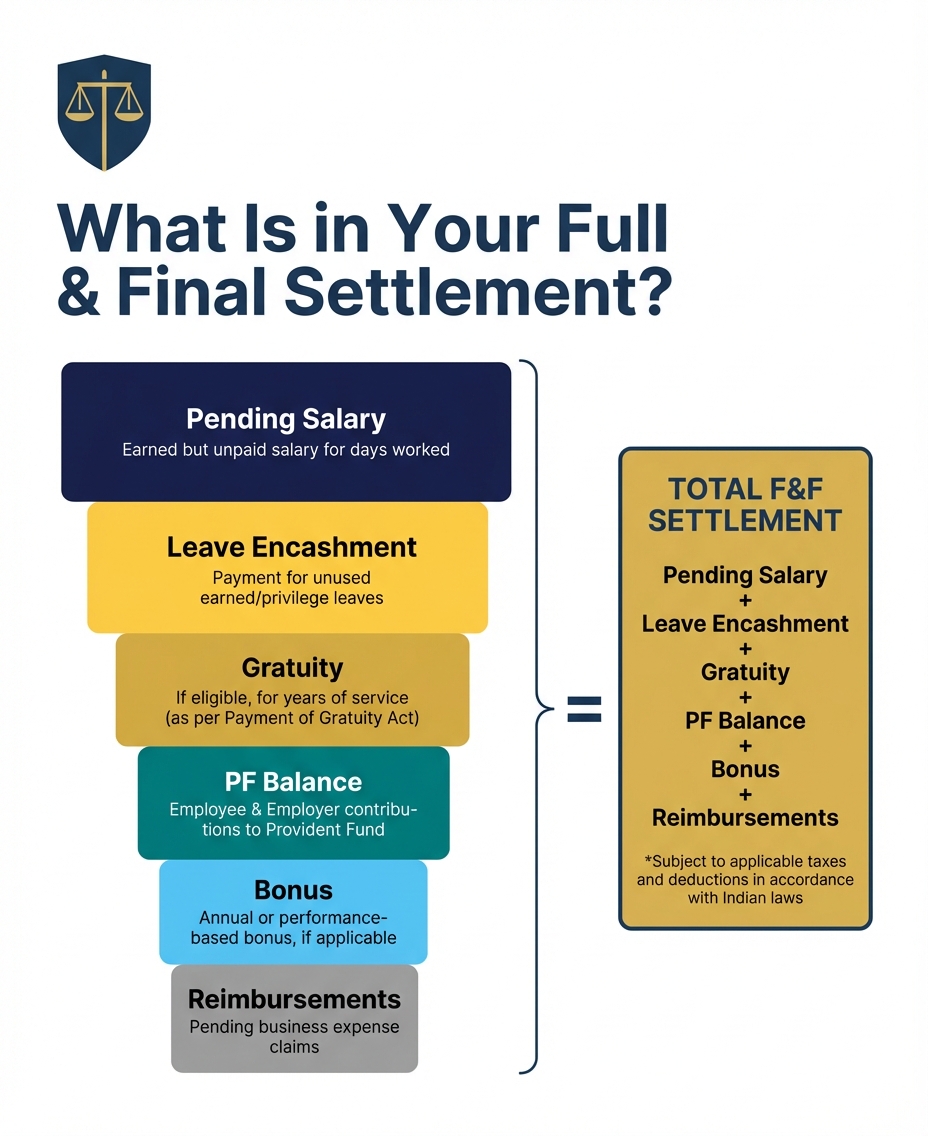
- Unpaid salary: Salary for the last month (or any preceding months) that has not been paid, calculated on a pro-rata basis for partial months worked.
- Earned leave encashment: Payment for accumulated but unavailed earned leave (also called privilege leave). This is calculated as (basic salary + DA) / 30 x number of earned leave days. Many companies cap the maximum number of encashable leave days, but this cap must be stated in the company policy or employment contract.
- Notice period pay: If the employer terminated you without serving the contractual notice period, you are entitled to salary in lieu of the notice period. Conversely, if you resigned without serving the full notice period, the employer may deduct the shortfall — but only if the employment contract explicitly provides for such deduction.
- Gratuity: If you have completed five or more years of continuous service, gratuity must be included in the F&F settlement (or paid separately within 30 days).
- Bonus: Any statutory bonus under the Payment of Bonus Act, 1965 (for employees drawing wages up to Rs. 21,000 per month) or contractual performance bonus that has accrued but not been paid.
- Reimbursements: Pending reimbursements for medical expenses, travel, telephone, fuel, relocation, or any other approved but unpaid expense claims.
- Incentives and commissions: Any performance-linked incentives, sales commissions, or variable pay that has been earned but not yet disbursed.
- Overtime wages: Payment for any overtime hours worked but not compensated at the statutory rate of twice the ordinary rate of wages.
- PF settlement assistance: While PF is settled directly through EPFO, the employer must provide the necessary documentation (Form 10C, Form 19, or facilitate online transfer) and should not obstruct the employee's PF withdrawal or transfer.
- Experience certificate and relieving letter: Though not financial components, these documents are part of the separation process and the employer is obligated to provide them. Withholding these documents is actionable.
When your employer provides an F&F settlement statement, review each line item carefully against your employment contract, salary slips, and company policy. If any component is missing, undervalued, or wrongfully deducted, raise the discrepancy in writing before accepting the settlement. Once you accept and sign the F&F settlement, it becomes significantly harder (though not impossible) to claim additional amounts later.
Key Elements of the Legal Notice
A legal notice for unpaid PF, gratuity, and F&F settlement must be comprehensive, precise, and legally sound. It should contain the following essential elements:
- Sender's details: Your full name, address, employee ID, designation, department, date of joining, and date of last working day. If the notice is sent through a lawyer, it should be on the lawyer's letterhead and include the lawyer's enrolment number.
- Employer's details: The company's full legal name, registered office address, CIN (Corporate Identification Number), and the name of the managing director or authorised signatory. For proprietorships or partnerships, include the proprietor's or partners' names.
- Employment history summary: A brief account of your employment — the date of joining, positions held, last drawn salary (component-wise: basic, HRA, DA, special allowance), the date and manner of separation (resignation, termination, retirement), and whether the separation was voluntary or involuntary.
- Statement of default: A clear, chronological description of the employer's default — specifically which dues have not been paid (PF, gratuity, F&F, or all three), since when they have been due, what steps you have taken to request payment informally, and the employer's response (or lack thereof).
- Legal provisions violated: Specific references to the statutes and sections violated — Section 6 and Section 14 of the EPF Act (for PF non-deposit), Section 4 and Section 7 of the Payment of Gratuity Act (for unpaid gratuity), Sections 3 and 5 of the Payment of Wages Act (for delayed F&F), and Section 33C(2) of the Industrial Disputes Act (if applicable).
- Detailed computation of dues: A line-by-line breakdown of every amount owed, with the basis of calculation for each. This should include unpaid salary (month-wise), earned leave encashment, gratuity calculation (showing the formula, last drawn wages, and years of service), PF arrears (month-wise, for both employee and employer shares), bonus, and any other contractual dues. State the grand total clearly.
- Demand for payment: An unambiguous demand for the total amount to be paid within a specified period, typically 15 days from receipt of the notice.
- Demand for documents: A demand for the employer to provide all pending documents — salary slips, Form 16, PF transfer/withdrawal forms, experience certificate, relieving letter, and F&F settlement statement.
- Consequences of non-compliance: A clear warning that if the demands are not met within the stipulated period, you will initiate legal proceedings, including filing complaints with EPFO, the Labour Commissioner, and the Labour Court, and that the employer will be liable for interest, damages, penalties, and litigation costs.
Attach Supporting Evidence References
While you do not need to attach actual documents to the legal notice, you should reference them. For example: "The employee's EPFO Member Passbook (copy annexed as Annexure A) shows that no employer contributions have been deposited for the months of January 2025 through May 2025." This signals to the employer that you have documented evidence and are prepared for litigation.
Step-by-Step Process to Send the Notice
Follow these steps methodically to ensure your legal notice is effective and legally valid:
- Step 1 — Gather your documents: Collect your appointment letter, salary slips (last 6-12 months), bank statements showing salary credits, EPFO passbook printout, Form 16, resignation letter or termination notice, any F&F settlement statement provided by the employer, and all email/written correspondence about your pending dues.
- Step 2 — Verify your EPFO records: Log in to the EPFO Member Passbook portal using your UAN. Download and print the passbook showing month-wise contributions. Identify the months where the employer's contribution is missing or short-deposited. Compare the passbook data with the PF deductions shown on your salary slips.
- Step 3 — Calculate all pending dues: Prepare a detailed calculation of every amount owed to you. Use the gratuity formula (basic + DA / 26 x 15 x years of service), compute leave encashment based on your leave balance, and list each month's unpaid PF contribution. Create a table with columns for the component, basis of calculation, and amount.
- Step 4 — Draft the legal notice: Use OpenVakil or engage a lawyer to draft the notice. Ensure it includes all the key elements described in the previous section. The notice should be addressed to the company (at its registered office address) and, ideally, to the directors or proprietor by name.
- Step 5 — Have the notice reviewed: If you drafted the notice yourself, have it reviewed by a lawyer before sending. Ensure the facts are accurate, the calculations are correct, the legal citations are appropriate, and the language is professional and firm.
- Step 6 — Send via Registered Post AD: Send the notice through Registered Post with Acknowledgment Due (RPAD) to the employer's registered office address. This provides proof of dispatch and delivery that is admissible in court. Keep the postal receipt and the returned acknowledgment card safely.
- Step 7 — Send a copy via email: Email a scanned PDF of the notice to the employer's HR department, the legal team (if known), and the directors' email addresses. Request a read receipt. This ensures faster delivery and creates an additional communication record.
- Step 8 — Wait for the response period: Allow the full 15-day period (from the date of receipt, not the date of sending) for the employer to respond. During this period, do not make public statements about the dispute or take any action that could prejudice your case.
- Step 9 — Evaluate and escalate: If the employer pays all dues, verify the amounts and obtain proper documentation. If the employer pays partially, accept without prejudice and continue pursuing the balance. If the employer sends a reply denying your claims, review it with a lawyer. If there is no response at all, proceed to file formal complaints with the appropriate authorities.
Filing Complaints: EPFO, Labour Commissioner, Labour Court
If the legal notice does not result in full payment of your dues, you have several formal complaint and litigation options, each tailored to the specific type of claim. Understanding which forum to approach for each entitlement is critical for efficient recovery.
Complaint with EPFO
For unpaid PF contributions, the most effective remedy is to file a complaint directly with the Employees' Provident Fund Organisation (EPFO). You can do this in multiple ways:
- Online complaint through EPFiGMS: The EPFO's Grievance Management System (EPFiGMS) at epfigms.gov.in allows you to file an online complaint specifying the months of non-deposit and attaching supporting documents. Complaints are typically acknowledged within 3 days and resolved within 30 days.
- Written complaint to the Regional PF Commissioner: Submit a detailed written complaint to the Regional Provident Fund Commissioner (RPFC) of the regional office that has jurisdiction over your employer's establishment. Include copies of your salary slips, EPFO passbook, and the legal notice sent to the employer.
- Section 7A inquiry: Based on your complaint, the RPFC can initiate a Section 7A inquiry to determine the amount of contributions due. The employer is summoned, and after hearing both sides, the RPFC passes an order determining the arrears, interest under Section 7Q, and damages under Section 14B.
- Criminal prosecution under Section 14: If the employer has deducted PF from your salary but not deposited it, the RPFC can initiate criminal prosecution against the employer. You can also file an independent criminal complaint before the Magistrate.
- Recovery proceedings under Section 8: Once the RPFC determines the arrears, a recovery certificate is issued to the District Collector for recovery as arrears of land revenue. This can include attachment and sale of the employer's property.
Complaint with Labour Commissioner
For unpaid gratuity and delayed F&F settlement, file a complaint with the Labour Commissioner's office (specifically, the Assistant Labour Commissioner or the Controlling Authority under the Gratuity Act) in the jurisdiction where you were employed. The process involves:
- Gratuity complaint under Section 7: File an application in Form N before the Controlling Authority under the Payment of Gratuity Act. The application should include details of your employment, the date of cessation, the amount of gratuity claimed, and the employer's refusal or failure to pay.
- Conciliation for F&F settlement: For general F&F settlement disputes, file a complaint with the Labour Commissioner. The Commissioner will summon both parties for a conciliation hearing, which is an informal mediation aimed at reaching an amicable settlement. Conciliation proceedings are free of charge and typically conclude within 30 to 60 days.
- Wages claim under Section 15: If any component of your F&F constitutes "wages" under the Payment of Wages Act, file an application before the authority appointed under Section 15 for recovery of the delayed wages with compensation.
Application Before Labour Court
If conciliation fails, or if you want to pursue a more formal adjudicatory process, you can approach the Labour Court:
- Section 33C(2) application: File an application for computation and recovery of money due from the employer. This is the most commonly used and effective remedy for recovering unpaid wages, gratuity, leave encashment, and other monetary benefits. No court fee is payable, and the Labour Court can directly calculate and order payment.
- Industrial dispute under Section 2A: If the non-payment is linked to your termination (e.g., you were terminated and the employer refused to pay F&F), you can raise an individual industrial dispute. The dispute is referred to the Labour Court for adjudication, and the court can order reinstatement, back wages, and payment of all dues.
- Civil suit for recovery: If you are classified as a managerial or supervisory employee and are not covered under the Industrial Disputes Act, you can file a civil suit for recovery of money in the appropriate civil court. This is subject to court fees and takes longer, but is the appropriate forum for non-workman employees.
- Writ petition (for government employees): Government employees or those employed by public sector undertakings can file a writ petition under Article 226 of the Constitution before the High Court for recovery of unpaid PF, gratuity, or other dues.
Multiple Remedies Can Be Pursued Simultaneously
You are not limited to pursuing just one remedy. You can simultaneously file a PF complaint with EPFO, a gratuity application before the Controlling Authority, and an F&F recovery application before the Labour Court. Each forum deals with a specific aspect of your claim, and pursuing multiple remedies in parallel can accelerate the overall recovery process.
Limitation Periods for Claims
Understanding the limitation periods for each type of claim is critical. Filing a claim after the limitation period has expired can result in your case being dismissed, regardless of its merits. The key limitation periods are:
- PF complaints (EPF Act): There is no strict limitation period for PF recovery proceedings under Section 7A. The RPFC can initiate proceedings for defaults going back several years. However, it is advisable to file your complaint as promptly as possible, as delay can make evidence harder to gather and witnesses less available.
- Gratuity claims (Gratuity Act): An application for gratuity must be filed before the Controlling Authority within the prescribed period. While the Act does not specify a strict limitation, courts have generally applied a reasonable time standard. Some High Courts have applied the Limitation Act's residuary period of three years. File your claim without delay to avoid any limitation issues.
- Wages claims (Payment of Wages Act): Claims under Section 15 must be filed within 12 months from the date the wages became due. This is a strict deadline — claims filed after 12 months can be dismissed. The authority may condone the delay in exceptional circumstances, but this is discretionary.
- Labour Court applications (Industrial Disputes Act): Applications under Section 33C(2) are generally subject to a three-year limitation period from the date the money became due. For industrial disputes under Section 2A, the dispute must be raised within three years of the date of termination.
- Civil suits (Limitation Act, 1963): A civil suit for recovery of money must be filed within three years from the date the cause of action arose (i.e., when the payment became due and the employer defaulted). This is governed by Article 55 or Article 58 of the Schedule to the Limitation Act.
The general rule is: file early, file promptly. Even though some claims have generous limitation periods, delays create evidentiary challenges, allow employers to transfer assets, and can result in unfavourable judicial interpretations. Sending a legal notice immediately upon default and following up with formal complaints within 60 to 90 days is the most effective strategy.
The law assists the vigilant, not the sleepy. An employee who sits on their rights for an unreasonably long period without explanation may find their claim barred by limitation or adversely affected by the doctrine of laches.
— Legal maxim: Vigilantibus non dormientibus jura subveniunt
Practical Tips for Employees
Based on the experience of thousands of employee claims across India, here are practical tips to maximise your chances of successfully recovering unpaid PF, gratuity, and F&F settlement:
- Check your EPFO passbook regularly: Do not wait until you leave the company to check whether PF has been deposited. Log in to the EPFO portal monthly and verify that both the employee's and employer's contributions are reflected. Raise discrepancies immediately with the employer in writing.
- Maintain all employment documents: Keep digital and physical copies of your offer letter, appointment letter, salary slips, Form 16, PF passbook printouts, resignation letter, termination letter, relieving letter, and all email communications. These documents are your primary evidence in any claim.
- Communicate in writing: Whenever you discuss pending dues with your employer, follow up with an email summarising the conversation. Statements like "As discussed today, my full and final settlement has been pending since [date]. Please confirm the expected date of processing" create a contemporaneous written record.
- Do not sign documents under pressure: Employers sometimes withhold F&F settlement until the employee signs a "no-claims" waiver, non-compete agreement, or NDA. You are not legally obligated to sign these documents as a precondition for receiving your earned dues. If pressured, consult a lawyer before signing.
- Verify the F&F statement carefully: Before accepting an F&F settlement, check every component against your calculations. Verify that gratuity (if eligible) is included, leave encashment is based on the correct leave balance, notice period pay/recovery is as per the contract, and no unauthorised deductions have been made.
- Use the correct employer address: Send your legal notice to the employer's registered office address (verifiable on the MCA portal at mca.gov.in for companies). Sending to a branch office or an individual's personal address may allow the employer to claim non-receipt.
- Keep copies of everything you send: Photocopy the legal notice, retain the postal receipt, and save the email delivery confirmation. If the employer claims they never received the notice, these records prove otherwise.
- Calculate interest on delayed payments: When computing your dues, include interest for the period of delay. Gratuity attracts simple interest under Section 7(3A) of the Gratuity Act. PF arrears attract interest at 12% per annum under Section 7Q of the EPF Act. Including interest in your demand signals that you understand your full entitlements.
- File complaints in parallel: If the employer defaults on PF, gratuity, and F&F, you can file complaints with EPFO, the Controlling Authority (for gratuity), and the Labour Commissioner (for F&F) simultaneously. Each forum handles a specific type of claim, and pursuing them in parallel is more efficient than sequential filing.
- Consult a lawyer for complex cases: If your employer is disputing your claims, has filed a counter-claim, or the amounts involved are substantial, consult a lawyer specialising in employment and labour law. The cost of legal consultation is a worthwhile investment for claims involving lakhs of rupees.
Document Everything from Day One
The best time to prepare for a potential employment dispute is before it arises. From the day you join a company, maintain a personal file with copies of your offer letter, appointment letter, monthly salary slips, PF statements, and all HR correspondence. When a dispute does arise, employees who have comprehensive documentation consistently achieve better outcomes than those who do not.
How OpenVakil Helps
Recovering unpaid PF, gratuity, and full and final settlement can be an overwhelming process, particularly when you are dealing with an unresponsive or hostile employer. OpenVakil is purpose-built to make this process accessible, efficient, and effective for every employee in India.
- AI-powered legal notice drafting: Answer a few straightforward questions about your employment, the type of dues that are pending (PF, gratuity, F&F, or all three), and the amounts involved. OpenVakil's AI engine generates a comprehensive, professionally worded legal notice that cites the correct provisions of the EPF Act, the Payment of Gratuity Act, the Payment of Wages Act, and other applicable statutes.
- Accurate dues computation: The platform helps you calculate each component of your pending dues — gratuity (using the statutory formula), PF arrears (month by month), leave encashment, notice period pay, bonus, and other entitlements — ensuring nothing is omitted from your claim.
- Statute-specific citations: Each legal notice generated by OpenVakil references the specific sections and provisions relevant to your claim — Section 6 and Section 14 of the EPF Act for PF defaults, Section 4 and Section 7 of the Gratuity Act for unpaid gratuity, Section 5 of the Payment of Wages Act for delayed F&F — giving your notice maximum legal weight.
- State-specific compliance: Labour laws and procedural requirements vary across Indian states. OpenVakil accounts for state-specific Shops and Establishments Acts, minimum wage rates, and procedural rules to ensure your notice complies with the laws applicable in your jurisdiction.
- Fast turnaround: Generate your draft legal notice in minutes, review it, make edits, and finalise it — all from your browser. There is no need to schedule appointments, visit a lawyer's office, or wait days for a draft.
- Affordable and accessible: Professional legal notices through OpenVakil cost a fraction of traditional lawyer fees, making legal recourse accessible to employees at every income level — from daily wage earners to senior professionals.
- Guidance on next steps: OpenVakil does not stop at drafting the notice. The platform provides clear guidance on how to file complaints with EPFO, the Labour Commissioner, and the Labour Court if the employer does not respond to the notice.
Your provident fund contributions, gratuity, and full and final settlement are not favours from your employer — they are your legally mandated entitlements, protected by some of the strongest labour laws in India. If your employer has defaulted on any of these obligations, you have every right to demand compliance. A well-drafted legal notice is the first and most effective step in that process.
Do not let inaction reward your employer's non-compliance. The law is firmly on your side, and the penalties for employers who default on PF, gratuity, and F&F — including criminal prosecution, damages, interest, and recovery as land revenue arrears — are designed to ensure that your rights are enforced. Take action today.
Get Your Unpaid PF, Gratuity & Settlement Today
Do not let your employer withhold what is legally yours. Use OpenVakil to draft a professional, statute-backed legal notice and take the first step toward recovering your provident fund, gratuity, and full and final settlement.
Start Your Legal Notice Now