Losing your job is stressful enough, but when it happens without lawful cause, proper notice, or payment of dues, the situation becomes a legal matter. In India, employees are protected by a robust framework of labour laws that govern how and when an employer can terminate employment. If your termination violates these protections — or if your employer is withholding your salary, gratuity, or provident fund — sending a legal notice is the most effective first step toward asserting your rights.
A well-drafted legal notice puts your employer on formal record that you intend to pursue legal remedies if your grievances are not addressed. It often leads to an out-of-court settlement, saving both parties the time and expense of prolonged litigation. This comprehensive guide explains everything Indian employees need to know about wrongful termination, unpaid salary claims, the relevant laws, and the step-by-step process to send an effective legal notice.
What Is Wrongful Termination?
Wrongful termination (also referred to as illegal termination or unfair dismissal) occurs when an employer ends an employee's services in a manner that violates the terms of the employment contract, the principles of natural justice, or the provisions of applicable labour legislation. Unlike an ordinary resignation or a lawful layoff, wrongful termination disregards the employee's statutory rights and entitlements.
Indian law does not use the specific phrase "wrongful termination" in a single statute, but multiple laws — including the Industrial Disputes Act, 1947, the Shops and Establishments Acts, and various employment contracts — collectively define the boundaries of lawful termination. When an employer crosses those boundaries, the termination is considered illegal, and the employee has the right to seek reinstatement, back wages, compensation, or all pending dues through legal channels.
Did You Know?
Under the Industrial Disputes Act, 1947, if a workman with more than one year of continuous service is terminated without following the prescribed procedure under Section 25F, the termination is void ab initio — meaning it is treated as if it never happened, and the employee is entitled to full back wages.
Common Grounds for Wrongful Termination Claims
Not every termination is wrongful. However, the following situations commonly give rise to valid wrongful termination claims under Indian law:
Termination Without Notice or Due Process
Most employment contracts and labour statutes require employers to provide a notice period (typically 30 to 90 days) before terminating an employee, or pay salary in lieu of the notice period. Additionally, if the termination is for alleged misconduct, the employer must conduct a proper domestic inquiry — giving the employee an opportunity to be heard, present evidence, and defend themselves. Termination without this due process is a violation of the principles of natural justice and is treated as wrongful.
Retrenchment Without Compliance
Retrenchment refers to the termination of a workman's services for reasons of redundancy, downsizing, or economic necessity — not as a punishment. Under Section 25F of the Industrial Disputes Act, 1947, an employer must satisfy three conditions before retrenching a workman who has been in continuous service for at least one year: (1) give one month's written notice or pay in lieu of notice, (2) pay retrenchment compensation at the rate of 15 days' average pay for every completed year of service, and (3) serve a copy of the notice on the appropriate government authority. Failure to comply with any of these conditions renders the retrenchment illegal.
Termination During Maternity Leave
The Maternity Benefit Act, 1961 (as amended in 2017) provides strong protection against termination during pregnancy and maternity leave. Under Section 12 of the Act, it is unlawful for an employer to discharge or dismiss a woman employee during or on account of her absence due to maternity leave. Any such termination is not only wrongful but also attracts criminal penalties including imprisonment and fines. This protection applies to all establishments employing 10 or more persons.
Discriminatory Termination
Termination based on an employee's caste, religion, gender, disability, or trade union membership is discriminatory and illegal. The Constitution of India (Articles 14, 15, and 16) guarantees equality and prohibits discrimination in employment. Additionally, the Rights of Persons with Disabilities Act, 2016 and the Equal Remuneration Act, 1976 provide further safeguards. If an employee can demonstrate that the real reason for termination was a protected characteristic rather than a genuine performance or business reason, the termination is wrongful.
Important: Probationary Employees
Even probationary employees have rights. While the threshold for termination during probation is lower, employers cannot terminate probationers in an arbitrary, discriminatory, or mala fide manner. If the termination is stigmatic (i.e., it damages the employee's reputation), the employer must still follow due process including a domestic inquiry.
Unpaid Salary and Employment Dues
Wrongful termination often goes hand-in-hand with the employer's failure to pay outstanding dues. Even in cases where the termination itself is lawful, withholding an employee's earned wages or statutory benefits is a separate violation. Here are the most common categories of unpaid employment dues:
Unpaid Wages
Under the Payment of Wages Act, 1936, employers are required to pay wages before the 7th day of the following month (for establishments with fewer than 1,000 workers) or before the 10th day (for larger establishments). Unpaid wages include not just basic salary but also overtime pay, earned leave encashment, bonus, and any other contractual allowances. Employees can file a claim before the authority appointed under the Act to recover unpaid wages along with compensation for delayed payment.
Gratuity
The Payment of Gratuity Act, 1972 entitles every employee who has completed five years of continuous service to gratuity upon termination, resignation, retirement, or death. The gratuity amount is calculated as 15 days' wages for each completed year of service (based on the last drawn salary). For piece-rated employees, the calculation is based on average wages over the last three months. The maximum gratuity payable is Rs. 20 lakh (as per the 2018 amendment). Employers who fail to pay gratuity within 30 days of it becoming due are liable to pay simple interest on the amount from the date it became due.
Provident Fund
Under the Employees' Provident Funds and Miscellaneous Provisions Act, 1952, both the employer and employee contribute 12% of the employee's basic wages to the Employees' Provident Fund (EPF). If an employer has been deducting the employee's share but not depositing it with the EPFO, this constitutes a criminal offence under Section 14 of the Act, punishable with imprisonment of up to three years and a fine. Employees can file a complaint with the regional EPF Commissioner or through the EPFO Grievance Portal.
Claim Your Unpaid Dues with a Legal Notice
OpenVakil helps you draft a professional legal notice to recover your unpaid salary, gratuity, and provident fund dues. Answer a few questions and get a lawyer-quality notice in minutes.
Create Your Legal NoticeLegal Framework
India's employment law landscape is governed by multiple statutes, each addressing specific aspects of the employer-employee relationship. Understanding the relevant provisions will help you identify which laws apply to your situation and strengthen your legal notice.
Industrial Disputes Act, 1947
The Industrial Disputes Act, 1947 (ID Act) is the primary legislation governing the termination and retrenchment of "workmen" in industrial establishments. Section 25F prescribes the conditions for valid retrenchment: one month's notice (or pay in lieu), retrenchment compensation of 15 days' average pay per year of service, and notice to the government. Section 25N imposes additional requirements for establishments employing 100 or more workmen — in such cases, the employer must obtain prior permission from the appropriate government before retrenching any workman. Termination in violation of these provisions is void and the workman is entitled to reinstatement with full back wages.
Payment of Wages Act, 1936
The Payment of Wages Act, 1936 regulates the timely payment of wages to certain classes of employees. It prohibits unauthorised deductions from wages and ensures that employees receive their wages within the prescribed time. Under Section 15, employees (or their representatives) can file a claim before the authority appointed under the Act for recovery of wages that have been delayed or wrongfully withheld. The authority can direct the employer to pay the wages along with compensation up to ten times the amount deducted or delayed.
Payment of Gratuity Act, 1972
The Payment of Gratuity Act, 1972 applies to every establishment employing 10 or more persons. Under Section 4, gratuity is payable to an employee on termination after completing five continuous years of service (the five-year requirement is relaxed in cases of death or disability). Under Section 7(3A), if an employer fails to pay the gratuity within the prescribed period, the controlling authority shall direct the employer to pay the amount along with simple interest. The Act also provides for penalties under Section 9 for employers who default on gratuity payments.
Maternity Benefit Act, 1961
The Maternity Benefit Act, 1961 (amended in 2017) provides for 26 weeks of paid maternity leave for the first two children and 12 weeks for subsequent children. Section 12 explicitly prohibits the discharge or dismissal of a woman during maternity leave or on account of her pregnancy. Violation of this provision is a criminal offence punishable with imprisonment up to three months and a fine up to Rs. 5,000. The Act also mandates that employers provide nursing breaks and crèche facilities in establishments with 50 or more employees.
Shops and Establishments Acts
Each state in India has its own Shops and Establishments Act that regulates working conditions, working hours, leave entitlements, and termination procedures for employees in commercial establishments, shops, hotels, restaurants, theatres, and other non-industrial workplaces. These state-specific Acts typically require employers to give one to three months' notice (or pay in lieu) before termination. For instance, the Delhi Shops and Establishments Act, 1954 requires 30 days' notice for employees who have completed three or more months of service, while the Maharashtra Shops and Establishments Act, 2017 prescribes similar protections. Since most white-collar employees in IT, BPO, and service sectors fall under these Acts rather than the ID Act, understanding your state's specific law is crucial.
The law does not permit an employer to hire and fire at will. Every termination must comply with the contract of service and the relevant statute. Where neither is followed, the law steps in to protect the workman.
— Workmen of Hindustan Steel Ltd. v. Hindustan Steel Ltd., AIR 1985 SC 251
Key Elements of an Employment Legal Notice
A legal notice for wrongful termination and unpaid salary must contain specific elements to be legally effective. Missing critical details can weaken your position if the matter proceeds to court or tribunal.
- Employee details: Full name, designation, employee ID, department, and date of joining. This establishes your identity and your relationship with the employer.
- Employer details: Full legal name of the company or establishment, registered office address, name of the managing director or authorised person, and CIN/GSTIN if applicable.
- Employment history: A brief chronological account of your employment — your date of joining, roles held, last drawn salary (including all components), and date of termination.
- Facts of termination: A detailed, factual description of how the termination occurred — whether you received a termination letter, whether a domestic inquiry was conducted, whether notice was given or pay in lieu was offered, and any verbal or written communications from the employer.
- Statutory violations: Clearly identify which laws have been violated — Section 25F or 25N of the ID Act, the Payment of Wages Act, the Shops and Establishments Act, or any other applicable statute. Reference specific sections.
- Unpaid dues breakdown: A detailed calculation of all amounts owed — unpaid salary (with months specified), notice period pay, leave encashment, gratuity, bonus, PF contributions not deposited, and any other contractual entitlements.
- Supporting evidence: Reference the documents you hold — appointment letter, salary slips, bank statements, termination letter, email correspondence, performance reviews, and any other relevant records.
- Relief sought: Clearly state what you are demanding — reinstatement with back wages, payment of all dues with interest, compensation for wrongful termination, issuance of experience certificate, or a combination of these remedies.
- Deadline for compliance: A specific timeframe (typically 15 to 30 days from receipt) within which the employer must comply with your demands or face legal proceedings.
- Consequences of non-compliance: A clear statement that failure to comply will result in legal action before the Labour Court, Industrial Tribunal, Civil Court, or other appropriate forum, and the employer will be liable for all litigation costs and additional compensation.
Preserve Your Evidence
Before sending the legal notice, make copies of all employment-related documents including your appointment letter, salary slips, PF statements, email communications, and any termination or warning letters. If you had a company laptop or email, take screenshots and save important files before your access is revoked. Electronic evidence is admissible under Section 65B of the Indian Evidence Act.
Step-by-Step Process
Here is the step-by-step process to send a legal notice for wrongful termination and recover your unpaid employment dues:
- Gather all employment documents: Collect your appointment letter, offer letter, salary slips, Form 16, bank statements showing salary credits, PF statements (from the EPFO portal), termination letter, and any written communications with your employer. Organise these chronologically.
- Identify the violations: Determine which specific laws have been violated in your case. Was the termination without notice? Without a domestic inquiry? During maternity leave? Were your wages withheld? Is your gratuity unpaid? Each violation strengthens your claim.
- Calculate your dues: Prepare a detailed breakdown of all amounts owed — unpaid salary, notice period pay, leave encashment, gratuity, bonus, PF arrears, and any other contractual amounts. Include the basis for each calculation.
- Draft the legal notice: Engage a lawyer or use a platform like OpenVakil to draft a comprehensive notice that covers all the elements discussed above. Ensure the tone is firm, professional, and factual — avoid emotional language or threats.
- Send via registered post with AD: The notice must be sent through registered post or speed post with acknowledgment due (AD) to the employer's registered office address. This provides proof of delivery. You may also send a copy via email for faster communication, but the postal delivery is the legally recognised method.
- Wait for the response: Allow the employer the full timeframe mentioned in the notice (typically 15 to 30 days) to respond. During this period, do not make public statements about the dispute that could be used against you.
- Evaluate the response and next steps: If the employer complies, the matter is resolved. If they send a reply denying your claims, review it with your lawyer. If they do not respond at all, their silence strengthens your position for filing a case before the Labour Court or appropriate tribunal.
Draft Your Employment Legal Notice in Minutes
OpenVakil makes it easy to create a professional legal notice for wrongful termination and unpaid salary. Simply answer a few questions about your situation and get a comprehensive, legally sound notice ready to send.
Start Your Notice NowWhat Happens After Sending the Notice
Once the employer receives your legal notice, one of several outcomes typically follows:
- Full settlement: Many employers, especially mid-size and large companies, prefer to settle the matter quietly once they receive a legal notice from a lawyer. They may release all pending dues, issue an experience certificate, and close the matter. This is the most common positive outcome.
- Negotiation: The employer may acknowledge some claims but dispute others. For instance, they may agree to pay unpaid salary but contest the gratuity calculation or deny wrongful termination. This often leads to a negotiated settlement where both parties reach a compromise.
- Reply denying all claims: The employer may send a formal reply through their legal team denying all allegations and justifying the termination. This reply becomes an important document in subsequent proceedings and often reveals the employer's legal strategy.
- No response: If the employer ignores the notice entirely, their silence is noted as evidence that they were given an opportunity to resolve the matter and chose not to. This strengthens the employee's case before the Labour Court or Civil Court.
Regardless of the outcome, the legal notice creates a formal record of your claims and demonstrates that you attempted to resolve the dispute before approaching the court. This is viewed favourably by judges and tribunal members.
Filing a Labour Complaint or Civil Suit
If the legal notice does not resolve the matter, the next step is to file a formal complaint or suit. The appropriate forum depends on your employment classification and the nature of your claim:
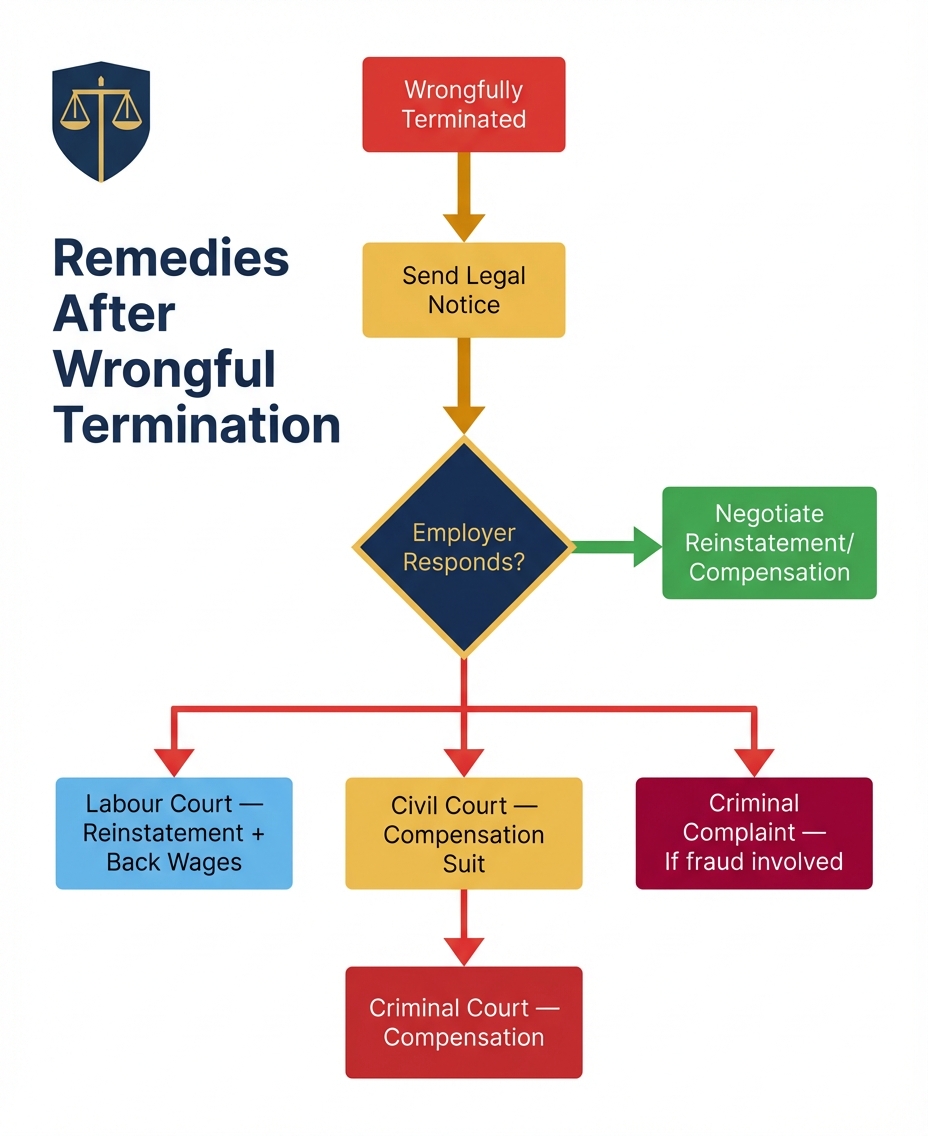
- Labour Court / Industrial Tribunal: If you are classified as a "workman" under the Industrial Disputes Act (broadly, employees who are not in managerial or supervisory roles with wages exceeding Rs. 10,000 per month), you can raise an industrial dispute through the Labour Commissioner's office. The matter is first referred for conciliation, and if that fails, it is referred to the Labour Court or Industrial Tribunal for adjudication. There is no court fee for raising an industrial dispute.
- Civil Court: If you are not covered under the ID Act (e.g., managerial or senior employees), you can file a civil suit for damages, unpaid dues, and compensation in the appropriate District Court. Court fees are payable on an ad valorem basis.
- Authority under the Payment of Wages Act: For claims of unpaid or delayed wages, you can file an application before the authority appointed under Section 15 of the Payment of Wages Act. This is a faster remedy specifically designed for wage recovery.
- Controlling Authority under the Gratuity Act: For unpaid gratuity, an application can be filed before the controlling authority under Section 7 of the Payment of Gratuity Act. The authority can direct the employer to pay the gratuity along with interest.
- EPFO complaint: For non-deposit of provident fund contributions, file a complaint with the Regional Provident Fund Commissioner under Section 7A of the EPF Act. The EPFO can initiate recovery proceedings against the employer and also impose penalties.
Conciliation Is Mandatory
Before an industrial dispute is referred to the Labour Court, the matter must first go through conciliation proceedings before the Labour Commissioner or Conciliation Officer. This process is designed to help parties reach an amicable settlement. If conciliation fails, the officer submits a "failure report" and the government refers the dispute for adjudication.
Common Mistakes to Avoid
Employees pursuing wrongful termination and unpaid salary claims often make avoidable mistakes that weaken their legal position. Here are the most common pitfalls and how to avoid them:
- Delaying action: There are limitation periods for filing employment claims. Under the Industrial Disputes Act, disputes should be raised within three years of the date of termination. Claims under the Payment of Wages Act must be filed within 12 months. Do not wait too long after termination to send the legal notice.
- Not preserving evidence: Many employees lose access to company email and documents after termination. Before or immediately after your last day, save all relevant documents — appointment letters, salary slips, performance reviews, and email communications.
- Signing a full and final settlement without reading it: Some employers present a "full and final settlement" document that includes a clause waiving all future claims. Never sign such a document without reading it carefully and consulting a lawyer. Once you sign, it becomes very difficult to pursue additional claims.
- Making public accusations: While you have every right to pursue legal remedies, making defamatory statements about your employer on social media or in public can expose you to a counter-claim for defamation. Keep your dispute confidential and let your lawyer handle communications.
- Sending a vague or emotional notice: A legal notice must be factual, specific, and professional. Avoid emotional language, personal attacks, or unsubstantiated allegations. Stick to the facts, cite the applicable laws, and clearly state the relief you seek.
- Not calculating dues accurately: An incorrect calculation of unpaid dues undermines your credibility. Take the time to compute your salary, notice pay, leave encashment, gratuity, and PF contributions accurately, with supporting documents for each component.
- Ignoring the correct forum: Filing your complaint in the wrong forum wastes time and money. Ensure you understand whether your case should go to the Labour Court, Civil Court, or a statutory authority under a specific Act. Consulting a lawyer on jurisdiction is essential.
- Accepting verbal assurances: If your employer promises to pay your dues or reinstate you verbally, insist on a written confirmation. Verbal promises are difficult to enforce and provide no legal protection.
Limitation Period Warning
The limitation period for raising an industrial dispute is three years from the date of termination, but some state variations may apply. For wage claims under the Payment of Wages Act, the limitation is just 12 months. If you are approaching these deadlines, send your legal notice immediately and consult a lawyer about filing your case without further delay.
How OpenVakil Helps
Navigating employment disputes can be overwhelming, especially when you are dealing with the financial and emotional stress of losing your job. OpenVakil simplifies the process of drafting and sending a legal notice for wrongful termination and unpaid salary, making professional legal support accessible and affordable.
- AI-powered drafting: Answer a few straightforward questions about your employment, termination, and unpaid dues, and OpenVakil generates a comprehensive legal notice tailored to your specific situation — referencing the correct statutes, calculating your dues, and using professional legal language.
- Customised to your state's laws: Employment law varies significantly across Indian states, particularly with respect to Shops and Establishments Acts. OpenVakil accounts for state-specific provisions to ensure your notice is accurate and enforceable.
- Fast and affordable: Get your draft notice in minutes at a fraction of what a traditional lawyer consultation would cost. Review it, suggest edits, and finalise it at your own pace.
- Comprehensive coverage: Your notice will address all relevant claims — wrongful termination, unpaid salary, gratuity, provident fund, leave encashment, and any other dues — so nothing is left on the table.
- Guidance beyond the notice: OpenVakil does not just draft your notice. The platform helps you understand your rights, identify the correct legal forum, and plan your next steps if the employer does not comply.
Whether you are a factory worker facing illegal retrenchment, an IT professional terminated without notice, or a new mother dismissed during maternity leave, OpenVakil gives you the tools and guidance to assert your employment rights effectively and affordably.
Protect Your Employment Rights Today
Do not let wrongful termination or unpaid salary go unchallenged. Create a professional, legally sound employment legal notice with OpenVakil and take the first step toward getting the justice and compensation you deserve.
Get Started Now