Every employee in India has a fundamental right to be paid for the work they have performed. When an employer withholds, delays, or refuses to pay your salary, it is not merely an inconvenience — it is a violation of law. Indian labour legislation provides robust protections to ensure that workers receive their wages on time and in full. A legal notice for non-payment of salary is one of the most powerful tools available to employees to compel an employer to release unpaid wages and settle outstanding dues.
Whether your employer has delayed your salary for months, withheld your full and final settlement after resignation, failed to deposit your provident fund contributions, or made unauthorised deductions from your pay, the law is firmly on your side. This comprehensive guide explains your legal rights, the applicable statutes, the step-by-step process to send a legal notice, and the remedies available if the employer still refuses to pay after receiving the notice.
A well-drafted legal notice serves a dual purpose: it puts the employer on formal notice of your intent to pursue legal remedies, and it creates a documented record of your claim that strengthens your position if the matter proceeds to a labour court or civil court. In the majority of cases, employers settle the outstanding dues within 15 to 30 days of receiving the notice, making it the most cost-effective first step for salary recovery.
What Is a Legal Notice for Non-Payment of Salary?
A legal notice for non-payment of salary is a formal written communication sent by an employee (or their lawyer) to an employer, demanding the payment of unpaid wages, withheld dues, or any other salary-related entitlements. It is drafted in accordance with Section 80 of the Code of Civil Procedure, 1908 (when the employer is a government body or public authority) or as a general demand notice under the principles of contract and labour law.
The notice serves as a pre-litigation step that formally informs the employer of the employee's grievance, the legal basis for the claim, the specific amount demanded, and the consequences of failing to pay within the stipulated deadline. It demonstrates the employee's seriousness and willingness to pursue legal action, which often prompts employers to settle the matter without the need for court proceedings.
Importantly, sending a legal notice is not the same as filing a case. It is a preliminary step that gives the employer an opportunity to resolve the dispute amicably. However, if the notice is ignored or the employer refuses to comply, the notice becomes a critical piece of evidence in subsequent legal proceedings, proving that the employee gave the employer adequate opportunity to settle the matter.
Legal Notice vs Demand Letter
While the terms are sometimes used interchangeably, a legal notice typically carries more formal weight. It is usually drafted by or in the name of a lawyer (advocate), references specific statutory provisions, and explicitly warns of legal action. A demand letter, by contrast, may be sent directly by the employee without lawyer involvement. For salary recovery, a legal notice sent through an advocate is significantly more effective in compelling the employer to respond.
Your Legal Rights as an Employee
Indian law provides employees with multiple layers of protection when it comes to the payment of wages. These rights are enshrined in several statutes, each addressing different aspects of salary payment, minimum wages, and employment conditions. Understanding these rights is essential before you draft your legal notice, as citing the correct provisions strengthens your claim significantly.
Payment of Wages Act, 1936
The Payment of Wages Act, 1936 is the primary legislation governing the timely payment of wages in India. Under Section 3, every employer is responsible for paying wages to employees. Section 5 mandates that wages must be paid before the 7th day of the following month (for establishments with fewer than 1,000 workers) or before the 10th day (for establishments with 1,000 or more workers). Any delay beyond these deadlines is a statutory violation, and the employee has the right to file a claim for recovery.
The Act also regulates permissible deductions from wages under Section 7. Only specific deductions are allowed — such as income tax, provident fund contributions, insurance premiums authorised by the employee, and fines imposed under the standing orders. Any deduction not covered under Section 7 is an unauthorised deduction, and the employee can claim the amount back along with compensation.
Minimum Wages Act, 1948
The Minimum Wages Act, 1948 ensures that no employee is paid below the minimum wage rate fixed by the appropriate government for their category of employment. Under Section 20, if an employer pays less than the minimum wage, the employee (or an inspector) can file a claim before the authority appointed under the Act. The authority can direct the employer to pay the difference along with compensation up to ten times the underpaid amount. This protection is particularly important for workers in the unorganised sector, contract labourers, and daily wage earners.
New Labour Codes
The Indian government has enacted four new labour codes to consolidate and modernise existing labour laws: the Code on Wages, 2019, the Industrial Relations Code, 2020, the Occupational Safety, Health and Working Conditions Code, 2020, and the Code on Social Security, 2020. The Code on Wages, 2019 is particularly relevant as it subsumes the Payment of Wages Act and the Minimum Wages Act into a single comprehensive statute. It introduces a universal minimum wage applicable to all employees across all sectors and strengthens the penalty provisions for non-payment of wages.
Check Which Laws Apply to You
Until the new labour codes are fully notified and implemented (which is pending as of early 2025), the existing statutes — Payment of Wages Act, 1936, Minimum Wages Act, 1948, and others — continue to remain in force. Always verify which laws currently apply in your state, as implementation timelines vary.
When Can You Send a Legal Notice?
You are legally entitled to send a legal notice for non-payment of salary in a wide range of situations. The common thread is that the employer has failed to fulfil their contractual or statutory obligation to pay your wages or employment-related dues. Below are the most common scenarios that warrant a legal notice:
Delayed or Irregular Salary Payments
If your employer consistently delays your salary beyond the statutory deadline under the Payment of Wages Act (7th or 10th of the following month), you have grounds to send a legal notice. Even a single instance of delayed payment is a violation, but a pattern of delayed payments over several months is an even stronger basis for legal action. Many employees tolerate occasional delays, but the law does not require you to do so — the deadlines are mandatory, not advisory.
Partial Payment or Unauthorised Deductions
Some employers pay only a portion of the agreed salary, citing cash flow problems, performance issues, or arbitrary "penalties." Unless the deduction falls within the categories permitted under Section 7 of the Payment of Wages Act, it is unlawful. Common examples of unauthorised deductions include deductions for supposed damages to company property without inquiry, deductions for not serving the full notice period beyond what the contract allows, and deductions for targets not met when the employment contract does not provide for such deductions.
Withheld Full and Final Settlement
One of the most common salary disputes arises after an employee resigns or is terminated. Employers are required to process the full and final settlement — which includes the last month's salary, earned leave encashment, bonus, gratuity (if applicable), notice period pay, and any other contractual dues — within a reasonable period, typically 30 to 45 days from the last working day. If the employer withholds your settlement without valid justification, a legal notice is the appropriate next step.
Beware of Coercive Settlement Practices
Some employers withhold the full and final settlement to pressure employees into signing non-compete clauses, non-disparagement agreements, or waivers of future claims. This practice is coercive and potentially illegal. If your employer conditions payment of your earned dues on signing additional documents, consult a lawyer before signing anything. Your right to receive your earned wages cannot be made contingent on waiving other legal rights.
Unpaid Overtime and Allowances
Under the Factories Act, 1948 and the various Shops and Establishments Acts, employees who work beyond the prescribed daily or weekly hours are entitled to overtime wages at twice the ordinary rate. Many employers, particularly in the IT, retail, and hospitality sectors, require employees to work extended hours without paying the legally mandated overtime. Similarly, if your employment contract or company policy provides for travel allowance, shift allowance, performance bonus, or other allowances, failure to pay these amounts is actionable.
Provident Fund Not Deposited
Perhaps the most egregious form of salary theft occurs when an employer deducts the employee's share of provident fund from the salary but fails to deposit it with the Employees' Provident Fund Organisation (EPFO). Under Section 6 of the EPF Act, 1952, both the employer and employee must contribute 12% of the employee's basic wages to the EPF. Non-deposit of these contributions is a criminal offence under Section 14, punishable with imprisonment of up to three years and a fine of up to Rs. 10,000. Employees can verify their PF deposits through the EPFO Member Passbook portal and send a legal notice if discrepancies are found.
The right to receive wages for work done is a fundamental right of the employee. No employer can withhold wages already earned, whether on account of a dispute, alleged misconduct, or any other reason, except to the extent permitted by law.
— Hindustan Times Ltd. v. Their Workmen, AIR 1963 SC 1332
Laws That Protect Your Salary Rights
India has a comprehensive framework of labour and employment statutes that protect an employee's right to timely and full payment of wages. When drafting your legal notice, referencing the correct statutes and sections lends legal weight to your demand and signals to the employer that you are aware of your rights. The key statutes are discussed below.
Payment of Wages Act, 1936 (Detailed)
The Payment of Wages Act, 1936 is the cornerstone statute for salary recovery claims. Key provisions include:
- Section 3 — Responsibility for payment: The employer is personally responsible for ensuring wages are paid on time. In the case of a company, the designated manager or person responsible for the supervision and control of the establishment bears this responsibility.
- Section 4 — Fixation of wage periods: Wages must be fixed for a period not exceeding one month, ensuring monthly payment cycles.
- Section 5 — Time of payment: Wages must be paid within 7 days (establishments with under 1,000 workers) or 10 days (larger establishments) after the end of the wage period. On termination, wages must be paid before the expiry of the second working day from the date of termination.
- Section 7 — Authorised deductions: Only specific deductions (fines, income tax, PF contributions, insurance premiums, etc.) are permissible. The total deductions in any wage period must not exceed 50% of the wages in the case of deductions for house accommodation, or 75% with cooperative society deductions.
- Section 15 — Claims for recovery: An employee can file an application before the authority under this Act to recover unpaid or delayed wages, and the authority can award compensation up to ten times the amount wrongfully deducted or delayed.
- Section 20 — Penalty for non-payment: An employer who contravenes the Act is punishable with a fine ranging from Rs. 1,500 to Rs. 7,500. For subsequent offences, the fine may extend to Rs. 22,500 or imprisonment for one to six months.
Industrial Disputes Act, 1947
The Industrial Disputes Act, 1947 is relevant when the salary dispute is connected to termination, retrenchment, or any change in employment conditions. Under Section 33C(2), a workman can file an application before the Labour Court for the computation and recovery of money due from an employer — including unpaid wages, bonus, overtime, and other benefits. This is a particularly powerful remedy because the Labour Court can directly calculate and order payment of the dues without the employee having to file a full-blown industrial dispute.
Section 2A of the Act also deems the termination, discharge, or retrenchment of an individual workman to be an industrial dispute, allowing the workman to directly approach the Labour Court without having to go through the conciliation process in certain circumstances. This provision simplifies the dispute resolution process for individual employees.
Payment of Bonus Act, 1965
The Payment of Bonus Act, 1965 mandates the payment of an annual bonus to employees drawing wages up to Rs. 21,000 per month (as per the 2015 amendment). The minimum bonus is 8.33% of the annual wages or Rs. 100, whichever is higher, even if the employer has no allocable surplus. The maximum bonus is 20% of annual wages. Bonus must be paid within eight months of the close of the accounting year. If your employer has not paid the statutory bonus, this constitutes a separate violation that can be included in your legal notice.
EPF and Miscellaneous Provisions Act, 1952
The Employees' Provident Funds and Miscellaneous Provisions Act, 1952 applies to every establishment employing 20 or more persons. Under this Act, the employer must contribute 12% of the employee's basic wages (plus dearness allowance) to the EPF, and must also deposit the employee's matching 12% contribution that is deducted from the salary. Under Section 7A, the Central Provident Fund Commissioner can conduct an inquiry and determine the amount of contributions due from the employer. Under Section 14, failure to pay contributions is a criminal offence. Under Section 14B, damages can be levied on employers for delayed deposits at rates ranging from 5% to 25% per annum of the arrears.
Criminal Liability for PF Non-Deposit
Non-deposit of provident fund is one of the few salary-related violations that attracts criminal prosecution. Under Section 14 of the EPF Act, the employer (and every person who was in charge of and responsible for the conduct of the business) can be sentenced to imprisonment for up to three years. This criminal liability makes PF-related claims particularly potent in legal notices.
Recover Your Unpaid Salary with a Legal Notice
OpenVakil helps you draft a comprehensive legal notice citing the correct statutes and provisions for your specific situation. Answer a few questions and get a professionally drafted notice ready to send to your employer.
Create Your Legal NoticeEssential Elements of a Salary Non-Payment Notice
A legal notice for non-payment of salary must be comprehensive, specific, and professionally drafted. Omitting critical details can weaken your claim and give the employer grounds to dismiss or contest the notice. Every effective salary non-payment notice must include the following elements:
- Employee identification: Your full legal name, residential address, employee ID number, designation, department, and date of joining. This establishes your identity and your employment relationship with the employer beyond any doubt.
- Employer identification: The full legal name of the company or establishment, its registered office address, the name and designation of the managing director, HR head, or authorised signatory, and the company's CIN or GSTIN. If the employer is a proprietorship or partnership, include the proprietor's or partners' names.
- Employment details: A concise summary of your employment history — the date of joining, position held, last drawn gross salary (with a component-wise breakdown of basic, HRA, DA, special allowance, etc.), mode of salary payment (bank transfer, cheque, or cash), and the date of your last working day (if applicable).
- Statement of facts: A chronological and factual narrative of the salary non-payment — when the salary was last paid, how many months' salary is outstanding, any partial payments received, any communications with the employer regarding the non-payment, and the employer's stated reasons (if any) for withholding the salary.
- Statutory provisions violated: Specific references to the sections of the Payment of Wages Act, 1936 (Sections 3, 5, and 7), the Minimum Wages Act, 1948, the EPF Act, 1952, the Payment of Bonus Act, 1965, or any other statute that the employer has violated. Citing the exact sections demonstrates legal awareness and seriousness.
- Detailed computation of dues: A line-by-line calculation of every amount owed — unpaid basic salary (month by month), HRA, DA, special allowances, earned leave encashment, bonus, gratuity, notice period pay, PF contributions not deposited, and any other contractual entitlements. Include the total sum demanded.
- Supporting evidence referenced: A list of documents in your possession that support your claim — appointment letter, salary slips, bank statements, PF passbook, Form 16, email correspondence, and any written communications from the employer regarding the non-payment.
- Demand and relief sought: A clear and unambiguous statement of what you are demanding — the exact total amount owed, interest on the delayed payment, issuance of salary slips and Form 16, release of experience certificate, or any other specific relief.
- Deadline for compliance: A specific timeframe (typically 15 days from the date of receipt of the notice) within which the employer must comply with the demands. This deadline must be reasonable but firm.
- Consequences of non-compliance: An explicit statement that failure to pay within the stipulated period will result in the employee initiating legal proceedings — which may include filing a claim under the Payment of Wages Act, raising an industrial dispute, filing a civil suit, or lodging a criminal complaint for PF non-deposit — and that the employer will bear all litigation costs.
Keep the Tone Professional
Your legal notice must be firm, factual, and professional. Avoid emotional language, personal insults, threats of violence, or exaggerated claims. Courts and tribunals look favourably upon notices that are measured and legally precise. An unprofessional notice can actually harm your credibility if the matter proceeds to litigation.
Step-by-Step Process to Send the Notice
Sending a legal notice for non-payment of salary involves several important steps. Following this process carefully ensures that your notice is legally valid, properly documented, and maximally effective.
- Collect and organise your documents: Before drafting the notice, gather all employment-related documents — your offer letter, appointment letter, salary slips (or bank statements showing salary credits), PF passbook or UAN statement, Form 16, any written communications about the salary delay, resignation acceptance (if applicable), and the full and final settlement statement (if issued). Organise these chronologically.
- Verify your PF and salary records: Log in to the EPFO Member Passbook portal (member.epfindia.gov.in) and verify that your employer has been depositing both the employer's and employee's share of PF contributions. Check your bank statements against your salary slips to identify any discrepancies in the amounts actually credited.
- Calculate the total dues with precision: Prepare a detailed month-by-month breakdown of all unpaid amounts. Include basic salary, allowances, bonus, overtime, leave encashment, gratuity (if you have completed five years of service), notice period pay, and PF contributions. Round off to the nearest rupee and ensure every figure is supported by documentation.
- Draft the legal notice: Engage a lawyer or use a platform like OpenVakil to draft the notice. The notice should be addressed to the employer (the company and/or its directors), include all the essential elements discussed above, and be signed by the advocate or the employee. Ensure the notice is printed on the advocate's letterhead if it is being sent through a lawyer.
- Review and finalise: Before sending, review the notice carefully for factual accuracy, correct calculation of dues, proper citation of legal provisions, and any typographical errors. An inaccurate or poorly drafted notice can undermine your credibility.
- Send via registered post with acknowledgment due (AD): The notice must be sent through Registered Post with Acknowledgment Due (RPAD) or Speed Post with AD to the employer's registered office address. This provides legally admissible proof that the notice was sent and received. Retain the postal receipt and the acknowledgment card when it is returned to you.
- Send a copy via email: In addition to the postal copy, send a scanned copy of the notice via email to the employer's official email address (typically the HR department or the company's legal team). This ensures faster receipt and creates an additional record of communication.
- Maintain a record: Keep photocopies of the notice, the postal receipt, the acknowledgment due card, the email confirmation, and all supporting documents in a secure file. These records are essential evidence if the matter proceeds to court.
- Wait for the response period to expire: Allow the employer the full period mentioned in the notice (typically 15 days from the date of receipt) to respond. During this waiting period, refrain from making public statements about the dispute or taking any action that could prejudice your case.
- Evaluate and proceed: After the response period expires, assess the employer's response (or lack thereof) and decide on the next course of action — whether to negotiate, file a labour complaint, approach the PF Commissioner, or initiate civil proceedings.
Salary Calculation and Dues Breakdown
One of the most critical aspects of your legal notice is the accurate calculation of unpaid dues. An imprecise or inflated claim undermines your credibility, while an underestimate means you leave money on the table. Your dues breakdown should include every component you are legally entitled to:
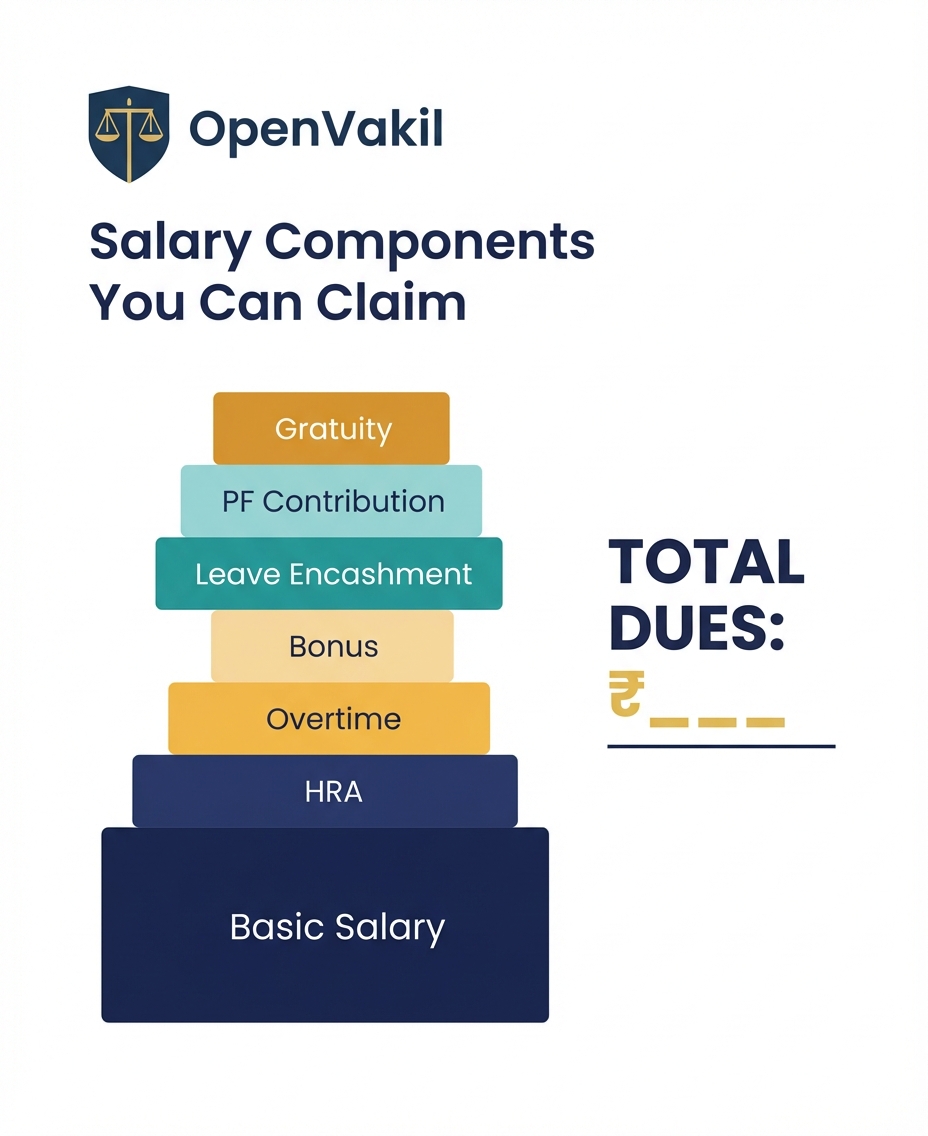
- Unpaid basic salary: Calculate the gross salary for each unpaid month, referencing your appointment letter or last salary slip for the component-wise breakdown (basic pay, HRA, conveyance allowance, special allowance, etc.).
- Dearness Allowance (DA): If your employment terms include DA, ensure it is calculated at the rate applicable during each unpaid month, as DA rates may change periodically.
- Earned leave encashment: Count the number of earned leave days accumulated but not availed. The encashment rate is typically calculated as (basic salary + DA) / 30 x number of leave days.
- Notice period pay: If you were terminated without being given the contractual notice period (or pay in lieu), calculate the salary for the notice period as specified in your employment contract or the applicable Shops and Establishments Act.
- Overtime wages: If you worked beyond the statutory working hours without receiving overtime pay, calculate overtime at twice the ordinary rate of wages as mandated by the Factories Act or Shops and Establishments Act.
- Bonus: If you are eligible under the Payment of Bonus Act (wages up to Rs. 21,000 per month), calculate the statutory bonus at the applicable rate (minimum 8.33%, maximum 20% of annual wages).
- Gratuity: If you have completed five or more years of continuous service, calculate gratuity as 15 days' wages x number of completed years of service / 26. The "wages" here means the last drawn basic salary plus DA.
- Provident Fund contributions: If the employer has not deposited PF contributions, calculate both the employer's share (12% of basic + DA) and the employee's share (12% of basic + DA) for each defaulting month, along with interest.
- Interest on delayed payment: Under various statutes, you may be entitled to interest on delayed payments. For example, the Payment of Gratuity Act provides for simple interest from the date gratuity becomes payable. The EPF Act provides for damages at 5% to 25% per annum.
- Reimbursements and other dues: Include any pending reimbursements (medical, travel, telephone, etc.) that were approved but not paid, as well as any other contractual entitlements such as performance-linked incentives or retention bonuses.
Present the calculation in a tabular or line-item format within the notice, showing each component, the basis of calculation, and the amount claimed. End with the grand total of all dues. This level of detail signals to the employer that your claim is well-researched and leaves little room for dispute on the quantum of the claim.
Wages once earned by an employee become a debt owed by the employer. The employer cannot refuse to pay or delay payment on the ground that a dispute exists regarding the terms of employment or the quantum of wages.
— Management of Gammon India Ltd. v. Niranjan Das, (1984) 1 SCC 509
What Happens After Sending the Notice?
After your employer receives the legal notice, one of several outcomes will typically follow. Understanding these possible outcomes will help you prepare your next steps in advance.
- Full payment of dues: This is the most desirable outcome. Many employers, upon receiving a formal legal notice from an advocate, realise the seriousness of the matter and release all pending dues within the stipulated deadline. This happens more often than you might expect — the legal notice alone resolves the dispute in a significant majority of salary non-payment cases.
- Partial payment and negotiation: The employer may release a portion of the dues while disputing certain components. For instance, they may pay the unpaid salary but contest the gratuity calculation or the overtime claim. In such cases, accept the partial payment without prejudice to your remaining claims (ensure this is communicated in writing) and continue negotiating or proceed to legal action for the balance amount.
- Employer sends a reply notice: The employer may engage their own legal team to send a formal reply denying your claims, disputing the amounts, or alleging that you owe the company money (for example, for notice period shortfall or training costs). Do not panic — a reply notice is simply the employer's version of events. Review it carefully with your lawyer, identify the factual inaccuracies, and prepare your response or proceed to file a case.
- Settlement offer: The employer may propose a lump-sum settlement that is less than the full amount claimed. Evaluate this offer carefully — consider the time, cost, and uncertainty of litigation versus the certainty of a settlement. If the offer is reasonable (typically 70% to 90% of the total claim), it may be pragmatic to accept. Ensure any settlement is documented in a written settlement agreement.
- No response at all: If the employer ignores the notice completely, their silence actually strengthens your legal position. The notice serves as proof that you gave the employer a fair opportunity to resolve the matter, and their failure to respond demonstrates a lack of good faith. You can now proceed to file a formal complaint or suit with the confidence that the court will view your efforts favourably.
Do Not Accept Conditional Payments
If the employer offers to pay your dues on the condition that you sign a "no claims" waiver or a non-disclosure agreement, consult your lawyer before accepting. Once you sign such documents, you may lose the right to pursue additional claims — including PF arrears, gratuity, or compensation for harassment. Always insist on receiving your legally earned dues without conditions.
Filing a Labour Complaint vs Civil Suit
If the legal notice fails to resolve the matter, the next step is to initiate formal legal proceedings. The appropriate forum depends on your employment classification, the nature of the claim, and the amount involved. Below are the primary options available to employees in India for salary recovery.
Labour Commissioner and Conciliation
The first step in the labour dispute resolution process is typically to file a complaint with the Labour Commissioner's office (also known as the Office of the Assistant Labour Commissioner) in the jurisdiction where you were employed. The Labour Commissioner will summon both parties for a conciliation hearing, which is an informal mediation process aimed at achieving an amicable settlement. Conciliation proceedings are free of cost, relatively quick (typically concluded within 30 to 60 days), and do not require you to engage a lawyer (though having one is advisable).
If conciliation succeeds, the settlement is recorded and becomes binding on both parties. If it fails, the Conciliation Officer submits a failure report to the appropriate government, which may then refer the dispute to the Labour Court or Industrial Tribunal for adjudication. Conciliation is mandatory before a labour court reference for most industrial disputes, so this step cannot be skipped.
Labour Court and Industrial Tribunal
The Labour Court and Industrial Tribunal are quasi-judicial bodies established under the Industrial Disputes Act to adjudicate employment disputes. Key remedies available include:
- Section 33C(2) Application: This is a powerful and commonly used remedy for salary recovery. A workman can file an application directly before the Labour Court for the computation and recovery of money due from the employer — without having to raise a formal industrial dispute. The Labour Court calculates the dues and issues an order for payment. There is no court fee for this application.
- Industrial Dispute under Section 2A: If the salary non-payment is connected to your termination or retrenchment, you can raise an individual industrial dispute. The dispute is referred to the Labour Court, which has the power to order reinstatement, back wages, and payment of all dues.
- Recovery Certificate: Once the Labour Court passes an order for payment, if the employer fails to comply, the court can issue a recovery certificate to the District Collector, who can recover the amount as an arrear of land revenue — one of the most powerful enforcement mechanisms in Indian law.
Civil Suit for Salary Recovery
If you are classified as a managerial or supervisory employee and are not covered under the Industrial Disputes Act (which applies to "workmen"), you can file a civil suit for recovery of money in the appropriate District Court or High Court. The suit would be filed under Order 37 of the Code of Civil Procedure (summary suit) for expedited recovery, or as a regular suit. Court fees are payable on an ad valorem basis (typically 1% to 7.5% of the claim amount, varying by state).
Additionally, regardless of your employment classification, you can file:
- Claim under the Payment of Wages Act: An application before the authority under Section 15 for recovery of wages delayed or deducted unlawfully. The authority can award compensation of up to ten times the amount wrongfully withheld.
- Claim under the Payment of Gratuity Act: An application before the Controlling Authority under Section 7 for recovery of unpaid gratuity with interest.
- Complaint with the EPFO: A complaint with the Regional Provident Fund Commissioner for non-deposit of PF contributions, which can trigger an inquiry under Section 7A and criminal prosecution under Section 14.
- Writ Petition (for government employees): If you are a government employee or employed by a public-sector undertaking, you can file a writ petition under Article 226 of the Constitution before the High Court for recovery of unpaid wages.
No Limitation for PF Claims
While claims under the Payment of Wages Act must be filed within 12 months and civil suits within 3 years, complaints regarding non-deposit of provident fund have no strict limitation period. The EPFO can initiate proceedings against the employer for PF defaults going back several years. This makes PF-related claims particularly powerful even if significant time has elapsed since the non-deposit.
Common Mistakes to Avoid
Employees pursuing salary recovery often make avoidable errors that weaken their legal position or delay the resolution of their claims. Being aware of these common mistakes will help you navigate the process more effectively:
- Waiting too long to act: The limitation period for filing a claim under the Payment of Wages Act is 12 months from the date the wages became due. For civil suits, the limitation under the Limitation Act, 1963 is three years. Many employees wait months or even years, hoping the employer will pay voluntarily. Send your legal notice as soon as the salary is overdue — delay only benefits the employer.
- Not maintaining written records: Verbal conversations with your manager or HR about the salary delay are difficult to prove in court. Always follow up verbal discussions with an email or written message summarising what was discussed. Send messages like "As discussed today, my salary for [month] has not been credited. Please confirm the expected date of payment." This creates a contemporaneous record.
- Sending the notice to the wrong address: The legal notice must be sent to the employer's registered office address (as listed on the MCA portal or the company's letterhead). Sending it to a branch office, factory, or an individual's home address may allow the employer to claim they never received it. Always verify the registered office address before sending.
- Failing to include all components of dues: Many employees only claim the unpaid monthly salary and forget to include leave encashment, bonus, gratuity, PF arrears, overtime, reimbursements, and other entitlements. Calculate every component you are owed and include it in the notice. Once you file a case claiming a certain amount, increasing the claim later can be procedurally complicated.
- Using vague or emotional language: A legal notice that says "you have cheated me and ruined my life" is less effective than one that says "you have violated Section 5 of the Payment of Wages Act, 1936 by failing to pay wages for the months of October, November, and December 2024, totalling Rs. 1,80,000." Be specific, factual, and legally precise.
- Not sending through registered post: Sending the notice only via email or WhatsApp is insufficient. While electronic copies are useful for speed, the legally recognised method is Registered Post with Acknowledgment Due. The postal receipt and AD card serve as proof of dispatch and delivery.
- Signing a full and final settlement under pressure: Some employers withhold salary to pressure employees into signing a settlement that includes a waiver of all claims. Never sign any document under duress or without reading it thoroughly. If you have already signed such a document, consult a lawyer — settlements signed under coercion can be challenged in court.
- Ignoring the employer's reply: If the employer sends a reply notice disputing your claims, do not ignore it. The reply often contains the employer's defence strategy, which your lawyer can use to prepare a stronger case. Evaluate the reply, identify factual inaccuracies, and respond appropriately or proceed to file your case.
- Choosing the wrong legal forum: Filing your claim in the wrong court or tribunal wastes valuable time and money. Understand whether your case should go to the Labour Court (for workmen), Civil Court (for managerial employees), the Payment of Wages authority, or the EPFO. Consulting a lawyer on jurisdiction is essential and can save months of delay.
- Publicly disparaging the employer: While you may be frustrated, posting about the dispute on social media, company review sites, or professional platforms can expose you to a defamation counter-claim. Keep the dispute confidential and let the legal process handle the resolution.
Limitation Period Alert
Under the Payment of Wages Act, 1936, claims must be filed within 12 months from the date wages became due. Under the Limitation Act, 1963, a civil suit for recovery of salary must be filed within 3 years. If you are approaching either of these deadlines, send your legal notice immediately and consult a lawyer about initiating formal proceedings without delay. Missing the limitation period can permanently bar your claim.
How OpenVakil Helps
Dealing with unpaid salary is stressful, and navigating the legal process on your own can be daunting. OpenVakil is designed to make salary recovery accessible, affordable, and effective for every employee in India — whether you are a factory worker, an IT professional, a sales executive, or a senior manager.
- AI-powered legal notice drafting: Answer a few simple questions about your employment, the unpaid salary period, and the components of your dues. OpenVakil's AI engine generates a comprehensive, professionally worded legal notice that cites the correct statutes, includes a detailed computation of dues, and is formatted in the standard legal notice template used by practising advocates.
- Accurate dues calculation: OpenVakil helps you compute every component of your unpaid dues — basic salary, allowances, leave encashment, bonus, gratuity, PF contributions, overtime, and more — so that nothing is left out of your claim.
- State-specific legal provisions: Employment and labour laws vary across Indian states, particularly the Shops and Establishments Acts and minimum wage rates. OpenVakil accounts for your state's specific provisions to ensure your notice is legally accurate and enforceable in your jurisdiction.
- Fast turnaround: Get your draft legal notice in minutes, not days. Review it, suggest edits, and finalise it at your convenience. You can send the notice the same day if needed.
- Affordable pricing: Professional legal notices through OpenVakil cost a fraction of what a traditional lawyer consultation and drafting would cost, making legal recourse accessible to employees at all income levels.
- Guidance on next steps: OpenVakil does not just draft your notice. The platform provides clear guidance on what to do if the employer does not respond, which legal forum to approach, and how to file a complaint with the Labour Commissioner, Labour Court, or EPFO.
Your salary is not a favour from your employer — it is your legal right. If that right has been violated, you do not have to accept it silently. A well-drafted legal notice is the first and most effective step toward recovering what is rightfully yours. OpenVakil empowers you to take that step with confidence, precision, and legal authority.
Get Your Unpaid Salary Back Today
Do not let your employer get away with withholding your hard-earned salary. Create a professional, legally sound notice with OpenVakil and take the first step toward recovering every rupee you are owed.
Start Your Legal Notice Now