If you are searching for how to send a legal notice online in Mumbai, Delhi, Bangalore, Chennai, or Hyderabad, you are not alone. Thousands of Indians in these major cities need to send legal notices every day for disputes ranging from cheque bounce and money recovery to property conflicts and employment issues. But the process, costs, and legal landscape can vary significantly from one city to another.
India's legal system is not uniform across the country. Each state has its own rent control legislation, its own RERA authority, its own court hierarchies, and its own bar culture with different fee structures. A tenant eviction notice in Mumbai operates under a completely different statutory framework than one in Chennai. A RERA complaint in Bangalore follows different procedural norms than one in Hyderabad. Understanding these city-specific nuances is critical if you want your legal notice to be effective and legally sound.
In this comprehensive city-wise guide, we cover everything you need to know about sending a legal notice online in India's five largest cities. We explain the local court structures, state-specific laws that affect common disputes, typical lawyer fees, the most frequently encountered dispute types, and why an online platform like OpenVakil can serve you better than a traditional legal notice lawyer near me search regardless of which city you are in.
Why Your City Matters for Legal Notices
When people search for a legal notice service near me, they instinctively understand that location matters. But why exactly does your city affect how you send a legal notice? There are several critical reasons:
- Jurisdiction determines which court has authority: Under the Code of Civil Procedure, 1908 (CPC), the territorial jurisdiction of a court depends on where the cause of action arose, where the defendant resides, or where the property in dispute is located. Your legal notice must reference the correct jurisdiction, because a notice threatening to file a case in the wrong court lacks credibility and legal force.
- State-specific legislation applies: Rent control laws, stamp duty rules, tenancy regulations, and state RERA rules differ from Maharashtra to Karnataka to Tamil Nadu to Telangana. A legal notice for tenant eviction in Mumbai must cite the Maharashtra Rent Control Act, 1999, while the same notice in Chennai must cite the Tamil Nadu Buildings (Lease and Rent Control) Act, 1960.
- Local court procedures vary: The Bombay High Court, Delhi High Court, Karnataka High Court, Madras High Court, and Telangana High Court each have their own rules and procedures. Familiarity with local court practices helps draft a notice that aligns with how the eventual court proceedings would unfold.
- Lawyer fees vary dramatically by city: The cost of hiring a lawyer to draft a legal notice in Mumbai can be two to three times higher than in Hyderabad. Understanding local market rates protects you from being overcharged.
- Language considerations: In cities like Chennai, legal notices may need to be bilingual (English and Tamil) depending on the recipient and the court where proceedings may be filed. Similarly, notices in Hyderabad may require Telugu translation for certain courts.
National Coverage, Local Expertise
OpenVakil serves all five major cities -- Mumbai, Delhi, Bangalore, Chennai, and Hyderabad -- as well as every district in India. Our AI drafting engine and empanelled advocates are familiar with state-specific laws, local court practices, and city-specific dispute patterns. You get local expertise without the local price premium.
How Jurisdiction Works in India
Before diving into the city-specific sections, it is essential to understand how jurisdiction works in India. Jurisdiction is the authority of a court to hear and decide a case. Filing a case in the wrong court can result in dismissal and wasted time and money. Your legal notice should clearly indicate where you intend to file proceedings if the dispute is not resolved, and this must be a court with proper jurisdiction.
Territorial Jurisdiction Under CPC
The Code of Civil Procedure, 1908 lays down the rules for territorial jurisdiction. The key provisions are:
- Section 16 CPC -- Suits related to immovable property: Must be filed in the court within whose jurisdiction the property is situated. If you are sending a legal notice for a property dispute in Mumbai, the suit would be filed in a Mumbai court. A property dispute notice for land in Hyderabad would go to a Hyderabad court.
- Section 19 CPC -- Suits for compensation for wrongs to person or movable property: May be filed where the wrong was committed or where the defendant resides or carries on business.
- Section 20 CPC -- Other suits: Must be filed where the defendant resides or carries on business, or where the cause of action (wholly or partly) arose. This is the most commonly used provision and applies to disputes like cheque bounce, money recovery, breach of contract, and more.
- Section 138 NI Act -- Cheque bounce cases: Following the Supreme Court's landmark decision in Dashrath Rupsingh Rathod v. State of Maharashtra (2014) and the subsequent amendment, cheque bounce complaints must be filed in the court having jurisdiction over the place where the cheque was delivered for collection (i.e., the branch of the payee's bank). This significantly impacts where your legal notice should indicate proceedings will be filed.
Jurisdiction for Legal Notices
A legal notice itself does not require "filing" in any court, so there is no jurisdictional requirement for the notice itself. You can send a legal notice from any city to any recipient anywhere in India. However, the notice should clearly state the jurisdiction of the court where you intend to file proceedings if the matter is not resolved. This is important because:
- It puts the recipient on notice about where they will need to appear if litigation follows, which adds pressure to settle.
- It demonstrates that you have sought proper legal advice and are aware of the correct forum.
- It prevents ambiguity that could be exploited by the recipient to delay proceedings through jurisdictional objections.
A legal notice that threatens proceedings in a court without jurisdiction is worse than no notice at all. It signals to the recipient that the sender has not taken proper legal advice, and it weakens the sender's negotiating position.
— Practical Guide to Civil Litigation in India
Send a Legal Notice from Any City in India
OpenVakil's platform automatically identifies the correct jurisdiction based on your dispute details. Our AI drafts notices with the right court references, state-specific laws, and proper legal language -- all from the comfort of your home.
Draft Your Legal Notice NowSend Legal Notice Online in Mumbai
Mumbai is India's financial capital and the country's most litigious city. With a population exceeding 20 million, Mumbai generates an enormous volume of legal disputes ranging from property and real estate matters to commercial and business conflicts. If you need to send a legal notice online in Mumbai, understanding the local legal ecosystem is essential for an effective notice.
Mumbai's legal landscape is shaped by its unique position as both a commercial hub and a city with extreme real estate pressures. The combination of sky-high property prices, dense commercial activity, and a large financial services sector means that legal notices in Mumbai frequently involve high-value claims. Whether you are a tenant facing illegal eviction in Dadar, a homebuyer dealing with a delayed possession in Thane, or a business owner chasing a bounced cheque from a client in Andheri, the process starts with a well-drafted legal notice.
Mumbai Courts and Legal Infrastructure
Mumbai has one of the most extensive court systems in India. When you send a legal notice from Mumbai or to a recipient in Mumbai, your notice should reference the appropriate court. The key courts in Mumbai are:
- Bombay High Court: One of the oldest High Courts in India, the Bombay High Court has original civil jurisdiction over disputes arising within Greater Mumbai where the claim value exceeds a specified threshold. It also hears writ petitions and appeals. The Bombay High Court bench at Nagpur, Aurangabad, and Goa also falls under its jurisdiction. For high-value commercial disputes, the Bombay High Court's Commercial Division is the relevant forum.
- City Civil Court, Mumbai: Handles civil suits where the claim value is below the Bombay High Court's original jurisdiction threshold. Most civil disputes in Mumbai involving amounts up to the prescribed pecuniary limit are filed here.
- Small Causes Court, Mumbai: Handles suits for money recovery where the claim is below a specified threshold, as well as disputes under the Maharashtra Rent Control Act, 1999. Rent and tenancy disputes in Mumbai are predominantly adjudicated by the Small Causes Court, making it one of the busiest courts in the city.
- Metropolitan Magistrate Courts: Handle criminal matters including cheque bounce cases under Section 138 of the Negotiable Instruments Act. Mumbai has multiple Metropolitan Magistrate courts spread across the city -- Esplanade, Andheri, Borivali, Kurla, and others -- each with jurisdiction over specific geographic areas.
- Consumer Disputes Redressal Forum (CDRF), Mumbai: Hears consumer complaints under the Consumer Protection Act, 2019. Mumbai has multiple district-level consumer forums, and the Maharashtra State Consumer Disputes Redressal Commission sits in Mumbai as well.
- MahaRERA (Maharashtra Real Estate Regulatory Authority): Located in Mumbai, MahaRERA adjudicates complaints against builders and developers under the Real Estate (Regulation and Development) Act, 2016. Mumbai accounts for a significant portion of RERA complaints in Maharashtra.
Mumbai: State-Specific Laws
Legal notices in Mumbai must account for Maharashtra-specific legislation. The key state laws that affect common disputes in Mumbai include:
- Maharashtra Rent Control Act, 1999: This is the governing legislation for landlord-tenant disputes in Mumbai. It prescribes the grounds for eviction, rent increase limits, and the procedure for termination of tenancy. A legal notice for tenant eviction in Mumbai must comply with this Act's requirements, including the prescribed notice period and specific grounds (e.g., non-payment of rent, bona fide personal use, subletting without permission). The Act applies to premises let for residential or commercial purposes in Greater Mumbai.
- Maharashtra Ownership Flats Act, 1963 (MOFA): MOFA regulates the construction and sale of flats in Maharashtra, including Mumbai. It imposes obligations on builders to disclose project details, form cooperative societies, and hand over common areas. Legal notices to builders in Mumbai for breach of MOFA provisions are extremely common, particularly for failure to form a cooperative society or hand over maintenance.
- RERA (Maharashtra): MahaRERA is one of the most active RERA authorities in India. Homebuyers in Mumbai frequently send legal notices to builders for delayed possession, deviation from sanctioned plans, failure to provide promised amenities, and other RERA violations. The notice must reference the specific RERA registration number and the provisions of the RERA Act, 2016.
- Maharashtra Stamp Act, 1958: Affects the validity of agreements, sale deeds, and other documents that may be referenced in a legal notice. In property dispute notices in Mumbai, it is important to verify that the underlying agreements are properly stamped under this Act.
- Maharashtra Co-operative Societies Act, 1960: Governs cooperative housing societies in Mumbai, which is the predominant form of flat ownership in the city. Disputes between society members, between societies and builders, and between societies and individual flat owners are common and often require legal notices citing this Act.
Mumbai-Specific Tip
If you are sending a legal notice for a property dispute in Mumbai, always check whether the property falls under the Maharashtra Rent Control Act, 1999, the Maharashtra Ownership Flats Act (MOFA), or RERA. Many properties in Mumbai are governed by overlapping legislation, and citing the wrong statute can undermine your notice. OpenVakil's AI is trained on all Maharashtra-specific property laws and automatically selects the correct statutory framework.
Common Disputes in Mumbai
The types of disputes for which people send legal notices in Mumbai reflect the city's economic character. The most common categories include:
- Property and real estate disputes: Mumbai's notoriously expensive real estate market generates a massive volume of property disputes. These include builder delays (particularly in suburbs like Thane, Navi Mumbai, and Panvel), illegal encroachment, society disputes, landlord-tenant conflicts in areas like South Mumbai and Dadar, and title disputes involving ancestral properties.
- Builder delays and RERA complaints: With thousands of residential projects under construction across Mumbai Metropolitan Region (MMR), delayed possession is one of the most common grounds for legal notices in Mumbai. Homebuyers in projects across Goregaon, Malad, Borivali, Thane, and Navi Mumbai regularly send notices demanding possession or refund under RERA.
- Cheque bounce and money recovery: As India's financial capital, Mumbai sees a high volume of cheque bounce cases. Businesses in Mumbai, from small traders in Crawford Market to large corporations in BKC, regularly send demand notices under Section 138 NI Act. Money recovery notices for unpaid invoices, loans, and dues are equally common.
- Business and commercial disputes: Mumbai's commercial ecosystem generates disputes involving breach of contract, partnership conflicts, joint venture disagreements, vendor payment defaults, and intellectual property matters. Legal notices in these cases often involve significant sums and require careful drafting.
- Tenant eviction: Given the scarcity and expense of real estate in Mumbai, tenant eviction disputes are extremely common. Landlords in areas like Bandra, Juhu, Colaba, and Worli frequently send eviction notices under the Maharashtra Rent Control Act, 1999. Tenants also send notices challenging illegal rent increases or harassment by landlords.
- Employment disputes: Mumbai's large corporate sector and entertainment industry (Bollywood) generate employment-related legal notices for wrongful termination, unpaid salary, non-compete violations, and POSH complaints.
Mumbai Lawyer Fees for Legal Notices
Mumbai is one of the most expensive cities in India for legal services. Lawyer fees for drafting a legal notice in Mumbai typically range as follows:
- Junior advocate (0-5 years): Rs. 5,000 to Rs. 10,000 for a standard legal notice in Mumbai
- Mid-level advocate (5-15 years): Rs. 10,000 to Rs. 20,000 for a standard notice; Rs. 20,000 to Rs. 40,000 for complex property or commercial disputes
- Senior advocate / law firm partner: Rs. 25,000 to Rs. 1,00,000+ depending on the complexity and the firm's standing
- Average cost for a standard legal notice in Mumbai: Rs. 5,000 to Rs. 25,000
- OpenVakil (online): Starting from Rs. 299 for AI-drafted notices; Rs. 999 to Rs. 4,999 with lawyer review
The high cost of legal notices in Mumbai is primarily driven by the city's expensive office rents, high overhead costs, and the premium that established advocates command. For individuals and small businesses in Mumbai, these costs can be prohibitive, especially for routine matters like cheque bounce notices or simple money recovery demands. This is precisely why sending a legal notice online in Mumbai through a platform like OpenVakil makes financial sense -- you get the same legal quality at a fraction of the traditional Mumbai lawyer fees.
Send Legal Notice Online in Delhi NCR
Delhi NCR (National Capital Region) is India's political and administrative capital, and one of the largest metropolitan regions in the world. The Delhi NCR encompasses not just the National Capital Territory of Delhi but also satellite cities including Noida and Greater Noida (Uttar Pradesh), Gurgaon (Gurugram) and Faridabad (Haryana), and Ghaziabad (Uttar Pradesh). When you need to send a legal notice in Delhi, it is critical to understand that the NCR spans three different states, each with its own laws and court systems.
Delhi's position as the seat of the Central Government, the Supreme Court of India, and numerous regulatory bodies makes it a hub for legal activity. The city's diverse economy -- spanning government, IT services, manufacturing, trade, real estate, and a massive consumer market -- generates every conceivable type of legal dispute. Sending a legal notice in Delhi requires awareness of the city's complex jurisdictional landscape, particularly when the dispute involves parties on both sides of the Delhi-Noida or Delhi-Gurgaon border.
Delhi Courts and Legal Infrastructure
Delhi has an extensive court system. The major courts relevant when you send a legal notice in Delhi or to a Delhi-based recipient include:
- Delhi High Court: The Delhi High Court has original jurisdiction over high-value civil disputes, intellectual property matters (it is the busiest IP court in India), and company law matters. It also hears writ petitions and appeals. The Delhi High Court sits at Sher Shah Road near India Gate.
- Tis Hazari Courts Complex: One of the largest court complexes in Asia, Tis Hazari houses numerous civil judges, additional district judges, and Metropolitan Magistrate courts. A significant proportion of civil suits and criminal cases in Delhi are handled at Tis Hazari. If your legal notice relates to a dispute in North or Central Delhi, proceedings would likely be filed here.
- Saket Courts Complex: Handles civil and criminal matters for South Delhi and parts of South-East Delhi. The Saket courts are the relevant forum for disputes in areas like Defence Colony, Greater Kailash, Saket, Vasant Kunj, and Mehrauli.
- Patiala House Courts: Located near India Gate, Patiala House handles civil and criminal matters for Central Delhi and New Delhi areas. It also handles matters related to Parliament Street, Connaught Place, and surrounding localities.
- Dwarka Courts Complex: A relatively newer complex that handles matters for West and South-West Delhi, including areas like Dwarka, Janakpuri, Najafgarh, and Uttam Nagar.
- Karkardooma Courts Complex: Handles civil and criminal matters for East Delhi, including areas like Preet Vihar, Laxmi Nagar, and Shahdara.
- NCR Courts: For disputes involving parties in Noida or Greater Noida, the relevant courts are in Gautam Buddh Nagar (Uttar Pradesh). For Gurgaon/Gurugram, the courts are under Haryana's judicial system. For Ghaziabad, the courts fall under UP's jurisdiction. This multi-state complexity makes NCR disputes particularly tricky.
Delhi: State-Specific Laws
Legal notices in Delhi must account for Delhi-specific and state-specific legislation (remembering that the NCR spans Delhi, Uttar Pradesh, and Haryana):
- Delhi Rent Control Act, 1958: This Act governs landlord-tenant relationships in Delhi for premises built before a certain date and with rent below a specified threshold. A legal notice for tenant eviction in Delhi must reference this Act if the premises fall within its scope. The Act prescribes specific grounds for eviction including non-payment of rent, subletting, bona fide need, and misuse of premises. Note that the Delhi Rent Control Act applies only within the NCT of Delhi; properties in Noida (UP) or Gurgaon (Haryana) fall under their respective state tenancy laws.
- Delhi Land Reforms Act, 1954: Relevant for disputes involving agricultural land within Delhi, which occasionally arise for properties on the city's outskirts.
- Haryana Urban (Control of Rent and Eviction) Act, 1973: Applies to rental properties in Gurgaon/Gurugram and Faridabad. Legal notices for tenancy disputes in the Haryana portion of NCR must cite this Act.
- Uttar Pradesh Urban Buildings (Regulation of Letting, Rent and Eviction) Act, 1972: Applies to rental properties in Noida, Greater Noida, and Ghaziabad. Legal notices for tenancy disputes in the UP portion of NCR must cite this Act.
- RERA (Delhi, Haryana, UP): Each state has its own RERA authority. Delhi has RERA Delhi, Haryana has HRERA (Haryana Real Estate Regulatory Authority with offices in Gurugram and Panchkula), and UP has UP-RERA. A legal notice for a builder delay in a Noida project must reference UP-RERA, while a notice for a Gurgaon project must reference HRERA.
NCR Jurisdiction Alert
Delhi NCR disputes require extra caution on jurisdiction. If you live in Noida but work in Delhi and your dispute arose in Gurgaon, the jurisdictional analysis becomes complex. A legal notice threatening proceedings in a Delhi court for a dispute that falls under Gurgaon's jurisdiction will be ineffective. OpenVakil's platform handles this complexity automatically -- our AI identifies the correct jurisdiction based on the facts of your dispute, whether it is in Delhi, Noida, Gurgaon, Ghaziabad, or Faridabad.
Common Disputes in Delhi NCR
Delhi NCR's diverse economy and massive population generate a wide range of legal disputes. The most common types of legal notices sent in Delhi NCR include:
- Property disputes: Delhi's complex property ownership patterns (including DDA flats, group housing societies, plotted colonies, and unauthorised constructions) generate significant property litigation. Legal notices in Delhi frequently involve title disputes, possession issues, encroachment, and breach of sale agreements.
- Builder delays and RERA complaints: The NCR region, particularly Noida, Greater Noida, and Gurgaon, has thousands of delayed real estate projects. Homebuyers across NCR send legal notices to builders demanding possession, refund with interest, or compensation under RERA. Projects along the Yamuna Expressway, Dwarka Expressway, and NH-24 are particularly affected.
- Cheque bounce and money recovery: Delhi's large trading community, particularly in areas like Chandni Chowk, Karol Bagh, and South Extension, generates a high volume of cheque bounce cases and money recovery disputes. B2B transaction disputes between Delhi-based businesses are extremely common.
- Employment and labour disputes: Delhi NCR is home to thousands of corporate offices, startups, and government organisations. Legal notices for wrongful termination, unpaid wages, non-compete violations, and POSH complaints are frequently sent by employees and employers in Delhi.
- Consumer complaints: As a major consumer market, Delhi sees numerous legal notices against product manufacturers, service providers, e-commerce companies, and retailers for defective products, deficient services, and unfair trade practices.
- Matrimonial disputes: Delhi has a high volume of matrimonial legal notices, including notices under Section 125 CrPC (now Section 144 BNSS) for maintenance, notices related to domestic violence under the Protection of Women from Domestic Violence Act, 2005, and notices relating to divorce proceedings.
Delhi NCR Lawyer Fees for Legal Notices
Delhi NCR offers a wide range of lawyer fees due to the diversity of practitioners, from Supreme Court advocates to local district court practitioners:
- Junior advocate (0-5 years): Rs. 3,000 to Rs. 8,000 for a standard legal notice in Delhi
- Mid-level advocate (5-15 years): Rs. 8,000 to Rs. 15,000 for a standard notice; Rs. 15,000 to Rs. 30,000 for complex matters
- Senior advocate / law firm: Rs. 20,000 to Rs. 75,000+ for high-stakes disputes
- Average cost for a standard legal notice in Delhi NCR: Rs. 3,000 to Rs. 20,000
- Noida/Gurgaon/Ghaziabad lawyers: Generally 10-20% lower than Delhi rates, ranging from Rs. 2,500 to Rs. 15,000
- OpenVakil (online): Starting from Rs. 299 for AI-drafted notices; Rs. 999 to Rs. 4,999 with lawyer review
The wide range of lawyer fees in Delhi NCR can make it difficult for individuals to know whether they are getting a fair deal. A lawyer at a prestigious Connaught Place or Greater Kailash office may quote Rs. 20,000 for the same cheque bounce notice that a competent advocate in Karkardooma would draft for Rs. 3,000. Sending a legal notice online in Delhi through OpenVakil eliminates this geographic price disparity entirely, giving you access to quality legal drafting at a standardised, affordable price regardless of whether you are in Lutyen's Delhi or Noida Extension.
Need a Legal Notice in Delhi NCR?
Whether your dispute is in Delhi, Noida, Gurgaon, Ghaziabad, or Faridabad, OpenVakil handles the jurisdictional complexity and drafts your legal notice with the correct state-specific laws. Start online in minutes.
Start Your Delhi NCR Legal NoticeSend Legal Notice Online in Bangalore
Bangalore (Bengaluru) is India's technology capital and one of the fastest-growing cities in the country. Home to thousands of IT companies, startups, and multinational corporations, Bangalore has a unique legal landscape shaped by its tech-driven economy, rapid urbanisation, and the resulting real estate boom. If you need to send a legal notice in Bangalore, understanding the city's specific legal context will make your notice far more effective.
Bangalore's legal disputes reflect its character as a tech hub with a rapidly expanding real estate footprint. Employment disputes involving IT professionals, startup equity conflicts, RERA complaints against builders in the city's ever-expanding periphery (Whitefield, Sarjapur, Electronic City, Devanahalli), and consumer complaints against tech service providers are the hallmarks of Bangalore's legal notice landscape.
Bangalore Courts and Legal Infrastructure
When you send a legal notice in Bangalore or to a Bangalore-based recipient, the key courts to be aware of include:
- Karnataka High Court: Located on Raj Bhavan Road in Bangalore, the Karnataka High Court has original jurisdiction over high-value civil disputes in Bangalore and hears appeals from subordinate courts across Karnataka. The High Court also handles writ petitions, company law matters, and IP disputes arising in Bangalore.
- City Civil Court, Bangalore: Handles civil suits within the city limits of Bangalore. Most property disputes, money recovery suits, and contract disputes in Bangalore are filed in the City Civil Court complex at Mayo Hall or the sessions court complex on Nrupathunga Road.
- District Courts, Bangalore Urban and Bangalore Rural: Bangalore Urban district court handles matters within the Bruhat Bengaluru Mahanagara Palike (BBMP) limits, while Bangalore Rural district court covers the surrounding areas. Understanding this distinction is important for disputes arising in the city's rapidly expanding outskirts.
- Metropolitan Magistrate Courts, Bangalore: Handle criminal matters including cheque bounce cases under Section 138 NI Act. Bangalore has multiple Magistrate courts across the city.
- Karnataka RERA (K-RERA): Karnataka's RERA authority handles complaints against builders and developers for projects in Bangalore and across Karnataka. K-RERA has been relatively active and has adjudicated thousands of complaints from Bangalore homebuyers.
- Consumer Disputes Redressal Forum, Bangalore: Handles consumer complaints under the Consumer Protection Act, 2019, for Bangalore Urban and surrounding districts.
Bangalore: State-Specific Laws
Legal notices in Bangalore must account for Karnataka-specific legislation:
- Karnataka Rent Act, 1999 (Karnataka Rent Control Act): Governs landlord-tenant relationships in Bangalore. This Act prescribes the grounds for eviction, rent increase limits, and tenant protections. A legal notice for tenant eviction in Bangalore must cite the Karnataka Rent Act, 1999, and specify the applicable ground for eviction. Key grounds include non-payment of rent, subletting without consent, bona fide personal requirement, and the tenant causing nuisance.
- RERA Karnataka (K-RERA): Karnataka was among the first states to notify its RERA rules. K-RERA has jurisdiction over all real estate projects in Bangalore, including apartments, plotted developments, and commercial projects. Legal notices to builders in Bangalore for delayed possession, quality defects, or failure to provide amenities must reference the RERA Act, 2016, along with the K-RERA rules.
- Karnataka Stamp Act, 1957: Affects stamp duty on property transactions in Bangalore. When drafting legal notices for property disputes in Bangalore, it is important to verify that the underlying agreements are properly stamped under this Act.
- Karnataka Land Revenue Act, 1964: Relevant for disputes involving land in Bangalore, particularly on the city's outskirts where agricultural land conversion is common.
- Karnataka Shops and Commercial Establishments Act, 1961: Governs employment conditions in commercial establishments in Bangalore, relevant for employment-related legal notices.
Bangalore-Specific Tip
If you are an IT professional in Bangalore dealing with an employment dispute (non-compete clause enforcement, unpaid ESOP, wrongful termination, or forced resignation), your legal notice should reference the Indian Contract Act, 1872, the Karnataka Shops and Commercial Establishments Act, 1961, and any applicable employment agreements. IT sector disputes in Bangalore often involve stock options and non-compete clauses that require careful legal analysis. OpenVakil has handled thousands of employment notices for Bangalore's tech workforce.
Common Disputes in Bangalore
Bangalore's dispute profile reflects its position as India's IT capital and a rapidly urbanising city:
- IT sector employment disputes: Bangalore's defining feature is its massive IT industry. Legal notices related to wrongful termination, non-compete clause enforcement, unpaid variable pay, ESOP disputes, and forced resignations are extremely common. IT employees in companies across Whitefield, Electronic City, Manyata Tech Park, and Outer Ring Road frequently need legal notices against their employers.
- Startup and equity disputes: As India's startup capital, Bangalore sees a high volume of co-founder disputes, investor-startup conflicts, SAFE/convertible note disagreements, and intellectual property ownership issues. Legal notices in these disputes require specialised drafting.
- RERA and builder delay complaints: Bangalore's real estate boom has resulted in thousands of delayed projects, particularly in areas like Whitefield, Sarjapur Road, Hebbal, Devanahalli, and Electronic City. Homebuyers in Bangalore regularly send legal notices to builders for delayed possession, title defects, and RERA violations.
- Tenant-landlord disputes: With a large migrant IT workforce, Bangalore has a massive rental housing market. Disputes over security deposit refunds, illegal rent hikes, premature eviction, and maintenance issues are extremely common. Tenants and landlords in Bangalore send tens of thousands of legal notices every year.
- Consumer complaints: Bangalore's tech-savvy population actively pursues consumer rights, sending legal notices against e-commerce platforms, tech service providers, home appliance companies, and automobile dealers.
- Cheque bounce and B2B disputes: Business-to-business disputes in Bangalore's SME sector, particularly involving payment defaults and bounced cheques, are a significant source of legal notices.
Bangalore Lawyer Fees for Legal Notices
Bangalore's lawyer fees for legal notices are generally lower than Mumbai but comparable to Delhi:
- Junior advocate (0-5 years): Rs. 3,000 to Rs. 7,000 for a standard legal notice in Bangalore
- Mid-level advocate (5-15 years): Rs. 7,000 to Rs. 12,000 for a standard notice; Rs. 12,000 to Rs. 25,000 for complex matters
- Senior advocate / law firm: Rs. 15,000 to Rs. 50,000+ for high-stakes disputes
- Average cost for a standard legal notice in Bangalore: Rs. 3,000 to Rs. 15,000
- OpenVakil (online): Starting from Rs. 299 for AI-drafted notices; Rs. 999 to Rs. 4,999 with lawyer review
Bangalore's tech professionals are often time-constrained and prefer digital solutions. The idea of visiting a lawyer's chamber during work hours, explaining the dispute in person, and then following up over multiple visits is unappealing to most Bangalore residents. This is why sending a legal notice online in Bangalore through OpenVakil has become the preferred approach for thousands of tech workers, startup founders, and professionals across the city. You can initiate your legal notice from your laptop at 11 PM after work, without taking a single day off.
Send Legal Notice Online in Chennai
Chennai is the capital of Tamil Nadu and one of India's oldest and most established metropolitan cities. With a rich legal tradition dating back to the Madras High Court's founding in 1862, Chennai has one of the most structured legal ecosystems in India. If you need to send a legal notice in Chennai, understanding the city's unique legal culture and Tamil Nadu-specific laws is essential.
Chennai's economy spans automotive manufacturing (it is known as the "Detroit of India"), IT services (with major tech parks in Sholinganallur, OMR, and Siruseri), healthcare, education, and a vibrant real estate sector. Legal notices in Chennai are influenced by Tamil Nadu's distinctive legislative framework, particularly in areas of rent control, property transactions, and labour law. An important practical consideration when sending a legal notice in Chennai is the language question: while legal notices are typically drafted in English, some courts and recipients may require or prefer Tamil, particularly for matters before lower courts and tribunals.
Chennai Courts and Legal Infrastructure
Chennai's court system is well-established and organised. The key courts relevant for legal notices in Chennai include:
- Madras High Court: One of the three original chartered High Courts of India (established 1862), the Madras High Court has original jurisdiction over high-value civil disputes within the limits of the city of Chennai. It is located on the iconic campus at Parry's Corner and is one of the most respected High Courts in the country. The Madras High Court also has a bench at Madurai.
- City Civil Court, Chennai: Handles civil suits within Chennai city limits where the claim value is below the High Court's original jurisdiction threshold. Property disputes, contract disputes, and money recovery suits in Chennai are predominantly filed here.
- Small Causes Court, Chennai: Handles small-value money recovery suits and certain rent control matters in Chennai.
- Metropolitan Magistrate Courts, Chennai: Handle criminal matters including cheque bounce cases under Section 138 NI Act. Chennai has several Magistrate courts at Egmore and Saidapet, each covering specific geographic zones within the city.
- Tamil Nadu RERA (TNRERA): The Tamil Nadu Real Estate Regulatory Authority handles builder complaints for projects in Chennai and across Tamil Nadu. TNRERA is headquartered in Chennai and accepts complaints from homebuyers against registered real estate projects.
- Consumer Disputes Redressal Forum, Chennai: Multiple district forums in Chennai handle consumer complaints. The Tamil Nadu State Consumer Disputes Redressal Commission also sits in Chennai.
Chennai: State-Specific Laws
Legal notices in Chennai must account for Tamil Nadu-specific legislation:
- Tamil Nadu Buildings (Lease and Rent Control) Act, 1960: This is the governing legislation for landlord-tenant disputes in Chennai and across Tamil Nadu. It is one of the most tenant-protective rent control laws in India, with strict limitations on eviction grounds and rent increases. A legal notice for tenant eviction in Chennai must meticulously comply with this Act's requirements. Grounds for eviction include non-payment of rent, subletting, structural damage by tenant, and bona fide personal need. The Act prescribes specific notice periods that must be strictly followed.
- Tamil Nadu Apartment Ownership Act, 1994: Governs apartment ownership and management in Chennai. Disputes involving apartment associations, common area maintenance, and builder obligations often require legal notices citing this Act.
- RERA Tamil Nadu (TNRERA): TNRERA regulates real estate projects in Chennai and Tamil Nadu. Legal notices to builders in Chennai for delayed possession, deviation from plans, or failure to register the project must reference TNRERA provisions.
- Tamil Nadu Stamp Act (Indian Stamp Act as applicable in TN): Affects stamp duty on property transactions in Chennai. Property dispute notices should verify that underlying documents are properly stamped.
- Tamil Nadu Shops and Establishments Act, 1947: Governs employment conditions in commercial establishments in Chennai. Employment-related legal notices in Chennai should reference this Act where applicable.
Chennai Language Tip
While legal notices are typically drafted in English, Chennai has unique language considerations. If the recipient is a Tamil-speaking individual who may not be comfortable with English, consider sending a bilingual notice (English and Tamil). Some lower courts in Chennai conduct proceedings primarily in Tamil, so if the matter escalates, having a Tamil version of the notice can be advantageous. OpenVakil can arrange for bilingual legal notices for Chennai disputes, ensuring the notice is effective regardless of the recipient's language preference.
Common Disputes in Chennai
The types of legal notices commonly sent in Chennai reflect the city's economic and social profile:
- Tenant-landlord disputes: Chennai has one of the most active rental markets in South India, and the Tamil Nadu Buildings (Lease and Rent Control) Act, 1960, creates a heavily regulated environment. Disputes over eviction, rent arrears, maintenance, and security deposit refunds are extremely common. Legal notices in Chennai for tenancy matters must strictly adhere to the Act's prescribed grounds and notice periods.
- Property disputes: Chennai's real estate market, particularly in areas like OMR, ECR, Porur, Ambattur, and the IT Corridor, generates disputes involving title verification, encroachment, breach of sale agreements, and illegal construction. Ancestral property disputes are also common in Chennai due to the city's large established families.
- Cheque bounce: Chennai's active trading community, particularly in areas like T. Nagar, Sowcarpet, and Parry's Corner, sees a significant volume of cheque bounce cases requiring legal notices under Section 138 NI Act.
- Consumer complaints: Legal notices against automobile dealers (Chennai being a major auto hub), healthcare providers, educational institutions, and real estate developers are common in Chennai.
- Employment disputes: Chennai's IT sector (OMR and Sholinganallur corridors), manufacturing sector, and healthcare industry generate employment-related legal notices for wrongful termination, unpaid wages, and workplace issues.
- Builder delays and RERA: The real estate corridor along OMR and ECR in Chennai has seen numerous project delays, leading to a steady stream of legal notices from homebuyers to builders under RERA.
Chennai Lawyer Fees for Legal Notices
Chennai offers relatively affordable legal services compared to Mumbai and Delhi:
- Junior advocate (0-5 years): Rs. 2,000 to Rs. 5,000 for a standard legal notice in Chennai
- Mid-level advocate (5-15 years): Rs. 5,000 to Rs. 10,000 for a standard notice; Rs. 10,000 to Rs. 20,000 for complex property matters
- Senior advocate / law firm: Rs. 12,000 to Rs. 40,000+ for high-stakes disputes
- Average cost for a standard legal notice in Chennai: Rs. 2,000 to Rs. 12,000
- OpenVakil (online): Starting from Rs. 299 for AI-drafted notices; Rs. 999 to Rs. 4,999 with lawyer review
While Chennai lawyer fees are more affordable than Mumbai's, they can still be significant for individuals and small businesses dealing with routine disputes. The convenience of sending a legal notice online in Chennai through OpenVakil is especially valuable for the city's large IT workforce, who often work long hours and prefer handling legal matters digitally rather than visiting a lawyer's office during business hours.
Send Legal Notice Online in Hyderabad
Hyderabad is the capital of Telangana and one of India's fastest-growing cities. Following the bifurcation of Andhra Pradesh in 2014 and the creation of Telangana as a separate state, Hyderabad has experienced a massive real estate and IT boom. The city is home to HITEC City, Financial District, and Genome Valley, making it a major hub for technology, pharmaceuticals, and financial services. If you need to send a legal notice in Hyderabad, the city's post-bifurcation legal landscape and rapid development bring unique considerations.
Hyderabad's legal notice landscape is dominated by two major themes: the booming real estate market (with disputes arising from the massive construction activity in areas like Gachibowli, Kondapur, Manikonda, Narsingi, and along the Outer Ring Road) and the growing IT/pharma workforce that faces employment-related legal issues. The city's relatively lower cost of living compared to Mumbai, Delhi, and Bangalore also means that legal services in Hyderabad are generally more affordable, making it easier for individuals to access justice.
Hyderabad Courts and Legal Infrastructure
Hyderabad's court system has evolved significantly since the formation of Telangana in 2014. The key courts relevant when you send a legal notice in Hyderabad include:
- Telangana High Court (formerly the common High Court of Judicature at Hyderabad): After the bifurcation of Andhra Pradesh, the High Court in Hyderabad became the Telangana High Court, while Andhra Pradesh established its High Court in Amaravati. The Telangana High Court handles writ petitions, appeals, and original jurisdiction matters for disputes arising in Hyderabad and across Telangana.
- City Civil Court, Hyderabad: Handles civil suits within Hyderabad city limits, including property disputes, contract disputes, and money recovery suits. The City Civil Court is located at Nampally.
- City Small Causes Court, Hyderabad: Handles small-value civil suits and certain rent disputes in Hyderabad.
- Metropolitan Magistrate Courts, Hyderabad: Handle criminal matters including cheque bounce cases under Section 138 NI Act. Hyderabad has multiple Magistrate courts at Nampally and other locations across the city.
- Telangana RERA (TS-RERA): The Telangana Real Estate Regulatory Authority handles complaints against builders and developers for projects in Hyderabad and across Telangana. TS-RERA has been particularly active given Hyderabad's real estate boom.
- Consumer Disputes Redressal Forum, Hyderabad: Handles consumer complaints under the Consumer Protection Act, 2019. The Telangana State Consumer Disputes Redressal Commission also sits in Hyderabad.
- Ranga Reddy District Court: Many areas of Greater Hyderabad, particularly the newer IT corridors in Gachibowli, HITEC City, and surrounding areas, fall within Ranga Reddy district. Disputes arising in these areas may need to be filed in the Ranga Reddy district courts at L.B. Nagar or Shamshabad.
Hyderabad: State-Specific Laws
Legal notices in Hyderabad must account for Telangana-specific legislation. Following the bifurcation in 2014, Telangana adopted most of the erstwhile Andhra Pradesh laws, some of which have since been amended or replaced:
- Telangana Buildings (Lease, Rent and Eviction) Control Act: Governs landlord-tenant relationships in Hyderabad. This Act, inherited from the undivided Andhra Pradesh legislation, prescribes grounds for eviction, rent regulation, and tenant protections in Hyderabad. A legal notice for tenant eviction in Hyderabad must cite this Act and specify the applicable ground. Key grounds include default in rent payment, subletting, bona fide personal need, and structural alterations without permission.
- Telangana RERA (TS-RERA) Rules: TS-RERA regulates real estate projects in Hyderabad and across Telangana. Given Hyderabad's massive construction activity, TS-RERA complaints are a significant source of legal notices. Notices to builders in Hyderabad must reference the RERA Act, 2016, the TS-RERA rules, and the specific project's RERA registration number.
- Indian Stamp Act as applicable in Telangana: Stamp duty rates in Telangana affect property transactions in Hyderabad. Property dispute notices should verify that underlying documents are properly stamped under the applicable rates.
- Telangana Shops and Establishments Act, 1988: Governs employment conditions in commercial establishments in Hyderabad. Employment-related legal notices in Hyderabad should reference this Act where applicable.
- Telangana Land Revenue Act: Relevant for disputes involving land in and around Hyderabad, particularly in rapidly developing areas where agricultural land is being converted for residential and commercial use.
Hyderabad-Specific Tip
Hyderabad's real estate boom has created a unique category of disputes: disputes involving land in areas that were recently agricultural and have been converted for residential or commercial development. Areas like Shamshabad, Adibatla, Mokila, and sections along the Outer Ring Road are hotspots. Legal notices for these disputes often involve complex questions of land title, conversion orders, and municipal approvals. OpenVakil's legal team is well-versed in Telangana land and property laws and can draft notices that address these complexities.
Common Disputes in Hyderabad
Hyderabad's rapidly growing economy and real estate market generate distinctive legal disputes:
- Real estate and property disputes: Hyderabad's massive construction boom, particularly in the western corridor (Gachibowli, Kondapur, Manikonda, Narsingi, Kokapet, and along the Outer Ring Road), has generated an enormous volume of property disputes. These include builder delays, title disputes involving converted agricultural land, encroachment, and disputes between co-owners of ancestral properties.
- Builder delays and RERA complaints: With hundreds of new residential projects across Hyderabad's expanding suburbs, delayed possession is one of the most common grounds for legal notices in Hyderabad. The TS-RERA authority has received thousands of complaints, particularly for projects in the Gachibowli-Kokapet belt and along the ORR.
- IT and pharma employment disputes: Hyderabad's booming IT sector (HITEC City, Financial District, Madhapur) and pharmaceutical industry (Genome Valley, Pashamylaram) generate employment-related legal notices for wrongful termination, unpaid wages, non-compete clauses, and forced resignation. The city's growing startup ecosystem also contributes to co-founder and equity disputes.
- Cheque bounce and money recovery: Hyderabad's active commercial sector, particularly in areas like Secunderabad, Abids, Begum Bazaar, and Ameerpet, sees a steady volume of cheque bounce cases and money recovery disputes.
- Tenant-landlord disputes: With a large migrant IT workforce from across India, Hyderabad's rental market is very active. Disputes over security deposit refunds, rent hikes, and premature eviction are common, particularly in IT corridor areas like Madhapur, Kondapur, and Gachibowli.
- Consumer complaints: Legal notices against electronics retailers, automobile dealers, real estate agents, and healthcare providers in Hyderabad are common given the city's growing consumer market.
Hyderabad Lawyer Fees for Legal Notices
Hyderabad offers the most affordable lawyer fees among the five major cities covered in this guide:
- Junior advocate (0-5 years): Rs. 2,000 to Rs. 4,000 for a standard legal notice in Hyderabad
- Mid-level advocate (5-15 years): Rs. 4,000 to Rs. 8,000 for a standard notice; Rs. 8,000 to Rs. 15,000 for complex matters
- Senior advocate / law firm: Rs. 10,000 to Rs. 35,000+ for high-stakes disputes
- Average cost for a standard legal notice in Hyderabad: Rs. 2,000 to Rs. 10,000
- OpenVakil (online): Starting from Rs. 299 for AI-drafted notices; Rs. 999 to Rs. 4,999 with lawyer review
Even though Hyderabad has the most affordable lawyer fees among major Indian cities, the convenience and speed of sending a legal notice online in Hyderabad through OpenVakil remains compelling. Hyderabad's IT professionals, many of whom work demanding schedules in HITEC City or Financial District, prefer the ease of initiating a legal notice from their phone or laptop rather than navigating traffic to visit a lawyer in Nampally or Abids during court hours.
Online vs Traditional: City-by-City Comparison
To put the city-wise analysis in perspective, here is a direct comparison of the cost and experience of sending a legal notice through a traditional lawyer versus an online platform like OpenVakil across all five cities:
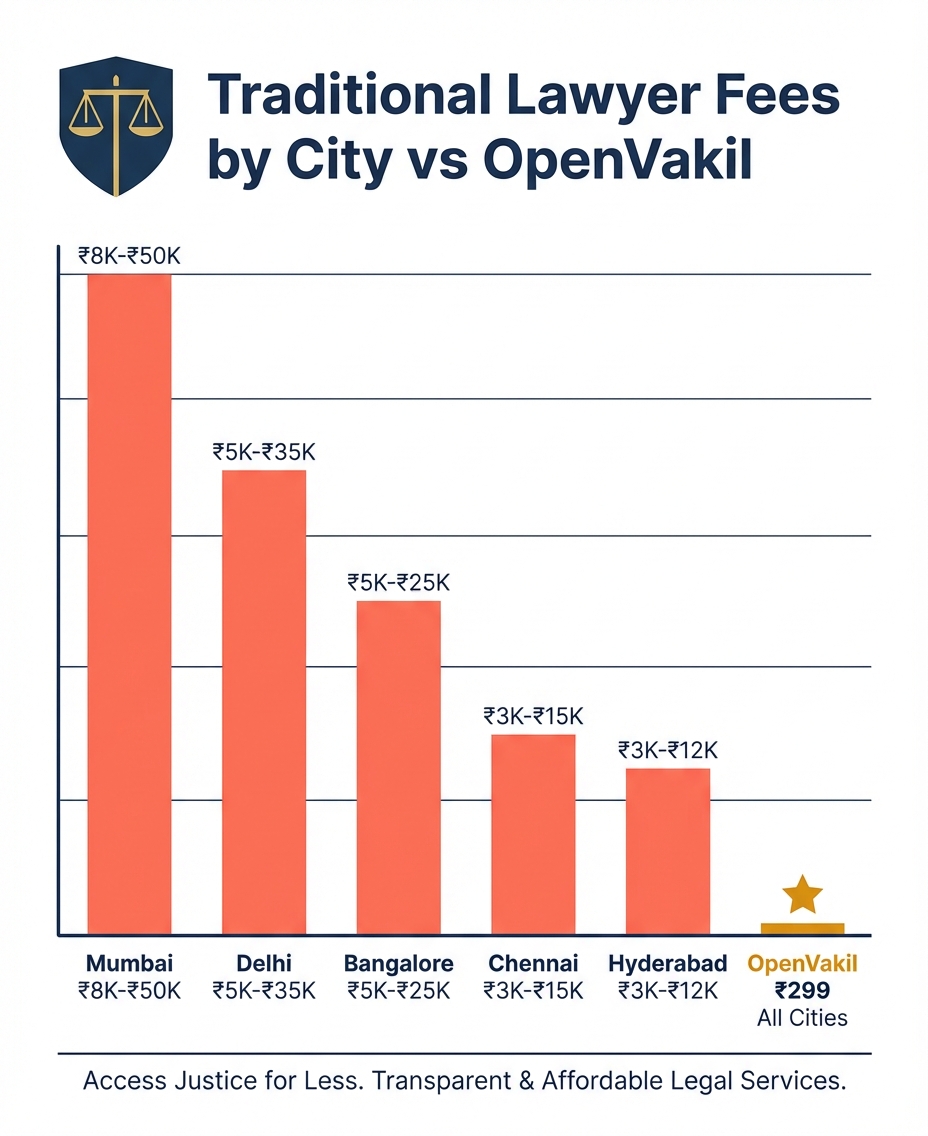
- Mumbai: Traditional lawyer fee: Rs. 5,000 to Rs. 25,000 | OpenVakil: Rs. 299 to Rs. 4,999 | Savings: Up to 94%. Mumbai's extremely high traditional lawyer fees make online legal notices particularly attractive. You can avoid paying the Nariman Point or BKC premium while getting the same legal quality.
- Delhi NCR: Traditional lawyer fee: Rs. 3,000 to Rs. 20,000 | OpenVakil: Rs. 299 to Rs. 4,999 | Savings: Up to 90%. The added complexity of NCR's multi-state jurisdiction makes OpenVakil's automated jurisdiction detection especially valuable for Delhi NCR users.
- Bangalore: Traditional lawyer fee: Rs. 3,000 to Rs. 15,000 | OpenVakil: Rs. 299 to Rs. 4,999 | Savings: Up to 90%. Bangalore's tech-savvy population is the most receptive to online legal notice services, and the time savings (no office visits) are especially valued by IT professionals.
- Chennai: Traditional lawyer fee: Rs. 2,000 to Rs. 12,000 | OpenVakil: Rs. 299 to Rs. 4,999 | Savings: Up to 85%. Chennai users benefit from OpenVakil's ability to handle bilingual notices (English and Tamil) seamlessly.
- Hyderabad: Traditional lawyer fee: Rs. 2,000 to Rs. 10,000 | OpenVakil: Rs. 299 to Rs. 4,999 | Savings: Up to 85%. Even in Hyderabad, where traditional fees are the lowest, OpenVakil offers significant savings and unmatched convenience.
The geographic disparity in legal notice costs across Indian cities is not justified by differences in legal complexity. A cheque bounce notice under Section 138 NI Act requires the same legal content whether drafted in Mumbai or Hyderabad. Online platforms eliminate this geographic pricing arbitrage entirely.
— Indian Legal Tech Association, 2024
Beyond cost, the online vs traditional comparison across all five cities reveals consistent advantages of the online approach:
- Time savings: Across all five cities, a traditional lawyer engagement requires at least 2-3 in-person visits (initial consultation, draft review, final sign-off). In traffic-congested cities like Mumbai, Delhi, and Bangalore, each visit can consume half a day. OpenVakil eliminates all physical visits -- the entire process is completed online.
- Availability: Traditional lawyers work court hours (typically 10 AM to 5 PM, Monday to Saturday). OpenVakil's platform is available 24/7 -- you can start your legal notice at midnight on a Sunday if that is when you have the time.
- Consistency: With traditional lawyers, the quality of your legal notice depends entirely on the individual advocate you hire. With OpenVakil, every notice benefits from AI-powered drafting that incorporates the correct legal provisions based on thousands of previously reviewed notices, supplemented by qualified advocate review.
- Record-keeping: OpenVakil maintains a complete digital record of your notice, dispatch details, tracking information, and delivery confirmation -- accessible anytime from your dashboard. With traditional lawyers, you rely on paper files and your own record-keeping.
- Cross-city disputes: If you live in Bangalore but need to send a notice to someone in Mumbai, a traditional approach would require you to either find a Mumbai lawyer or rely on your Bangalore lawyer who may not be familiar with Maharashtra-specific laws. OpenVakil handles cross-city disputes seamlessly, applying the correct state-specific laws regardless of where you or the recipient are located.
Same Quality, Any City, Fraction of the Cost
Whether you are in Mumbai, Delhi, Bangalore, Chennai, or Hyderabad, OpenVakil delivers professionally drafted legal notices with the correct state-specific laws and jurisdiction references. Start your legal notice online and save up to 94% compared to traditional lawyers.
Draft Your Legal NoticeHow OpenVakil Works Across All Cities
OpenVakil is India's AI-powered legal notice platform that serves individuals and businesses across all five major cities -- Mumbai, Delhi NCR, Bangalore, Chennai, and Hyderabad -- as well as every other district in India. Here is how our platform handles the city-specific complexities discussed in this guide:
- Intelligent jurisdiction detection: When you submit your dispute details on OpenVakil, our AI automatically identifies the correct territorial jurisdiction based on where the cause of action arose, where the parties reside, and the nature of the dispute. For Delhi NCR disputes, the system correctly distinguishes between Delhi, Noida (UP), and Gurgaon (Haryana) jurisdictions.
- State-specific law selection: Our AI drafting engine is trained on the legislation of all Indian states. When drafting a tenant eviction notice for a Mumbai property, it automatically cites the Maharashtra Rent Control Act, 1999. For a Chennai property, it cites the Tamil Nadu Buildings (Lease and Rent Control) Act, 1960. For Hyderabad, it cites the Telangana Buildings Control Act. You do not need to know which law applies -- our system handles it.
- Correct court references: The legal notice generated by OpenVakil references the specific court where proceedings would be filed if the dispute is not resolved. Whether it is the Bombay High Court for a high-value Mumbai dispute, the Karkardooma Courts for an East Delhi matter, or the Ranga Reddy District Court for a Hyderabad ORR property dispute, the notice names the correct forum.
- Standardised pricing across all cities: Unlike traditional lawyers whose fees vary by up to 300% across cities, OpenVakil offers the same pricing whether you are in Mumbai or Hyderabad. Our AI-drafted notices start from Rs. 299, and notices with full lawyer review are available from Rs. 999 to Rs. 4,999 depending on complexity -- the same price regardless of your city.
- Pan-India dispatch: OpenVakil dispatches legal notices via registered post with acknowledgement due to any address in India. Whether the recipient is in Churchgate, Mumbai, or Gachibowli, Hyderabad, we handle the dispatch and provide you with tracking details and delivery confirmation.
- Empanelled advocates across cities: Our panel includes qualified advocates familiar with the laws and courts of Maharashtra, Delhi, Karnataka, Tamil Nadu, Telangana, and every other state. When you opt for lawyer review, your notice is reviewed by an advocate with relevant expertise in the applicable state's legal framework.
- Language support: For Chennai and other cities where bilingual notices may be needed, OpenVakil can arrange for translation of the legal notice into the relevant regional language (Tamil, Telugu, Hindi, Marathi, Kannada, etc.).
The result is a legal notice that is locally accurate but nationally accessible. You get the benefit of city-specific legal expertise without the constraints of geographic proximity, office visits, or location-based pricing premiums.
In today's digital India, there is no reason why accessing quality legal services should require you to physically visit a lawyer's office. A well-drafted legal notice requires legal expertise, not physical proximity. Online platforms are democratising access to justice across all Indian cities.
— Indian Legal Technology Review, 2024
Whether you are a homebuyer in Mumbai fighting a builder's delay, a startup founder in Bangalore dealing with a co-founder dispute, an IT professional in Hyderabad facing wrongful termination, a small business owner in Delhi chasing a bounced cheque, or a tenant in Chennai facing illegal eviction -- OpenVakil is your legal notice service across all Indian cities. Our platform combines the power of artificial intelligence with the expertise of qualified advocates to deliver legal notices that are legally sound, properly dispatched, and competitively priced.
Ready to Send Your Legal Notice?
Join thousands of Indians in Mumbai, Delhi, Bangalore, Chennai, and Hyderabad who have protected their legal rights through OpenVakil. Our AI-powered platform drafts your notice in minutes, an experienced advocate reviews it, and we handle dispatch via registered post -- all from the comfort of your home.
Start Your Legal Notice NowNo matter which city you are in, the process of protecting your legal rights starts with a single step: a properly drafted legal notice. With OpenVakil, that step is faster, more affordable, and more accessible than ever before. Stop searching for a legal notice lawyer near me and start your notice online today.