A legal notice is the most important pre-litigation tool in Indian law. Whether you are dealing with a cheque bounce, money recovery, property dispute, consumer complaint, employment issue, or any other legal matter, a properly formatted legal notice is often the first step toward resolving the dispute — and sometimes the only step needed. The format and structure of your legal notice can determine whether it is taken seriously, whether it holds up in court, and whether it achieves its intended purpose.
This guide provides comprehensive legal notice formats, samples, and templates for the most common legal situations in India. Whether you are a lawyer seeking a reference format, an individual drafting a notice for the first time, or a business protecting its interests, this guide covers everything you need to create a legally sound notice.
What Is a Legal Notice Format?
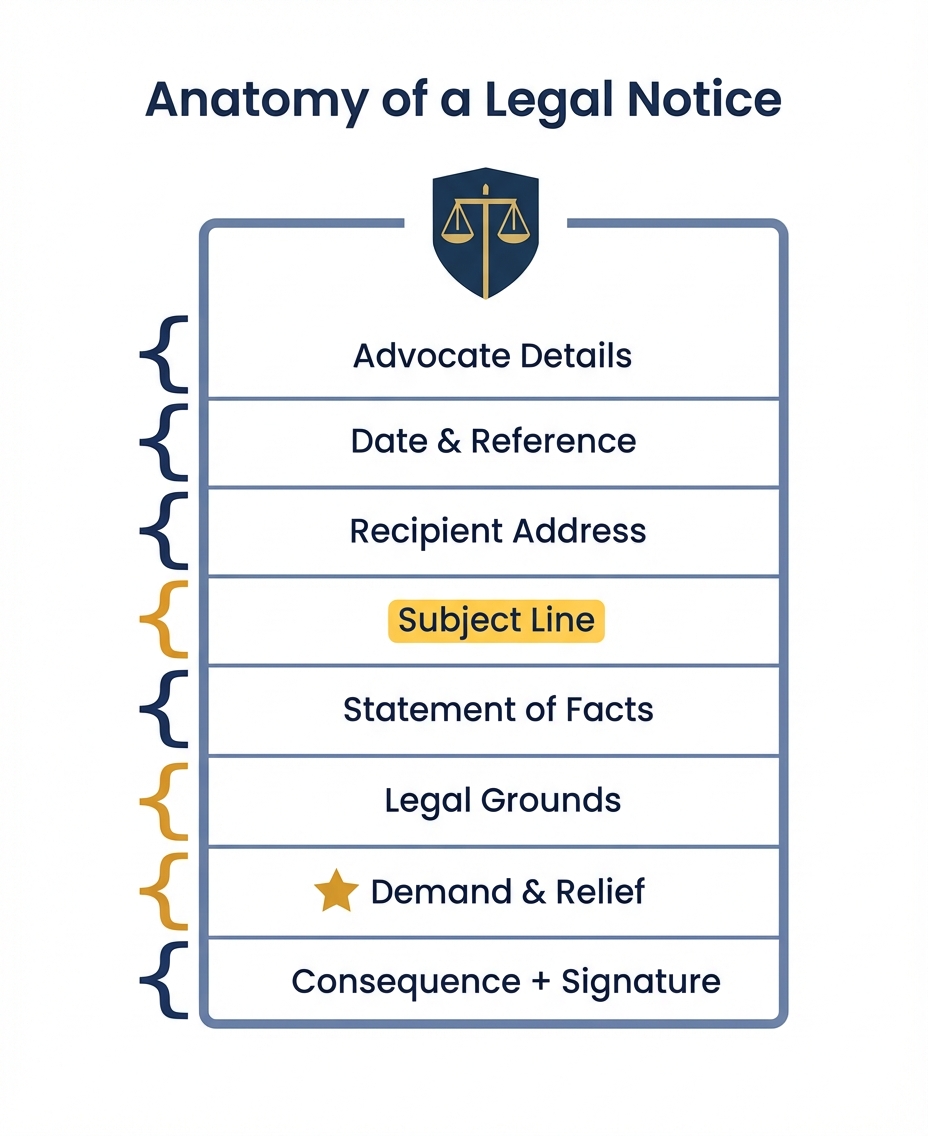
A legal notice format is the standard structure and layout followed when drafting a legal notice under Indian law. While there is no single prescribed statutory format for legal notices (except in specific cases like Section 80 CPC notices to government), legal practice has established a widely accepted structure that courts recognise and expect. A properly formatted notice includes the advocate's details, the sender and recipient's information, a clear statement of facts, the legal basis for the claim, the specific demand, and the consequences of non-compliance.
Think of the format as a framework that ensures your notice is comprehensive, organised, and legally effective. The actual content — the facts, the law, and the demand — must be customised to your specific situation.
Is There a Single Official Legal Notice Format?
No. Indian law does not prescribe a universal format for legal notices (unlike court filings, which have specific rules). However, legal practice has developed a standard structure that is universally accepted. Deviating significantly from this structure can make your notice appear unprofessional and may reduce its effectiveness. The format described in this guide follows the conventions used by advocates across India.
Why the Format of a Legal Notice Matters
- Professional credibility: A well-formatted notice on an advocate's letterhead with proper structure conveys seriousness and professionalism. It tells the recipient that you have engaged legal counsel and are prepared to take formal action.
- Legal effectiveness: Courts examine legal notices as evidence. A notice that follows the standard format, clearly states the facts and law, and includes all required elements is far more persuasive than an informal letter or email.
- Completeness: The standard format ensures you do not miss critical elements — advocate details, specific dates, statutory references, clear demands, and response deadlines — any of which, if omitted, could weaken your legal position.
- Compliance with statutory requirements: Certain types of notices (e.g., Section 138 NI Act cheque bounce notices, Section 80 CPC notices to government) have specific content requirements. Using the proper format ensures compliance.
- Record for the court: The notice becomes part of the documentary evidence if the matter proceeds to litigation. A professionally formatted notice creates a favourable impression before the judge.
Standard Legal Notice Structure
Every legal notice, regardless of the subject matter, follows a standard structure with the following components:
Header and Advocate Details
The notice begins with the advocate's letterhead or header, which includes the advocate's full name, designation, enrolment number (e.g., "Advocate, Bar Council of Delhi, Enrolment No. D/1234/2020"), office address, phone number, and email address. If the notice is sent by a law firm, the firm's name and all relevant advocate details should appear. The letterhead establishes the professional authority of the notice.
Notice Reference and Date
Below the header, include a reference number (e.g., "Ref: LN/2025/0142") for filing and tracking purposes, the date of the notice, and the mode of dispatch (e.g., "By Registered Post A.D. / Speed Post / Hand Delivery"). The date is critical as it establishes the starting point for any response deadlines.
Addressee (Recipient) Details
The notice is addressed to the recipient with their full legal name and complete address. If the recipient is a company, include the company name, registered office address, and the name and designation of the relevant officer (e.g., Managing Director). If there are multiple recipients, address each separately.
Subject Line
A clear, concise subject line that identifies the nature of the notice. For example: "Subject: Legal Notice for Recovery of Outstanding Amount of Rs. 5,00,000/-" or "Subject: Legal Notice Under Section 138 of the Negotiable Instruments Act, 1881." The subject line allows the recipient to immediately understand the nature of the communication.
Body of the Notice
The body is the most substantive part and follows this structure:
- Opening paragraph: State that you are writing on behalf of your client (the sender), identify the client, and reference the relationship or transaction between the parties.
- Statement of facts: Present a chronological, detailed account of the relevant facts — dates, events, agreements, communications, breaches, and losses. Be specific, factual, and include references to supporting documents.
- Legal basis: Cite the specific laws, sections, and provisions that apply to the dispute. Reference relevant case law or legal principles if they strengthen your position.
- Grievance: Clearly state how the recipient's actions (or inactions) have caused harm, loss, or violated the sender's rights.
Demand and Relief Sought
After the body, clearly articulate the specific demand: payment of a specified amount, performance of a specific action, cessation of a specific activity, return of property, or any other relief sought. Be precise about the amount (in figures and words), the action required, and the deadline for compliance (e.g., "within 15 days from the receipt of this notice").
Consequences of Non-Compliance
State the legal consequences that will follow if the recipient fails to comply with the demand. This typically includes filing a civil suit, criminal complaint, or proceedings before the appropriate court or forum. Use language such as: "In the event of your failure to comply with the above demand within the stipulated period, my client shall be constrained to initiate appropriate legal proceedings, civil and/or criminal, at your risk, cost, and consequences."
Closing and Signature
Close the notice with a formal closing line, the advocate's signature, name, enrolment number, and a note that a copy of the notice has been retained for the client's records. If the notice is sent to multiple parties, indicate that copies have been sent to all addressees.
General Legal Notice: Sample Format
Below is a sample format showing the standard structure of a legal notice. The specific content must be customised to your situation:
Sample Legal Notice Structure
[ADVOCATE'S LETTERHEAD] Ref: LN/2025/XXXX | Date: [Date] By Registered Post A.D. To, [Full Name & Address of Recipient] Subject: Legal Notice for [Nature of Claim] Dear Sir/Madam, Under instructions from and on behalf of my client, [Client Name], residing at [Address], I do hereby serve upon you the following legal notice: 1. That my client and you entered into [describe the relationship/transaction]... 2. That you have [describe the breach/wrong/grievance]... 3. That despite repeated requests, you have failed to [describe the failure]... 4. That by your aforesaid acts, you have violated [cite legal provisions]... I, therefore, on behalf of my client, call upon you to [specific demand] within [15/30] days from the receipt of this notice, failing which my client shall be constrained to initiate appropriate civil and/or criminal proceedings against you at your risk, cost, and consequences. A copy of this notice has been retained for record and further use. [Advocate's Signature] [Name, Enrolment No.] [Address]
Do Not Use Templates Without Customisation
A template is a starting point, not a finished product. Sending a generic, unmodified template as your legal notice is worse than not sending one at all. Every legal notice must be customised to your specific facts, the applicable law, and the relief you seek. Generic notices are easily challenged and can reflect poorly on your case.
Skip the Template — Get a Custom Legal Notice
Why struggle with templates when OpenVakil can draft a comprehensive, personalised legal notice for your specific situation in minutes? Answer a few questions, and get a professionally drafted notice ready to send.
Draft Your Notice NowLegal Notice Format for Specific Situations
While the overall structure remains the same, the content, legal references, and demands vary significantly depending on the type of dispute. Here are the key variations for the most common types of legal notices:
Money Recovery Notice Format
A legal notice for money recovery must include: the exact amount owed (in figures and words), the basis of the debt (loan agreement, invoice, contract, oral promise), the date(s) when the amount was due, any partial payments received, the total outstanding balance with interest (if contractually agreed), and a demand for payment within a specified period. Reference the Indian Contract Act, 1872 (Sections 73-74 for damages) and the applicable limitation period under the Limitation Act, 1963.
Cheque Bounce Notice Format (Section 138)
The cheque bounce notice has strict legal requirements under Section 138 of the Negotiable Instruments Act. It must include: cheque number, date, amount, bank name, and branch; the date of presentation and dishonour; the reason for dishonour as stated in the return memo; the underlying debt or liability for which the cheque was issued; and a demand for payment of the cheque amount only (not interest or damages) within 15 days. The notice must be sent within 30 days of receiving the return memo.
Property Dispute Notice Format
A property dispute notice should include: complete property details (survey number, plot number, address, area, registration details), the basis of your claim (sale deed, title deed, will, inheritance, adverse possession), the nature of the dispute (encroachment, illegal construction, boundary dispute, possession dispute), and the specific relief sought (vacation, demolition, restoration of possession). Reference the Transfer of Property Act, 1882, Registration Act, 1908, and relevant state-specific property laws.
Consumer Complaint Notice Format
A consumer complaint notice should reference the Consumer Protection Act, 2019 and include: details of the product or service purchased, the defect or deficiency in service, the invoice/receipt details, any prior complaints made, the specific relief sought (refund, replacement, repair, compensation), and a warning that a complaint will be filed before the Consumer Disputes Redressal Commission if the matter is not resolved.
Employment Dispute Notice Format
An employment dispute notice (for wrongful termination, unpaid salary, or workplace issues) should include: employment details (designation, date of joining, terms of employment), the specific grievance (termination without notice, unpaid wages, harassment), reference to applicable labour laws (Industrial Disputes Act, Payment of Wages Act, Shops and Establishments Act), and the specific demand (reinstatement, salary payment, compensation, experience letter). If the employee is a "workman" under the Industrial Disputes Act, the notice requirements are more specific.
How to Customise a Template for Your Case
If you are starting with a template, follow these steps to customise it for your specific situation:
- Replace all placeholder text: Every bracket, blank, or placeholder in the template must be replaced with your actual facts. Do not leave any generic text in the final notice.
- Add your specific facts: The template provides a structure, but the facts of your case are unique. Write a detailed, chronological narrative of what happened, including specific dates, amounts, and events.
- Verify the legal provisions: Ensure that the sections and acts cited in the template apply to your specific situation. Laws change, and the wrong citation can undermine your notice.
- Tailor the demand: Make your demand specific — exact amounts, exact actions, exact deadlines. A vague demand weakens the notice.
- Adjust the tone: The tone should be firm and professional but appropriate to the relationship. A notice to a long-standing business partner differs in tone from a notice to a fraudster.
- Have it reviewed by a lawyer: Even a customised template should be reviewed by a qualified advocate before dispatch. A lawyer can identify gaps, potential issues, and strategic improvements that a template cannot provide.
Legal Requirements for a Valid Notice
While there is no universal statutory format, a legal notice must meet certain requirements to be considered valid and effective:
- Sent through an advocate: While not strictly mandatory in all cases, notices sent through a licensed advocate carry significantly more weight. In practice, courts expect legal notices to be drafted and dispatched by advocates.
- Proper service: The notice must be served on the recipient via a legally recognised mode — Registered Post with Acknowledgement Due (RPAD) is the gold standard. Speed post, reputed courier, and hand delivery with signed acknowledgement are also acceptable.
- Correct address: The notice must be sent to the recipient's correct address. If the address is wrong and the notice is returned undelivered, it may not be considered served.
- Clear identification of parties: Both the sender and recipient must be clearly identified with full legal names and addresses.
- Specific facts and law: The notice must state the facts giving rise to the claim and the legal basis for the demand. A notice without factual or legal basis can be challenged.
- Clear demand with deadline: The specific relief sought and the time period for compliance must be clearly stated.
- Statutory compliance (where applicable): For Section 138 NI Act notices, the notice must be sent within 30 days. For Section 80 CPC notices, specific content requirements apply. Ensure compliance with any statutory requirements.
How to Send a Legal Notice
- Print the notice on the advocate's letterhead: Use quality paper and ensure the letterhead is professional and complete.
- Sign the notice: The advocate must sign the notice. In some cases, the client also signs below the advocate's signature.
- Make copies: Prepare at least 3 copies — one for the recipient, one for your records, and one for the court file.
- Dispatch via Registered Post with AD: Take the notice to the post office and send it via Registered Post with Acknowledgement Due. Retain the postal receipt.
- Send additional copies via speed post or courier (optional): For faster delivery, send a copy via speed post or reputed courier. This supplements but does not replace the RPAD.
- Email a copy (optional): Send a scanned copy via email to the recipient for immediate awareness. This is supplementary — not a substitute for physical service.
- Record and preserve: File the postal receipt, courier tracking details, email sent confirmation, and the AD card (when returned) in a safe place. These documents prove service and are essential if the matter goes to court.
Common Mistakes in Legal Notice Format
- Using a template without customisation: Sending a generic template with blanks unfilled or placeholder text remaining is unprofessional and legally ineffective.
- Missing the advocate's details: A notice without an advocate's name, enrolment number, and signature may not be taken seriously and lacks professional authority.
- Vague or general allegations: Statements like "you have caused me loss" without specific facts, dates, and amounts are ineffective. Be specific and detailed.
- Citing incorrect legal provisions: Referencing the wrong section or act undermines the legal basis of your notice. Verify all citations before dispatch.
- No clear demand: A notice that describes the problem but does not state what you want the recipient to do is incomplete. Always include a specific, actionable demand.
- No deadline for response: Failing to specify a time period for compliance leaves the demand open-ended and weakens your ability to take follow-up legal action.
- Inflammatory language: Using abusive, threatening, or defamatory language in a legal notice can expose you to counter-claims and reflects poorly before the court.
- Not sending via proper channels: Sending the notice only via WhatsApp or email (without physical copy via RPAD) may not constitute valid service.
- Factual errors: Incorrect dates, amounts, names, or addresses can be exploited by the recipient to challenge the validity of the notice.
- Not retaining proof of dispatch: Without postal receipts and AD cards, you cannot prove that the notice was sent and delivered, which is critical if the matter goes to court.
Template vs Professional Drafting: Which Should You Choose?
The choice between using a template and getting a professionally drafted notice depends on the complexity and stakes of your case:
- Templates are suitable when: The dispute is straightforward with clear facts, the amount involved is relatively small, you are familiar with the legal issues, and you have access to a lawyer who can review the customised template before dispatch.
- Professional drafting is essential when: The dispute involves complex facts or multiple legal issues, significant money or property is at stake, the matter is likely to proceed to litigation, criminal law provisions are involved, the recipient is a large company or government body, or there are time-sensitive statutory requirements (like Section 138 NI Act deadlines).
In most cases, the safest approach is to start with a professionally drafted notice rather than a template. The cost difference is minimal compared to the potential consequences of a poorly drafted notice that fails to protect your legal rights.
How OpenVakil Helps
OpenVakil bridges the gap between generic templates and expensive legal consultations. It combines the convenience and speed of a template with the quality and customisation of professional drafting.
- AI-powered custom drafting: Instead of filling in a template, answer a few questions about your situation. OpenVakil's AI generates a comprehensive, fully customised legal notice tailored to your specific facts, the applicable law, and the relief you seek.
- Correct format every time: Every notice follows the standard legal notice format accepted by courts across India — proper header, structured body, precise legal references, clear demands, and professional language.
- All types of notices covered: Whether you need a money recovery notice, cheque bounce notice, consumer complaint, property dispute, employment matter, or any other type of legal notice, OpenVakil drafts it with the correct format and legal provisions.
- No legal knowledge required: You do not need to know which sections or acts apply to your situation. OpenVakil identifies the relevant legal provisions based on your answers and incorporates them automatically.
- Ready to review and send: The draft is ready for your advocate to review, sign, and dispatch. No more struggling with templates or second-guessing your format.
- Minutes, not days: Get your draft notice in minutes at a fraction of the cost of a traditional legal consultation.
Stop searching for templates that may be outdated, incomplete, or inapplicable to your situation. Get a professionally drafted, fully customised legal notice that follows the correct format and is tailored to your case.
Get Your Custom Legal Notice Now
Why use a generic template when you can get a professionally drafted legal notice in minutes? Answer a few questions about your situation and receive a comprehensive, court-ready notice tailored specifically to your case.
Draft Your Legal Notice