The Right to Information Act, 2005 is one of the most powerful tools available to Indian citizens for demanding transparency and accountability from public authorities. Every year, millions of RTI applications are filed seeking information from government departments, public sector undertakings, and statutory bodies. Yet, a disturbingly large number of these applications are met with silence, evasive replies, or outright refusal — in direct violation of the law. If you have filed an RTI application and the Public Information Officer (PIO) has failed to respond within the statutory time limit, provided an incomplete response, demanded excessive fees, or wrongfully denied information under the guise of exemptions, you have clear legal remedies available to you.
This comprehensive guide explains your rights under the RTI Act 2005, the statutory deadlines that public authorities must follow, the appeal and complaint mechanisms available to you, the penalty provisions that can be imposed on non-compliant officers, and how to draft an effective legal notice that compels action. Whether you are a citizen seeking basic government records, an activist pursuing systemic transparency, or a journalist investigating public interest matters, understanding the enforcement provisions of the RTI Act is essential to making this landmark legislation work for you.
What Is RTI and Your Right to Information?
The Right to Information Act, 2005 (RTI Act) was enacted by the Indian Parliament to provide a practical framework for citizens to exercise their fundamental right to access information held by public authorities. The Act came into force on 12 October 2005 and applies to all public authorities across India — including Central Government ministries, State Government departments, local bodies, public sector undertakings, and any body or institution that is substantially financed or controlled by the government. Under Section 3 of the Act, all citizens of India have the right to information, subject only to the specific exemptions enumerated in Sections 8 and 9.
The term "information" is defined broadly under Section 2(f) of the Act to include any material in any form — records, documents, memos, emails, opinions, advices, press releases, circulars, orders, logbooks, contracts, reports, papers, samples, models, and data material held in electronic form. The right extends not just to inspection of documents but also to obtaining certified copies, taking notes, and obtaining information in electronic form including data stored in computers, CDs, floppies, or any other electronic device.
Constitutional Foundation: Article 19(1)(a)
The right to information is rooted in the fundamental right to freedom of speech and expression guaranteed under Article 19(1)(a) of the Constitution of India. The Supreme Court of India has consistently held that the right to know is an integral part of the right to freedom of speech and expression. In the landmark case of S.P. Gupta v. Union of India (1982), the Supreme Court declared that the right to know is a necessary ingredient of participatory democracy and that citizens have a right to receive information about the functioning of the government.
The concept of an open Government is the direct emanation from the right to know which seems to be implicit in the right of free speech and expression guaranteed under Article 19(1)(a). Therefore, disclosure of information in regard to the functioning of the Government must be the rule, and secrecy an exception.
— S.P. Gupta v. Union of India, AIR 1982 SC 149
This constitutional foundation means that when a public authority refuses to provide information or fails to respond to an RTI application, it is not merely violating a statutory provision — it is infringing upon your fundamental right as a citizen. This elevated status of the right to information strengthens your position when filing appeals, complaints, or legal notices against non-compliant authorities.
Key Provisions of the RTI Act 2005
- Section 3: All citizens have the right to information, subject to the provisions of the Act.
- Section 4: Every public authority is obligated to proactively disclose information, maintain records, publish them through various means, and disseminate information widely.
- Section 5: Every public authority must designate Central Public Information Officers (CPIOs) and State Public Information Officers (SPIOs), as well as Assistant PIOs, within 100 days of the enactment of the Act.
- Section 6: Provides the process for making an RTI application — it can be in English, Hindi, or the official language of the area, and must be accompanied by the prescribed fee.
- Section 7: Mandates the time limits for disposal of RTI requests — 30 days from receipt as a general rule, and 48 hours where the information sought concerns the life or liberty of a person.
- Section 8: Lists the specific categories of information that are exempt from disclosure, including information affecting sovereignty, security, or strategic interests of India, information received in confidence from foreign governments, and information that would constitute an invasion of privacy.
- Section 18: Empowers the Information Commission to receive and inquire into complaints from persons who have been refused information or who have not received a response.
- Section 19: Establishes the two-tier appeal mechanism — first appeal to the senior officer within the public authority, and second appeal to the Information Commission.
- Section 20: Provides for penalties against PIOs who fail to comply with the Act, including a penalty of Rs. 250 per day of delay, up to a maximum of Rs. 25,000.
Who Qualifies as a "Public Authority"?
Under Section 2(h) of the RTI Act, a "public authority" includes any authority or body established by or under the Constitution, by any law made by Parliament or State Legislature, by notification or order of the Government, and any body owned, controlled, or substantially financed by the Government. This covers an extremely wide range of institutions — from Central ministries and State departments to gram panchayats, public sector banks, government-aided educational institutions, and even some private bodies that receive substantial government funding.
When to Send a Legal Notice for RTI Non-Response
While the RTI Act itself provides a robust appeal and complaint mechanism (discussed in detail below), there are situations where sending a formal legal notice to the public authority or the concerned PIO becomes necessary and strategically advantageous. A legal notice serves as a formal demand for compliance, puts the officer on personal notice regarding potential penalties, and creates a documented trail of your efforts to obtain information. You should consider sending a legal notice in the following situations:
No Response Within Statutory Time Limit
Under Section 7(1) of the RTI Act, the PIO is required to provide the information (or reject the request with reasons) within 30 days of receipt of the application. If the application was submitted to an Assistant PIO or was transferred from one public authority to another under Section 6(3), the 30-day period begins from the date the application is received by the concerned PIO. If the 30-day period has expired and you have received no response whatsoever, the PIO has committed a deemed refusal under Section 7(2), and you are entitled to file a first appeal and/or send a legal notice. In cases involving life or liberty, the PIO must respond within 48 hours — failure to do so is an even more serious violation.
Incomplete or Evasive Response
A common tactic employed by public authorities is to provide a partial, vague, or evasive response that does not actually answer the specific questions raised in the RTI application. For instance, the PIO may provide generic information that is already in the public domain, refer you to a website without specifying the exact link or document, provide information for only some of the queries while ignoring others, or give a response that is technically responsive but substantively meaningless. Such responses are treated as non-compliance with the Act, and you have the right to file an appeal and send a legal notice demanding complete and specific answers.
Excessive Fees Demanded
Under Section 7(5), the PIO may require the applicant to pay additional fees for providing the information, particularly when the request involves a large volume of documents. However, the fee structure is prescribed by the government and is typically nominal — Rs. 2 per page for photocopies at the Central level. Some PIOs demand exorbitant fees that are not in accordance with the prescribed rates, effectively using the fee mechanism to discourage applicants from pursuing their requests. If you believe the fees demanded are excessive or not in accordance with the prescribed rates, you have the right to challenge this through an appeal and a legal notice.
Wrongful Denial Under Section 8
Section 8 of the RTI Act lists ten categories of information that are exempt from disclosure. These include information that would prejudicially affect the sovereignty, integrity, or security of India; information received in confidence from foreign governments; information that would endanger the life or safety of any person; cabinet papers; trade secrets and intellectual property; information received in a fiduciary relationship; information that would impede investigation or prosecution; and information that constitutes an invasion of privacy. However, these exemptions are frequently misused by PIOs to deny information that should legitimately be disclosed. Common instances of wrongful denial include invoking Section 8(1)(j) (privacy) to refuse disclosure of public servants' official decisions, citing Section 8(1)(d) (trade secrets) for government contracts, or claiming Section 8(1)(e) (fiduciary relationship) for routine inter-departmental correspondence.
It is crucial to note that even the exemptions under Section 8 are not absolute. Section 8(2) provides that information which cannot be denied to Parliament or a State Legislature shall not be denied to any person. Furthermore, Section 8(3) states that information relating to any occurrence, event, or matter that has taken place more than twenty years before the date of the request shall be provided, notwithstanding the exemptions. Additionally, the public interest override applies — if the public interest in disclosure outweighs the harm to the protected interests, the information must be disclosed.
Deemed Refusal Under Section 7(2)
If the PIO fails to respond to your RTI application within the prescribed time limit (30 days, or 48 hours for life/liberty matters), the request is deemed to have been refused. This deemed refusal triggers your right to file a first appeal under Section 19(1). Do not wait indefinitely for a response — the first appeal must be filed within 30 days of the expiry of the response deadline, though the Appellate Authority may condone delay if sufficient cause is shown.
Legal Framework for RTI Enforcement
The RTI Act 2005 provides a comprehensive legal framework for enforcement when public authorities fail to comply with their obligations. Understanding the relevant provisions in detail is essential for drafting an effective legal notice and pursuing your remedies.
Section 6: The Application Process
Section 6 sets out the procedure for making an RTI request. The application must be made in writing or through electronic means, accompanied by the prescribed fee. Importantly, the applicant is not required to give any reason for seeking the information or any other personal details except those necessary for contacting the applicant. Under Section 6(3), if the application is made to a public authority that does not hold the information, the authority is required to transfer the application to the correct public authority within five days and inform the applicant about the transfer. This transfer obligation is mandatory and failure to comply constitutes a violation of the Act.
Section 7: Disposal of Request and Time Limits
Section 7 is the core provision governing the time limits for responding to RTI applications. Under Section 7(1), the PIO must provide the information or reject the request (with reasons) within 30 days of receipt. Under Section 7(6), where the information sought concerns the life or liberty of a person, the response must be provided within 48 hours. If the request is rejected, the PIO must communicate the reasons for rejection, the period within which an appeal can be filed, and the particulars of the Appellate Authority under Section 7(8). A rejection without reasons is itself a violation of the Act. Under Section 7(3), the PIO may charge additional fees (beyond the application fee) for providing the information, but the fee must be reasonable and in accordance with the prescribed rates.
Section 8: Exemptions from Disclosure
Section 8(1) enumerates ten specific categories of information that a public authority is not obligated to disclose. These exemptions must be narrowly construed and cannot be used as a blanket shield to deny all information. The ten exemptions cover:
- Section 8(1)(a): Information that would prejudicially affect the sovereignty and integrity of India, the security, strategic, scientific, or economic interests of the State, or relations with a foreign State, or lead to incitement of an offence.
- Section 8(1)(b): Information that has been expressly forbidden to be published by any court of law or tribunal.
- Section 8(1)(c): Information that would cause a breach of privilege of Parliament or State Legislature.
- Section 8(1)(d): Information including commercial confidence, trade secrets, or intellectual property whose disclosure would harm the competitive position of a third party.
- Section 8(1)(e): Information available to a person in their fiduciary relationship.
- Section 8(1)(f): Information received in confidence from a foreign Government.
- Section 8(1)(g): Information that would endanger the life or physical safety of any person.
- Section 8(1)(h): Information that would impede the process of investigation or apprehension or prosecution of offenders.
- Section 8(1)(i): Cabinet papers including records of deliberations of the Council of Ministers, Secretaries, and other officers.
- Section 8(1)(j): Information that relates to personal information the disclosure of which has no relationship to any public activity or interest, or which would cause unwarranted invasion of the privacy of the individual.
The Supreme Court has clarified that these exemptions are not self-operating — the PIO must demonstrate how the specific information sought falls within the exemption and why disclosure would cause the harm envisaged by the exemption. A vague or general invocation of Section 8 without specific reasoning is a violation of the Act.
Time Limits and Deadlines Under the RTI Act
The RTI Act prescribes strict time limits at every stage. Knowing these deadlines is critical for enforcing your rights and drafting an effective legal notice:
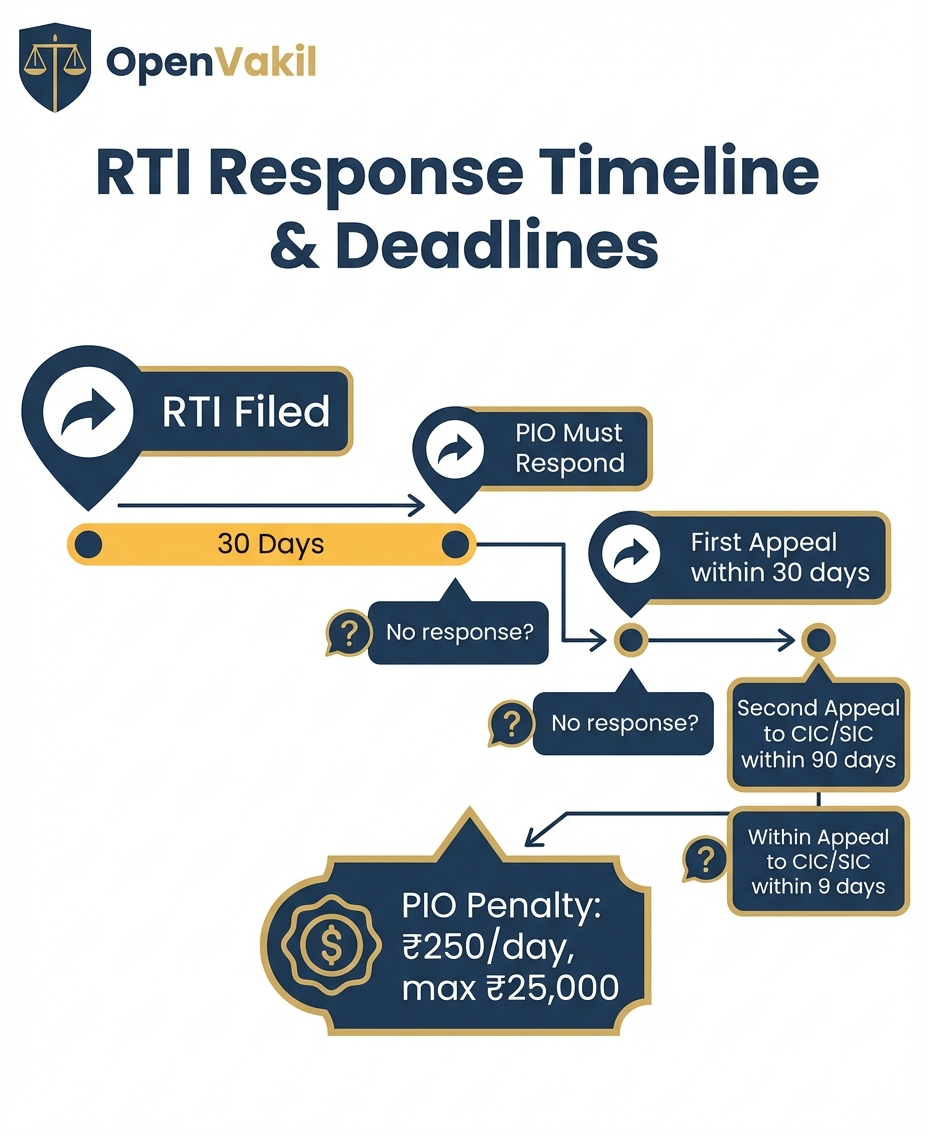
- PIO response time: 30 days from receipt of the application (Section 7(1)). If the application was transferred under Section 6(3), the 30-day period runs from the date of receipt by the transferred PIO.
- Life or liberty matters: 48 hours from receipt of the application (Section 7(6)). This accelerated timeline applies when the information concerns the life or liberty of a person.
- Transfer to correct authority: 5 days from receipt of the application if the PIO does not hold the information (Section 6(3)).
- First appeal deadline: Within 30 days from the date of the response, or within 30 days from the expiry of the 30-day response period if no response was received (Section 19(1)). The Appellate Authority may condone a delay of up to an additional 30 days if the appellant shows sufficient cause.
- First appeal disposal: The Appellate Authority must dispose of the first appeal within 30 days, extendable by a further 15 days with recorded reasons (Section 19(6)).
- Second appeal deadline: Within 90 days from the date of the first appeal decision, or within 90 days from when the decision should have been made (Section 19(3)).
- Complaint to Information Commission: No specific time limit is prescribed for complaints under Section 18, but it is advisable to file promptly.
Maintain a Timeline Record
From the moment you file your RTI application, maintain a detailed chronological record of every date — the date of filing, the date of receipt by the PIO (as shown on the postal receipt or online acknowledgement), the date the 30-day period expires, the date of any response received, and the dates of your appeals. This timeline is critical evidence when filing appeals, complaints, or legal notices, and is essential for calculating penalties under Section 20.
First Appeal Under Section 19(1)
The first appeal is the primary remedy available when the PIO fails to respond, provides an incomplete response, wrongfully denies information, or charges excessive fees. Under Section 19(1), any person who does not receive a decision within the time specified under Section 7, or is aggrieved by a decision of the PIO, may file an appeal to the First Appellate Authority (FAA) — who is a senior officer within the same public authority, designated as the Appellate Authority.
The first appeal must be filed within 30 days of the expiry of the response period (in case of no response) or within 30 days of receiving the PIO's decision. The Appellate Authority may condone delay up to a further 30 days if the applicant demonstrates sufficient cause. The appeal should contain:
- Copy of the original RTI application and proof of filing (postal receipt, online acknowledgement, or dated office stamp).
- Copy of the PIO's response (if any was received).
- Grounds of appeal: A clear statement of why the PIO's response is inadequate, incomplete, wrongful, or delayed. Cite the specific sections of the RTI Act that have been violated.
- Relief sought: What information you are seeking, and whether you are also requesting that penalties be recommended against the PIO under Section 20.
- Identity and contact details of the appellant.
The FAA is required to dispose of the appeal within 30 days, extendable by a further 15 days with recorded reasons under Section 19(6). In practice, many first appeals are also met with delays or unsatisfactory orders, which triggers the right to file a second appeal before the Information Commission.
RTI Application Ignored? Take Action Now
If the government has failed to respond to your RTI application, you have strong legal remedies available under the RTI Act 2005. OpenVakil helps you draft a professional legal notice demanding compliance with statutory obligations. Get your notice drafted in minutes.
Draft Your RTI Legal NoticeSecond Appeal to CIC/SIC Under Section 19(3)
If the first appeal is rejected, or the FAA fails to decide within the prescribed time, or you are dissatisfied with the FAA's decision, you may file a second appeal before the Central Information Commission (CIC) or the State Information Commission (SIC), as the case may be. Under Section 19(3), the second appeal must be filed within 90 days from the date on which the decision of the FAA was given or should have been given.
The Central Information Commission hears second appeals against decisions of public authorities under the Central Government, while State Information Commissions hear appeals against State Government public authorities. The Information Commission has wide powers under the RTI Act:
- Order disclosure: The Commission can direct the public authority to provide the information sought by the applicant.
- Direct compliance within a timeline: The Commission can set a specific deadline by which the PIO must furnish the information.
- Recommend disciplinary action: Under Section 20(2), the Commission can recommend disciplinary action against the PIO under the applicable service rules.
- Impose penalties: Under Section 20(1), the Commission can impose a penalty of Rs. 250 per day of delay on the PIO, up to a maximum of Rs. 25,000.
- Award compensation: The Commission can direct the public authority to compensate the complainant for any loss or detriment suffered due to the PIO's non-compliance.
- Examine records in camera: The Commission can examine any record under the control of the public authority during the hearing, including records claimed to be exempt.
The second appeal before the Information Commission is a quasi-judicial proceeding. The Commission issues notice to the public authority, conducts hearings (in person or via video conference), examines the records, and passes a reasoned order. The decision of the Information Commission is binding on the public authority and can only be challenged through a writ petition before the High Court.
Filing Complaints Under Section 18
In addition to the appeal mechanism under Section 19, the RTI Act provides a separate complaint mechanism under Section 18. Any person can file a complaint directly with the Central Information Commission or State Information Commission if:
- The person has been unable to submit an RTI request because no PIO or APIO has been appointed by the public authority.
- The person has been refused access to information without reasonable cause.
- The person has not received a response within the time limit specified under the Act.
- The person has been required to pay unreasonable fees.
- The person believes the information provided is incomplete, misleading, or false.
- The person has faced any other matter relating to requesting or obtaining access to information under the Act.
The key difference between an appeal under Section 19 and a complaint under Section 18 is that a complaint does not require you to have first filed a first appeal. You can approach the Information Commission directly with a complaint, particularly in situations where filing a first appeal is impractical (e.g., the public authority has not designated an Appellate Authority) or where the issue is systemic rather than specific to a single RTI request. The Commission has the same powers when inquiring into a complaint as it has when hearing a second appeal, including the power to impose penalties under Section 20.
Penalty Provisions Under Section 20
Section 20 of the RTI Act is the teeth of the legislation — it provides for personal penalties against the PIO for non-compliance. When the Information Commission, at the time of deciding an appeal or complaint, is of the opinion that the PIO has, without any reasonable cause, refused to receive an RTI application, not furnished information within the time specified, malafidely denied the request, knowingly given incorrect, incomplete, or misleading information, destroyed information that was the subject of a request, or obstructed the exercise of any right under the Act, the Commission shall impose a penalty of Rs. 250 per day until the information is furnished, subject to a maximum penalty of Rs. 25,000.
Additionally, under Section 20(2), the Commission may recommend disciplinary action against the PIO under the service rules applicable to them. This can include departmental proceedings that may lead to censure, withholding of increments, or other adverse consequences for the officer. The penalty under Section 20(1) is imposed on the PIO personally — it is not paid from public funds or by the department, but from the officer's own pocket. This makes it a powerful deterrent against non-compliance.
How the Rs. 250/Day Penalty Is Calculated
The penalty of Rs. 250 per day is calculated from the date on which the PIO should have provided the information (i.e., the expiry of the 30-day period or 48-hour period, as applicable) until the date the information is actually furnished. For example, if the PIO was required to respond by 15 January but provides the information only on 15 March (a delay of 59 days), the penalty would be 59 x Rs. 250 = Rs. 14,750. However, if the delay exceeds 100 days, the penalty is capped at Rs. 25,000 regardless of the actual number of days of delay.
Key Elements of a Legal Notice for RTI Non-Compliance
While the RTI Act provides statutory appeal and complaint mechanisms, a well-drafted legal notice sent through an advocate can significantly strengthen your position and compel faster action. The legal notice serves as a formal demand for compliance and puts the PIO and the public authority on notice regarding the legal consequences of continued non-compliance. A comprehensive legal notice for RTI non-response should include the following elements:
- Advocate's letterhead: The notice should be sent on the letterhead of a practising advocate, containing the advocate's name, enrolment number, address, and contact details.
- Addressee details: The full name and designation of the PIO, the name of the public authority, and the office address. Also address copies to the Head of the Department and the designated First Appellate Authority.
- Applicant's details: Full name, address, and contact information of the RTI applicant on whose behalf the notice is being sent.
- RTI application details: The date of filing, the mode of filing (online, by post, in person), the reference or registration number, the fee paid, and the postal receipt or acknowledgement number.
- Chronological facts: A clear narration of events — when the application was filed, when the 30-day period expired, whether any response was received, and if so, why it is inadequate.
- Specific information sought: Reproduce the exact queries raised in the original RTI application so there is no ambiguity about what information is being demanded.
- Legal provisions violated: Cite the specific sections of the RTI Act that have been violated — Section 7(1) for time limit violation, Section 7(2) for deemed refusal, Section 7(8) for failure to provide reasons, Article 19(1)(a) for infringement of fundamental rights.
- Consequences of continued non-compliance: State clearly that failure to provide the information within the stipulated time will result in filing a first appeal under Section 19(1), a second appeal before the Information Commission under Section 19(3), a complaint under Section 18, and a request for imposition of penalty under Section 20.
- Demand and deadline: Demand that the complete information be provided within a specific period, typically 7 to 15 days from receipt of the notice.
- Reservation of rights: Reserve the right to seek compensation, penalty, and disciplinary action against the PIO for wilful non-compliance.
A legal notice for RTI non-compliance is not merely a letter of complaint — it is a strategic communication that demonstrates your knowledge of the law, your determination to pursue all available remedies, and the personal consequences that await the PIO for continued defiance of the RTI Act.
Step-by-Step Process to Enforce Your RTI Rights
If a public authority has failed to respond to your RTI application or has provided an inadequate response, follow this systematic process to enforce your rights under the RTI Act 2005:
- Verify the 30-day deadline: Confirm the date the PIO received your RTI application (using the postal tracking receipt, online portal acknowledgement, or office receipt stamp). Calculate whether the 30-day response period has expired. If the information concerns life or liberty, the deadline is 48 hours.
- Document the non-compliance: If no response has been received, prepare a written record noting the application date, the deadline, and the fact that no response or an inadequate response was received. If a response was received, document exactly which queries were answered and which were not.
- Send a reminder to the PIO: While not legally required, sending a polite reminder to the PIO (citing the 30-day deadline and Section 7(1)) sometimes prompts a response. Send it by email or registered post and retain proof.
- Send a legal notice through an advocate: If the reminder does not produce results, send a formal legal notice through an advocate, citing all relevant provisions and demanding compliance within 7 to 15 days.
- File a First Appeal under Section 19(1): Within 30 days of the expiry of the response deadline (or within 30 days of receiving an unsatisfactory response), file a first appeal before the First Appellate Authority designated by the public authority. Include copies of your RTI application, postal receipts, any response received, and your legal notice.
- File a Second Appeal before the Information Commission: If the FAA does not decide within 45 days or gives an unsatisfactory decision, file a second appeal before the CIC or SIC within 90 days. Request imposition of penalties under Section 20 and compensation for the detriment suffered.
- File a Complaint under Section 18: Simultaneously or alternatively, file a complaint under Section 18 with the Information Commission. This is particularly useful if the public authority has not designated an Appellate Authority or if the non-compliance is systemic.
- Attend hearings and present evidence: The Information Commission will schedule hearings. Attend in person or through your advocate, present your evidence (application, postal receipts, legal notice, appeal records), and argue for penalty and compensation.
- Enforce the Commission's order: If the Information Commission passes an order in your favour directing disclosure, imposing penalties, or awarding compensation, and the public authority still fails to comply, you can file a writ petition before the High Court under Article 226 of the Constitution for enforcement of the order.
Do Not Miss the Appeal Deadlines
The first appeal must be filed within 30 days of the expiry of the response period (extendable by 30 days for sufficient cause), and the second appeal must be filed within 90 days. Missing these deadlines can result in your appeal being dismissed on limitation grounds. While the Information Commission has the power to condone delay, it is not guaranteed. Always file your appeals well within the prescribed time limits.
Practical Tips for Effective RTI Enforcement
Based on the experience of thousands of RTI applicants and the jurisprudence developed by Information Commissions across India, here are practical tips to maximise the effectiveness of your RTI application and subsequent enforcement actions:
- Be specific in your RTI application: Avoid broad, vague, or open-ended queries. Instead of asking "provide all information about project X," ask specific questions such as "provide the total expenditure incurred on project X during FY 2024-25, along with a copy of the expenditure statement." Specific queries are harder to evade and easier to enforce.
- Cite exact sections in your application and appeals: When filing your application, mention that it is filed under Section 6(1) of the RTI Act, 2005. In appeals and legal notices, cite the specific sections violated (Section 7(1) for time limits, Section 7(8) for failure to provide reasons, Section 8 for wrongful exemption claims). This demonstrates your knowledge of the law and makes it harder for the PIO to take your application lightly.
- Follow up systematically: Maintain a folder (physical or digital) for each RTI application containing the original application, postal receipts, tracking details, any response received, reminders sent, legal notices, appeals filed, and orders received. Systematic documentation is the cornerstone of successful RTI enforcement.
- File online where possible: The RTI Online Portal (rtionline.gov.in) for Central Government departments provides an automatic tracking system, acknowledgement receipts, and a clear record of submission dates. Many State Governments also have online RTI portals. Online filing reduces disputes about receipt dates.
- Address the application to the correct PIO: Research the designated PIO for the specific public authority and department. Filing with the wrong PIO or the wrong department can cause unnecessary delays, as the application may need to be transferred under Section 6(3).
- Do not ask for opinions or justifications: The RTI Act provides for access to "information" — not for explanations, opinions, or justifications from public authorities. Frame your queries as requests for specific records, documents, or data, not as "why" questions.
- Use the 48-hour provision strategically: If the information genuinely concerns the life or liberty of a person (e.g., information about an undertrial prisoner, a patient in a government hospital, or a missing person), invoke Section 7(6) explicitly in your application and demand a response within 48 hours.
- Request penalty in every appeal: In both first and second appeals, explicitly request the Appellate Authority or Information Commission to recommend or impose penalties under Section 20 against the PIO. Many commissions do not impose penalties unless specifically requested by the appellant.
- Seek compensation for losses: If you have suffered any tangible loss due to the PIO's non-compliance (e.g., inability to apply for a scheme because you did not receive the required information, or inability to exercise a legal right), document this loss and request compensation under Section 19(8)(b).
- Engage an advocate for complex cases: While RTI proceedings are designed to be accessible to ordinary citizens without legal representation, complex cases involving exemption claims under Section 8, third-party objections under Section 11, or systemic non-compliance by large government departments benefit significantly from professional legal assistance.
Keep RTI Applications Focused and Separate
File separate RTI applications for separate topics or departments, even if they relate to the same broader issue. A focused application with 3 to 5 specific queries is far more effective than a single application with 20 wide-ranging questions. It is also easier to track, appeal, and enforce separate applications than a single omnibus request that may be partially answered and partially ignored.
How OpenVakil Helps
When a public authority ignores your RTI application or provides an inadequate response, navigating the appeal and complaint process can be confusing and time-consuming, especially for citizens who are not familiar with legal procedures. OpenVakil simplifies the entire process of drafting legal notices, first appeal applications, second appeal petitions, and complaints under the RTI Act 2005.
- AI-powered legal notice drafting: Answer a few questions about your RTI application — which public authority you approached, what information you sought, when you filed, and what (if any) response you received. OpenVakil generates a comprehensive legal notice citing all relevant provisions of the RTI Act, including Sections 6, 7, 8, 18, 19, and 20, addressed to the correct officer.
- Appeal and complaint drafting: OpenVakil helps you draft first appeal applications under Section 19(1) and second appeal petitions to the Information Commission under Section 19(3), ensuring all mandatory particulars and grounds are included.
- Correct identification of PIOs and Appellate Authorities: Based on your inputs, OpenVakil identifies the correct PIO, First Appellate Authority, and the relevant Information Commission (Central or State) for your case.
- Penalty and compensation claims: OpenVakil's drafts include specific requests for imposition of penalties under Section 20 and compensation under Section 19(8)(b), maximising the pressure on the non-compliant authority.
- Complete documentation support: The platform helps you organise and reference all relevant documents — your original RTI application, postal receipts, PIO responses, and prior correspondence — in a structured format that Information Commissions expect.
- Fast and affordable: Receive your draft legal notice or appeal in minutes at a fraction of the cost of traditional legal services. Time is critical in RTI enforcement due to strict appeal deadlines, and OpenVakil ensures you can act quickly.
The RTI Act is a powerful weapon in the hands of informed citizens. But its effectiveness depends entirely on your willingness and ability to enforce your rights when public authorities fail to comply. A well-drafted legal notice, followed by systematic appeals and complaints, transforms the RTI Act from a paper right into a practical tool for transparency and accountability. OpenVakil ensures you have the professional legal support you need at every step of this journey.
Enforce Your Right to Information with OpenVakil
Do not let government silence defeat your right to know. Whether you need a legal notice, a first appeal, or a second appeal to the Information Commission, OpenVakil drafts professionally structured, legally sound documents that compel action. Answer a few questions and get your draft in minutes.
Get Started NowThe Right to Information Act 2005 represents a fundamental shift in the relationship between citizens and the State in India. It embodies the principle that information held by public authorities belongs to the people, not to the government. When a PIO refuses to respond to your application, provides misleading information, or wrongfully invokes exemptions under Section 8, they are not just violating a statute — they are undermining the very foundation of democratic accountability. Sections 18, 19, and 20 of the RTI Act provide you with powerful remedies to challenge such non-compliance, including personal penalties on the erring officer. Use these remedies. File your appeals on time. Send that legal notice. Approach the Information Commission. The law is on your side — all you need to do is exercise it.