When a citizen has a grievance against a government body, municipal corporation, or public authority in India, the law does not allow them to simply walk into court and file a suit. Section 80 of the Code of Civil Procedure, 1908 (CPC) makes it mandatory to first send a legal notice to the government or public officer, giving them an opportunity to consider the claim and resolve the matter before litigation begins. This requirement applies whether you are suing the Central Government, a State Government, a municipal corporation, a police authority, a public sector undertaking, or any government officer acting in their official capacity.
Failure to send a Section 80 notice — or sending a defective notice — can result in your entire suit being dismissed, no matter how meritorious your claim. This guide explains everything you need to know about Section 80 CPC notices: when they are required, what they must contain, how to send them, and what happens after.
What Is Section 80 CPC?
Section 80 of the Code of Civil Procedure, 1908 provides that no suit shall be instituted against the Government (Central or State) or against a public officer acting in their official capacity until the expiration of two months after a notice in writing has been delivered to or left at the office of the appropriate authority. The notice must state the cause of action, the name and address of the plaintiff, the relief claimed, and other prescribed particulars.
The purpose of Section 80 is twofold: it gives the government an opportunity to examine the claim, settle it if justified, or prepare its defence without the expense and burden of litigation; and it protects public interest by preventing hasty or frivolous suits against the government that could disrupt public administration.
The object of Section 80 CPC is to give the Government and public officers an opportunity to reconsider the legal position and to make amends or settle the claim, if so advised, without litigation. The requirement is mandatory and not merely procedural — non-compliance renders the suit bad in law.
— State of Andhra Pradesh v. Gundugola Venkata Suryanarayana Garu, (1965) 1 SCR 372
Why the Section 80 Notice Is Mandatory
- Statutory requirement: Section 80 uses the language "no suit shall be instituted" — this is a mandatory condition precedent, not a directory provision. Courts have consistently held that compliance with Section 80 is a prerequisite for maintaining a suit against the government.
- Opportunity for settlement: The notice gives the government time to examine the claim, verify the facts, and settle the matter administratively — avoiding the cost and delay of litigation for both the citizen and the government.
- Prevents hasty litigation: The two-month waiting period ensures that citizens do not rush to court without giving the government a fair chance to address their grievance.
- Prepares the government's defence: Government departments often involve multiple layers of bureaucracy. The notice period allows the relevant department to gather files, consult with legal advisors, and prepare a considered response.
- Judicial economy: If the government settles the claim after receiving the notice, court time and judicial resources are saved.
Non-Compliance = Suit Dismissed
If you file a suit against the government without first sending a Section 80 notice (or without waiting for the two-month period to expire), the government can raise a preliminary objection and the court is likely to dismiss your suit on this ground alone. You would then have to send the notice, wait two months, and file the suit again — wasting valuable time and potentially losing your claim to the statute of limitations.
Who Must Receive a Section 80 Notice?
Section 80 applies whenever you intend to file a civil suit against any of the following:
Central Government
Any suit against a Central Government ministry, department, or agency (e.g., Ministry of Home Affairs, Income Tax Department, Passport Authority, Railways, Defence Ministry) requires a Section 80 notice. The notice must be addressed to the Secretary of the relevant ministry or department at New Delhi.
State Government
Any suit against a State Government department (e.g., Revenue Department, PWD, Education Department, Police Department, Transport Department) requires the notice to be addressed to the Secretary of the relevant department at the state capital or to the Collector/District Magistrate of the relevant district.
Municipal Corporations and Local Bodies
Suits against municipal corporations, nagar palikas, zila parishads, gram panchayats, development authorities, and other local government bodies also require a Section 80 notice. The notice should be addressed to the Commissioner or Chief Executive Officer of the body. Many state municipal laws also have their own notice provisions that must be complied with in addition to Section 80.
Government Officers in Their Official Capacity
When suing a government officer (e.g., a Collector, Superintendent of Police, Tehsildar, or Block Development Officer) for acts done in their official capacity, a Section 80 notice is required. The notice is addressed to the officer by name and designation at their office address. Note: if you are suing the officer in their personal capacity (for a private dispute), Section 80 does not apply.
Public Sector Undertakings and Statutory Bodies
Whether Section 80 applies to public sector undertakings (PSUs) like LIC, SBI, ONGC, and statutory bodies depends on whether they are considered "Government" or "public officers" within the meaning of Section 80. Courts have generally held that bodies that are instrumentalities of the State (under the "State" definition in Article 12 of the Constitution) may require a Section 80 notice. Consult your lawyer for specific entities.
Common Situations Requiring a Section 80 Notice
Section 80 notices are required in a wide variety of situations affecting everyday citizens:
- Road and infrastructure damage: If you suffered injury or property damage due to a pothole, broken road, fallen tree, or poorly maintained public infrastructure, you must send a Section 80 notice to the municipal corporation or PWD before suing for compensation.
- Illegal demolition or encroachment action: If a municipal body illegally demolished your property or encroached on your land, a notice is required before seeking damages or restoration.
- Government contract disputes: Disputes with government departments over contracts (supply contracts, construction contracts, service contracts) require Section 80 compliance.
- Service-related matters: Government employees suing for wrongful termination, unpaid salary, pension disputes, or service benefits must send a Section 80 notice to the appropriate department.
- Police negligence or inaction: If the police failed to act on your complaint, were negligent in investigating, or were complicit in a crime, a notice to the police authority is required before suing.
- Land acquisition disputes: If the government acquired your land without proper compensation or procedure, Section 80 notice is necessary before challenging the acquisition in civil court.
- Passport and visa delays: Unreasonable delays or rejections in passport issuance or visa services by the Passport Authority or Ministry of External Affairs.
- Utility service failures: Disputes with government-run electricity boards, water authorities, or gas agencies for service failures, overcharging, or property damage.
- Education-related issues: Disputes with government schools, universities, or education boards regarding admissions, examinations, or certification.
- Tax disputes: While most tax disputes have separate statutory remedies, civil suits arising from tax-related matters against the government require Section 80 notices.
Need to Sue the Government? Start with a Notice
A Section 80 CPC notice is mandatory before filing any civil suit against the government. OpenVakil helps you draft a legally compliant notice addressed to the correct authority, with all required particulars. Get it right the first time.
Draft Your Government NoticeEssential Elements of a Section 80 CPC Notice
Section 80 specifies the mandatory contents of the notice. A notice that fails to include any of these elements may be considered defective and could result in the suit being dismissed:
- Name, description, and place of residence of the plaintiff: The full legal name, occupation/description, and complete residential address of the person intending to file the suit.
- Cause of action: A clear and concise statement of the facts giving rise to the claim — what the government or officer did (or failed to do), when and where it happened, and how it affected the plaintiff.
- Name of the defendant (government body or officer): The exact name and designation of the government entity or officer against whom the suit is intended. If suing a government officer, include both the officer's name and their official designation.
- Relief claimed: The specific relief or remedy sought — compensation (with amount specified), injunction, declaration, specific performance, mandamus, or any other relief. Be precise about the amount of damages claimed.
- The plaint or a summary thereof: Section 80(1) requires that a copy of the proposed plaint (or a concise summary of it) be enclosed with the notice. This ensures the government has full information about the intended suit.
- Legal basis: While not expressly required by Section 80, best practice dictates including the legal provisions under which the suit will be filed — the relevant sections of the CPC, specific government acts, constitutional provisions (Article 14, 19, 21), or other applicable laws.
Be Specific About the Cause of Action
Courts have held that the notice must give sufficient information to enable the government to identify the claim and consider settlement. A vague notice that does not clearly state the facts, the officer/department involved, and the specific relief sought may be treated as defective. Include dates, locations, file/reference numbers, and any prior correspondence.
The Two-Month Waiting Period
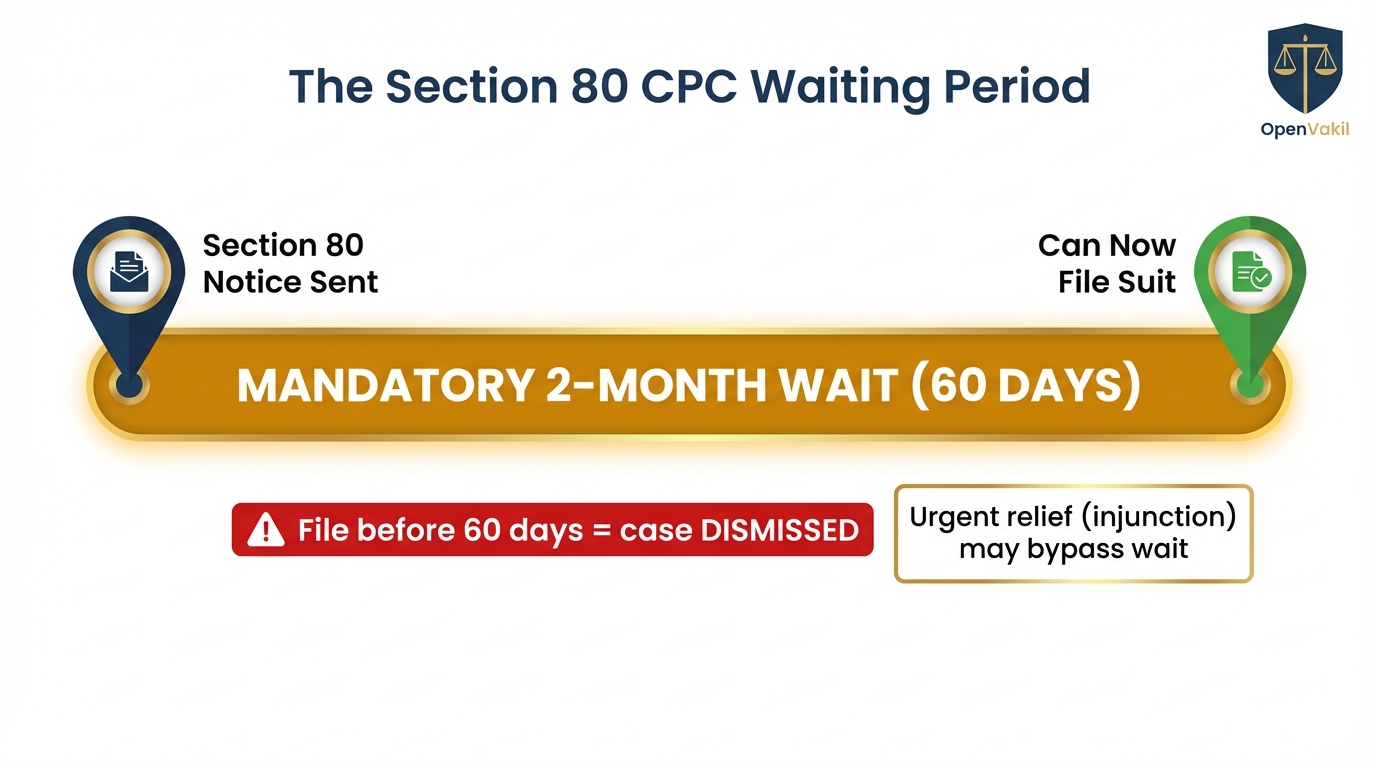
After the notice is served, the plaintiff must wait for two months before filing the suit. This period is calculated from the date the notice is delivered to or left at the office of the appropriate authority — not from the date of dispatch. During this period:
- The government department examines the claim and the enclosed plaint.
- The matter is referred to the relevant section, department, or officer for verification of facts.
- The government's legal advisors assess the legal merits of the claim.
- The department may contact the plaintiff or their advocate for further information or negotiation.
- The government decides whether to settle, negotiate, or prepare to contest the suit.
If the government does not respond or settle within the two-month period, the plaintiff is free to institute the suit. However, the two-month period must be strictly observed — filing even one day before the expiry of two months can be grounds for dismissal.
Exception: Urgent or Immediate Relief
Section 80(2) provides an important exception: where the suit seeks urgent or immediate relief (such as an interim injunction to prevent irreparable harm), the court may allow the suit to be filed without waiting for the two-month period, provided that the notice has been served or is served simultaneously with the filing of the suit. The court must be satisfied that the urgency is genuine and that waiting would cause irreparable injury to the plaintiff.
When Can You Seek Urgent Relief?
The urgent relief exception is narrow. Courts typically allow it when: the government is about to demolish your property, irreparable environmental damage is imminent, your fundamental rights are being violated with ongoing harm, or a limitation period is about to expire. The court still requires that the Section 80 notice be served — it simply allows the suit to proceed before the two-month period expires.
Step-by-Step Process for Sending a Section 80 Notice
- Identify the correct government body or officer: Determine exactly which government entity or officer your grievance lies against. Is it the Central Government, a State Government department, a municipal corporation, a specific officer, or a statutory body? This determines to whom the notice must be addressed.
- Consult a lawyer: Section 80 notices have strict technical requirements. A lawyer experienced in government litigation can ensure your notice is legally compliant and strategically effective.
- Gather all relevant documents: Collect evidence supporting your claim — government orders, correspondence, contracts, photographs, medical reports, property documents, RTI responses, and any prior complaints or representations.
- Draft the notice with all mandatory particulars: Include all elements required by Section 80 — plaintiff details, cause of action, defendant details, relief sought, and a copy or summary of the proposed plaint.
- Prepare the proposed plaint: Draft the plaint (or a detailed summary) that you intend to file in court. This must accompany the notice.
- Dispatch via registered post with AD: Send the notice to the correct address of the government entity or officer via RPAD. Also send copies to the Secretary/Head of the Department and any other relevant authority.
- Send a copy via speed post or hand delivery: For additional proof of service, send a copy via speed post or deliver it by hand to the government office, obtaining a dated acknowledgement stamp on your copy.
- Wait for two months: Count two months from the date of delivery (not dispatch). Do not file the suit before the two-month period expires unless you are seeking urgent relief under Section 80(2).
- If no response or unsatisfactory response, file the suit: After the two-month period, file the civil suit in the appropriate court with the Section 80 notice and proof of service as part of the plaint documents.
Where to Send the Notice: Correct Addressee and Address
Sending the notice to the wrong person or address is one of the most common and fatal mistakes in Section 80 compliance. Here is a guide:
- Central Government: To the Secretary to the Government of India in the relevant ministry or department, New Delhi. Also send a copy to the specific office or officer directly involved.
- State Government: To the Secretary of the relevant department in the State Government at the state capital. Also send a copy to the Collector/District Magistrate of the relevant district.
- Municipal Corporation: To the Municipal Commissioner or Chief Executive Officer at the corporation's head office. Also send a copy to the Zonal/Ward Officer if the grievance is area-specific.
- Police Authority: To the Director General of Police (for state-level issues) or the Superintendent of Police / Commissioner of Police (for district-level issues). Also send a copy to the specific officer involved.
- Government Officer: To the officer by name and designation at their official address. Also send a copy to their superior officer and the Head of Department.
- Public Sector Undertaking: To the Chairman/Managing Director at the registered/head office. Also send a copy to the regional or local office involved.
Always Send to Multiple Addresses
To ensure compliance and avoid technical objections, send the Section 80 notice to the head of the relevant department/body AND to the specific officer or office directly involved in the dispute. Also consider sending a copy to the concerned minister's office. Use RPAD for each copy and retain all postal receipts.
Consequences of Not Sending a Section 80 Notice
- Suit dismissed at threshold: The government can raise a preliminary objection (often as a first response) that the suit is barred for non-compliance with Section 80. Courts routinely dismiss suits on this ground.
- Waste of time and money: Filing a suit without a Section 80 notice means starting over — sending the notice, waiting two months, and filing again. Court fees, lawyer fees, and months of effort are wasted.
- Limitation risk: If the limitation period for your claim is close to expiring, the time spent on a defective suit (which gets dismissed for non-compliance with Section 80) cannot be recovered. You may lose your right to sue entirely.
- Defective notice = same consequences: A notice that is technically deficient (wrong addressee, missing cause of action, no copy of plaint, incorrect plaintiff details) may be treated as no notice at all.
What Happens After Sending the Notice?
- Government settles or resolves the issue: In some cases, the government department takes action on the grievance — pays compensation, corrects the administrative error, releases the withheld benefit, or takes other remedial steps. This is the best outcome.
- Government proposes negotiation: The department or its legal advisor may contact your advocate to discuss terms of settlement. Government bodies sometimes prefer to settle meritorious claims to avoid adverse court orders.
- Government sends a reply denying the claim: The government may send a formal reply through its advocate, denying the claim and stating its legal position. This reply helps you understand the defence you will face in court.
- No response: Government departments frequently do not respond to Section 80 notices. This does not affect your right to file the suit — the two-month period is the condition, not the response. Proceed to file the suit after two months.
Section 80 Notice for Specific Government Issues
Municipal Corporation Issues
Common grievances against municipal bodies include: failure to maintain roads and drains causing injury or property damage, illegal encroachment removal, water supply and sanitation failures, refusal to grant building permissions, property tax disputes, and demolition of unauthorised construction. The notice should cite the relevant municipal act (e.g., the Municipal Corporation Act of the relevant state) along with Section 80 CPC.
Police Inaction and Negligence
If the police failed to register your FIR (violating the Supreme Court's direction in Lalita Kumari v. Government of UP, 2014), were negligent in investigating your case, were complicit in a crime, or caused harm through excessive force, you can send a Section 80 notice to the police authority before suing for damages or mandatory relief. The notice should be addressed to the DGP and/or the SP/Commissioner of Police.
Pension and Retirement Benefits
Government employees facing non-payment, delayed payment, or incorrect calculation of pension, gratuity, leave encashment, or other retirement benefits must send a Section 80 notice before filing a suit. The notice should include the employee's service details, the specific benefit claimed, the amount due, and references to the applicable pension rules or government orders.
Land Acquisition and Compensation
When the government acquires private land under the Right to Fair Compensation and Transparency in Land Acquisition, Rehabilitation and Resettlement Act, 2013 (or its state equivalent), disputes over compensation, procedure, or rehabilitation require a Section 80 notice. The notice should detail the land particulars, the acquisition notification, the compensation offered, the market value claimed, and the specific provisions of the Act relied upon.
Passport and Visa Delays
Unreasonable delays in passport issuance or renewal, wrongful rejection of passport applications, or failures in police verification can be challenged through a Section 80 notice addressed to the Regional Passport Officer and the Ministry of External Affairs. The notice should include the application reference number, dates of application and follow-up, and the specific ground of complaint.
Common Mistakes to Avoid
- Addressing the notice to the wrong authority: The most common and fatal error. Sending the notice to the local office instead of the Secretary, or to the wrong department, can invalidate the notice. Always verify the correct addressee.
- Not enclosing the plaint or summary: Section 80 requires that the notice be accompanied by a copy of the plaint or its concise summary. Omitting this can be treated as non-compliance.
- Filing the suit before two months: The two-month waiting period is calculated from the date of delivery, not dispatch. Filing even one day early can result in dismissal.
- Vague or incomplete cause of action: The notice must clearly state what the government did wrong, when, where, and how it affected you. A vague notice may be treated as defective.
- Not retaining proof of service: Without RPAD receipts and AD cards, you cannot prove that the notice was served. This is a critical piece of evidence when filing the suit.
- Forgetting to send to all required parties: If multiple government entities or officers are involved, each must receive a separate notice. Failure to serve any one of them can create jurisdictional issues.
- Not updating the notice if facts change: If material facts change between the date of the notice and the date of filing the suit (e.g., the relief sought changes significantly), you may need to send a fresh notice and wait two months again.
- Confusing Section 80 with other notice requirements: Some specific statutes (e.g., Land Acquisition Act, Railway Claims Tribunal Act) have their own notice provisions. You may need to comply with both Section 80 and the specific statute.
How OpenVakil Helps
Filing against the government is a daunting process, and getting the Section 80 notice wrong means starting over from scratch. OpenVakil simplifies the process of drafting a legally compliant Section 80 CPC notice that meets all statutory requirements.
- AI-powered drafting: Answer a few questions about your grievance — which government body is involved, what happened, and what relief you seek. OpenVakil generates a comprehensive Section 80 notice with all mandatory particulars, correctly addressed to the appropriate authority.
- Correct addressee identification: Based on your inputs, OpenVakil identifies the correct government entity, officer, and address to which the notice must be sent — eliminating the most common source of Section 80 errors.
- All statutory requirements met: The notice includes every element required by Section 80 — plaintiff details, cause of action, defendant details, relief sought, and a summary of the proposed plaint — ensuring compliance.
- Covers all types of government disputes: Whether your grievance is against a municipal corporation, police authority, revenue department, passport office, or any other government body, OpenVakil drafts a notice tailored to your specific situation.
- Professional, court-ready language: The notice is drafted in the formal language expected in government litigation, with proper legal references and measured tone.
- Fast and affordable: Receive your draft notice in minutes at a fraction of traditional legal costs. Don't risk missing the limitation period because of slow drafting.
Getting the Section 80 notice right is not optional — it is the mandatory first step in any suit against the government. OpenVakil ensures you get it right the first time, so your case starts on solid legal footing.
Draft Your Section 80 CPC Notice with OpenVakil
A defective notice means your suit gets dismissed. Get a professionally drafted, legally compliant Section 80 CPC notice that meets every statutory requirement. Answer a few questions and receive your notice in minutes.
Get Started Now