Introduction: Why Choosing the Right Legal Action Matters
When you face a legal wrong in India — whether someone owes you money, a company sold you a defective product, a business partner cheated you, or a tenant refuses to vacate your property — the first question is almost always: What should I do? Should you send a legal notice? File an FIR at the police station? Approach the consumer court? Or hire a lawyer and file a civil suit?
Most people get this decision wrong. They rush to the police station for what is essentially a civil dispute, or they spend years in civil court when a consumer forum would have resolved the matter in months. Choosing the wrong legal remedy does not just waste time and money — it can actively harm your case. A criminal complaint filed for a contractual dispute may be dismissed as an abuse of process. A civil suit filed for a consumer grievance may be struck down for lack of jurisdiction.
This comprehensive guide breaks down the four primary legal remedies available in India — Legal Notice, FIR (First Information Report), Consumer Court, and Civil Suit — and gives you a clear framework to decide which action (or combination of actions) is right for your specific situation.
The law provides multiple remedies for redressal of grievances. The aggrieved party must choose the appropriate remedy available under the law. Filing proceedings before a wrong forum not only results in delay and waste of resources but may also amount to an abuse of the process of law.
— Indian Oil Corporation Ltd. v. Consumer Protection Council, (1993) 1 SCC 397
Understanding the 4 Main Legal Remedies
Before diving into the details of each remedy, it helps to understand the fundamental nature of each option. Indian law broadly divides wrongs into civil wrongs (where one party causes loss to another) and criminal offences (where an act is considered harmful to society as a whole). Your choice of remedy depends on which category your dispute falls into — or whether it straddles both.
- Legal Notice (Section 80 CPC / General): A formal written communication sent through an advocate, demanding that the other party fulfil an obligation, pay a debt, or cease a wrongful act. It is a pre-litigation tool — not a court proceeding itself — but it is often mandatory before certain types of lawsuits and is a powerful negotiation instrument.
- FIR (First Information Report): A formal complaint lodged with the police under the Code of Criminal Procedure (CrPC) / Bharatiya Nagarik Suraksha Sanhita (BNSS), 2023, reporting the commission of a cognizable criminal offence. Filing an FIR sets the criminal justice machinery in motion — police investigation, arrest, charge sheet, and trial.
- Consumer Court (Consumer Protection Act, 2019): A complaint filed before one of India's three-tier Consumer Disputes Redressal Commissions (District, State, or National) for issues related to defective goods, deficient services, unfair trade practices, or misleading advertisements.
- Civil Suit (Code of Civil Procedure, 1908): A formal lawsuit filed in a Civil Court seeking specific relief — recovery of money, enforcement of a contract, possession of property, injunction against a wrongful act, or declaration of a legal right. Civil suits are governed by the Code of Civil Procedure (CPC), 1908.
Key Principle: Civil vs Criminal
In a criminal case, the State prosecutes the accused for committing an offence against society (e.g., cheating, assault, theft). The outcome is punishment (imprisonment, fine). In a civil case, the aggrieved party sues the other party for a private wrong (e.g., breach of contract, property dispute). The outcome is typically compensation, injunction, or specific performance. Some disputes, such as fraud or cheque bounce, can involve both criminal and civil remedies.
Legal Notice: When, Why & How
A legal notice is the most common first step in almost any legal dispute in India. It is a formal written demand sent by an advocate on behalf of the aggrieved party, putting the other side on notice that legal action will follow if the grievance is not addressed within a specified period (typically 15 to 30 days).
Legal notices are governed by Section 80 of the Code of Civil Procedure (CPC) when the intended defendant is the government or a public officer — in which case a 60-day notice is mandatory before filing a suit. For private disputes, while not always legally mandatory, a legal notice is almost always strategically advisable. It serves as evidence of your attempt to resolve the matter amicably and strengthens your position in any subsequent court proceeding.
Under the Negotiable Instruments Act, 1881 (Section 138), sending a legal notice within 30 days of a cheque bounce is a mandatory precondition to filing a criminal complaint. Similarly, under RERA and several other statutes, a demand notice is a prerequisite to formal proceedings.
Pros and Cons of Sending a Legal Notice
Advantages:
- Low cost and fast: A legal notice can be drafted and dispatched within 1–3 days at a fraction of the cost of court proceedings.
- Often resolves disputes without litigation: A significant percentage of disputes settle after a legal notice is received, as the other party recognises the seriousness of the situation.
- Creates a documentary record: The notice establishes your version of facts, the demand made, and the deadline given — all of which become evidence in court.
- Mandatory in certain cases: For cheque bounce cases (Section 138 NI Act) and suits against the government (Section 80 CPC), a legal notice is a legal prerequisite.
- Demonstrates bona fides: Courts view favourably a party who attempted to resolve matters out of court before litigating.
Disadvantages:
- No enforcement power: A legal notice is not a court order. If the other party ignores it, you must still approach a court or forum for enforcement.
- Can alert the opponent: In some cases, especially fraud, sending a notice may give the accused time to destroy evidence, hide assets, or abscond.
- May provoke a counter-notice: The other party may respond aggressively with their own legal notice or pre-emptive legal action.
Cost and Timeline for a Legal Notice
- Cost: Rs. 1,000 to Rs. 15,000 depending on complexity and whether drafted by a lawyer or an AI-assisted platform like OpenVakil. Traditional lawyers in metro cities may charge Rs. 5,000 to Rs. 25,000 or more.
- Drafting time: 1–3 business days (or minutes with OpenVakil).
- Response period: Typically 15 to 30 days from the date of receipt.
- Total timeline to resolution: If the other party complies, the matter can be resolved in 2–6 weeks from the date of sending.
Need to Send a Legal Notice?
OpenVakil drafts professional, court-ready legal notices in minutes. Answer a few questions about your dispute and receive a comprehensive notice citing the correct legal provisions, ready for dispatch.
Draft Your Legal Notice NowFIR: When to Go to the Police
A First Information Report (FIR) is the formal document prepared by the police when they receive information about the commission of a cognizable offence. It is governed by Section 154 of the Code of Criminal Procedure (CrPC), 1973 (now Section 173 of the Bharatiya Nagarik Suraksha Sanhita (BNSS), 2023). Filing an FIR sets the entire criminal justice machinery into motion — investigation by the police, collection of evidence, arrest of the accused (if warranted), filing of a charge sheet, and eventually a trial before a criminal court.
You should file an FIR when a criminal offence has been committed against you. Common criminal offences relevant to everyday disputes include:
- Cheating and fraud: Section 420 IPC / Section 318 BNS — imprisonment up to 7 years. This applies when someone deceives you with dishonest intention to cause wrongful gain or loss.
- Criminal breach of trust: Section 406 IPC / Section 316 BNS — imprisonment up to 3 years. Applies when someone entrusted with property or money misappropriates it.
- Criminal intimidation: Section 506 IPC / Section 351 BNS — imprisonment up to 2 years (7 years for death threats).
- Theft: Section 378 IPC / Section 303 BNS — imprisonment up to 3 years.
- Forgery: Section 463 IPC / Section 336 BNS — imprisonment up to 2 years.
- Domestic violence: Section 498A IPC / Section 85 BNS — imprisonment up to 3 years.
- Dishonour of cheque: Section 138 of the Negotiable Instruments Act — imprisonment up to 2 years (though this is typically pursued through a Magistrate complaint, not an FIR).
Cognizable vs Non-Cognizable Offences
Understanding the distinction between cognizable and non-cognizable offences is critical when deciding whether to file an FIR:
- Cognizable offences: Serious offences (murder, robbery, kidnapping, cheating under Section 420, criminal breach of trust) where the police can arrest without a warrant and must register an FIR upon receiving information. If the police refuse to register your FIR for a cognizable offence, you can approach the Superintendent of Police or file a complaint before the Magistrate under Section 156(3) CrPC / Section 175(3) BNSS.
- Non-cognizable offences: Less serious offences (assault, defamation, mischief below a certain value) where the police cannot arrest without a warrant and cannot investigate without the permission of a Magistrate. For non-cognizable offences, you must file a private complaint before the Magistrate under Section 200 CrPC / Section 223 BNSS.
Police Refusing to Register Your FIR?
Under Section 154(1) CrPC / Section 173(1) BNSS, the police are legally obligated to register an FIR when information about a cognizable offence is given. If the Station House Officer (SHO) refuses, you have three options: (1) Send your complaint by registered post to the Superintendent of Police (SP), who must investigate or direct investigation; (2) File a complaint before the Judicial Magistrate under Section 156(3) CrPC / Section 175(3) BNSS, who can direct the police to register an FIR; (3) Approach the High Court under Section 482 CrPC / Section 528 BNSS.
Zero FIR Explained
A Zero FIR is an FIR that can be filed at any police station, regardless of the jurisdiction where the offence was committed. Introduced through a 2013 amendment following the Justice Verma Committee recommendations and now formally codified under Section 173(1) BNSS, the Zero FIR ensures that no police station can turn you away citing jurisdictional limitations. The FIR is assigned a temporary number (prefixed with "0") and is subsequently transferred to the police station having actual jurisdiction for investigation.
This is especially useful in cases of online fraud (where the accused may be in a different state), crimes against women, and emergencies where the victim cannot travel to the jurisdictional police station.
Pros and Cons of Filing an FIR
Advantages:
- State machinery investigates for you: The police are obligated to investigate, collect evidence, and file a charge sheet. You do not bear the burden of investigation.
- Powerful deterrent: The threat of arrest, prosecution, and a criminal record creates enormous pressure on the accused to settle or cooperate.
- Immediate action in serious cases: For cognizable offences, the police can arrest without a warrant and take immediate preventive action.
- No cost to file: Filing an FIR is completely free. There is no court fee or filing fee.
- Can lead to recovery: Courts can order compensation to victims under Section 357 CrPC / Section 395 BNSS.
Disadvantages:
- Slow process: Criminal cases in India can take 5–15 years to reach final conclusion. Investigation delays, adjournments, and backlog are common.
- Burden of proof is high: The prosecution must prove the offence "beyond reasonable doubt" — a much higher standard than civil cases.
- You lose control: Once an FIR is filed, the case is between the State and the accused. The complainant has limited control over prosecution strategy.
- Risk of counter-FIR: The accused may file a counter-FIR against you, especially in disputes involving mutual allegations.
- Not suitable for civil disputes: Filing an FIR for what is essentially a breach of contract or money dispute can be dismissed as an abuse of process and may even attract action for filing a false complaint.
A mere breach of contract cannot give rise to a criminal prosecution for cheating unless fraudulent or dishonest intention is shown right at the beginning of the transaction. Every civil wrong is not a criminal offence.
— Hridaya Ranjan Prasad Verma v. State of Bihar, (2000) 4 SCC 168
Consumer Court: When to Approach the Consumer Forum
The Consumer Protection Act, 2019 provides a fast-track, affordable mechanism for resolving disputes related to goods and services. If you have purchased a defective product, received deficient services, been subjected to unfair trade practices, or been misled by false advertisements, the consumer court (formally called the Consumer Disputes Redressal Commission) is often your best remedy.
Unlike civil courts, consumer commissions are designed to be less formal, faster, and more accessible. The procedures are simpler, lawyers are not mandatory (you can appear in person), and the commissions are required to dispose of complaints within specific timelines. The 2019 Act also introduced e-filing through the E-Daakhil portal, mediation as an alternative dispute resolution mechanism, and product liability provisions that hold manufacturers, sellers, and service providers accountable.
District, State & National Commission Jurisdiction
The Consumer Protection Act, 2019 establishes a three-tier structure with pecuniary jurisdiction as follows:
- District Consumer Disputes Redressal Commission: Complaints where the value of goods/services and compensation claimed does not exceed Rs. 1 crore. This is the most commonly used forum for everyday consumer disputes.
- State Consumer Disputes Redressal Commission: Complaints where the value exceeds Rs. 1 crore but does not exceed Rs. 10 crore. Also hears appeals against District Commission orders.
- National Consumer Disputes Redressal Commission (NCDRC): Complaints where the value exceeds Rs. 10 crore. Also hears appeals against State Commission orders. Appeals from NCDRC go to the Supreme Court.
Who Is a "Consumer"?
Under the Consumer Protection Act, 2019, a "consumer" is any person who buys goods or avails services for consideration, including online and e-commerce transactions. However, a person who obtains goods for resale or commercial purposes is NOT a consumer. Services availed for commercial purposes are excluded unless the transaction is for self-employment or earning a livelihood. This means a person buying a laptop for personal use is a consumer, but a company buying 100 laptops for resale is not.
Pros and Cons of Consumer Court
Advantages:
- Fast resolution: Consumer commissions are mandated to decide cases within 3–5 months (though actual timelines may vary, they are significantly faster than civil courts).
- Low cost: Filing fees are nominal (a few hundred to a few thousand rupees depending on the value). Lawyers are not mandatory.
- Consumer-friendly: The burden of proof is lighter. The commissions adopt a pro-consumer approach as mandated by the Act.
- Wide remedies: The commission can order refund, replacement, compensation, punitive damages, and even corrective advertisements.
- E-filing available: Complaints can be filed online through the E-Daakhil portal without visiting the commission physically.
Disadvantages:
- Limited scope: Only disputes related to goods and services purchased as a "consumer" are covered. Property disputes, employment issues, and purely contractual matters between businesses are excluded.
- Enforcement challenges: While the commission's orders are enforceable, getting actual compliance from the opposite party can sometimes require further execution proceedings.
- Not suitable for criminal wrongs: If you have been cheated or defrauded, the consumer court can award compensation but cannot imprison the offender. Criminal prosecution requires an FIR or Magistrate complaint.
Civil Suit: When to File in Civil Court
A civil suit is a formal legal proceeding filed in a Civil Court under the Code of Civil Procedure (CPC), 1908. It is the most comprehensive — and often the most complex — legal remedy available. Civil suits are appropriate for a wide range of disputes including recovery of money or debt, enforcement or rescission of contracts, property ownership and possession disputes, declaratory relief (establishing a legal right), permanent and temporary injunctions, and specific performance of contracts.
Civil courts have the broadest jurisdiction among all forums. They can hear virtually any dispute that is not barred by a specific statute or exclusively assigned to another tribunal. The suit is filed before the court of the lowest pecuniary and territorial jurisdiction competent to try it.
Injunctions and Summary Suits (Order 37 CPC)
Two powerful tools available in civil suits deserve special mention:
- Injunctions (Order 39 CPC): A court can grant a temporary injunction to restrain a party from doing something (e.g., selling disputed property, disposing of assets, continuing infringement) while the suit is pending. In urgent cases, an ex parte injunction can be obtained without even hearing the other side. This is critical in property disputes, intellectual property cases, and situations where irreparable harm is imminent.
- Summary Suits (Order 37 CPC): For straightforward money recovery claims based on bills of exchange, hundis, promissory notes, or written contracts, Order 37 CPC allows a fast-track "summary suit" procedure. The defendant must obtain the court's leave (permission) to defend the suit, which is only granted if they can show a triable issue. This significantly shortens the timeline for clear-cut debt recovery cases.
The purpose of a temporary injunction is to preserve the status quo until the rights of the parties can be determined in the suit. The court must consider whether the plaintiff has a prima facie case, whether the balance of convenience is in favour of granting the injunction, and whether the plaintiff would suffer irreparable injury if the injunction is refused.
— Dalpat Kumar v. Prahlad Singh, (1992) 1 SCC 719
Pros and Cons of Filing a Civil Suit
Advantages:
- Broadest jurisdiction: Civil courts can hear almost any type of dispute — money recovery, property, contracts, torts, family matters, and more.
- Powerful interim remedies: Injunctions, attachment before judgment (Order 38), and receiver appointments protect your interests during the pendency of the suit.
- Enforceable decrees: A civil court decree can be executed through attachment and sale of the defendant's property, arrest, and other coercive methods under Order 21 CPC.
- Lower burden of proof: Civil cases are decided on "preponderance of probabilities" — a significantly lower standard than criminal cases.
- Full scope of relief: Courts can award damages, specific performance, declaratory relief, mandatory injunctions, and costs.
Disadvantages:
- Extremely slow: Civil suits in Indian courts routinely take 5–20 years to reach final judgment. Delays in service, discovery, evidence, and arguments are endemic.
- Expensive: Court fees (which are ad valorem — calculated as a percentage of the claim amount), lawyer fees, and ancillary costs can be substantial. In high-value disputes, court fees alone can run into lakhs.
- Procedural complexity: The CPC is a complex procedural code. Navigating pleadings, written statements, issues, discovery, evidence, arguments, and execution requires legal expertise.
- No criminal consequence: A civil suit cannot result in the imprisonment of the defendant. If you want the offender punished, you need criminal proceedings.
Head-to-Head Comparison of All Four Remedies
The following comparison highlights the key differences across the four legal remedies to help you make an informed decision:
Comparison: Legal Notice vs FIR vs Consumer Court vs Civil Suit
COST:
Legal Notice: Rs. 1,000 – Rs. 15,000 | FIR: Free | Consumer Court: Rs. 200 – Rs. 5,000 | Civil Suit: Rs. 5,000 – Rs. 5,00,000+
TIMELINE TO RESOLUTION:
Legal Notice: 2–6 weeks | FIR: 2–15 years | Consumer Court: 3–18 months | Civil Suit: 3–20 years
ENFORCEMENT POWER:
Legal Notice: None (voluntary compliance) | FIR: Arrest, imprisonment, fine | Consumer Court: Enforceable order, penalty for non-compliance | Civil Suit: Decree execution, property attachment, arrest
BURDEN OF PROOF:
Legal Notice: N/A | FIR: Beyond reasonable doubt | Consumer Court: Preponderance of probabilities | Civil Suit: Preponderance of probabilities
SCOPE:
Legal Notice: Any dispute | FIR: Criminal offences only | Consumer Court: Consumer goods & services only | Civil Suit: Any civil dispute
LAWYER REQUIRED?
Legal Notice: Recommended | FIR: No | Consumer Court: No (optional) | Civil Suit: Yes (practically essential)
COMPLEXITY:
Legal Notice: Low | FIR: Low to Medium | Consumer Court: Medium | Civil Suit: High
Decision Framework: Which Legal Action Should You Take?
Use this decision framework to identify the most appropriate legal remedy for your situation. In many cases, the optimal strategy involves a combination of remedies deployed in a specific sequence:
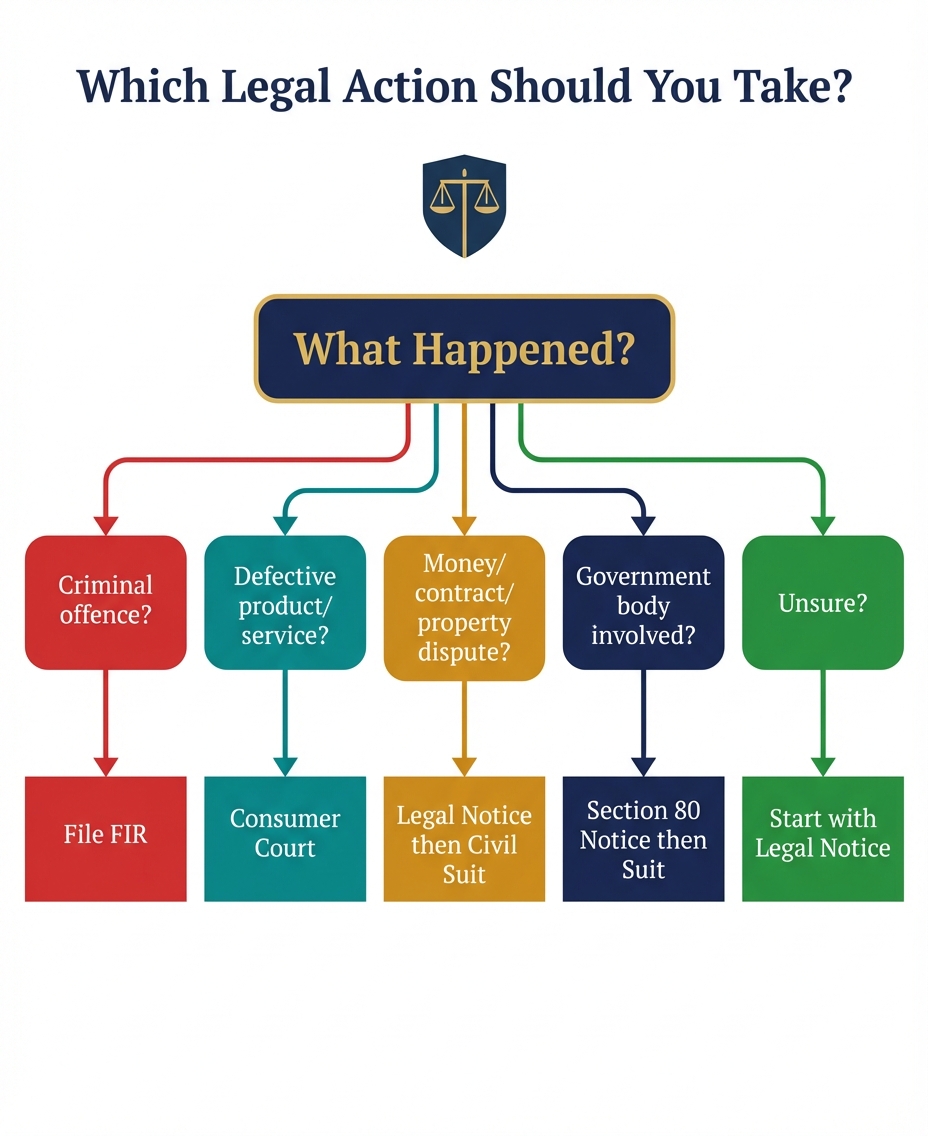
Decision Guide: Match Your Situation to the Right Remedy
1. Someone owes you money (loan, debt, unpaid invoice):
Start with a Legal Notice demanding payment within 15 days. If ignored, file a Civil Suit for recovery. If the debt is based on a cheque, promissory note, or written contract, use Order 37 CPC for a fast-track summary suit.
2. A cheque has bounced:
Send a Legal Notice under Section 138 NI Act within 30 days of receiving the bank memo. Wait 15 days. If unpaid, file a criminal complaint before the Magistrate within 30 days of the notice period expiring. This is a strict statutory timeline — missing it bars your claim.
3. You have been cheated or scammed:
File an FIR under Section 420 IPC / Section 318 BNS immediately. Simultaneously send a Legal Notice demanding return of money. If the amount is large, also file a Civil Suit for recovery with an application for attachment of assets.
4. Defective product or poor service:
Send a Legal Notice to the company. If no response, file a Consumer Complaint with the appropriate commission (District/State/National based on value). Consumer court is faster and cheaper than civil court for goods and services disputes.
5. Property dispute (ownership, possession, encroachment):
File a Civil Suit for declaration of title, possession, or injunction. Apply for a temporary injunction under Order 39 CPC to maintain status quo. Send a Legal Notice first if negotiation is possible. If forgery or fraud is involved, also file an FIR.
6. Employment dispute (unpaid salary, wrongful termination):
Send a Legal Notice to the employer. If unresolved, approach the Labour Court or Industrial Tribunal under the Industrial Disputes Act, 1947. For salary recovery, a civil suit or application under Order 37 may also be appropriate.
7. Landlord-tenant dispute:
Send a Legal Notice for eviction or rent recovery. File an eviction petition under the applicable State Rent Control Act. For rent recovery, file a civil suit.
8. Domestic violence or harassment:
File an FIR immediately. Also consider filing a complaint under the Protection of Women from Domestic Violence Act, 2005 for additional protection orders and maintenance.
The key takeaway is that a legal notice should almost always be your first step, regardless of which subsequent remedy you pursue. It is low-cost, fast, and creates a documentary foundation for everything that follows.
Can You Take Multiple Actions Simultaneously?
Yes, in many situations, you can — and should — pursue multiple legal remedies simultaneously. Criminal proceedings and civil proceedings operate independently of each other. The Supreme Court has consistently held that the pendency of one does not bar the other:
It is well settled that criminal proceedings and civil proceedings can proceed simultaneously as they are based on different standards of proof and serve different purposes. An acquittal in a criminal case does not necessarily bar a civil suit arising from the same facts, and vice versa.
— P. Swaroopa Rani v. M. Hari Narayana, (2008) 5 SCC 765
Here are the most common combinations:
- Legal Notice + FIR: Send a notice demanding restitution while simultaneously filing an FIR for the criminal offence. This is the standard approach for fraud and cheating cases.
- Legal Notice + Consumer Court: Send a notice first, wait for the response period to expire, then file a consumer complaint. The notice and its non-response become evidence before the commission.
- FIR + Civil Suit: File an FIR for the criminal offence and a civil suit for monetary recovery. The criminal case seeks punishment; the civil case seeks compensation. Both can proceed in parallel.
- Consumer Court + Civil Court: Generally, you should choose one or the other for the same cause of action. Filing in both may result in one being dismissed. However, if different aspects of the dispute fall under different jurisdictions (e.g., deficiency of service before consumer forum and property title dispute before civil court), parallel proceedings may be appropriate.
- Legal Notice + FIR + Civil Suit: For large-scale fraud involving significant sums, the most aggressive and comprehensive strategy is to send a legal notice, file an FIR, and file a civil suit with an interim application for attachment of the accused's assets — all simultaneously.
Beware of Forum Shopping
While pursuing multiple remedies is legally permissible, you must not file identical claims in multiple forums seeking the same relief for the same cause of action. This is known as "forum shopping" and is frowned upon by courts. For example, you cannot claim Rs. 5 lakhs for deficiency in service before both the consumer commission and the civil court. Choose the forum best suited to your claim for each specific relief you seek, and disclose the existence of parallel proceedings to all forums.
Common Mistakes When Choosing Legal Action
These are the most frequent errors people make when deciding how to pursue a legal remedy — and how to avoid them:
- Filing an FIR for a civil dispute: This is the most common mistake. If someone has not repaid a loan or breached a business contract, it is a civil matter, not criminal. Filing an FIR for a purely civil wrong can lead to the complaint being quashed under Section 482 CrPC / Section 528 BNSS, and you may face action for filing a false complaint under Section 211 IPC / Section 217 BNS.
- Going directly to civil court when consumer court is more appropriate: If your dispute involves defective goods or deficient services, the consumer commission is almost always a better choice — it is faster, cheaper, and more consumer-friendly. Civil courts should be reserved for disputes that fall outside the consumer commission's jurisdiction.
- Skipping the legal notice: Many people rush to court without sending a legal notice first. This wastes time and money. A significant percentage of disputes settle after a legal notice. In some cases (Section 138 NI Act, Section 80 CPC), skipping the notice makes your subsequent filing legally invalid.
- Missing limitation periods: Every legal remedy has a deadline. A cheque bounce notice must be sent within 30 days. A consumer complaint must be filed within 2 years. A civil suit for contract breach must be filed within 3 years. An FIR should be filed promptly (delay weakens credibility). Consult the Limitation Act, 1963 for specific deadlines.
- Not preserving evidence before filing: Before alerting the opponent through a legal notice or FIR, secure all evidence — screenshots, bank statements, contracts, messages, recordings. Once the other side knows legal action is imminent, evidence may be destroyed.
- Using the wrong legal provisions: Citing IPC sections for offences committed after 1 July 2024 (when the BNS came into force) or vice versa creates procedural issues. Similarly, citing the old Consumer Protection Act 1986 instead of the 2019 Act weakens your filing.
- Filing in the wrong forum or jurisdiction: Filing a consumer complaint in a district where neither you nor the opposite party reside, or filing a civil suit in a court without pecuniary jurisdiction, results in automatic dismissal. Always verify territorial and pecuniary jurisdiction before filing.
- Not disclosing parallel proceedings: If you have filed both an FIR and a civil suit arising from the same facts, you must disclose this to both forums. Failure to disclose can be treated as suppression of material facts and result in adverse consequences.
- Delaying action indefinitely: Many people send a legal notice but then take months or years to follow up with court proceedings. This delay weakens your case and may even result in the expiry of the limitation period. Have a clear timeline and escalation strategy before you send the first notice.
- Not consulting a lawyer when the stakes are high: While platforms like OpenVakil make legal notices accessible to everyone, complex disputes involving multiple parties, large sums, or cross-jurisdictional issues benefit from the guidance of an experienced litigation lawyer.
How OpenVakil Helps You Take the Right Legal Action
Choosing the right legal remedy and drafting the right legal notice is half the battle. OpenVakil helps you get this critical first step right — quickly, affordably, and with professional quality.
- AI-powered notice drafting: Answer a few guided questions about your dispute — what happened, who is involved, what you want, and what evidence you have. OpenVakil's AI generates a comprehensive, legally accurate notice in minutes, citing the correct provisions of the IPC/BNS, CPC, Consumer Protection Act, NI Act, or any other applicable statute.
- Situation-specific guidance: OpenVakil does not just draft a notice — it helps you understand which legal remedy is most appropriate for your situation, whether that is a legal notice alone, an FIR, consumer court, civil suit, or a combination.
- Correct legal provisions: Whether your dispute arose before or after 1 July 2024, OpenVakil ensures the notice cites the correct law — IPC or BNS, CrPC or BNSS, and the applicable substantive statutes.
- Court-ready language: Every notice is drafted in formal, professional legal language that commands attention from the recipient and is ready to be submitted as evidence in any court or forum.
- Fast turnaround: While traditional lawyers may take days or weeks, OpenVakil delivers your draft notice in minutes. In legal disputes, speed matters — whether it is meeting a statutory deadline or acting before evidence disappears.
- Affordable and transparent: Professional legal notices at a fraction of traditional lawyer costs, with clear pricing and no hidden fees.
- Dispatch support: OpenVakil can help you dispatch your notice via registered post with acknowledgement due, so you have proof of delivery from day one.
Whether you need to recover money, fight a fraudster, hold a business accountable for a defective product, or protect your property rights, the right legal action starts with the right legal notice. OpenVakil ensures you get it right the first time.
Take the Right Legal Action Today
Not sure whether you need a legal notice, an FIR, or a court case? Start with OpenVakil. Answer a few questions about your dispute, and get a professionally drafted legal notice that sets the foundation for the right legal remedy — delivered in minutes, not days.
Get Started NowRemember: the right legal remedy, chosen at the right time, pursued through the right forum, can mean the difference between a swift resolution and years of fruitless litigation. When in doubt, start with a legal notice — it keeps all options open while giving the other party a fair chance to resolve the matter. And if the matter escalates, you will have the documentary foundation to pursue any remedy with confidence.