Every day, millions of Indian consumers face issues with defective products, poor services, hidden charges, and misleading advertisements. While most people feel helpless against large corporations and businesses, Indian law provides powerful protections. A consumer complaint legal notice is the first formal step to assert your rights, demand accountability, and seek justice under the Consumer Protection Act 2019.
This comprehensive guide explains everything you need to know about sending a consumer complaint notice in India -- from understanding your rights and the types of complaints you can file, to the step-by-step process, consumer forum jurisdictions, available remedies, and how to make your complaint as strong as possible.
What Is a Consumer Complaint Legal Notice?
A consumer complaint legal notice is a formal written communication sent by a consumer (or their advocate) to a business, service provider, manufacturer, or seller, informing them of a grievance related to goods purchased or services availed. The notice demands that the recipient remedy the issue within a specified time frame -- typically 15 to 30 days -- failing which the consumer intends to approach the appropriate consumer forum or court.
Sending a legal notice is not mandatory before filing a complaint with the consumer commission. However, it serves several important purposes: it puts the other party on formal notice, demonstrates the seriousness of your complaint, creates a documented record, and often leads to an out-of-court settlement, saving both parties time and money.
Did You Know?
Under the Consumer Protection Act 2019, the definition of "consumer" includes anyone who buys goods or avails services for personal use through both offline and online transactions -- including e-commerce purchases.
Your Rights Under the Consumer Protection Act 2019
The Consumer Protection Act 2019 replaced the earlier 1986 Act and introduced sweeping reforms to strengthen consumer rights in India. It established the Central Consumer Protection Authority (CCPA) and brought e-commerce, telecom, real estate, and digital services firmly within its ambit. Under this Act, every consumer in India is entitled to the following six rights:
- Right to Safety: Protection against goods and services that are hazardous to life and property.
- Right to Information: The right to be informed about the quality, quantity, potency, purity, standard, and price of goods or services.
- Right to Choose: Access to a variety of goods and services at competitive prices with an assurance of satisfactory quality.
- Right to Be Heard: The right to be heard and assured that consumer interests will receive due consideration at appropriate forums.
- Right to Seek Redressal: The right to seek redressal against unfair or restrictive trade practices, defective goods, or deficient services.
- Right to Consumer Education: The right to acquire knowledge and skills to be an informed consumer.
When any of these rights are violated, you have the legal standing to send a consumer complaint notice and, if necessary, escalate the matter to the appropriate consumer dispute redressal commission.
Types of Consumer Complaints
Consumer complaints in India generally fall into four broad categories. Understanding which category your grievance belongs to helps in framing an effective legal notice and, if required, a complaint before the consumer forum.
Defective Products
A product is considered defective under Section 2(10) of the Consumer Protection Act 2019 if it has any fault, imperfection, or shortcoming in its quality, quantity, potency, purity, or standard. This includes manufacturing defects, design defects, and deviations from the express or implied warranty. Common examples include electronic devices that malfunction within the warranty period, vehicles with recurring mechanical issues, food products containing foreign objects, and medicines with incorrect compositions.
Deficient Services
Deficiency in service is defined under Section 2(11) as any fault, imperfection, shortcoming, or inadequacy in the quality, nature, and manner of performance required to be maintained by or under any law, or agreed upon in a contract. This covers a wide range of scenarios -- delayed delivery by courier services, medical negligence by hospitals, failure of insurance companies to settle legitimate claims, poor workmanship by home renovation contractors, and banking errors that cause financial loss.
Unfair Trade Practices
Section 2(47) of the Act defines unfair trade practices broadly. These include making false or misleading representations about the quality or standard of goods, offering gifts or prizes with the intention of not providing them, selling goods not conforming to safety standards, charging prices in excess of the MRP, and collecting personal data without consent. Hidden charges in telecom bills, forced bundling of services, and bait-and-switch pricing tactics all fall under this category.
Misleading Advertisements
The 2019 Act introduced specific provisions against misleading advertisements under Sections 2(28) and 21. An advertisement is considered misleading if it falsely describes a product or service, gives a false guarantee, or deliberately conceals important information. Notably, the Act also empowers the CCPA to hold endorsers (including celebrities) liable for misleading claims. This means if a brand ambassador promotes a product with false claims and the endorser did not exercise due diligence, they can also be held responsible.
When Should You Send a Consumer Complaint Notice?
You should consider sending a consumer complaint legal notice when informal channels of complaint resolution have failed. Here are common scenarios where a legal notice becomes appropriate:
- The seller or manufacturer refuses to replace or repair a defective product despite repeated requests.
- A service provider delivers substandard or incomplete services and refuses a refund.
- Your insurance claim has been wrongfully denied or unduly delayed.
- A builder or developer has failed to deliver possession of a flat as promised.
- You have been charged hidden fees or subjected to unfair terms by a bank, telecom company, or e-commerce platform.
- A hospital or doctor has been negligent, leading to physical or financial harm.
- A company is refusing to honour a warranty or guarantee commitment.
- You have been deceived by misleading advertising or false product claims.
Pro Tip
Always attempt to resolve the dispute by contacting the company's customer support and escalating through their internal grievance mechanism first. Document every interaction -- save emails, chat transcripts, call recordings, and complaint ticket numbers. This evidence strengthens your legal notice significantly.
Ready to Send a Consumer Complaint Notice?
OpenVakil's AI-powered platform helps you draft a professional consumer complaint legal notice in minutes. Answer a few simple questions and get a lawyer-reviewed notice ready to send.
Draft Your Notice NowKey Elements of a Consumer Complaint Legal Notice
A well-drafted consumer complaint legal notice should include the following essential elements to be effective and legally sound:
- Sender's Details: Full name, address, and contact information of the consumer sending the notice.
- Recipient's Details: Name, designation, registered address, and other identifying details of the company, seller, or service provider.
- Date and Reference: The date of the notice and any relevant reference numbers (order IDs, complaint ticket numbers, policy numbers).
- Statement of Facts: A clear, chronological account of the transaction -- when the goods were purchased or the service was availed, what was promised, and what went wrong.
- Legal Basis: Reference to the specific provisions of the Consumer Protection Act 2019 (or other applicable law) that have been violated.
- Supporting Evidence: Mention of enclosed documents such as invoices, receipts, photographs of the defective product, correspondence, medical reports, or other relevant proof.
- Relief Sought: Clearly state what you are demanding -- refund, replacement, compensation, damages, or any other specific remedy.
- Time Frame: A reasonable deadline (typically 15 to 30 days) for the recipient to respond or comply.
- Consequence of Non-Compliance: A clear statement that failure to act within the given time frame will result in filing a formal complaint before the appropriate consumer commission, and the recipient will bear all costs and consequences.
Important
Keep the tone of your notice firm but professional. Avoid threats, abusive language, or exaggerated claims. A well-reasoned and factually accurate notice is far more persuasive -- and carries more weight in court -- than an emotional one.
Step-by-Step Process to Send a Consumer Complaint Notice
Follow these steps to effectively send a consumer complaint legal notice in India:
- Gather Evidence: Collect all documents related to the transaction -- purchase receipts, invoices, warranties, email correspondence, screenshots, photographs of defects, and records of previous complaints.
- Draft the Legal Notice: Prepare a detailed notice containing all the key elements described above. You can draft this yourself, engage a lawyer, or use a platform like OpenVakil for AI-assisted drafting with legal review.
- Review and Verify: Ensure all facts are accurate, dates are correct, and the legal provisions cited are applicable. Mistakes can weaken your position.
- Send via Registered Post / Speed Post: Send the notice through India Post's registered post or speed post with acknowledgment due (AD). This provides proof of delivery. Keep the postal receipt and tracking details.
- Send a Copy via Email: Additionally, send a scanned copy of the notice via email to the recipient's official email address. This creates a digital trail.
- Retain Copies: Keep at least two copies of the notice -- one for your records and one for filing with the consumer commission if needed.
- Wait for Response: Allow the stipulated time (15-30 days) for the recipient to respond. Many disputes get resolved at this stage.
- File a Complaint if Needed: If the response is unsatisfactory or there is no response, proceed to file a formal complaint with the appropriate consumer commission.
Consumer Forums and Commissions in India
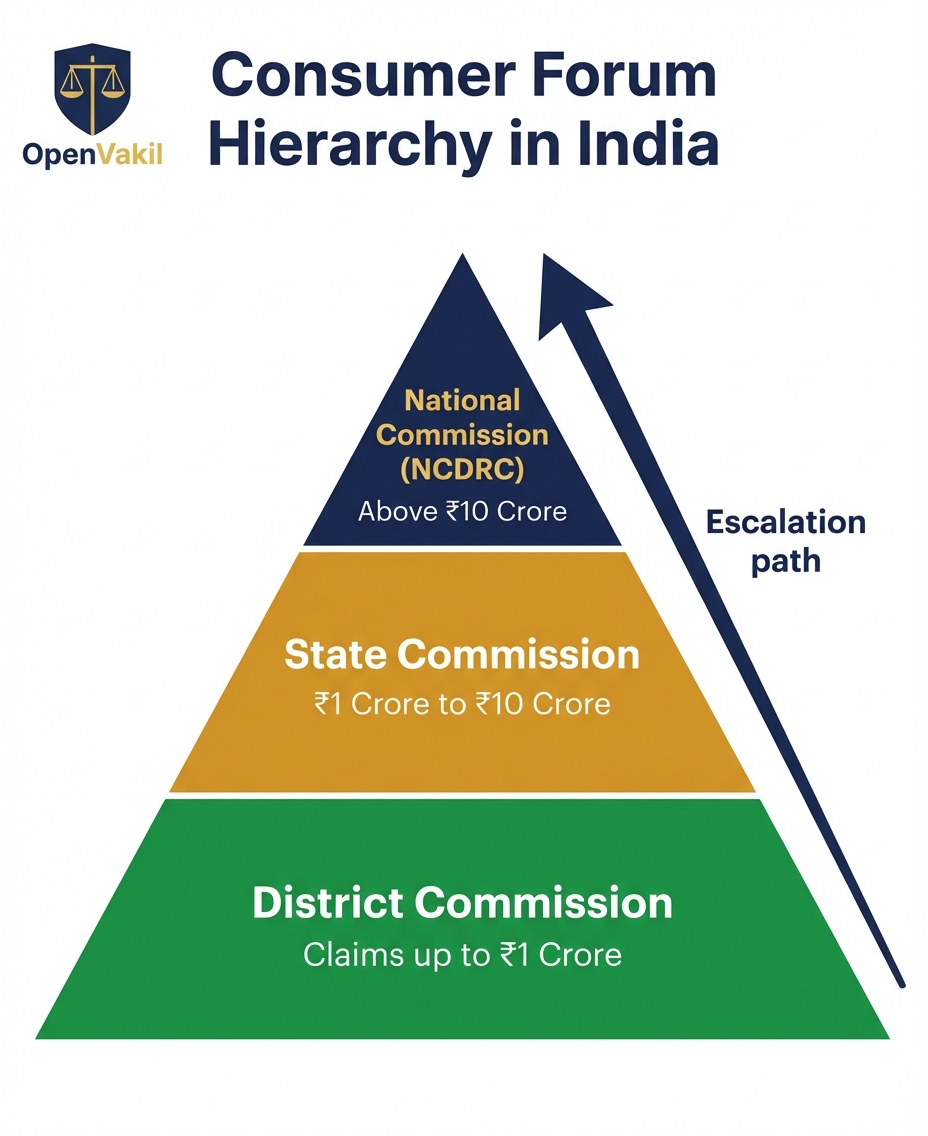
The Consumer Protection Act 2019 established a three-tier quasi-judicial mechanism for consumer dispute resolution. These commissions are designed to provide quick, affordable, and accessible justice to consumers. The jurisdiction of each commission depends on the value of goods or services and the compensation claimed.
District Consumer Disputes Redressal Commission
The District Commission is the first tier and handles complaints where the value of goods or services paid as consideration does not exceed Rs. 1 crore (Rs. 50 lakh prior to the 2019 amendment). It is established in each district and is typically the most accessible forum for everyday consumer disputes. Complaints can be filed in the district where the opposite party resides or carries on business, or where the cause of action arose.
State Consumer Disputes Redressal Commission
The State Commission handles complaints where the value of goods or services paid as consideration exceeds Rs. 1 crore but does not exceed Rs. 10 crore. It also hears appeals against orders of the District Commissions within the state. Each state and union territory has its own State Commission.
National Consumer Disputes Redressal Commission
The National Consumer Disputes Redressal Commission (NCDRC), headquartered in New Delhi, handles complaints where the value of goods or services paid as consideration exceeds Rs. 10 crore. It also hears appeals against orders of the State Commissions and has the power of judicial review over orders of State Commissions. Appeals against NCDRC orders lie before the Supreme Court of India.
Jurisdiction Summary
District Commission: Up to Rs. 1 crore | State Commission: Rs. 1 crore to Rs. 10 crore | National Commission: Above Rs. 10 crore. The pecuniary jurisdiction is determined by the value of goods/services and the compensation claimed, whichever is relevant.
Time Limit for Filing a Consumer Complaint
Under Section 69(1) of the Consumer Protection Act 2019, a consumer complaint must be filed within two years from the date on which the cause of action arose. The "cause of action" is typically the date when the defect or deficiency was discovered, or the date when the service provider failed to fulfil their obligation.
However, the consumer commission has the discretion to condone the delay if the complainant can show sufficient cause for not filing within the prescribed period. To invoke this provision, you must file a separate application along with your complaint explaining the reasons for the delay. Courts have generally been liberal in condoning delays when the consumer can demonstrate genuine reasons, but it is always advisable to file within the limitation period to avoid complications.
Do Not Delay
The two-year limitation period is strict. While condonation of delay is possible, it is not guaranteed. The moment you identify a consumer rights violation, begin documenting your evidence and send a legal notice promptly. Delayed action weakens both your legal position and negotiating power.
Remedies Available to Consumers
The Consumer Protection Act 2019 empowers consumer commissions to grant a wide range of remedies under Section 39. Depending on the nature of the complaint, the commission may order one or more of the following:
- Refund: Return of the price paid for the goods or services, along with interest from the date of the transaction.
- Replacement: Replacement of the defective product with a new one of the same or similar specification.
- Repair: Removal of defects from the goods at the cost of the opposite party.
- Compensation: Monetary compensation for the loss or injury suffered by the consumer due to the negligence of the opposite party.
- Punitive Damages: In cases involving gross negligence, fraud, or willful misconduct, the commission may award punitive (exemplary) damages to deter such behavior.
- Discontinuation of Unfair Trade Practices: An order directing the business to stop engaging in unfair trade practices or misleading advertisements.
- Adequate Costs: Litigation costs, including the fee paid for filing the complaint, postal charges for the legal notice, and reasonable lawyer fees.
- Corrective Advertisement: In cases of misleading advertisements, the commission can order the opposite party to issue a corrective advertisement at their own expense.
The object of the Consumer Protection Act is to provide for better protection of the interests of consumers and for that purpose to make provision for the establishment of consumer councils and other authorities for the settlement of consumers' disputes.
— Preamble, Consumer Protection Act 2019
E-Filing Consumer Complaints: E-Daakhil & Consumer Helpline
The Government of India has taken significant steps to digitize the consumer complaint process, making it easier for consumers to file complaints without physically visiting the consumer commission.
E-Daakhil (edaakhil.nic.in) is the official e-filing portal for consumer complaints. Launched by the Department of Consumer Affairs, it allows consumers to file complaints online with the District, State, and National Consumer Commissions. The platform enables you to upload your complaint, supporting documents, and pay the required fee electronically. You can track the status of your complaint online and receive notifications about hearing dates.
The National Consumer Helpline (NCH), reachable at toll-free number 1800-11-4000 or by dialing 1915, is a pre-litigation service that attempts to resolve consumer grievances through mediation and convergence with companies. If the matter is not resolved through NCH, the consumer can proceed to file a formal complaint. You can also register complaints through the NCH mobile app or the website consumerhelpline.gov.in.
E-Filing Advantage
E-Daakhil has made it possible to file consumer complaints from anywhere in India without visiting the commission in person. This is especially helpful for consumers in remote areas or those with mobility constraints. Ensure your documents are scanned clearly and your complaint is well-structured before uploading.
Tips for a Strong Consumer Complaint
The effectiveness of your consumer complaint -- whether it is a legal notice or a formal filing before the commission -- depends largely on how well it is prepared. Here are practical tips to strengthen your case:
- Document Everything from Day One: Preserve every piece of evidence -- purchase receipts, invoices, product packaging, warranties, terms of service, email confirmations, chat transcripts, and phone call records. Take photographs or videos of the defective product or substandard service.
- Maintain a Timeline: Create a clear chronological timeline of events -- when you made the purchase, when you discovered the defect, when you first complained, and what responses you received.
- Use Official Communication Channels: Always communicate through official channels (email, registered post, company's grievance portal) rather than verbal conversations. Written records are admissible evidence.
- Be Specific About the Relief You Seek: Clearly state whether you want a refund, replacement, repair, compensation, or a combination. Quantify the damages with supporting calculations.
- Cite Relevant Legal Provisions: Reference specific sections of the Consumer Protection Act 2019 that apply to your case. This demonstrates legal awareness and adds weight to your complaint.
- Keep Emotions Out: Present facts objectively. Avoid emotional appeals, threats, or hyperbole. Consumer commissions rely on evidence and legal merit, not sentiments.
- Include Expert Opinions Where Applicable: For complex cases like medical negligence or construction defects, include reports from independent experts or professionals.
- Set Realistic Expectations: Claim a reasonable amount of compensation backed by evidence of actual loss. Excessive or unjustified claims can hurt your credibility.
How OpenVakil Helps You Draft a Consumer Complaint Notice
Drafting an effective consumer complaint legal notice requires a clear understanding of consumer law, precise language, and proper formatting. OpenVakil simplifies this entire process by combining advanced AI technology with legal expertise.
With OpenVakil, you can generate a professional, legally sound consumer complaint notice in minutes. Simply answer a few guided questions about your grievance -- the product or service involved, the nature of the defect or deficiency, the relief you seek, and the details of the opposite party. Our AI engine drafts a comprehensive notice citing the relevant provisions of the Consumer Protection Act 2019, and our legal team reviews it for accuracy and completeness.
- AI-Powered Drafting: Get a professionally worded consumer complaint notice generated in minutes, tailored to the specifics of your case.
- Lawyer-Reviewed Quality: Every notice is reviewed for legal accuracy, ensuring it meets the standards expected by consumer commissions.
- Affordable & Transparent Pricing: Access legal notice drafting at a fraction of the cost of traditional lawyer fees, with no hidden charges.
- End-to-End Support: From drafting the notice to guidance on sending it and filing a formal complaint, OpenVakil supports you throughout the process.
- Digital Convenience: Complete the entire process online from your phone or computer -- no need to visit a lawyer's office.
Whether you are dealing with a defective smartphone, an unresolved insurance claim, a builder who failed to deliver your flat, or an e-commerce platform that refused a legitimate refund, OpenVakil equips you with the legal tools to assert your rights confidently and effectively.
Protect Your Consumer Rights Today
Don't let businesses get away with defective products or poor services. Draft a powerful consumer complaint legal notice with OpenVakil and take the first step toward justice.
Get Started for FreeConsumer protection is a fundamental right, and the law is firmly on the side of the consumer. Armed with the right knowledge, proper documentation, and a well-drafted legal notice, you can hold any business accountable. Remember -- a legal notice is often all it takes to resolve a dispute without the need for prolonged litigation. Take action today and safeguard your rights as a consumer.