You have a legitimate grievance. Someone owes you money, a cheque has bounced, a tenant refuses to vacate, or an employer has not paid your dues. You have heard that sending a legal notice is the first step — but a nagging question holds you back: does it actually work? Will the other party take it seriously, or will your notice end up in the dustbin while you are left with nothing but a postal receipt and wasted hope?
This is a valid concern. Legal notices cost time and money, and no one wants to invest in a step that produces no result. In this article, we set aside vague reassurances and look at what the data, legal provisions, and real-world case outcomes actually tell us about the effectiveness of legal notices in India. We examine success rates across different types of disputes, explain the psychological and legal mechanisms that make notices work, present anonymized case studies of actual outcomes, and — just as importantly — tell you honestly when legal notices do not work and what you can do to maximize your chances.
Do Legal Notices Actually Work? (The Big Question)
The short answer is: yes, in a significant majority of cases, they do. But the long answer requires nuance, because the outcome depends on the type of dispute, the strength of your claim, the quality of the notice, and the character and circumstances of the recipient.
A legal notice is not a court order. It does not compel the recipient to do anything. It cannot freeze bank accounts, seize property, or impose penalties. What it does do is communicate your grievance formally, put the recipient on notice that legal action will follow if they do not comply, and create a documented record that Indian courts take very seriously. The power of a legal notice lies not in its enforceability — but in its credibility as a precursor to enforceable legal action.
Most people who receive a well-drafted legal notice from an advocate understand one simple fact: ignoring it does not make the problem disappear. It makes the problem worse. And that understanding — combined with the cost, time, and reputational risk of defending a lawsuit — is what drives resolution at the notice stage in a large proportion of cases.
The Core Insight
A legal notice works not because it forces the other party to comply, but because it credibly signals that non-compliance will lead to formal legal proceedings. The stronger the signal -- through precise facts, correct legal citations, and a lawyer's letterhead -- the higher the likelihood of resolution.
Overall Success Rates: What the Numbers Say
India does not have a centralised government database that tracks legal notice outcomes. However, data from bar council surveys, legal aid organisations, legal technology platforms, and practising advocates provides a reasonably reliable picture. According to various industry estimates and practitioner surveys, approximately 40% to 60% of civil disputes in India are resolved — either fully or through negotiated settlement — after a legal notice is sent, without the matter ever reaching a courtroom.
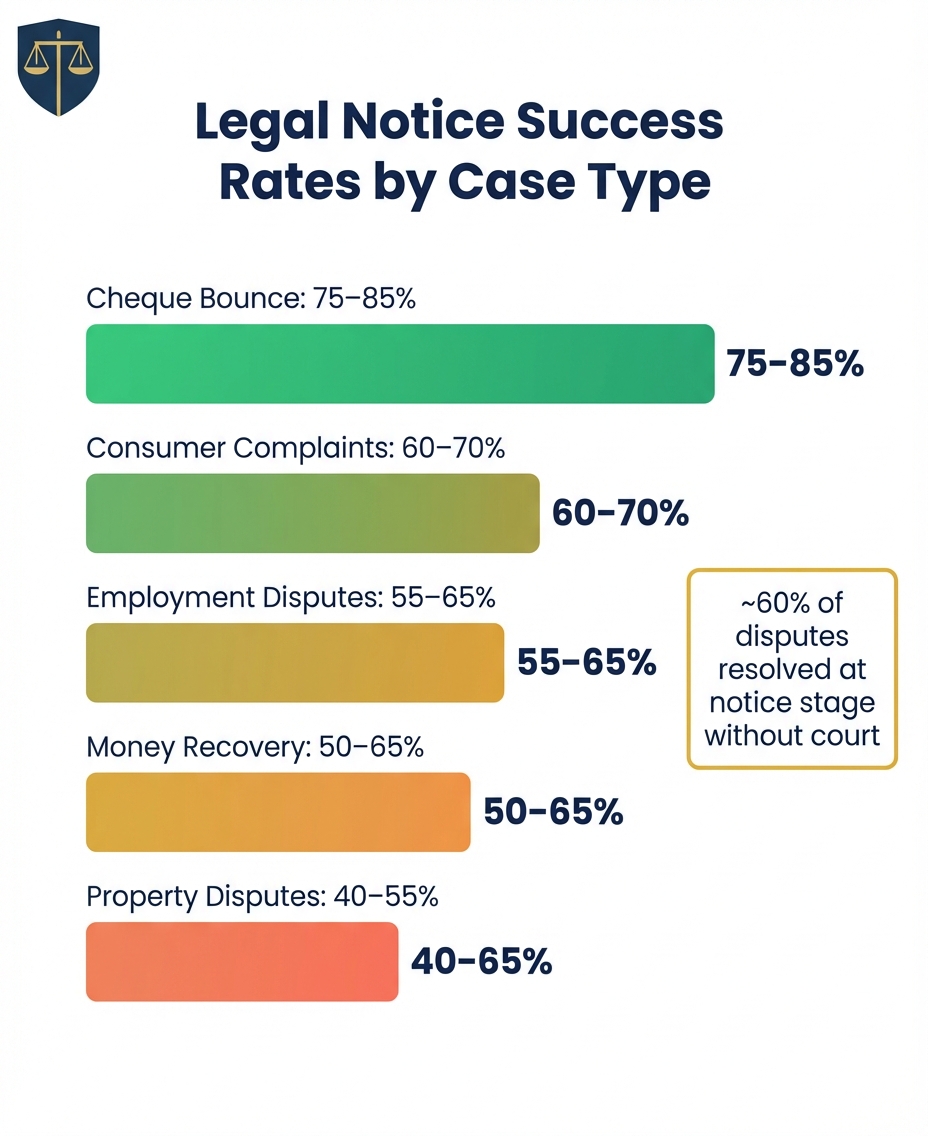
This figure varies significantly depending on the type of dispute. Some categories of notices enjoy substantially higher success rates, while others tend to require escalation to court. Here is a breakdown of estimated success rates by dispute type, drawn from legal industry data and practitioner experience:
Cheque Bounce Notice Success Rate
Estimated success rate: 60% to 70%
Cheque bounce notices under Section 138 of the Negotiable Instruments Act, 1881 have among the highest resolution rates of any legal notice category. This is because the consequences of ignoring a cheque bounce demand notice are severe and well-defined: the payee can file a criminal complaint that carries a punishment of up to 2 years imprisonment, or a fine up to twice the cheque amount, or both. The Supreme Court has also upheld provisions for interim compensation of up to 20% of the cheque amount under Section 143A and compensation up to twice the cheque amount on appeal under Section 148. Faced with these consequences, a substantial majority of cheque drawers choose to settle at the notice stage.
Money Recovery Notice Success Rate
Estimated success rate: 50% to 60%
Money recovery notices — demanding repayment of loans, outstanding invoices, unpaid professional fees, or other financial obligations under the Indian Contract Act, 1872 — have a moderate-to-high success rate. The outcome depends heavily on whether the debtor has the ability to pay and whether the underlying obligation is clearly documented. When the debt is supported by written agreements, promissory notes, invoices, or bank transfer records, the debtor recognises that a court case would likely go against them, and settlement becomes the rational choice. Success rates are lower when the debtor genuinely cannot pay or when the obligation is disputed.
Consumer Complaint Notice Success Rate
Estimated success rate: 45% to 55%
Consumer complaint notices sent to businesses under the Consumer Protection Act, 2019 have a variable success rate that depends largely on the size and type of the business. Large e-commerce companies, insurance firms, and branded consumer goods companies often have internal legal and customer escalation teams that respond to legal notices promptly to avoid complaints before Consumer Disputes Redressal Commissions and negative publicity. Smaller businesses or individual service providers may be less responsive. The growing awareness of consumer rights and the relative speed of consumer forums compared to civil courts has improved resolution rates in this category over the past few years.
Employment Dispute Notice Success Rate
Estimated success rate: 40% to 55%
Notices related to unpaid salary, wrongful termination, non-payment of gratuity under the Payment of Gratuity Act, 1972, or provident fund issues under the Employees' Provident Funds and Miscellaneous Provisions Act, 1952 have a moderate success rate. Established companies and large employers tend to respond to legal notices because they are conscious of their reputation, compliance obligations, and the risk of proceedings before Labour Courts or Tribunals. Smaller employers or those already in financial distress may be less responsive. The success rate is higher when the employee has clear documentation — appointment letters, salary slips, termination letters, and bank statements showing payment history.
Key Takeaway on Success Rates
Across all dispute categories, the single biggest factor that separates successful notices from unsuccessful ones is the quality of evidence supporting the claim. A legal notice backed by clear documentation -- contracts, receipts, bank statements, correspondence -- is far more likely to produce a favourable outcome than one based on verbal agreements or assumptions.
Why Legal Notices Are Effective
Understanding why legal notices work is just as important as knowing how often they work. The effectiveness of a legal notice is driven by a combination of psychological, legal, and practical factors.
The Psychological Impact
Receiving a legal notice is a jarring experience for most people. The formal language, the advocate's letterhead, the registered post delivery, and the explicit mention of legal consequences create a powerful psychological effect that informal reminders, phone calls, and WhatsApp messages simply cannot replicate.
- Fear of litigation: Most people in India have a strong aversion to court proceedings. They know that litigation is expensive, time-consuming, stressful, and uncertain. A legal notice that credibly threatens to initiate a lawsuit taps into this deep-seated fear and motivates compliance.
- Social and reputational pressure: In Indian society, receiving a legal notice carries a social stigma. The recipient may worry about family members, business partners, neighbours, or colleagues learning about the notice. For businesses, a legal notice can also trigger concerns about reputational damage and loss of goodwill.
- Disruption of normalcy: A legal notice forces the recipient to engage with the dispute in a formal, structured way. They need to consult a lawyer, understand the claims, evaluate their defence, and take a decision. This disruption of their normal routine creates a strong incentive to resolve the matter quickly.
- Perceived seriousness: When a notice is sent through an advocate via registered post, it signals that the sender is serious, has invested money in professional legal help, and is prepared to escalate. This perception alone resolves many disputes.
Legal Consequences of Ignoring a Notice
Beyond psychology, there are real legal consequences to ignoring a legal notice that make compliance the smarter option in most situations:
- Adverse inference in court: If the matter reaches court, the recipient's failure to respond to the notice can be presented as evidence. Courts may draw an adverse inference — presuming that the recipient had no defence to the claims made, which strengthens the sender's case.
- Mandatory prerequisite fulfilled: In cases under Section 138 of the NI Act (cheque bounce) and Section 80 of the CPC (suits against the government), the legal notice is a mandatory step. Ignoring it does not prevent the sender from filing a case — it actually triggers the right to file.
- Evidence of bad faith: A recipient who ignores a reasonable notice and forces the sender to incur the costs of litigation may be viewed unfavourably by the court. This can affect decisions on costs, interest, and even the quantum of compensation awarded.
- Loss of opportunity to settle: The notice period is often the cheapest and fastest window for the recipient to resolve the dispute. Once a case is filed, legal fees, court fees, and the time commitment escalate dramatically for both parties.
Courts View Notices Favourably
Indian courts have consistently encouraged the practice of sending legal notices before initiating proceedings. The Supreme Court of India, in Salem Advocate Bar Association v. Union of India (2005) 6 SCC 344, emphasised the importance of pre-litigation dispute resolution. Under the Mediation Act, 2023 and Section 12A of the Commercial Courts Act, 2015, parties are increasingly expected to attempt resolution before approaching the court. A legal notice serves as the most visible and credible evidence of such an attempt.
The sending of a legal notice demonstrates the bona fide intention of the aggrieved party to resolve the dispute amicably and gives the other party a fair opportunity to address the grievance. Courts look favourably upon parties who make genuine efforts to settle matters outside the courtroom.
— Principle Recognised in Indian Civil Jurisprudence
Give Your Dispute the Best Chance of Resolution
A well-drafted legal notice resolves 40-60% of disputes without ever going to court. OpenVakil's AI-powered platform creates precise, legally sound notices that maximize your chances of a favourable outcome.
Draft Your Legal NoticeCase Study Scenarios: Real Outcomes After Legal Notices
Data and statistics are useful, but nothing illustrates the effectiveness of a legal notice better than real scenarios. The following case studies are based on common patterns observed in legal practice across India. All names, specific amounts, and identifying details have been changed to protect privacy, but the situations, legal issues, and outcomes are representative of actual cases.
Case Study 1: Cheque Bounce Recovery
Situation: Mr. A, a small business owner in Pune, supplied goods worth Rs. 4,80,000 to a retailer. The retailer issued a post-dated cheque as payment, which was dishonoured by the bank with the endorsement "funds insufficient." Mr. A made several phone calls and personal visits to the retailer, who kept promising to pay "next week" but never did. After two months of delays, Mr. A was losing hope.
Notice sent: Mr. A engaged an advocate who sent a formal demand notice under Section 138 of the Negotiable Instruments Act, 1881 within the statutory 30-day window. The notice clearly stated the cheque number, date, amount, bank details, the date of dishonour, and the bank's return memo reference. It demanded payment of the full cheque amount within 15 days and warned that failure to pay would result in a criminal complaint carrying imprisonment of up to 2 years and a fine of up to twice the cheque amount.
Outcome: The retailer responded through his own advocate within 10 days, acknowledging the debt and requesting a 30-day extension to arrange the funds. Mr. A's advocate agreed to the extension on the condition that the retailer issue a fresh cheque along with a written acknowledgement of the debt. The retailer paid the full amount of Rs. 4,80,000 within the extended period. The dispute was resolved in approximately 45 days from the date of the notice, without filing a single court case.
Case Study 2: Tenant Eviction
Situation: Mrs. B owned a residential flat in Bangalore that she had rented out to a tenant under an 11-month rental agreement. The agreement expired, and the tenant refused to vacate despite multiple verbal requests. The tenant had also not paid rent for three months. Mrs. B needed the flat back for her son's personal use. The tenant was simply ignoring her calls.
Notice sent: A legal notice was drafted citing Section 106 of the Transfer of Property Act, 1882 and the relevant provisions of the Karnataka Rent Control Act. The notice demanded that the tenant (a) pay the three months' outstanding rent within 15 days; (b) vacate the premises within 30 days; and (c) hand over the keys and possession in a clean and habitable condition. The notice also mentioned that failure to comply would result in eviction proceedings before the Rent Controller and a civil suit for recovery of rent arrears with interest.
Outcome: The tenant, upon receiving the notice from an advocate via registered post, consulted his own lawyer and realised that his legal position was weak. He negotiated through his lawyer for a 45-day extension to find alternative accommodation, agreed to pay the outstanding rent immediately, and vacated the premises within the agreed timeframe. Mrs. B recovered the unpaid rent and regained possession of her flat without filing an eviction case — a process that could have taken 1 to 3 years through the courts.
Case Study 3: Unpaid Salary Dispute
Situation: Mr. C worked as a software developer at a mid-sized IT company in Hyderabad. He resigned after serving a two-month notice period as required by his employment contract. However, the company withheld his final two months' salary (approximately Rs. 1,60,000), his earned leave encashment, and his experience certificate. The HR department cited vague "pending clearances" and stopped responding to his emails.
Notice sent: The legal notice was addressed to the company's Managing Director and the HR Head. It cited the Payment of Wages Act, 1936, the Indian Contract Act, 1872, and the specific clauses of Mr. C's appointment letter regarding full and final settlement. The notice demanded payment of the withheld salary and leave encashment within 15 days, issuance of the experience certificate, and release of the Form 16 for tax filing purposes. It warned that non-compliance would result in a complaint before the Labour Commissioner and a civil suit for recovery.
Outcome: The company's legal department responded within 8 days. They processed the full and final settlement, released the withheld salary and leave encashment, and issued the experience certificate and Form 16 within 12 days of receiving the notice. The total cost to Mr. C was the notice drafting fee and postal charges — a fraction of what he recovered.
Case Study 4: Consumer Complaint Against an E-Commerce Platform
Situation: Ms. D purchased a laptop worth Rs. 72,000 from a major e-commerce platform. The laptop developed a screen defect within two weeks. She applied for a return and refund through the platform's customer service, but the return was rejected citing "physical damage" — a claim Ms. D disputed. After multiple customer service calls, emails, and social media complaints over six weeks, the platform refused to budge.
Notice sent: A legal notice was sent to the e-commerce platform's registered office address and its customer grievance officer, citing the Consumer Protection Act, 2019 (Sections 2(6), 2(9), and 2(42) defining consumer rights, defect, and unfair trade practice) and the Consumer Protection (E-Commerce) Rules, 2020. The notice demanded a full refund of Rs. 72,000 plus Rs. 10,000 as compensation for mental harassment and loss of productivity, within 15 days, failing which a complaint would be filed before the District Consumer Disputes Redressal Commission.
Outcome: The platform's legal team responded within 7 days, offering a full refund of the purchase amount and a discount coupon for future purchases. Ms. D accepted the refund (she declined the coupon). The matter was resolved within 3 weeks of sending the notice, compared to the 6 weeks she had already spent fighting through customer service channels with zero result.
Pattern Across Case Studies
Notice two common threads in all four case studies. First, the legal notice succeeded where informal approaches (phone calls, emails, personal visits) had failed. Second, the notices that worked were specific -- they cited exact amounts, dates, legal provisions, and consequences. Vague or generic notices rarely produce these outcomes.
When Legal Notices Don't Work
Honesty demands that we also address the situations in which a legal notice is unlikely to produce the desired result. Sending a notice is not a magic wand, and there are genuine scenarios where it will not resolve the dispute:
- The opponent has nothing to lose: A legal notice derives its power from the threat of legal action. If the recipient is already insolvent, bankrupt, or has no assets to attach, the threat of a lawsuit carries little weight. A person who is judgment-proof — meaning they have no property, income, or assets that can be seized to satisfy a court decree — has little incentive to comply with a notice.
- The claim is frivolous or weak: If your claim lacks a sound legal basis, the recipient (or their advocate) will recognise this and ignore the notice. A notice threatening a defamation suit over a fair and honest review, or demanding money without any contractual basis, will not produce results. In fact, a frivolous notice can backfire and expose you to a counter-claim for abuse of process.
- The matter requires an FIR, not a notice: For serious criminal offences such as theft, assault, fraud involving criminal breach of trust under Section 405 of the IPC (now Section 316 of the Bharatiya Nyaya Sanhita, 2023), or cheating under Section 420 of the IPC (now Section 318 of the BNS), the appropriate first step is to file a First Information Report (FIR) with the police, not to send a legal notice. A notice in such cases may actually give the accused time to destroy evidence or flee.
- Dealing with powerful entities without escalation strategy: Sending a legal notice to a large corporation, a government body, or a politically connected individual without a credible plan for follow-through can be ineffective. These entities deal with legal notices routinely and may not take yours seriously unless it is drafted by a reputed advocate and backed by a clear litigation or regulatory complaint strategy.
- The recipient is deliberately evasive: Some individuals change addresses, close businesses, or move jurisdictions to avoid service. While the law provides for deemed service under Section 27 of the General Clauses Act, 1897, tracking down an evasive recipient and proving service adds complexity and delay.
- Emotional or relationship disputes without clear legal claims: Disputes that are primarily emotional — family feuds, neighbourhood disagreements, personal grudges — often cannot be resolved through a legal notice because the underlying issue is not a legal right but a personal conflict. A notice in such cases may escalate rather than resolve the situation.
Be Honest About Your Case
Before sending a legal notice, assess your claim honestly. Do you have a genuine legal right that has been violated? Is there evidence to support your claim? Can the other party realistically comply with your demand? If the answer to any of these questions is no, a legal notice may not be the right tool, and you should consult an advocate about alternative approaches.
What Makes a Legal Notice More Effective
The difference between a legal notice that resolves a dispute and one that is ignored often comes down to how the notice is drafted and sent. Based on legal practice and outcome data, the following factors significantly increase the effectiveness of a legal notice:
- Specific and accurate facts: A notice that states the exact dates, amounts, transaction details, agreement references, and sequence of events is taken far more seriously than one that makes vague, general allegations. Specificity signals that you have a well-documented case and are prepared for court.
- Correct legal citations: Citing the precise sections of law applicable to your claim — whether it is Section 138 of the NI Act, Section 80 of the CPC, provisions of the Consumer Protection Act, 2019, or clauses of the Indian Contract Act, 1872 — demonstrates legal preparedness and makes the notice harder to dismiss.
- Sent through a qualified advocate: Notices drafted on an advocate's letterhead carry significantly more weight than self-drafted notices. The recipient knows that a lawyer has been retained, that the claim has been professionally evaluated, and that the sender is serious about pursuing legal action.
- Dispatched via registered post with acknowledgement due (RPAD): Registered post creates a legally admissible record of dispatch and delivery. Courts treat RPAD as the gold standard for service. Under Section 27 of the General Clauses Act, 1897, a notice sent by registered post is presumed to have been served.
- Reasonable deadline for compliance: A notice that gives the recipient 15 to 30 days to comply is taken more seriously than one that demands compliance within 24 or 48 hours. Unreasonable deadlines suggest emotional impulsiveness rather than legal strategy. Courts also expect senders to allow reasonable time.
- Credible threat of specific next steps: Instead of vague warnings like "legal action will be taken," effective notices specify the exact next step: "a criminal complaint will be filed before the Metropolitan Magistrate under Section 138 of the Negotiable Instruments Act" or "a complaint will be filed before the District Consumer Disputes Redressal Commission." Specificity makes the threat real.
- Copies sent to multiple channels: Sending the notice via registered post (primary) and supplementing with email and courier (secondary) creates multiple layers of proof and makes it impossible for the recipient to claim non-receipt.
What Makes a Legal Notice Less Effective
Just as certain practices increase effectiveness, the following mistakes actively undermine the impact of a legal notice and reduce the likelihood of a favourable outcome:
- Vague or unclear demands: A notice that says "pay the money you owe me" without specifying the exact amount, the basis of the obligation, or the timeline for payment gives the recipient room to ignore it or respond with counter-claims. Courts also view vague demands unfavourably.
- Empty threats with no follow-through plan: Threatening to file a "criminal case" for what is clearly a civil dispute, or threatening "action in the Supreme Court" for a matter worth Rs. 50,000, exposes the sender's lack of legal knowledge. If the recipient's lawyer recognises empty threats, the entire notice loses credibility.
- Wrong or outdated legal provisions: Citing repealed sections of the Indian Penal Code instead of the corresponding provisions of the Bharatiya Nyaya Sanhita, 2023, or referencing inapplicable statutes, signals that the notice was not drafted by a competent legal professional. This can embolden the recipient to ignore the notice.
- Sent to the wrong person or address: A notice addressed to a former director of a company instead of the current management, or sent to an old address when the recipient has moved, will never reach the right person. Even if deemed served, the practical impact is lost.
- Absence of supporting evidence: A notice that makes assertions without referring to any supporting documentation — no contract reference, no invoice number, no cheque details, no correspondence trail — appears unsubstantiated and weak.
- Emotional or abusive language: Using threatening, derogatory, or emotionally charged language in a legal notice is counterproductive. It weakens the notice's legal weight and can expose the sender to a counter-claim for criminal intimidation under Section 503 of the IPC (now Section 351 of the BNS) or defamation under Section 499 of the IPC (now Section 356 of the BNS).
- Sent only by email or WhatsApp without physical dispatch: While electronic communication is increasingly accepted, relying solely on email or WhatsApp for a legal notice is risky. Many courts still require proof of physical dispatch for statutory notices. Always supplement electronic channels with registered post.
A legal notice is a strategic document, not a venue for expressing frustration. Every sentence should advance your legal position and build your case for court, should it come to that.
— Legal Drafting Best Practices, Bar Council of India
The Cost-Benefit Analysis: Notice vs Litigation
One of the most compelling arguments in favour of sending a legal notice is the dramatic cost difference between the notice stage and full-blown litigation. Consider the following comparison:
- Cost of a legal notice: Depending on the dispute type and the platform or advocate you choose, a legal notice costs between Rs. 299 (on AI-assisted platforms like OpenVakil) and Rs. 10,000 to Rs. 25,000 (through traditional advocates in metro cities). Even at the higher end, this is a one-time expense with a 40-60% chance of resolving the dispute entirely.
- Cost of litigation: Filing a civil suit involves court fees (calculated as a percentage of the claim amount, which can be substantial for high-value claims), advocate fees (which can range from Rs. 25,000 to several lakhs depending on the case and advocate), documentation and evidence preparation costs, travel expenses for court appearances, and the opportunity cost of time spent over 3 to 10 years or more of proceedings.
- Time comparison: A legal notice process — from drafting to resolution — typically takes 30 to 60 days. A civil suit in an Indian district court can take 3 to 7 years for judgment at the trial stage, with an additional 2 to 5 years if appealed. Cheque bounce cases under Section 138 NI Act, despite being designed for expeditious disposal, often take 1 to 3 years in practice.
- Emotional and mental cost: Litigation is stressful. Repeated adjournments, procedural delays, cross-examination, and the uncertainty of outcome take a significant toll on mental health and personal well-being. Resolving a dispute at the notice stage avoids this entirely.
- Return on investment: If a Rs. 1,500 notice recovers Rs. 5,00,000 in unpaid dues without going to court, the return on investment is extraordinary. Even a Rs. 10,000 notice that avoids Rs. 2,00,000 in litigation costs over 5 years represents a sound financial decision.
The Math Is Clear
A legal notice is the highest-ROI legal step you can take. For a cost of Rs. 299 to Rs. 10,000, you have a 40-60% chance of resolving the dispute entirely. Even if the notice does not resolve the dispute, it creates essential documentation for court, demonstrates good faith, and strengthens your overall case. There is virtually no scenario in which a well-drafted legal notice makes you worse off.
How to Maximize Your Chances of Success
Based on everything discussed in this article — the data, the case studies, the factors that make notices more or less effective — here is a practical checklist to maximize the probability that your legal notice will produce a favourable outcome:
- Gather all evidence before drafting: Collect contracts, agreements, invoices, bank statements, cheque copies, dishonour memos, email correspondence, WhatsApp screenshots, and any other documents that support your claim. The stronger your documentation, the more powerful your notice.
- Choose the right legal professional or platform: For routine matters (cheque bounce, basic money recovery, standard consumer complaints), an affordable online platform like OpenVakil provides excellent value. For complex, high-stakes disputes involving property title, multi-party commercial claims, or sensitive corporate matters, consider engaging an experienced advocate who specialises in the relevant area of law.
- Ensure factual and legal accuracy: Every date, amount, name, and legal citation in the notice must be correct. Even a small error — the wrong cheque date, an incorrect section number, a misspelled name — can undermine the notice's credibility and create openings for the recipient to challenge it.
- Set a reasonable but firm deadline: Allow 15 to 30 days for compliance, depending on the nature of the demand and any applicable statutory requirements. A reasonable deadline demonstrates good faith and makes it harder for the recipient to argue that they were not given sufficient time.
- Send via registered post with acknowledgement due: This is non-negotiable. RPAD provides the legally admissible proof of dispatch and delivery that you will need if the matter goes to court. Supplement with email or courier for additional layers of proof.
- Have a clear escalation plan: Before sending the notice, decide what you will do if the recipient does not comply. Will you file a civil suit? A criminal complaint? A consumer forum complaint? A complaint with a regulatory authority? Knowing your next step in advance ensures that the threat in your notice is credible and that you can act quickly when the notice period expires.
- Do not delay: Statutory deadlines under the NI Act, CPC, Limitation Act, and other laws are strict. Delaying the notice can result in the permanent loss of your right to take legal action. Act as soon as you recognise the need for a notice.
- Maintain confidentiality: Do not discuss the notice or the dispute on social media, with mutual acquaintances, or in any public forum. Loose talk can create complications, give the recipient ammunition for counter-claims, and undermine the professional tone of your legal strategy.
Ready to Send a Legal Notice That Actually Works?
OpenVakil combines AI efficiency with legal expertise to deliver notices that resolve disputes. Specific facts, correct citations, proper dispatch — every element optimized for the best possible outcome. Start in minutes.
Get Started NowHow OpenVakil Increases Your Success Rate
The factors that make a legal notice effective — factual precision, correct legal citations, professional presentation, proper dispatch, and a credible escalation strategy — are exactly what OpenVakil is designed to deliver. Here is how our platform systematically improves the probability of a favourable outcome for every notice we help create:
- AI-powered precision: Our AI technology analyses your inputs and generates notices with specific facts, accurate calculations, and relevant legal provisions. The AI draws from a knowledge base that includes the Indian Contract Act, Negotiable Instruments Act, Consumer Protection Act, Transfer of Property Act, CPC, labour legislation, and hundreds of other statutes and case law references. This ensures that your notice is factually and legally precise from the start.
- Advocate review for legal soundness: Every notice can be reviewed by a qualified advocate from our panel who verifies the legal accuracy, strengthens the strategic positioning, and ensures compliance with all applicable statutory requirements. This hybrid AI-plus-lawyer approach combines the speed and consistency of technology with the judgment and expertise of legal professionals.
- Correct formatting and presentation: A notice that looks professional is taken more seriously. OpenVakil generates notices on properly formatted advocate letterheads with the standard structure that Indian courts and legal professionals recognise — including the subject line, factual narration, legal basis, specific demand, deadline, and consequences of non-compliance.
- Proper dispatch via registered post: We handle the dispatch of your notice via Registered Post with Acknowledgement Due (RPAD), creating the legally admissible proof of service that courts require. You receive tracking details and delivery confirmation on your dashboard.
- Tailored to your dispute type: Whether your notice involves a cheque bounce, money recovery, consumer complaint, tenant eviction, employment dispute, property issue, or any other category, OpenVakil tailors the content, legal citations, and demands to the specific type of dispute — because a one-size-fits-all notice is a weak notice.
- Affordable and accessible: Cost should never be a barrier to asserting your legal rights. OpenVakil makes professional-quality legal notices accessible to everyone — starting from just Rs. 299 for AI-assisted drafting. By removing the cost barrier, we enable individuals and small businesses to send notices that would otherwise require engaging an expensive advocate.
- Speed that preserves your rights: With AI-powered drafting, your notice can be ready within minutes of providing your details. This speed is critical when statutory deadlines are approaching — such as the 30-day window for a cheque bounce demand notice under Section 138 NI Act.
The question is no longer whether legal notices work in India. The data shows that they do — resolving 40% to 60% of disputes across categories, and even higher in specific categories like cheque bounce. The real question is whether your legal notice will work. And that depends entirely on how it is drafted, how it is sent, and whether it credibly communicates your readiness to escalate.
A vague, emotional, improperly cited notice sent via WhatsApp has a near-zero chance of success. A specific, factual, legally precise notice sent on an advocate's letterhead via registered post, with a clear demand and a credible threat of defined legal action, has the best possible chance of resolving your dispute without a single day in court.
The choice is yours. If you have a genuine grievance backed by evidence, a well-drafted legal notice is almost always worth the investment. It is the most cost-effective, time-efficient, and strategically sound first step you can take to protect your legal rights in India.