Introduction: The Real Journey Begins After the Notice
You have drafted a legal notice, had it reviewed, sent it via registered post, and confirmed delivery. Most guides on legal notices in India end at this point — but in reality, the most critical phase of the legal notice process begins after dispatch. What you do in the days and weeks following the notice often determines whether the dispute is resolved amicably, escalates into protracted litigation, or simply fades into uncertainty.
The period after sending a legal notice is filled with important decisions: How long should you wait for a response? What does it mean if the recipient ignores the notice entirely? What if they offer a partial settlement? What legal remedies become available once the notice period expires? And how do Indian courts actually view legal notices when cases reach trial?
This comprehensive guide covers everything that happens after you send a legal notice — the waiting period, the five possible outcomes, the legal remedies available to you, the specific timelines for different types of notices, and the critical mistakes that people make after sending a notice that can undermine their entire case. Whether you are pursuing a cheque bounce claim, money recovery, property dispute, consumer complaint, or any other civil or criminal matter, this guide will help you navigate the next steps with confidence.
A Legal Notice Is a Prerequisite, Not the End Goal
A legal notice is a formal demand and, in many cases, a statutory prerequisite before filing a case. It is not a court order, and it does not compel the recipient to comply. Its primary purpose is to communicate your grievance, demand a remedy, and demonstrate your bona fide intent to resolve the matter before approaching the court. What happens after the notice period expires is where the real legal strategy unfolds.
The Waiting Period: How Long Should You Wait?
After dispatching a legal notice, the law requires you to allow the recipient a reasonable period to respond before taking further legal action. The length of this waiting period depends on the type of notice, the nature of the dispute, and any statutory requirements that apply. Rushing to court before the notice period expires can result in your case being dismissed on procedural grounds — a costly and avoidable mistake.
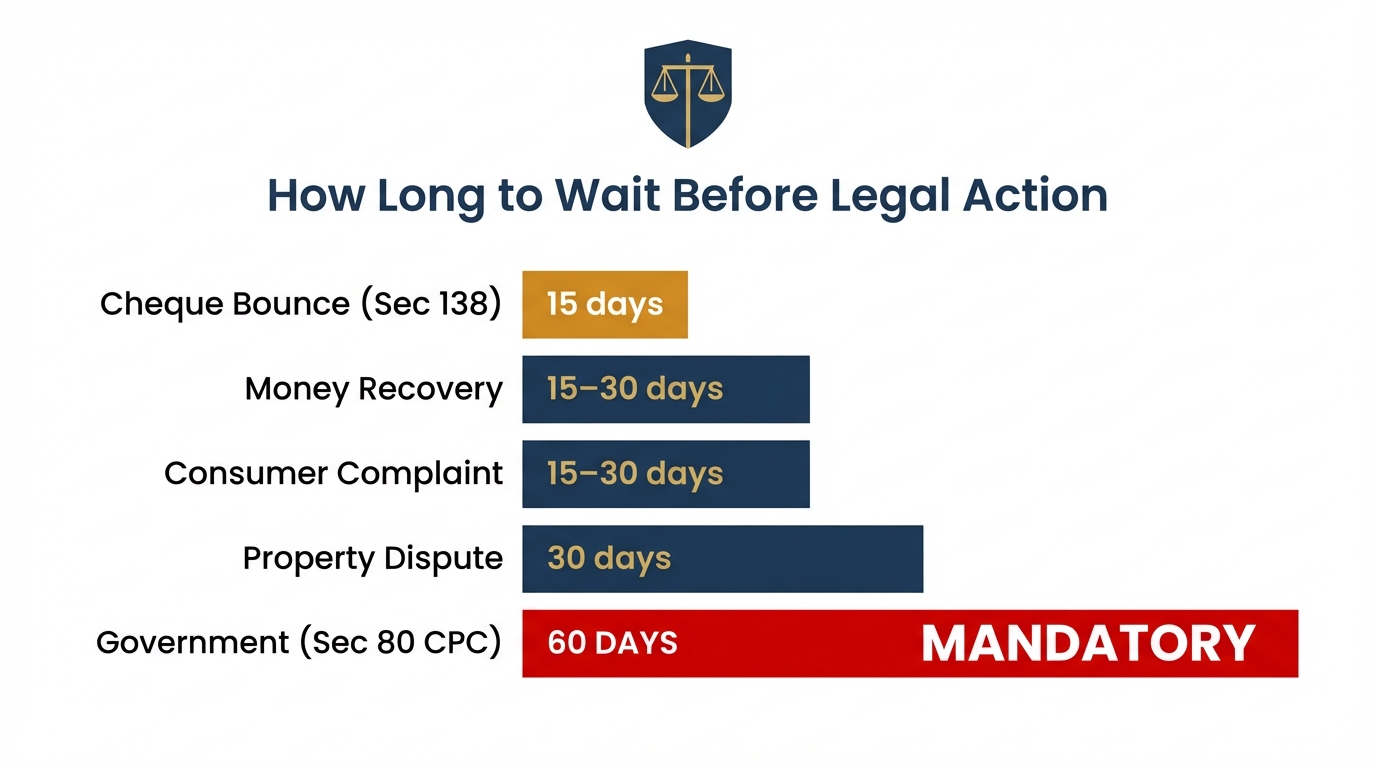
- General civil disputes (15 to 30 days): Most legal notices specify a response period of 15 to 30 days. This is the standard timeframe recognised in legal practice, giving the recipient sufficient time to consult an advocate, review the claims, and formulate a response.
- Cheque bounce under Section 138 NI Act (15 days): The Negotiable Instruments Act mandates a 15-day period from the date of receipt of the demand notice. If the drawer fails to make the payment within these 15 days, the payee can file a criminal complaint.
- Government bodies under Section 80 CPC (2 months): When the notice is addressed to a government authority, the Code of Civil Procedure requires a waiting period of two months from the date of service before a suit can be filed. Corresponding provisions are found under Section 82 of the Bharatiya Nagarik Suraksha Sanhita (BNSS), 2023.
- Consumer complaints (15 to 30 days): While the Consumer Protection Act, 2019 does not mandate a legal notice before filing a complaint, sending one with a 15 to 30-day response period demonstrates your attempt to resolve the matter and strengthens your case.
- RERA complaints (as specified): Notices to builders and developers under RERA typically allow 15 to 30 days for a response before approaching the RERA authority.
When Does the Clock Start?
A critical question that many people overlook is: when does the notice period actually begin? The answer depends on the specific statutory provision and the method of service:
- Date of receipt (general rule): In most cases, the notice period starts from the date the recipient actually receives the notice. This is evidenced by the acknowledgement due (AD) card returned by the post office with the recipient's signature and the date of delivery.
- Date of receipt under Section 138 NI Act: The Supreme Court held in C.C. Alavi Haji v. Palapetty Muhammad (2007) that the 15-day period starts from the date the notice is received by the drawer, not the date of dispatch. However, if the notice is sent to the correct address and is returned unclaimed, it is deemed to have been served.
- Deemed service: If the notice is sent to the correct address via registered post and is returned with an endorsement such as "refused," "not claimed," or "addressee left," courts in India generally treat the notice as deemed served. The notice period starts from the date the notice was available for collection or the date it was returned.
- Section 27 of the General Clauses Act, 1897: This provision creates a presumption that service is deemed complete when a letter is properly addressed, pre-paid, and posted by registered post, unless the contrary is proved.
Document the Date of Receipt Carefully
The date of receipt is the starting point for calculating the notice period. If you cannot prove when the recipient received the notice, you may face disputes about whether sufficient time was allowed before filing a case. Always send notices via RPAD and preserve the acknowledgement card and tracking records as evidence.
Tracking Delivery via RPAD
Registered Post with Acknowledgement Due (RPAD) is the gold standard for sending legal notices in India because it provides legally admissible proof of both dispatch and delivery. Here is how to track and document delivery:
- Postal receipt: When you dispatch the notice via RPAD at the post office, you receive a receipt with a unique tracking number. Preserve this receipt — it proves that the notice was dispatched on a specific date.
- India Post tracking: Use the tracking number on the India Post website (indiapost.gov.in) to monitor the delivery status. The system records when the article was booked, dispatched, arrived at the destination office, and delivered.
- Acknowledgement Due (AD) card: This is the green card attached to the registered article. When the recipient takes delivery, they sign the AD card with the date of receipt. The card is then returned to the sender by the post office. This signed card is the strongest proof of service available.
- Follow up with the post office: If the AD card is not returned within 2 to 3 weeks, visit your local post office with the tracking number to inquire about the delivery status. Sometimes the AD card is delayed in transit even after successful delivery.
- Obtain a delivery certificate: If the AD card is lost or delayed, you can request a delivery certificate from the post office, which confirms the date and details of delivery from their records.
5 Possible Outcomes After Sending a Legal Notice
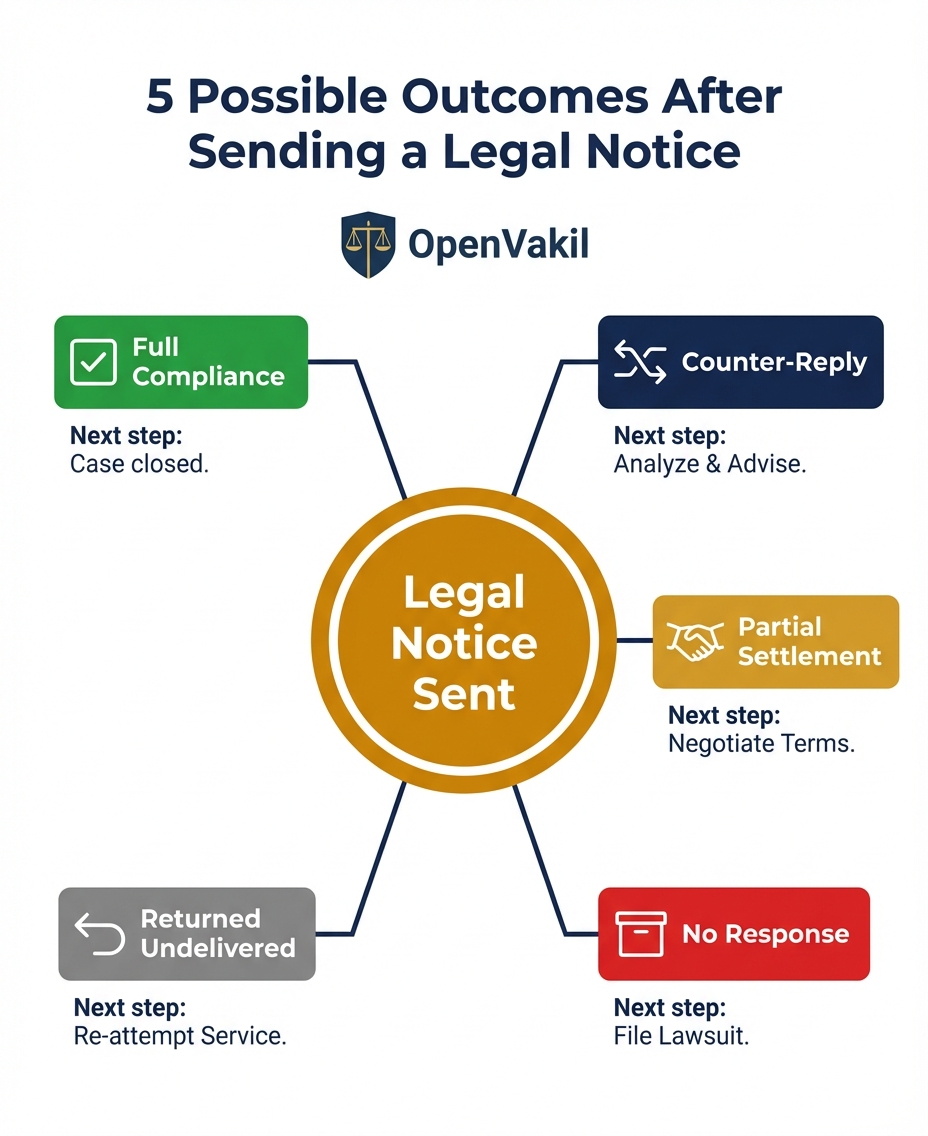
Once the legal notice has been delivered and the waiting period begins, one of five outcomes will typically unfold. Understanding each outcome and knowing how to respond is essential for protecting your legal rights and advancing your case effectively.
Outcome 1: Recipient Complies Fully
This is the ideal outcome. The recipient receives the notice, recognises the legitimacy of your claim, and takes the action demanded — whether it is paying the outstanding amount, vacating a property, ceasing an infringing activity, or fulfilling a contractual obligation. Full compliance resolves the dispute without the need for further legal proceedings.
What to do when the recipient complies:
- Verify the compliance: Confirm that the recipient has actually fulfilled the demand completely. If the demand was for payment, verify that the full amount (including any interest or costs demanded) has been received. If the demand was for an action, confirm that the action has been completed to your satisfaction.
- Document the compliance: Obtain written confirmation or acknowledgement from the recipient that they have complied with the demands of the notice. This prevents future disputes about whether compliance was achieved.
- Issue a receipt or acknowledgement: If payment has been received, issue a formal receipt. If the dispute involved a contractual obligation, consider executing a written settlement or release deed that confirms the matter is resolved.
- Preserve all records: Keep copies of the original notice, proof of delivery, the compliance documentation, and any correspondence exchanged. These records are essential if the recipient later claims the matter was not resolved or attempts to re-open the dispute.
- Withdraw or close the matter: If the compliance is complete and satisfactory, you may send a formal communication confirming that the dispute stands resolved and that no further legal action will be taken.
Always Get Compliance in Writing
Verbal promises to comply are not enough. If the recipient says they will pay or take the demanded action, insist on a written confirmation with a specific timeline. Many disputes re-surface because the sender accepted oral assurances that were never followed through.
Outcome 2: Recipient Sends a Reply or Counter-Notice
A common outcome is that the recipient responds with a formal reply through their advocate, either refuting your claims, raising counter-arguments, or presenting their version of the facts. In some cases, the recipient may go further and send a counter-notice making their own claims against you.
How to evaluate the reply:
- Analyse the reply carefully with your advocate: Read every paragraph of the reply and compare it against your original notice. Identify which of your claims the recipient has admitted, which they have denied, and what new facts or defences they have raised.
- Assess the strength of their defences: Are the recipient's counter-arguments legally sound? Do they cite relevant legal provisions? Are their factual claims supported by evidence, or are they making vague, unsupported assertions?
- Identify admissions: Sometimes the reply contains inadvertent admissions that actually support your case. For example, a recipient who denies breach of contract but admits to receiving the goods or services has effectively confirmed the existence of the contract and the delivery of consideration.
- Determine if negotiation is viable: The reply may indicate a willingness to negotiate even if it does not expressly accept your demands. Look for language suggesting a desire to resolve the matter amicably, openness to discussion, or proposed alternative terms.
- Decide on next steps: Based on your advocate's analysis, decide whether to (a) send a rejoinder notice addressing the reply, (b) initiate settlement negotiations, or (c) proceed to file a case in the appropriate court or forum.
The exchange of notices between parties is not merely a formality — it is the foundation of the documentary record that courts rely upon to understand the dispute, the positions of the parties, and the efforts made towards resolution before litigation.
— Principle Recognised in Indian Civil Jurisprudence
Outcome 3: Recipient Offers Partial Settlement
In many cases, the recipient will not accept your demands in full but will offer a partial settlement — for example, paying a portion of the claimed amount, agreeing to some but not all of your conditions, or proposing modified terms. This is one of the most nuanced outcomes and requires careful consideration.
Should you accept a partial settlement? Consider the following factors:
- Strength of your case: How strong is your legal position? If your case has weaknesses — gaps in evidence, limitation concerns, jurisdictional issues — a partial settlement may be better than risking an adverse judgment.
- Cost of litigation: Litigation in India is expensive and time-consuming. Court fees, advocate fees, travel, documentation, and the opportunity cost of time spent on the case can sometimes exceed the amount in dispute. A partial settlement may offer better value than a full trial.
- Time to resolution: Indian courts are burdened with significant backlogs. A civil suit may take 5 to 10 years (or more) to reach final judgment, including appeals. A partial settlement today may be worth more than a full recovery several years from now.
- Enforceability: Even if you win a court judgment, enforcing it (actually recovering the money or compelling the action) can be a separate, protracted process. A voluntary partial settlement is immediately enforceable.
- Relationship considerations: If the dispute involves a business partner, employer, tenant, family member, or ongoing commercial relationship, a partial settlement that preserves the relationship may be preferable to adversarial litigation.
- Tax and accounting implications: In commercial disputes, the timing and amount of recovery can have tax implications. Consult your accountant or tax adviser before accepting a settlement.
Document Any Settlement in Writing
If you accept a partial settlement, execute a formal settlement agreement or compromise deed that clearly specifies the amount accepted, the terms of payment, the timelines, and a clause stating that the matter stands fully and finally resolved upon compliance. Without a written agreement, the recipient may later dispute the terms or you may lose your right to claim the remaining amount.
Outcome 4: Recipient Ignores the Notice Completely
This is one of the most common outcomes, and understandably one of the most frustrating for the sender. The notice was delivered, the waiting period has expired, and the recipient has not responded at all — no reply, no payment, no action, no communication whatsoever.
What does ignoring a legal notice mean legally?
- It is not a criminal offence: There is no law in India that makes it a crime to ignore a legal notice. The recipient is not obligated to reply unless a specific statute requires it.
- Adverse inference in court: When the matter reaches court, the recipient's failure to respond to the legal notice can be presented as evidence. Courts may draw an adverse inference — meaning they may presume that the recipient had no defence, accepted the allegations, or was acting in bad faith by not engaging with the dispute.
- Demonstrates sender's bona fide intent: Your legal notice, combined with proof of delivery and the recipient's silence, demonstrates to the court that you made a genuine effort to resolve the matter amicably before resorting to litigation. This is viewed favourably by courts.
- Strengthens your case for costs: If the court ultimately rules in your favour, the recipient's failure to respond to the legal notice may be considered when awarding costs. Courts may impose higher costs on a party who forced the sender into litigation by refusing to engage.
- Triggers your right to file a case: The expiry of the notice period without compliance triggers your right to pursue the legal remedies available under the applicable law — civil suit, criminal complaint, tribunal complaint, or other forum.
Your options when the notice is ignored:
- Send a reminder or follow-up notice: In some cases, sending a second notice (a "reminder notice") giving a final opportunity to comply may be appropriate, particularly in commercial disputes where you want to demonstrate every reasonable effort was made.
- Proceed to file a case: If the notice period has expired and the recipient has not complied, you are entitled to file a suit, complaint, or petition in the appropriate court or forum. The legal notice and proof of non-response will be part of your case.
- Explore alternative dispute resolution: Before filing a case, consider whether mediation or arbitration (if the agreement contains an arbitration clause) might be a faster and more cost-effective route.
The failure of the defendant to reply to the legal notice and to comply with the demand therein is a relevant circumstance that the court can take into consideration while deciding the suit. It shows that the defendant was not willing to address the plaintiff's grievance despite being given a fair opportunity to do so.
— Principle from Indian Civil Court Jurisprudence
Outcome 5: Notice Is Returned Undelivered
Sometimes the legal notice is returned by the post office without being delivered to the recipient. The endorsement on the returned envelope provides critical information about why delivery failed and determines your next steps:
- "Refused": The recipient was available but deliberately refused to accept the notice. In this case, courts treat the notice as deemed served. The refusal itself is evidence of the recipient's attempt to evade service.
- "Not claimed" or "Unclaimed": The postal authorities attempted delivery, but the recipient did not collect the notice from the post office. Courts generally treat this as deemed served if the notice was sent to the correct address.
- "Addressee left" or "Left without address": The recipient is no longer at the given address. You will need to make efforts to locate the recipient's current address and re-send the notice.
- "Insufficient address" or "No such address": The address was incorrect or incomplete. Verify the address and re-send the notice to the correct address.
- "House locked": The recipient's premises were locked when the postman attempted delivery. If this happens repeatedly, courts may still consider the notice as having been tendered.
Steps to take when a notice is returned undelivered:
- Preserve the returned envelope: Do not open or discard the returned envelope. The postal endorsement on the returned article is evidence of the attempted service.
- Re-send to an alternative address: If you have the recipient's alternative address (office, registered office of a company, permanent address), re-send the notice via RPAD to that address.
- Send via courier and email: As supplementary measures, send the notice via a reputed courier service and by email to the recipient's known email address. While these may not constitute formal service in all cases, they strengthen the overall case for deemed service.
- Publication notice (in extreme cases): In certain proceedings, if the recipient cannot be located despite reasonable efforts, service by publication in a newspaper may be permitted by the court.
- Proceed with deemed service: If the notice was sent to the last known correct address and was returned as "refused" or "unclaimed," you can proceed with filing a case. Present the returned envelope and tracking records to the court as evidence of deemed service under Section 27 of the General Clauses Act, 1897.
Deemed Service Under Section 27, General Clauses Act
Section 27 of the General Clauses Act creates a legal presumption that service is complete when a document is properly addressed, pre-paid, and posted by registered post. This means that even if the recipient deliberately refuses or avoids collecting the notice, the law treats it as served. This principle has been upheld by the Supreme Court in numerous cases, including under Section 138 of the Negotiable Instruments Act.
Notice Sent but No Response? Know Your Next Steps
If your legal notice has been ignored or the recipient has not complied, OpenVakil can help you understand your legal options and guide you on the most effective path forward — whether it is sending a follow-up notice, initiating settlement discussions, or preparing to file a case.
Explore Your OptionsLegal Remedies After the Notice Period Expires
Once the notice period has expired and the recipient has failed to comply with your demands, a range of legal remedies becomes available to you. The appropriate remedy depends on the nature of the dispute, the applicable law, the amount involved, and the relief you seek.
Filing a Civil Suit
A civil suit is the most common legal remedy for disputes involving breach of contract, money recovery, property disputes, and other civil wrongs. The suit is filed in the appropriate civil court based on the subject matter, the pecuniary value of the claim, and the territorial jurisdiction. Key considerations include:
- Pecuniary jurisdiction: The value of the claim determines whether the suit is filed in the District Court, the City Civil Court, or (for lower amounts) the Court of the Senior Civil Judge or the Small Causes Court.
- Territorial jurisdiction: The suit must generally be filed where the cause of action arose, where the defendant resides, or where the defendant carries on business, in accordance with Sections 15 to 20 of the CPC.
- Court fees: Civil suits require the payment of court fees calculated as a percentage of the claim amount. These fees can be significant for high-value claims.
- Limitation period: You must file the suit within the limitation period prescribed by the Limitation Act, 1963 (e.g., 3 years for breach of contract, money recovery, etc.). The legal notice does not extend or toll the limitation period.
- Interim relief: You can apply for interim orders such as temporary injunctions, attachment before judgment, or appointment of a receiver to protect your interests while the suit is pending.
Criminal Complaint Under Section 138 NI Act
For cheque bounce cases, the legal notice under Section 138 of the Negotiable Instruments Act is a mandatory prerequisite before filing a criminal complaint. The statutory framework is precise:
- Cheque is returned unpaid (dishonoured): The payee becomes aware of the dishonour.
- Demand notice sent within 30 days: The payee must send a written demand notice to the drawer within 30 days of receiving information of the dishonour.
- 15-day waiting period: The drawer has 15 days from the receipt of the demand notice to make the payment.
- File complaint within 30 days: If the drawer does not make the payment within 15 days, the payee must file a criminal complaint before the Magistrate within 30 days of the expiry of the 15-day period. Missing this 30-day window can be fatal to the prosecution.
The offence under Section 138 is punishable with imprisonment for up to 2 years, or a fine up to twice the cheque amount, or both. Courts under the NI Act also have the power to award compensation to the complainant under Section 143A (interim compensation of up to 20% of the cheque amount) and Section 148 (up to twice the cheque amount on appeal).
Consumer Forum Complaint
Under the Consumer Protection Act, 2019, if the dispute involves deficiency in service, defective goods, unfair trade practices, or restrictive trade practices, you can file a complaint before the appropriate Consumer Disputes Redressal Commission:
- District Commission: For claims up to Rs. 1 crore.
- State Commission: For claims between Rs. 1 crore and Rs. 10 crore.
- National Commission: For claims exceeding Rs. 10 crore.
Consumer complaints are relatively faster and less expensive than civil suits. The legal notice you sent serves as evidence of your attempt to resolve the matter and strengthens your complaint. Complaints can now be filed online through the e-daakhil portal (edaakhil.nic.in). The limitation period for filing a consumer complaint is 2 years from the date of the cause of action.
Labour Court and Employment Tribunals
For employment-related disputes — wrongful termination, non-payment of salary, denial of gratuity, provident fund disputes, or workplace harassment — the remedy lies before the Labour Court, Industrial Tribunal, or the appropriate authority under the relevant employment legislation (Industrial Disputes Act, 1947; Payment of Gratuity Act, 1972; Employees' Provident Funds and Miscellaneous Provisions Act, 1952; or the new labour codes). A legal notice to the employer is an important step in demonstrating that you sought resolution before approaching the tribunal.
RERA Authority Complaint
For disputes related to real estate — delayed possession, deviation from sanctioned plans, defective construction, or non-registration of projects — the Real Estate (Regulation and Development) Act, 2016 provides for complaints before the State RERA Authority and the RERA Appellate Tribunal. The legal notice to the builder or developer serves as proof of your demand for compliance and your attempt at resolution. RERA adjudicating officers can award compensation and direct compliance within defined timelines.
Arbitration and Mediation
If the agreement or contract between the parties contains an arbitration clause, the dispute may need to be referred to arbitration under the Arbitration and Conciliation Act, 1996, rather than (or before) filing a civil suit. The legal notice can serve as a demand for arbitration if drafted appropriately. Mediation is another alternative dispute resolution mechanism that is faster, less adversarial, and often mandated by courts before trial under Section 12A of the Commercial Courts Act (for commercial disputes) and under the Mediation Act, 2023.
Timeline for Different Types of Notices
Each type of legal notice follows its own timeline, governed by different statutes and legal principles. Understanding these timelines is critical to preserving your right to legal action.
Cheque Bounce Notice Timeline
The cheque bounce timeline under Section 138 of the Negotiable Instruments Act is the most strictly regulated:
- Day 0: Cheque is presented to the bank and returned unpaid (dishonoured) for insufficiency of funds or any reason covered under Section 138.
- Within 30 days of dishonour: The payee must send a written demand notice to the drawer demanding payment of the cheque amount.
- 15 days from receipt of notice: The drawer has 15 days from the date of receipt of the notice to make the payment. If the drawer pays within this period, no criminal complaint can be filed.
- Within 30 days of expiry of the 15-day period: If the drawer fails to pay, the payee must file a criminal complaint under Section 138 before the competent Magistrate within 30 days. This deadline is crucial — the Supreme Court in Sadanandan Bhadran v. Madhavan Sunil Kumar (1998) held that the complaint must be filed within this period, though courts can condone delay in exceptional circumstances.
- Total framework: The complete cycle is approximately 30 + 15 + 30 = 75 days from the date of cheque dishonour to the final deadline for filing the complaint.
Money Recovery Notice Timeline
- Notice period: Typically 15 to 30 days from receipt.
- Limitation for filing suit: 3 years from the date the cause of action arises (e.g., the date the payment was due, the date of breach). This is governed by the Limitation Act, 1963.
- Summary suit option: For claims based on a written contract, bills of exchange, or promissory notes, you may file a summary suit under Order XXXVII CPC, which provides a faster procedure with limited defence opportunities for the defendant.
Property Dispute Notice Timeline
- Notice period: 15 to 30 days from receipt.
- Limitation for filing suit: Varies based on the specific claim — 3 years for possession based on title, 12 years for possession of immovable property, 3 years for specific performance of contract, and so on under the Limitation Act.
- Urgent relief: In property disputes involving encroachment, illegal construction, or threatened demolition, you can seek urgent interim injunctions from the court even during the notice period, if immediate harm is threatened.
Consumer Complaint Notice Timeline
- Notice period: 15 to 30 days (no mandatory notice period under the Consumer Protection Act, 2019, but sending a notice is recommended).
- Limitation for filing complaint: 2 years from the date of the cause of action under Section 69 of the Consumer Protection Act, 2019.
- Key advantage: Consumer forums are designed to be less formal and more consumer-friendly than civil courts. No advocate is mandatory, though having one is advisable for complex cases.
Section 80 CPC Notice Timeline (Government Bodies)
When your dispute is with the Central Government, State Government, or a public officer acting in their official capacity, Section 80 of the CPC (and corresponding provisions under the BNSS for criminal matters) imposes a mandatory notice requirement:
- Mandatory 2-month notice period: The notice must be served at least 2 months before filing the suit. This period allows the government to investigate the claim and potentially settle it without litigation.
- Urgent exception: If urgent or immediate relief is required (e.g., to prevent demolition, to restrain government action), the court may permit filing the suit without waiting for the full 2-month period, provided the notice has been served and the court is satisfied that waiting would cause irreparable harm.
- Consequences of non-compliance: Filing a suit against the government without serving the mandatory Section 80 notice, or without waiting for the 2-month period, can result in the suit being dismissed at the threshold.
Missing Statutory Deadlines Can Be Fatal
Unlike general civil disputes where timelines are flexible, statutory deadlines under the NI Act (Section 138), CPC (Section 80), and other specific legislation are strictly enforced. Missing the deadline to file a complaint or suit after the notice period expires can permanently extinguish your right to legal action. Always calendar these deadlines and track them diligently.
How Courts View Legal Notices
Understanding how Indian courts treat legal notices can help you appreciate why the post-notice phase is so important. A legal notice is not just a letter — it is a document with significant evidentiary and procedural implications in court.
Evidentiary Value of Legal Notices
- Admissible as evidence: A legal notice, along with its postal receipt and acknowledgement due card, is admissible as documentary evidence in court proceedings under the Indian Evidence Act, 1872 (now the Bharatiya Sakshya Adhiniyam, 2023).
- Establishes the factual narrative: The facts and allegations stated in the notice establish the sender's version of events at a specific point in time. This is important because courts assess the consistency of a party's case from the notice stage through to the trial.
- Demonstrates bona fide intent: Courts view the sending of a legal notice as evidence that the party made a genuine attempt to resolve the dispute before resorting to litigation. This demonstrates good faith and can influence the court's discretion on matters like costs, interim relief, and the overall assessment of the case.
- Non-response creates adverse inference: As discussed earlier, the recipient's failure to reply to the notice can be used against them. While silence alone is not an admission, combined with other evidence, it can support the inference that the recipient had no defence.
- Inconsistencies matter: If the recipient's defence in court contradicts their reply to the legal notice (or lack thereof), the court will note the inconsistency. This is why the reply to a legal notice is a critical document that can determine the outcome of subsequent proceedings.
Mandatory vs Optional Notices
Not all legal notices are created equal. The law distinguishes between notices that are mandatory prerequisites to filing a case and notices that are optional but advisable:
- Mandatory notices: Section 138 NI Act (cheque bounce — demand notice is a prerequisite to filing a criminal complaint), Section 80 CPC (notice to government before filing suit), Section 106 Transfer of Property Act (notice to quit before eviction proceedings), and various provisions under specific statutes that require prior notice.
- Optional but highly advisable: Most civil disputes (money recovery, breach of contract, property disputes, defamation, etc.) do not require a mandatory legal notice before filing a suit. However, sending one is strongly recommended because it demonstrates bona fide intent, may lead to settlement, and creates a strong evidentiary foundation for your case.
- Practical impact: Courts are increasingly favouring parties who attempt resolution before litigation. The Mediation Act, 2023 and various amendments to procedural codes encourage pre-litigation resolution. A legal notice is the first and most visible step in this direction.
Where a notice is not mandatory, the court cannot dismiss a suit for want of notice. However, the absence of a prior notice may affect the court's assessment of the plaintiff's intent to resolve the matter amicably and may be relevant to the question of costs.
— General Principle of Indian Civil Procedure
Common Mistakes After Sending a Legal Notice
Many people invest significant effort in drafting and sending a legal notice but then make critical errors in the post-notice phase that weaken or destroy their case. Here are the most common mistakes to avoid:
- Not following up on delivery status: Sending the notice and forgetting about it is a recipe for disaster. Track the delivery status, ensure the AD card is returned, and follow up with the post office if needed. If you cannot prove delivery, you may not be able to prove service.
- Accepting verbal promises instead of written compliance: The recipient calls you and says "I will pay next week" or "I will fix the issue soon." You believe them and wait. Weeks turn into months, and you have no documentary proof of their promise. Always insist on written commitments with specific timelines.
- Missing the filing deadline after the notice period: This is particularly devastating in cheque bounce cases where you have only 30 days after the expiry of the 15-day period to file the complaint. Mark the deadline in your calendar and prepare the complaint in advance.
- Destroying or misplacing evidence: After sending the notice, some people become careless with their evidence — deleting emails, discarding receipts, losing contracts, or overwriting digital records. Preserve all evidence meticulously from the moment the dispute arises through the conclusion of any proceedings.
- Discussing the case on social media or publicly: Posting about the dispute on social media, making public accusations, or discussing the matter with people unrelated to the case can create problems. The recipient may use your public statements against you, and you could face a counter-claim for defamation.
- Engaging directly with the recipient without legal advice: After sending the notice through an advocate, some people then contact the recipient directly to "work things out." Direct communication can lead to inadvertent admissions, emotional confrontations, and statements that undermine the carefully crafted legal position in the notice.
- Failing to act after the notice period expires: Some people send a legal notice and then take no further action, hoping the notice alone will resolve the matter. If the recipient has not complied, you must be prepared to follow through with legal proceedings. A notice without follow-through loses credibility — for this dispute and for any future disputes with the same party.
- Not considering the limitation period: While you wait for a response and weigh your options, the limitation period for filing a suit continues to run. Do not let the limitation period expire while you are deciding what to do. Consult your advocate promptly about filing deadlines.
Create a Post-Notice Checklist
After sending a legal notice, maintain a checklist: (1) Confirm delivery and preserve the AD card, (2) Mark the deadline for filing a case in your calendar, (3) Preserve all evidence and documents, (4) Do not communicate directly with the recipient without legal advice, (5) Review any response with your advocate, (6) Decide on next steps before the limitation period approaches.
Settlement vs Litigation: When to Settle and When to Fight
One of the most important decisions in the post-notice phase is whether to settle the dispute or proceed to litigation. Neither option is inherently better — the right choice depends on the specific circumstances of your case. Here is a framework to guide your decision:
When Settlement Makes Sense
- The offer is reasonable: If the recipient offers a settlement that is close to your demand (say, 70-80% or more), the certainty and immediacy of recovery may outweigh the marginal gain from a court judgment that could take years.
- Evidence is weak or mixed: If your evidence is not strong enough to guarantee a favourable judgment, a settlement avoids the risk of losing the case entirely. A bird in hand is better than the uncertainty of trial.
- The dispute is personal or relational: Disputes with family members, neighbours, employers, or business partners have a relational dimension. Litigation can irreparably damage relationships, while settlement preserves the possibility of future interaction.
- Time and cost matter: If the cost of litigation (advocate fees, court fees, travel, time) would consume a significant portion of the claim amount, settlement offers a more efficient outcome.
- The opponent has limited assets: Winning a judgment is one thing; enforcing it is another. If the opponent has limited assets or income, even a favourable judgment may be difficult to execute. A voluntary settlement, even for a lower amount, ensures actual recovery.
- Privacy is important: Court proceedings are public. If the dispute involves sensitive personal or business information, a private settlement preserves confidentiality.
When Litigation Is the Better Option
- The claim is strong and well-evidenced: If you have solid evidence, clear legal provisions in your favour, and a high probability of success, litigation may yield a full recovery plus interest and costs.
- The principle matters: Some disputes are about more than money. If the case involves a question of rights, precedent, or principle (e.g., wrongful termination, harassment, discrimination), pursuing the case through court may be important for vindication and deterrence.
- The opponent is acting in bad faith: If the recipient is deliberately delaying, making false promises, or using the dispute as leverage, litigation sends a clear message and forces accountability through the legal system.
- The settlement offer is unreasonably low: If the recipient offers a token amount that does not reflect the strength of your case or the harm suffered, accepting it may not be in your interest.
- Interim relief is needed: If you need a court order to restrain the opponent from taking harmful action (injunction), to attach their assets (attachment before judgment), or to preserve evidence, litigation is necessary.
- You need a court order for enforcement: Some remedies — specific performance of contracts, possession of property, injunctions — can only be granted by a court and cannot be achieved through settlement alone.
Cost-Benefit Analysis
Before deciding to file a case, conduct a realistic cost-benefit analysis with your advocate:
- Claim amount vs litigation cost: For a claim of Rs. 5 lakh, spending Rs. 3 lakh on litigation over 5 years may not make financial sense. For a claim of Rs. 50 lakh or more, the calculus changes significantly.
- Time to judgment: Indian courts are notoriously slow. A civil suit in a district court may take 3 to 7 years for judgment, with another 2 to 5 years for appeals. Factor this into your decision.
- Interest and costs: Courts can award interest on the claim amount (typically 6-18% per annum) and may award costs to the successful party. These can significantly increase the total recovery.
- Emotional and mental cost: Litigation is stressful. The uncertainty, the repeated court appearances, and the emotional toll should not be underestimated.
- Opportunity cost: Time spent on litigation is time not spent on your business, career, or personal life. Consider whether the dispute warrants the sustained attention required.
It is the duty of the court to encourage settlement of disputes, particularly at the pre-trial stage. The courts should make every effort to promote alternative dispute resolution and should not frown upon parties who choose to settle their differences outside the court.
— Salem Advocate Bar Association v. Union of India (2005) 6 SCC 344
Need Help Deciding Your Next Step?
Whether you are considering settlement negotiations, preparing to file a case, or evaluating a reply to your legal notice, OpenVakil provides the tools and guidance you need. Start with a clear understanding of your legal position and the options available to you.
Get Started with OpenVakilHow OpenVakil Helps Beyond the Notice
Sending a legal notice is just the beginning. The post-notice phase requires careful strategy, timely action, and informed decision-making. OpenVakil is designed to support you not just in drafting the notice but in navigating the entire journey that follows.
- AI-powered legal notice drafting: Create professionally drafted legal notices tailored to your specific situation in minutes. Answer a few questions and receive a comprehensive notice that covers all the legally required elements.
- Follow-up and reminder notices: If the recipient has not responded to your first notice, OpenVakil can help you draft a follow-up or reminder notice that reinforces your demand and establishes a clear record of your persistent efforts.
- Reply evaluation guidance: If you have received a reply to your notice, OpenVakil helps you understand the response, identify admissions and weaknesses, and determine the most effective next steps.
- Settlement documentation: If the dispute is being resolved through negotiation, OpenVakil can assist with drafting settlement agreements and compromise deeds that protect your interests.
- Understanding your legal remedies: Not sure whether to file a civil suit, criminal complaint, or tribunal complaint? OpenVakil provides clear, accessible guidance on the legal remedies available for your specific type of dispute.
- Affordable and accessible: Legal advice should not be a luxury. OpenVakil makes professional-quality legal support accessible to everyone at a fraction of the cost of traditional legal consultations.
The period after sending a legal notice is a critical window of opportunity. Handle it correctly, and you can resolve the dispute efficiently — whether through compliance, settlement, or well-prepared litigation. Handle it poorly, and you risk losing your rights, missing deadlines, or entering court proceedings at a disadvantage.
Do not let your legal notice go to waste. The effort you put into sending the notice should be matched by equally diligent follow-through. Whether the recipient complies, negotiates, ignores, or fights back, knowing your options and acting within the prescribed timelines is the key to a successful outcome.
Draft Your Legal Notice with OpenVakil
Whether you are sending your first legal notice, drafting a follow-up, or evaluating a response, OpenVakil provides AI-powered legal notice drafting and guidance tailored to Indian law. Answer a few simple questions and get a professionally drafted notice in minutes — comprehensive, confidential, and ready to send.
Start Drafting Now