A legal notice is one of the most effective tools in Indian law. Sent before litigation, it puts the other party on record, demonstrates your seriousness, and — in many cases — resolves disputes without ever setting foot in a courtroom. But here is the catch: a poorly drafted or improperly served legal notice can do more harm than good. It can get dismissed, expose you to counter-claims, or simply fail to achieve its purpose.
Whether you are recovering unpaid money, dealing with a cheque bounce under Section 138 of the Negotiable Instruments Act, fighting a property dispute, or addressing a consumer complaint, the way you draft and send your notice matters enormously. In this article, we break down the 10 most common mistakes people make when sending a legal notice in India — and show you exactly how to avoid each one.
Why Getting Your Legal Notice Right Matters
A legal notice is not just a letter — it is a strategic legal document. If the matter goes to court, the notice becomes part of the evidence on record. Judges examine the language, the legal provisions cited, the demands made, and the manner in which the notice was served. A notice that is well-drafted, properly served, and legally accurate strengthens your case from day one. A notice riddled with errors, on the other hand, gives the opposing side ammunition to challenge your claims.
According to various bar council estimates, 40–50% of civil disputes in India are resolved at the notice stage itself. That statistic only holds true when the notice is done right. A sloppy notice does not just fail to resolve the dispute — it can actively weaken your legal position and waste precious time, especially when statutory deadlines are involved.
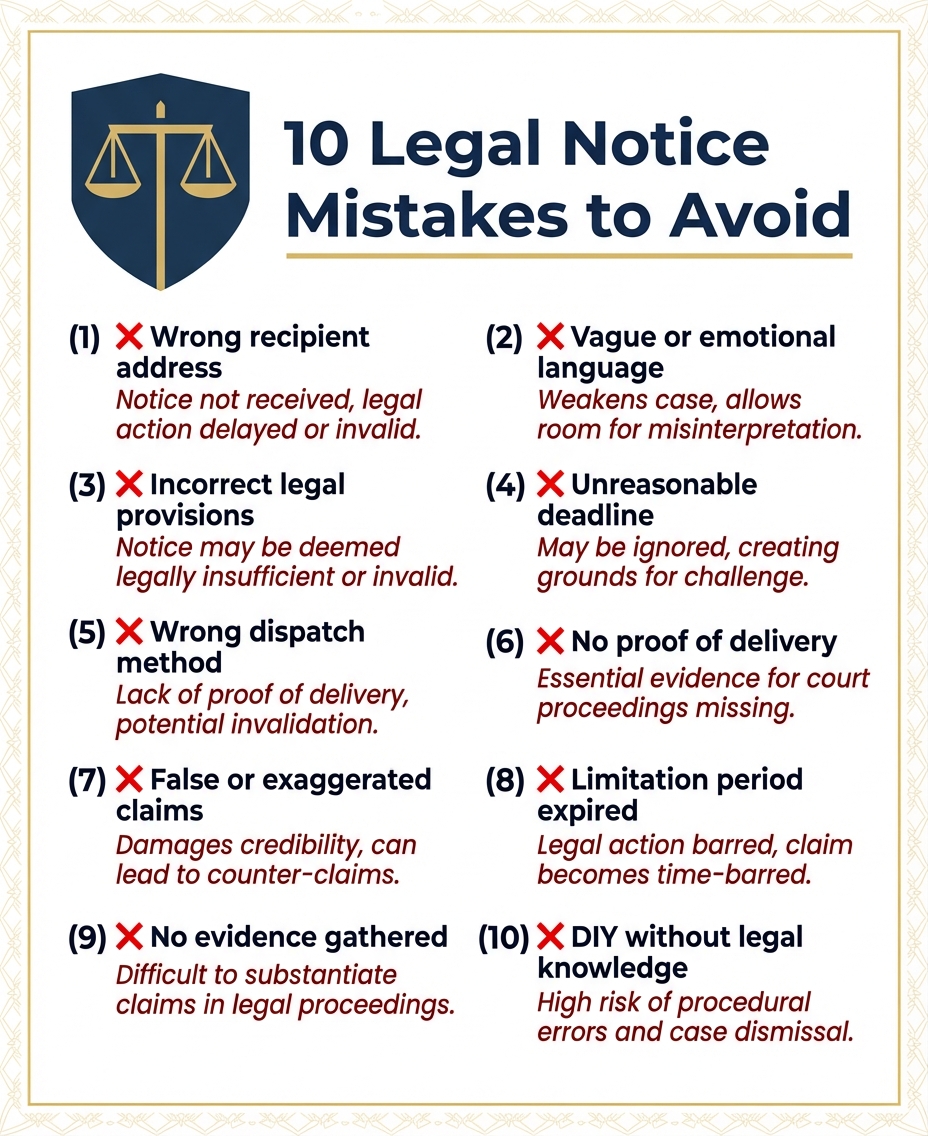
Let us walk through the 10 mistakes that derail legal notices most often, along with practical advice on how to avoid each one.
Mistake #1: Sending the Notice to the Wrong Address
This is the single most common — and most avoidable — mistake. If your legal notice is sent to an incorrect or outdated address, it will be returned by the postal department as "addressee not found" or "returned to sender." In legal terms, a notice that is returned undelivered is generally not considered to have been served on the recipient. Your entire effort — the drafting, the legal fees, the time — goes to waste.
This matters enormously in time-sensitive cases. For instance, under Section 138 of the Negotiable Instruments Act, 1881, you must send the demand notice within 30 days of receiving the cheque dishonour memo. If the notice is returned because the address was wrong, and you have to re-send it to the correct address, you may have already missed the statutory deadline — permanently losing your right to file a criminal complaint.
How to Avoid This Mistake
Verify the recipient's address through multiple sources before dispatching the notice. Check the address on contracts, cheques, Aadhaar or PAN records, company filings on the MCA portal (for companies and directors), recent correspondence, invoices, or visiting cards. For companies, always use the registered office address as shown on the Ministry of Corporate Affairs (MCA) website. If the person has multiple known addresses, send the notice to all of them via separate RPAD envelopes.
It is worth noting that the Supreme Court of India has held in Jagdish Singh v. Natthu Singh that a notice sent to the correct address is deemed served even if the recipient refuses to accept it. But this protection only applies when the address itself is correct. An RPAD returned with the endorsement "addressee not found" is fundamentally different from one marked "refused" — the former suggests a wrong address, while the latter confirms service.
Mistake #2: Using Vague or Emotional Language
When people feel wronged, the natural impulse is to vent. But a legal notice is not the place for emotional outbursts. Phrases like "you have ruined my life," "you are a cheater and a fraud," or "I will teach you a lesson" do not strengthen your case. In fact, they actively weaken it.
Courts look for specifics in a legal notice — exact dates, precise amounts, clear descriptions of what happened and what is being demanded. Vague statements like "you owe me a lot of money" or "you have caused me great suffering" are legally meaningless because they do not give the recipient a clear picture of what is being alleged or what they are expected to do about it.
Worse, emotional or defamatory language can expose you to a counter-notice for defamation under Sections 499 and 500 of the Indian Penal Code (now Sections 356 and 357 of the Bharatiya Nyaya Sanhita, 2023) or even criminal intimidation under Section 503 IPC (Section 351 BNS). What started as your grievance can quickly turn into a legal problem for you.
Real-World Consequence
In several reported cases, recipients of poorly worded legal notices have filed counter-complaints for criminal intimidation and defamation. A notice that says "I will destroy your reputation" or "you will face dire consequences" crosses the line from a legitimate legal demand to a threat. Courts have taken a dim view of such language, and it can result in the sender facing criminal proceedings.
The rule of thumb is simple: state facts, cite law, make demands, and leave emotions out of it. Every sentence in your notice should be something you can prove with evidence. If you cannot back it up, do not include it.
Mistake #3: Not Citing the Correct Legal Provisions
A legal notice derives much of its authority from the statutes and sections it cites. When a recipient reads that their actions violate specific provisions of law and that proceedings will be initiated under those provisions, it creates a powerful incentive to comply. But when the wrong sections are cited — or worse, when entirely irrelevant Acts are referenced — the notice loses credibility instantly.
Consider this common example: someone sends a notice for money recovery and cites Section 420 of the Indian Penal Code (cheating). Section 420 is a criminal provision that requires proof of dishonest inducement from the very beginning of the transaction. If the dispute is simply about a loan that has not been repaid, Section 420 does not apply, and citing it makes the sender look uninformed. The correct approach would be to cite the Indian Contract Act, 1872 (Sections 73 and 74 for damages arising from breach of contract) and the applicable provisions of the Limitation Act, 1963.
Similarly, in a cheque bounce notice, citing generic civil law provisions instead of Section 138 read with Section 142 of the Negotiable Instruments Act, 1881 is a missed opportunity. The NI Act creates a specific criminal offence with specific procedural requirements, and your notice must reflect that.
- Wrong citation = lost credibility: An advocate receiving your notice on the other side will immediately spot incorrect citations, and this weakens your negotiating position.
- Wrong citation = wrong remedy: If you cite criminal provisions when only civil remedies are available, you may be accused of misusing the legal process.
- No citation at all: Some self-drafted notices skip legal provisions entirely. This makes the notice appear amateurish and reduces its persuasive force.
How to Avoid This Mistake
Always research or consult a legal professional about the specific statutes applicable to your dispute before drafting the notice. Common statutes include the Indian Contract Act (1872), Negotiable Instruments Act (1881), Consumer Protection Act (2019), Transfer of Property Act (1882), Specific Relief Act (1963), Code of Civil Procedure (1908), and the Bharatiya Nyaya Sanhita (2023). An AI-assisted platform like OpenVakil automatically identifies and cites the correct provisions based on your case details.
Mistake #4: Setting an Unreasonable Deadline
Every legal notice includes a deadline — the period within which the recipient must comply with the demand or respond. Getting this deadline right is more important than most people realise. Set it too short, and the recipient can argue that the deadline was unreasonable and that they were not given a fair opportunity to comply. Set it too long, and the notice loses its sense of urgency and the recipient may simply ignore it.
The sweet spot for most civil disputes is 15 to 30 days from the date of receipt of the notice. This period is widely accepted by Indian courts as reasonable and gives the recipient adequate time to seek legal advice, gather documents, and respond or comply.
However, there are important statutory exceptions:
- Section 138 NI Act (cheque bounce): The demand notice must give the drawer 15 days to make the payment. This is a statutory requirement, not a matter of choice.
- Section 80 CPC (suits against government): A legal notice to the Central Government, State Government, or a public officer must be given at least two months before filing the suit. Setting a 15-day deadline in a Section 80 notice would be a fatal error.
- Section 106 Transfer of Property Act (tenancy termination): The notice period for terminating a month-to-month tenancy is 15 days ending with the month of tenancy.
- Section 8 IBC (insolvency): An operational creditor must give the debtor 10 days to pay the outstanding operational debt.
Setting a deadline of "3 days" or "48 hours" in a standard civil dispute looks aggressive and unreasonable. Courts may view such deadlines as evidence that the sender was not genuinely interested in an amicable resolution but was simply going through the motions before litigation. Conversely, a 90-day deadline in a matter involving perishable goods or ongoing harm would be unreasonably long.
Not Sure What Deadline to Set?
OpenVakil automatically calculates the correct response period based on your specific dispute type and the applicable law. No guesswork, no missed statutory requirements.
Draft Your Legal NoticeMistake #5: Failing to Send via the Proper Channel
In the age of instant communication, it is tempting to send a legal notice via WhatsApp, email, or even SMS. While courts have gradually become more accepting of electronic communication, relying solely on digital channels for serving a legal notice is risky and, in many situations, insufficient.
Registered Post with Acknowledgement Due (RPAD) remains the gold standard for legal notice dispatch in India. It is universally accepted by all courts, creates an official postal record of dispatch and delivery, and provides a signed acknowledgement card as proof that the notice was received (or refused) by the recipient. Speed Post with tracking is also widely accepted.
The problem with WhatsApp or email-only notices is threefold:
- Authentication issues: The recipient can claim they did not receive the message, that the email went to spam, or that the WhatsApp message was not actually read despite blue ticks.
- Statutory non-compliance: Certain statutes, particularly Section 80 CPC, specifically require delivery to or leaving at the office of the government officer. An email may not satisfy this requirement.
- Evidentiary challenges: While electronic records are admissible under Section 65B of the Indian Evidence Act (now Section 63 of the Bharatiya Sakshya Adhiniyam, 2023), proving the authenticity and receipt of electronic communications adds an extra layer of complexity.
Best Practice: Use Multiple Channels
Send the original notice via RPAD (primary) and supplement it with a scanned copy via email and/or WhatsApp (secondary). This way, you have the legal protection of RPAD along with the speed and additional proof of digital delivery. Always retain the postal receipt, AD card, email sent confirmation, and WhatsApp delivery/read receipts.
Mistake #6: Not Keeping Proof of Delivery
You drafted a perfect legal notice. You sent it via RPAD. The recipient complied with nothing. You decide to file a case. And then the court asks: "Can you prove the notice was served?" If you cannot produce the postal receipt, the AD card, or the tracking record, you are in trouble.
Proof of service is not a formality — it is a legal requirement in many cases. Under Section 138 of the NI Act, you must prove that the notice was sent and that it was delivered (or that the recipient refused to accept it). Under Section 80 CPC, you must prove that the notice was served on the appropriate government authority. Without documentary proof, the court may hold that the notice was never served, which can be fatal to your case.
The documents you must preserve include:
- Postal receipt: The receipt issued by the post office when you dispatch the RPAD. It contains the article number used for tracking.
- AD card (Acknowledgement Due card): The green card that is signed by the recipient and returned to you by the postal department. This is the strongest proof of delivery.
- India Post tracking printout: A printout of the tracking history from the India Post website showing dispatch, transit, and delivery status.
- Courier receipt and proof of delivery (if applicable): If you also sent the notice by courier, retain the consignment receipt and the delivery proof.
- Email delivery confirmation: If sent by email, retain the "sent" email, any delivery receipt, and any read receipt.
- Copy of the notice: Always keep at least two copies of the notice itself — one for your records and one for the court file.
Store these documents safely. If the matter goes to court years later (which is common in India), you will need to produce these originals. Many advocates recommend scanning all proof-of-service documents and storing digital copies as backup.
Mistake #7: Making False or Exaggerated Claims
There is a significant difference between presenting your case in the strongest possible light and making claims that are false or grossly exaggerated. A legal notice is a document that can be produced in court, and every statement in it can be scrutinised. If the court finds that you made false claims in your notice, your credibility is damaged — and credibility is everything in litigation.
Common examples of this mistake include:
- Inflating the claim amount: Claiming you are owed Rs. 10 lakhs when the actual amount is Rs. 3 lakhs. This can be exposed during cross-examination and destroys your credibility.
- Fabricating events: Describing meetings, conversations, or promises that never occurred. If the other side has evidence to the contrary, your entire case collapses.
- Mischaracterising the relationship: Claiming a formal contract existed when the arrangement was informal and oral. While oral contracts are valid under Indian law, misrepresenting them as written agreements is dishonest.
- Threatening criminal action without basis: Threatening to file an FIR for cheating (Section 420 IPC / Section 318 BNS) when the dispute is purely civil in nature. This can constitute an abuse of the legal process.
Defamation Risk
If your legal notice contains false statements that damage the recipient's reputation, the recipient can send a counter-notice for defamation and file a criminal complaint under Sections 499-500 IPC (Sections 356-357 BNS). A legal notice is not absolutely privileged — only a qualified privilege applies, meaning the statements must be made in good faith and must be relevant to the dispute. Stick to provable facts and you will be safe.
The golden rule: only include facts in your legal notice that you can support with evidence. If you have a contract, reference the specific clause. If you have bank statements showing the payment, reference the transaction details. If you have email correspondence, quote the relevant portions. A notice grounded in verifiable facts is far more powerful than one that relies on bluster and exaggeration.
Mistake #8: Ignoring the Limitation Period
The Limitation Act, 1963 prescribes specific time periods within which different types of legal claims must be filed. Once the limitation period expires, your right to seek legal remedy is extinguished — no matter how strong your case is on merits. A legal notice sent after the limitation period has lapsed is essentially a wasted effort because even if the recipient ignores it, you cannot follow through with legal proceedings.
Here are some key limitation periods under Indian law:
- Money recovery (simple contract): 3 years from the date when the debt becomes due (Article 36, Schedule I, Limitation Act).
- Cheque bounce (Section 138 NI Act): The demand notice must be sent within 30 days of the dishonour memo. If the drawer does not pay within 15 days, the complaint must be filed within 1 month after that. These are very tight, non-negotiable deadlines.
- Suit on a promissory note: 3 years from the date the promissory note falls due (Article 19).
- Recovery of immovable property: 12 years from the date the possession becomes adverse (Article 65).
- Compensation for tort (wrongful act): 1 year from the date when the wrong occurs (Article 72-73).
- Consumer complaints: 2 years from the date on which the cause of action arises, under the Consumer Protection Act, 2019.
- Suits against government (Section 80 CPC): The limitation period applies to the suit itself, but remember you also need to factor in the mandatory 2-month notice period.
The critical point is this: your legal notice should be sent well before the limitation period expires, leaving you enough time to follow up with legal action if the notice is ignored. If the limitation period for your claim expires in two months, sending a notice with a 30-day deadline leaves you only one month to prepare and file a suit — cutting it dangerously close.
Does Sending a Legal Notice Extend the Limitation Period?
No. A common misconception is that sending a legal notice "pauses" or extends the limitation period. It does not. The limitation clock keeps ticking regardless of whether you have sent a notice. However, if the recipient makes a part payment or acknowledges the debt in writing (including in a reply to the notice), that can restart the limitation period under Section 18 and Section 19 of the Limitation Act, 1963. This is another reason why a well-drafted notice is so important — it can prompt an acknowledgement that gives you more time.
Mistake #9: Sending the Notice Without Gathering Evidence First
Many people rush to send a legal notice the moment a dispute arises, without first taking the time to gather and organise their evidence. This is a strategic mistake for two reasons.
First, a legal notice that references specific evidence — contracts with dates, bank transfer details, email threads, photographs, recordings — is far more persuasive than one that makes bare assertions. When the recipient sees that you have documented everything, they are more likely to take the notice seriously and comply.
Second, once you send a legal notice, the other party is put on alert. They know a dispute is coming, and they may take steps to destroy, alter, or hide evidence. If you have not already secured your evidence before sending the notice, you may lose access to critical proof. For example, if you are disputing a business transaction and the evidence is in the form of WhatsApp chats or emails that the other party controls, sending a premature notice gives them the opportunity to delete those communications.
- Before sending: Collect all contracts, agreements, invoices, receipts, bank statements, cheque copies, dishonour memos, email correspondence, WhatsApp screenshots, photographs, video recordings, and any other documentary evidence.
- Organise chronologically: Arrange your evidence in date order to create a clear timeline of events. This will also help your advocate draft a more effective notice.
- Secure digital evidence: Take screenshots with timestamps, back up emails, save chat exports, and store digital files in multiple locations. Consider getting a notarised printout for critical digital evidence.
- Identify witnesses: Note down the names and contact details of any witnesses who can corroborate your version of events.
- Then draft and send: Once your evidence is secure, proceed with drafting the notice. Your advocate can reference specific documents and dates, making the notice significantly stronger.
A legal notice backed by solid evidence is not just a demand letter — it is a preview of the case you are prepared to present in court. That preview alone is often enough to prompt a settlement.
— Litigation Strategy, Indian Legal Practice
Mistake #10: Trying to Draft It Yourself Without Legal Knowledge
The internet is full of legal notice templates. A quick search will give you dozens of formats in Word, PDF, and even online generators. The temptation to copy-paste a template, fill in the blanks, and send it off is strong — especially when you want to save money or time. But DIY legal notices are one of the biggest reasons notices fail to achieve their purpose.
Here is what typically goes wrong with self-drafted notices:
- Wrong format: The notice does not follow the standard structure that courts and advocates expect. It may lack essential elements like the advocate's letterhead, proper addressee details, or the consequences clause.
- Missing legal provisions: Without legal training, most people do not know which sections and Acts apply to their dispute. The notice either cites no provisions or the wrong ones.
- Improper language: Legal notices use a specific register of language that is formal, precise, and follows established conventions. Self-drafted notices often sound either too casual or too aggressive.
- Incomplete demands: The notice may describe the problem at length but fail to clearly state what the sender wants the recipient to do, or it may omit the deadline for compliance.
- Template mismatch: A template designed for a cheque bounce notice is used for a property dispute, or a consumer complaint template is used for an employment matter. Each type of dispute requires different legal provisions, different facts, and different demands.
- No advocate's name or enrolment number: A notice that is not on an advocate's letterhead or does not bear an advocate's credentials is taken far less seriously by the recipient.
This does not mean you necessarily need to visit a traditional law office and pay tens of thousands of rupees for a simple notice. The best approach lies in the middle ground: AI-assisted drafting with professional legal review. Platforms like OpenVakil use artificial intelligence to generate a custom-drafted notice based on your specific facts and the applicable law, and then have it reviewed for accuracy and completeness. This gives you the quality of professional drafting at a fraction of the traditional cost.
Template vs. AI-Assisted Drafting vs. Traditional Lawyer
A generic template costs nothing but often misses critical legal elements. A traditional lawyer may charge Rs. 5,000 to Rs. 50,000 depending on the city and complexity. AI-assisted platforms like OpenVakil offer a middle path: custom drafting that adapts to your specific case, correct legal citations, and proper formatting — typically starting at Rs. 1,499. You get professional quality without the professional price tag.
Bonus Tips for a Bulletproof Legal Notice
Beyond avoiding the 10 mistakes above, here are a few additional tips that separate a good legal notice from a great one:
- Send to all relevant parties: If the dispute involves multiple people or entities (e.g., a company and its directors, a business partner and a guarantor), send the notice to each of them separately at their respective addresses.
- Always send a copy to yourself: Send one copy of the notice to your own address via RPAD. This creates an additional piece of evidence showing what was sent and when.
- Keep the language firm but professional: The tone should convey seriousness without crossing into hostility. Phrases like "my client reserves all rights" and "at your risk, cost, and consequences" are standard legal language that conveys firmness without being threatening.
- Number your paragraphs: A numbered, structured notice is easier to read, easier to respond to, and easier for a court to reference. This is standard practice in professional legal drafting.
- Reference your evidence without attaching it: Mention that you possess supporting documents (e.g., "a copy of the agreement dated 15.03.2024 is in my client's possession") without actually attaching them to the notice. You do not want to give the other side your full evidence file at the notice stage.
- Proofread meticulously: A notice with spelling errors, wrong dates, or incorrect names looks unprofessional and can be challenged on factual accuracy. Double-check every detail.
- Factor in postal transit time: If your statutory deadline is approaching, remember that RPAD takes 3–7 days for delivery. Post the notice early enough that it reaches the recipient within the required time frame.
How OpenVakil Helps You Avoid All 10 Mistakes
OpenVakil is designed to ensure that every legal notice sent through our platform avoids the pitfalls described in this article. Here is how we address each of the 10 mistakes:
- Address verification guidance: Our platform prompts you to provide the recipient's full address and offers tips on verifying it through MCA filings, contracts, and public records. We also encourage sending to multiple addresses when available.
- Professional, precise language: OpenVakil's AI generates notices in the formal legal register expected by courts — no emotional language, no vague statements. Every sentence is factual, specific, and strategically drafted.
- Correct legal citations: Based on your case type and the facts you provide, OpenVakil automatically identifies and cites the correct sections and Acts. You do not need to know the law — our system does it for you.
- Appropriate deadlines: The platform sets the legally compliant response period based on the type of dispute and the applicable statute, whether it is 15 days for a Section 138 notice or 2 months for a Section 80 CPC notice.
- RPAD dispatch support: We guide you through sending the notice via Registered Post with AD and also support supplementary dispatch via email. You get clear instructions on what to do at the post office and what receipts to retain.
- Proof-of-delivery checklist: OpenVakil provides a checklist of all the documents you need to preserve as proof of service, along with reminders to track your RPAD and collect the AD card.
- Fact-based, defensible content: Our AI drafts the notice based on the specific facts you provide, ensuring that every claim is grounded in the information you supply. No exaggeration, no fabrication.
- Limitation period awareness: The platform flags potential limitation period issues based on the dates you enter, alerting you if your claim may be approaching or has crossed the statutory deadline.
- Evidence organisation: OpenVakil prompts you to gather and list your supporting documents before generating the notice, ensuring that the notice references your evidence and that you are prepared for next steps.
- AI + legal quality = no DIY risks: Instead of copy-pasting a generic template, you get a fully customised notice drafted by AI and structured in the exact format courts expect. It is professionally drafted, legally sound, and ready to send.
A legal notice is often your one shot at resolving a dispute without going to court. Making any of the 10 mistakes described above can turn that opportunity into a wasted effort — or worse, create new legal problems for you. By understanding these pitfalls and taking the right precautions, you can ensure that your legal notice is effective, credible, and legally sound.
Whether you are dealing with a cheque bounce, an unpaid debt, a property dispute, a consumer complaint, an employment issue, or any other legal matter, the principles remain the same: get the address right, be specific and factual, cite the correct law, set a reasonable deadline, send it properly, keep your proof, stick to the truth, respect limitation periods, gather your evidence first, and get professional help with the drafting.
Ready to Send a Mistake-Free Legal Notice?
OpenVakil combines AI-powered drafting with legal expertise to help you create a professionally crafted legal notice that avoids all the common pitfalls. Answer a few questions about your situation and get a court-ready notice in minutes.
Start Your Legal Notice NowDo not let a preventable mistake undermine your legal rights. Get your legal notice right the first time — your future self will thank you.