One of the most frequently asked legal questions in India is: "Do I need to send a legal notice before going to court?" The answer is not a simple yes or no — it depends entirely on the type of case you are filing and the specific law that governs your dispute. In some situations, sending a legal notice is a mandatory legal prerequisite without which your case will be thrown out at the threshold. In other situations, it is technically optional but so strongly recommended that skipping it would be a strategic mistake. This guide breaks down exactly when a legal notice is mandatory, when it is advisable, and when you can go directly to court.
The Short Answer: It Depends on Your Case
Indian law does not have a single, universal rule requiring a legal notice before every court case. Instead, specific statutes mandate a notice in specific situations. Here is the quick summary:
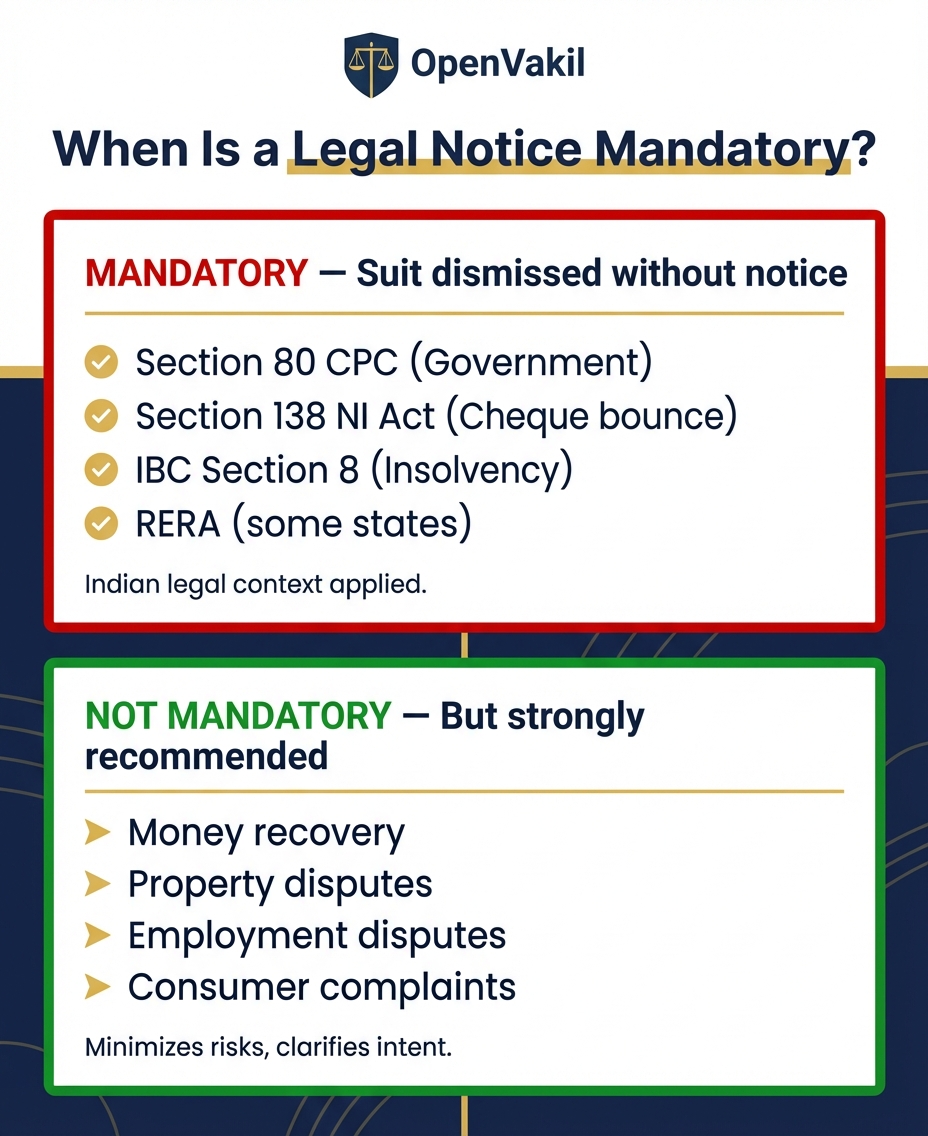
- Mandatory: Suits against the government (Section 80 CPC), cheque bounce cases (Section 138 NI Act), tenancy termination (Section 106 TPA), corporate insolvency (Section 8 IBC), and certain regulatory matters.
- Highly recommended: Money recovery, property disputes, breach of contract, consumer complaints, defamation, employment disputes, insurance claims, and most civil matters.
- Not required: Most criminal complaints (FIR), urgent interim relief (injunctions), public interest litigation (PIL), habeas corpus petitions, and certain matrimonial proceedings.
Rule of Thumb
When in doubt, send a legal notice. It costs very little (starting from Rs. 299 on OpenVakil), takes minimal time, and can only strengthen your legal position. There is virtually no downside to sending one, even when it is not mandatory.
When Is a Legal Notice Legally Mandatory?
Several Indian statutes expressly require a legal notice as a precondition to filing a case. If your dispute falls under any of these categories, you cannot file a case without first sending the prescribed notice and waiting for the stipulated period to expire.
Section 80 CPC — Suits Against the Government
Section 80 of the Code of Civil Procedure, 1908 is the most well-known mandatory notice provision in Indian law. It states that no suit shall be instituted against the Central Government, any State Government, or any public officer acting in their official capacity unless a written notice has been delivered to or left at the office of the appropriate authority at least two months before the suit is filed.
The notice must contain the name, description, and place of residence of the plaintiff, the cause of action, the relief sought, and the name and address of the advocate sending the notice. Courts have been strict about compliance with Section 80 — suits have been dismissed at the threshold for even minor defects in the notice, such as an incorrect designation of the government officer or failure to wait the full two-month period.
- Who it applies to: Any person or entity planning to sue the Central Government, State Government, municipal corporation, panchayat, or any public officer in their official capacity.
- Notice period: Two months from the date the notice is delivered.
- Exception: In cases of urgency, the court may grant leave to file the suit without waiting the full two months, but the notice itself must still be served. This exception is narrowly construed.
- Consequence of non-compliance: The suit is liable to be dismissed at the first hearing. The Supreme Court has consistently upheld this in decisions including State of Rajasthan v. Virdhi Chand.
Critical: Do Not Skip the Section 80 Notice
If you are suing any government body, municipal corporation, or public officer, failing to send a proper Section 80 notice will result in your case being dismissed at the threshold — regardless of how strong your case is on merits. This is one of the most common procedural mistakes in Indian litigation.
Section 138 NI Act — Cheque Bounce Cases
Under Section 138 of the Negotiable Instruments Act, 1881, sending a demand notice is a mandatory prerequisite before filing a criminal complaint for cheque dishonour. The payee must send a written demand notice to the drawer within 30 days of receiving the cheque return memo from the bank. The drawer then has 15 days from receipt of the notice to make the payment. Only if the drawer fails to pay within this 15-day window can the payee file a complaint, and this complaint must be filed within 30 days from the expiry of the 15-day period.
The entire timeline is approximately 75 days from the date of the cheque return memo to the last date for filing a complaint. Missing any of these deadlines is fatal to your case — the Supreme Court has held in Kusum Ingots & Alloys Ltd. v. Pennar Peterson Securities Ltd. and other decisions that strict compliance with the Section 138 timeline is mandatory.
Section 106 Transfer of Property Act — Tenancy Termination
Section 106 of the Transfer of Property Act, 1882 requires a landlord to give the tenant a notice of termination of tenancy before filing an eviction suit. The notice period depends on the type of tenancy:
- Month-to-month tenancy: 15 days' notice expiring with the end of a month of the tenancy.
- Tenancy for agricultural or manufacturing purposes: Six months' notice expiring with the end of a year of the tenancy.
- Other tenancies: As specified in the lease agreement or applicable state Rent Control Act.
State-specific Rent Control Acts may prescribe additional notice requirements or different notice periods. For example, the Delhi Rent Control Act, the Maharashtra Rent Control Act, and the Tamil Nadu Buildings (Lease and Rent Control) Act each have their own provisions regarding notice to tenants. A landlord who files an eviction suit without serving the required notice will find the suit dismissed for non-compliance.
Companies Act and IBC — Corporate Insolvency
Under Section 8 of the Insolvency and Bankruptcy Code (IBC), 2016, an operational creditor must deliver a demand notice or a copy of an invoice demanding payment of the unpaid operational debt to the corporate debtor. The corporate debtor has 10 days from receipt of the demand notice to either pay the debt or notify the operational creditor of a dispute regarding the debt. If neither payment nor notice of dispute is received within 10 days, the operational creditor may file an application before the National Company Law Tribunal (NCLT) to initiate the Corporate Insolvency Resolution Process (CIRP).
Similarly, under Section 271 of the Companies Act, 2013 (now largely superseded by the IBC for insolvency matters), a creditor could issue a statutory demand notice to a company for an unpaid debt exceeding one lakh rupees, which could trigger winding-up proceedings if not satisfied within 21 days.
RERA — Real Estate Disputes
While the Real Estate (Regulation and Development) Act, 2016 (RERA) does not expressly mandate a legal notice before filing a complaint with the RERA authority, sending one is considered a practical necessity. Most RERA authorities expect that the allottee has first attempted to resolve the matter directly with the builder or promoter before approaching the authority. A legal notice demanding possession, refund, or compensation serves as evidence that the allottee made a genuine attempt at resolution. In practice, RERA complaints that are accompanied by a prior legal notice and proof of the builder's non-response are treated more favourably.
Need to Send a Mandatory Legal Notice?
Do not risk having your case dismissed for a procedural technicality. OpenVakil drafts legally compliant notices for all statutory requirements — Section 80 CPC, Section 138 NI Act, IBC, and more.
Draft Your Notice NowWhen Is a Legal Notice Not Mandatory but Highly Recommended?
For the vast majority of civil disputes in India, sending a legal notice is not a statutory requirement but is strongly recommended by lawyers, courts, and legal experts. Here are the most common scenarios where a notice is optional but advisable:
- Money recovery and debt disputes: No statute requires a notice before filing a civil suit for recovery of money. However, a notice formally puts the debtor on record, establishes the amount owed, and demonstrates that you gave them a fair opportunity to pay before approaching the court.
- Property disputes: Disputes involving encroachment, boundary violations, title disputes, and breach of sale agreements do not require a mandatory notice (except tenancy termination under Section 106 TPA). But a notice documents your claim and can prompt the other party to negotiate.
- Breach of contract: The Indian Contract Act, 1872, does not mandate a notice before filing a suit for breach. However, courts look favourably upon parties who attempted to resolve the matter before litigation.
- Consumer complaints: The Consumer Protection Act, 2019, does not require a notice before filing a complaint with the Consumer Disputes Redressal Commission. But sending one can trigger the company's internal escalation process and lead to a faster resolution.
- Defamation: Neither the civil nor criminal provisions for defamation require a prior notice. But a well-drafted notice can compel the offending party to retract defamatory statements and issue an apology, avoiding the need for litigation altogether.
- Employment disputes: Wrongful termination, unpaid wages, and workplace harassment cases do not always require a mandatory notice (though some industrial disputes statutes do). A notice formalises your grievance and creates a documented timeline.
- Insurance claim disputes: The Insurance Act does not mandate a notice before approaching the Ombudsman or court, but a notice to the insurance company often triggers a review of the rejected claim.
Did You Know?
Courts in India regularly ask parties whether a legal notice was sent before the suit was filed. While the absence of a notice may not invalidate your case in non-mandatory situations, it can affect the court's perception of your diligence and good faith. Judges appreciate parties who try to resolve matters amicably before burdening the court system.
When Is a Legal Notice NOT Required?
There are certain categories of legal proceedings where a prior legal notice is neither mandatory nor expected:
- Criminal complaints and FIRs: If you are reporting a cognisable offence (theft, assault, fraud, etc.), you file an FIR directly with the police. No legal notice is required. For non-cognisable offences, you approach the Magistrate directly under Section 200 of the Bharatiya Nagarik Suraksha Sanhita (BNSS), 2023.
- Urgent interim relief: If you need an emergency injunction, stay order, or restraining order from the court, you can file directly without a prior notice. Courts recognise that in urgent situations, the delay caused by sending a notice could result in irreparable harm.
- Public Interest Litigation (PIL): PILs can be filed directly before the High Court or Supreme Court without any prior notice to the respondents. The court itself issues notice to the parties.
- Habeas corpus petitions: Petitions for the production of a detained person can be filed directly before the High Court or Supreme Court without any prior notice.
- Certain matrimonial proceedings: Divorce petitions, applications for maintenance under Section 125 CrPC (now Section 144 BNSS), and domestic violence complaints under the Protection of Women from Domestic Violence Act, 2005, do not require a prior legal notice.
- Writ petitions against government: While civil suits against the government require a Section 80 notice, writ petitions under Article 226 (High Court) or Article 32 (Supreme Court) of the Constitution generally do not require a prior notice.
Benefits of Sending a Legal Notice Even When Not Mandatory
Even when the law does not require you to send a legal notice, doing so offers significant strategic and practical advantages:
- Creates a formal record: A legal notice establishes a documented timeline of events, your grievance, and the specific relief you are seeking. This record becomes valuable evidence if the matter goes to court.
- Gives the other party an opportunity to respond: By giving the other side a chance to resolve the matter, you demonstrate reasonableness and good faith — qualities that courts value highly.
- Resolves disputes without court: According to various bar council estimates, 40–50% of disputes are resolved at the legal notice stage without ever reaching the courtroom. A notice is often the fastest and cheapest way to get what you want.
- Strengthens your legal position: A well-drafted notice with accurate legal citations and a clear demand shows the court that you were serious, diligent, and gave the other party every opportunity to comply before filing suit.
- Shows good faith to the court: Indian courts appreciate parties who attempt amicable resolution before litigation. Judges may take a dim view of a plaintiff who rushed to court without first sending a notice.
- Establishes limitation awareness: By sending a notice, you demonstrate that you were aware of your rights and the applicable limitation period, making it harder for the other party to argue that your claim is time-barred.
- Psychological pressure: Receiving a formal legal notice from an advocate signals seriousness and often motivates the other party to settle rather than face the cost and stress of litigation.
A legal notice serves as a final opportunity for dispute resolution before the matter reaches the courts. It demonstrates the sender's seriousness and often prompts the other party to negotiate or comply with legitimate demands.
— Legal Drafting Principles, Bar Council of India
What Happens If You File a Case Without Sending a Legal Notice?
The consequences of filing a case without a prior legal notice depend entirely on whether the notice was mandatory or optional for your type of dispute:
If the notice was mandatory: Your case will almost certainly be dismissed at the threshold. The court will not examine the merits of your case if you have failed to comply with a statutory precondition like Section 80 CPC or Section 138 NI Act. You will lose your court fees, waste time, and may even miss limitation periods while refiling after sending the required notice.
If the notice was optional: Your case will not be automatically dismissed. However, the opposing party may argue that you did not act in good faith or give them an opportunity to resolve the matter. The court may also factor in the absence of a notice when considering costs and interim relief. In some cases, courts have adjourned proceedings to direct the plaintiff to first send a notice and attempt settlement before proceeding with the trial.
Do Not Risk a Dismissal
If there is any doubt about whether a legal notice is required for your case, send one. The cost of sending a notice (as low as Rs. 299) is negligible compared to the cost of having your case dismissed and needing to refile.
Legal Notice vs Court Case: Key Differences
Understanding the fundamental differences between a legal notice and a court case helps you appreciate why the notice stage is so important:
- Stage: A legal notice is a pre-litigation step. A court case is formal litigation before a judicial authority.
- Who is involved: A notice is a direct communication between you (or your advocate) and the other party. A court case involves a judge, court staff, opposing counsel, and potentially witnesses.
- Cost: Sending a legal notice costs between Rs. 299 and Rs. 5,000 on average. A court case can cost Rs. 10,000 to Rs. 5,00,000 or more in legal fees, court fees, and related expenses over its lifetime.
- Timeline: A legal notice typically gives the recipient 15–30 days to respond. A court case can take months to years to reach a conclusion, depending on the complexity and the court's docket.
- Privacy: A legal notice is a private communication between the parties. Court proceedings are generally part of the public record and can be accessed by anyone.
- Resolution rate: Legal notices resolve 40–50% of disputes without any court involvement. Court cases resolve the remainder but at significantly higher cost and time.
Send Your Legal Notice Before It Is Too Late
A legal notice is the most cost-effective first step in resolving any dispute. Draft, review, and dispatch your notice through OpenVakil in minutes.
Get Started NowType-by-Type Guide: Is Legal Notice Required for Your Case?
Use this comprehensive reference to determine whether a legal notice is mandatory, recommended, or optional for your specific type of dispute:
- Cheque bounce (Section 138 NI Act): Mandatory. 30-day demand notice required before filing criminal complaint.
- Suit against government (Section 80 CPC): Mandatory. Two-month notice required before filing civil suit.
- Tenancy termination (Section 106 TPA): Mandatory. 15 days to 6 months notice depending on tenancy type.
- Corporate insolvency (Section 8 IBC): Mandatory. 10-day demand notice for operational creditors.
- Money recovery: Recommended. Not mandatory but creates evidence trail and often prompts payment.
- Property dispute: Recommended. Documents your claim and opens door for negotiation.
- Breach of contract: Recommended. Demonstrates good faith and willingness to settle.
- Consumer complaint: Optional but advisable. Can trigger company's internal resolution process.
- Employment and salary disputes: Recommended. Formalises your grievance on record.
- Defamation: Recommended. May lead to retraction and apology without court.
- Builder delay (RERA): Recommended. Strengthens RERA complaint significantly.
- Insurance claim rejection: Recommended. May trigger review of rejected claim.
- Divorce: Optional. Depends on grounds and whether mutual consent.
- Domestic violence: Not required. File directly under the DV Act.
- Criminal complaint (FIR): Not required. Report directly to police.
Pro Tip
Even in cases marked "Optional" or "Not required", consider sending a legal notice if your primary goal is to resolve the dispute quickly and affordably. A court case should be the last resort, not the first step.
How OpenVakil Makes Legal Notices Simple
Whether your legal notice is mandatory or optional, OpenVakil makes the process fast, affordable, and reliable. Our platform is designed for individuals and businesses who want professional-quality legal notices without the traditional law firm price tag.
- Starting at Rs. 299: Professional legal notices at a fraction of traditional lawyer fees. No hidden charges.
- AI-assisted drafting: Answer a few simple questions and our AI generates a comprehensive, legally accurate notice tailored to your specific dispute.
- Advocate review: Every notice is reviewed by an experienced advocate to ensure accuracy, proper legal citations, and compliance with statutory requirements.
- Multi-channel dispatch: Your notice is sent via Registered Post, Email, and WhatsApp — ensuring delivery through multiple channels for maximum legal protection.
- Compliance guaranteed: We ensure your notice meets all statutory requirements, whether it is a Section 80 CPC notice, a Section 138 demand notice, or any other type.
- 5-minute process: From start to dispatch, the entire process takes just minutes. No appointments, no office visits, no waiting.
Draft Your Legal Notice in 5 Minutes
Do not let a procedural technicality derail your case. Send a legally compliant notice through OpenVakil and protect your right to justice.
Start Your Legal NoticeWhether it is mandatory or simply advisable, a legal notice is almost always the smartest first step in any dispute. It costs a fraction of what a court case costs, resolves nearly half of all disputes without litigation, and strengthens your position if the matter does go to court. Do not skip this critical step — send your legal notice through OpenVakil today.