In the digital age, one of the most common questions people ask is: can I just WhatsApp or email a legal notice instead of sending it by registered post? The answer is nuanced — yes, in many cases electronic legal notices are perfectly valid, but there are important caveats and situations where registered post remains mandatory.
India’s legal system has progressively embraced digital communication. The Information Technology Act, 2000, the Indian Evidence Act (Section 65B), and multiple High Court and Supreme Court rulings have recognised email and WhatsApp as legitimate modes of communication — including for serving legal notices. However, specific statutes and situations still require physical delivery through registered post or speed post with acknowledgment due.
This comprehensive guide explains exactly when you can send a legal notice via email or WhatsApp, when you cannot, and the smartest strategy to ensure your notice is both legally valid and practically effective.
The Legal Framework: IT Act 2000 and Electronic Records
The foundation for the validity of electronic legal notices in India rests on three key legal provisions. Understanding these is essential before deciding how to send your notice.
Section 4: Legal Recognition of Electronic Records
Section 4 of the Information Technology Act, 2000 is the cornerstone provision. It establishes that information or documents in electronic form cannot be denied legal validity, effect, or enforceability merely because they are in electronic form. This means an email or WhatsApp message carrying a legal notice has the same legal standing as a physical document, provided it meets the other requirements of law.
Where any law provides that information or any other matter shall be in writing or in the typewritten or printed form, then, notwithstanding anything contained in such law, such requirement shall be deemed to have been satisfied if such information or matter is rendered or made available in an electronic form.
— Section 4, Information Technology Act, 2000
Section 5: Legal Recognition of Electronic Signatures
Section 5 of the IT Act extends legal recognition to electronic signatures (previously called digital signatures). Where any law requires a document to be authenticated by a signature, an electronic signature satisfies that requirement. This is relevant because legal notices typically bear the signature of the advocate — and a digitally signed PDF attached to an email fulfils this requirement.
Section 65B: Indian Evidence Act
Section 65B of the Indian Evidence Act governs the admissibility of electronic records as evidence in court. Any information contained in an electronic record — whether it is an email, a WhatsApp message, or a digitally stored document — is admissible as evidence, provided it is accompanied by a certificate under Section 65B(4) identifying the electronic record and describing how it was produced. This certificate is crucial if the matter proceeds to court.
Key Takeaway
Indian law explicitly recognises electronic communication as legally valid. The IT Act, 2000 and the Indian Evidence Act together ensure that emails and WhatsApp messages can serve as legitimate legal documents — provided you maintain proper proof of delivery and authenticity.
Legal Notice via Email: Is It Valid?
Yes, a legal notice sent via email is generally valid in India. Courts across the country have accepted email as a legitimate mode of delivering legal notices, especially in civil disputes, commercial matters, and consumer complaints. Email provides a reliable paper trail, timestamped delivery records, and the ability to attach signed PDF copies of the notice.
The key advantage of email is proof of delivery. Modern email services provide delivery confirmations, and if the recipient’s email server accepts the message, it serves as evidence that the notice was transmitted. Some email providers also support read receipts, which confirm the recipient actually opened the email.
Several Indian courts have upheld email notices as valid service. In particular, where the parties had a history of communicating via email — such as in business relationships, employment disputes, or contractual matters — courts have held that sending a legal notice to the same email address constitutes proper service.
Best Practices for Email Notices
- Send from your official or personal email address: Use an email address that is clearly identifiable as yours or your lawyer’s. Avoid temporary or anonymous email accounts.
- Attach the notice as a signed PDF: The body of the email should serve as a covering letter, with the detailed legal notice attached as a PDF document bearing the advocate’s signature.
- CC yourself and your lawyer: Always copy yourself and your lawyer on the email to maintain a verifiable record in multiple inboxes.
- Enable delivery and read receipts: Turn on delivery confirmation and read receipt requests in your email client to document that the email reached the recipient.
- Use a clear subject line: The subject should explicitly state the nature of the email, such as "Legal Notice — Demand for Payment" or "Legal Notice under Section 138 NI Act." This prevents any claim that the recipient did not recognise the email as important.
- Send to known email addresses: Use the email address the recipient has used in prior correspondence, is listed on their official documents, or has provided to you directly.
Pro Tip: Track Your Email Delivery
Use an email tracking tool or enable delivery/read receipt functionality in your email client (Outlook, Gmail, etc.). A delivery receipt confirms the email reached the recipient’s mail server, while a read receipt confirms they opened it. Both serve as valuable evidence if the matter goes to court.
Legal Notice via WhatsApp: Is It Valid?
Yes, legal notices sent via WhatsApp are increasingly accepted by Indian courts. Multiple High Courts have recognised WhatsApp as a valid mode of communication for serving notices and legal documents. WhatsApp’s built-in delivery indicators — the double grey tick (delivered) and double blue tick (read) — provide a convenient and widely understood proof of delivery.
The rationale is straightforward: WhatsApp is end-to-end encrypted, widely used across India (with over 500 million users), and provides timestamped delivery and read confirmations. Courts have observed that in the age of Digital India, insisting exclusively on physical delivery when the parties regularly communicate via WhatsApp would be impractical and unjust.
That said, WhatsApp notices carry certain risks. Messages can be deleted by the sender or the recipient, phone numbers can be changed, and there is no formal postal acknowledgment. This is why documentation is critical when using WhatsApp to deliver a legal notice.
Best Practices for WhatsApp Notices
- Send the notice as a PDF attachment: Do not simply type the notice as a WhatsApp message. Attach the properly formatted and signed legal notice as a PDF document, accompanied by a brief text message explaining what is being sent.
- Screenshot the delivery and read receipts: Immediately after sending, take clear screenshots showing the blue ticks (read receipt) along with the date and time. These screenshots serve as evidence of delivery.
- Maintain the entire chat history: Do not delete any messages in the conversation thread. The complete chat history — including any replies from the recipient — may be needed as evidence.
- Use the recipient’s known number: Send the notice to the WhatsApp number the recipient has used in prior dealings with you. If possible, verify this number through previous correspondence, business cards, or official records.
- Follow up with a text summary: After sending the PDF, send a brief text message in the same chat summarising the key demand and the deadline, so there is no ambiguity about what was communicated.
- Export the chat: WhatsApp allows you to export the entire chat including media. Export and save this file as a backup, ideally stored in a cloud service with automatic timestamp verification.
Warning: WhatsApp Messages Can Be Deleted
WhatsApp’s "Delete for Everyone" feature means the recipient could potentially delete your message. Always take screenshots immediately after the message is delivered and read (blue ticks). Additionally, export the chat and save a backup. Without this documentation, proving that the notice was sent and received becomes significantly harder.
When Registered Post Is MANDATORY (You Cannot Skip It)
Despite the growing acceptance of electronic communication, there are specific situations in Indian law where registered post (or speed post with acknowledgment due) is mandatory. Sending only an email or WhatsApp message in these cases will not satisfy the legal requirement, and your notice may be deemed invalid.
- Section 80 CPC — Notice to Government: Before filing any suit against the Central Government, a State Government, or a public officer acting in an official capacity, Section 80 of the Code of Civil Procedure requires a written notice to be delivered to the office of the relevant authority. Courts have consistently held that this notice must be served through registered post or physical delivery — an email or WhatsApp alone will not suffice.
- Section 138 Negotiable Instruments Act — Cheque Bounce: When a cheque is dishonoured, the payee must send a demand notice to the drawer within 30 days of receiving the "cheque return memo" from the bank. Section 138 read with Section 142 of the NI Act requires this notice to be sent by registered post or speed post with AD. This is a strict procedural requirement, and failure to comply can invalidate your entire case.
- Specific contractual requirements: Many contracts — especially commercial agreements, lease deeds, and partnership deeds — contain a clause specifying the mode of notice (e.g., "all notices shall be sent by registered post to the address mentioned herein"). If your contract mandates postal service, you must comply with that requirement regardless of what the law otherwise permits.
- Court orders requiring physical service: In ongoing litigation, if the court has specifically ordered that a notice or document be served through a particular method (such as personal service or registered post), you must follow the court’s direction. Substituted service through electronic means is only permitted when the court expressly allows it.
- Eviction notices under Rent Control Acts: Several State Rent Control Acts require eviction notices to be served in writing through registered post or personal service. Check your state’s specific legislation before relying on electronic delivery.
Critical: Do Not Assume Digital Is Always Enough
Sending a legal notice only via email or WhatsApp when the law requires registered post can be a fatal procedural error. Your case could be dismissed on this ground alone, regardless of the strength of your underlying claim. When in doubt, always include registered post as one of the delivery channels.
When Electronic Notice Is Sufficient
For a wide range of civil and commercial disputes, an electronic legal notice sent via email or WhatsApp is legally sufficient. These include:
- General civil disputes: Property disputes, partnership disagreements, defamation claims, and other civil matters where no specific statute mandates the mode of notice.
- Consumer complaints: When raising a complaint against a business, service provider, or e-commerce platform, an email notice is widely accepted and is often the most practical approach.
- Demand for payment: In general debt recovery situations (outside of cheque bounce cases under Section 138 NI Act), a demand notice sent via email or WhatsApp is valid.
- Breach of contract: Unless the contract itself specifies the mode of notice delivery, a breach-of-contract notice sent electronically is valid. If the parties have been communicating via email throughout the contractual relationship, using the same channel for the legal notice strengthens its validity.
- Employment disputes: If the employer and employee have a history of communicating through official email or WhatsApp groups, a legal notice sent through these channels is generally accepted. This is especially relevant for disputes involving salary dues, wrongful termination, or harassment.
- Tenant-landlord disputes (non-eviction): For disputes related to maintenance, repairs, security deposit refund, or other non-eviction matters, electronic notices are typically sufficient.
- Intellectual property disputes: Cease-and-desist notices for trademark infringement, copyright violation, or passing off are routinely sent via email, and courts accept them as valid notice of the rights holder’s objections.
General Rule of Thumb
If no specific statute or contract mandates a particular mode of delivery, electronic notice is valid. The key is to ensure you have reliable proof that the notice was delivered and, ideally, read by the recipient.
Registered Post vs Email vs WhatsApp: Comparison
Each delivery method has distinct strengths and weaknesses. Understanding these will help you choose the right approach — or, better yet, use a combination of all three.
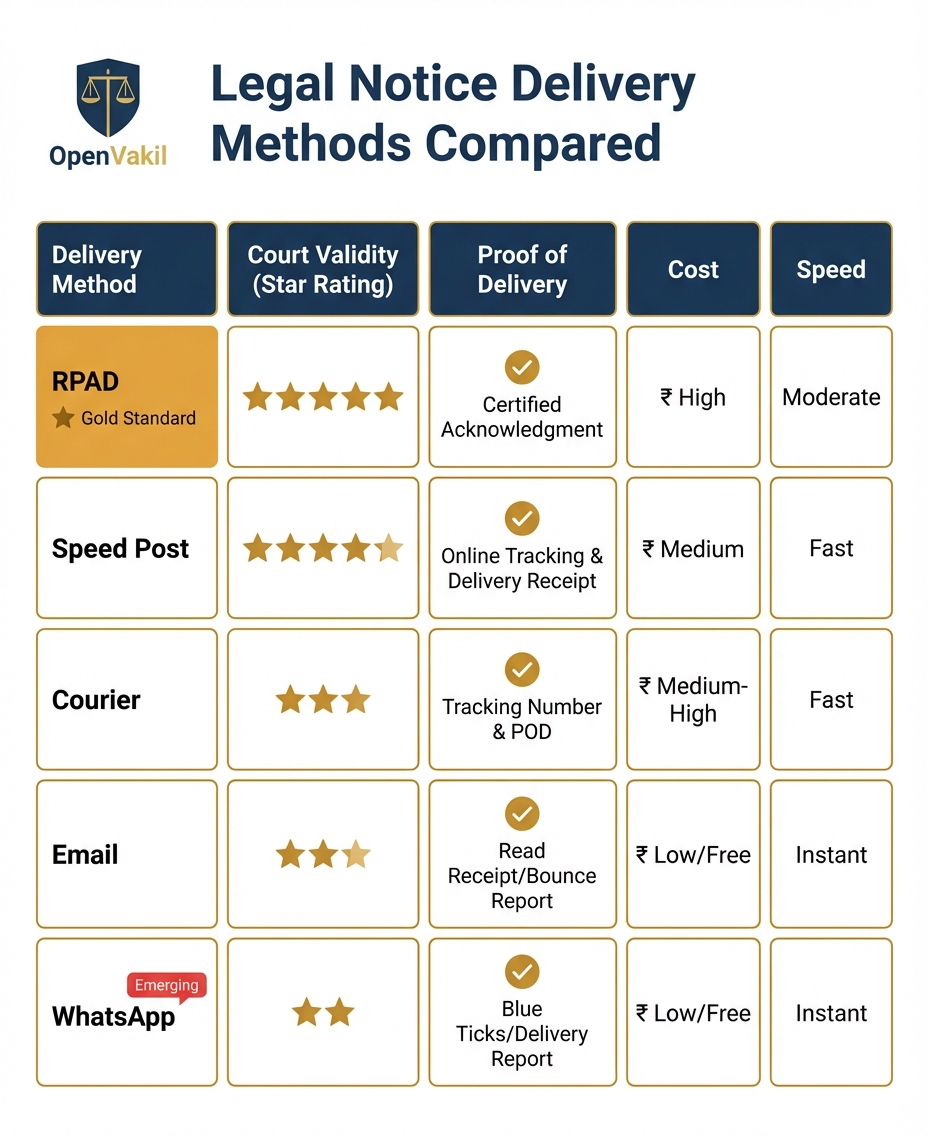
- Legal certainty: Registered post offers the highest legal certainty and is accepted universally by all courts. Email is widely accepted but may face objections in some cases. WhatsApp is increasingly accepted but is the newest and least established method.
- Proof of delivery: Registered post provides an acknowledgment due (AD) card signed by the recipient, which is considered strong proof. Email offers delivery confirmations and optional read receipts. WhatsApp provides blue tick read receipts with timestamps.
- Cost: Registered post costs Rs. 50–100+ depending on weight and distance. Email is essentially free. WhatsApp is free (requires only an internet connection).
- Speed: Registered post takes 3–7 business days for delivery within India. Email is delivered instantly. WhatsApp is delivered instantly (and read receipts appear in real time).
- Court acceptance: Registered post is accepted without question in all courts. Email is accepted in most civil and commercial matters. WhatsApp is accepted in an increasing number of cases, with supportive High Court rulings.
- Formality and seriousness: A registered post notice carries a strong psychological impact — receiving a physical legal notice feels more serious and formal. Email is moderately formal. WhatsApp, while effective, may be perceived as less formal.
- Risk of being ignored: Registered post is rarely ignored, as the act of accepting or refusing delivery is itself documented. Emails can be filtered to spam or overlooked. WhatsApp messages may be ignored, deleted, or the sender may be blocked.
The Multi-Channel Approach: Why Smart Senders Use All Three
Given the strengths and limitations of each delivery method, the most effective strategy is to send your legal notice through all three channels simultaneously: registered post, email, and WhatsApp. This multi-channel approach provides the strongest possible position, both legally and practically.
- Registered post provides legal certainty: By sending via registered post with AD, you satisfy every statutory requirement and eliminate any procedural objection the recipient could raise.
- Email provides an immediate paper trail: The email is delivered instantly, creating a timestamped digital record. The PDF attachment ensures the recipient has the complete notice on the same day, even if the registered post takes several days.
- WhatsApp provides instant notification: A WhatsApp message is likely to be seen within minutes. The blue tick confirmation provides immediate proof that the recipient is aware of the notice. This also removes any later claim that the recipient "did not know" about the notice.
By using all three channels, you cover every angle: the physical formality and legal certainty of registered post, the instant delivery and paper trail of email, and the immediate personal notification of WhatsApp. If the recipient claims they did not receive the notice, you have three independent channels of proof.
This Is Exactly What OpenVakil Does
OpenVakil’s Standard and Premium plans include multi-channel dispatch: your legal notice is sent via registered post (with tracking), email, and WhatsApp. This ensures maximum legal validity, immediate delivery, and comprehensive proof — without you having to coordinate three separate dispatch methods yourself.
Send Your Legal Notice Through All Three Channels
OpenVakil dispatches your legal notice via registered post, email, and WhatsApp — giving you the strongest possible delivery proof. Get started in minutes.
Create Your Legal NoticeCourt Rulings on Electronic Legal Notices
Indian courts have progressively recognised the validity of electronic communication for serving legal notices and court documents. Here are some notable developments:
- SBI vs Ajay Kumar Sood (Punjab & Haryana High Court): In this case, the High Court accepted that a legal notice sent via email constituted valid service. The court observed that where the parties had been communicating through email, using the same channel for a legal notice was a reasonable and effective mode of service.
- High Court rulings on WhatsApp service: Multiple High Courts — including the Delhi, Bombay, and Madras High Courts — have permitted service of court notices and summons through WhatsApp in various civil proceedings. These courts have recognised that WhatsApp’s delivery and read receipts provide adequate proof of service, particularly when traditional methods of service have failed or are impractical.
- Supreme Court observations on Digital India: The Supreme Court of India has made observations supporting the use of digital communication in legal proceedings. The Court has noted that in the era of Digital India, the legal system must adapt to technological advancements and that insisting on only physical modes of communication may cause unnecessary delays and hardship.
- Kerala High Court on electronic service: The Kerala High Court has allowed service of notices through email and WhatsApp in multiple cases, emphasising that the purpose of serving a notice is to bring the contents to the knowledge of the recipient, and electronic means effectively achieve this purpose.
The overall trend is clear: Indian courts are moving toward acceptance of electronic communication as a valid mode of service. However, this acceptance is contextual — courts consider factors such as the parties’ prior mode of communication, the nature of the dispute, and whether the statute in question mandates a specific mode of delivery.
Evolving Legal Landscape
Court acceptance of electronic legal notices is expanding with each passing year. However, the safest approach remains to use electronic delivery as a supplement to registered post, not as a complete replacement — unless you are certain that no statute or contractual clause requires physical delivery.
How to Ensure Your Electronic Notice Holds Up in Court
Sending a notice electronically is one thing; ensuring it holds up as valid evidence in court is another. Follow these practical steps to maximise the evidentiary value of your electronic legal notice:
- Prepare a Section 65B certificate: If the matter goes to court, you will need a certificate under Section 65B(4) of the Indian Evidence Act to authenticate the electronic record. This certificate must be prepared by the person who has control over the device or system used to send the notice. Draft this certificate at the time of sending, not later.
- Save screenshots with timestamps: Take clear, dated screenshots of the email delivery report, WhatsApp delivery ticks, and read receipts. Include the complete message, the date and time, and the recipient’s contact details in the screenshot.
- Use your official or personal email address: Notices sent from identifiable, traceable email addresses carry more weight. Avoid using disposable email services (like Guerrilla Mail or Temp Mail) as they undermine credibility.
- Send the notice as a PDF attachment: A properly formatted PDF of the legal notice — complete with the lawyer’s letterhead, signature, and enrollment number — is far more credible than a plain-text email or WhatsApp message.
- Follow up with registered post when possible: Even when electronic notice is legally sufficient, sending a follow-up copy via registered post strengthens your position significantly. The registered post serves as a backup, and the combination of electronic and physical delivery is virtually unassailable.
- Maintain the chain of custody for digital evidence: Do not edit, modify, or delete the original email or WhatsApp messages. Store backups on a separate device or cloud service. If you export WhatsApp chats, keep the exported file in its original format.
- Record the IP address and metadata if possible: Email headers contain sender and receiver IP addresses, timestamps, and routing information. Save the complete email headers as additional proof of delivery.
- Obtain independent verification: If possible, have a witness present when you send the notice and take screenshots. The witness can later testify about the sending and delivery of the notice if required.
Common Mistakes with Digital Legal Notices
Sending a legal notice digitally is convenient, but several common mistakes can undermine its validity and effectiveness. Avoid these pitfalls:
- Sending from an anonymous or unverifiable email: A legal notice from "randomuser12345@gmail.com" or a temporary email service has little credibility. Courts may question the identity of the sender, and the recipient can easily claim they did not take it seriously. Always use an identifiable email address.
- Not saving proof of delivery: Many people send a notice via email or WhatsApp and assume the job is done. Without delivery receipts, read confirmations, or screenshots, you have no evidence that the notice was actually received. Always document delivery immediately.
- Using only WhatsApp without other channels: While WhatsApp notices are valid in many cases, relying solely on WhatsApp is risky. The recipient can block your number, change their phone, or delete the message. Always complement WhatsApp with at least one other delivery method.
- Not following up if there is no read receipt: If the WhatsApp message shows only single grey ticks (sent but not delivered) or double grey ticks (delivered but not read), the notice may not have come to the recipient’s actual knowledge. Follow up with email and registered post to ensure delivery.
- Assuming digital is sufficient for government notices: This is one of the most dangerous mistakes. Section 80 CPC explicitly requires notice to government bodies through specific channels. Sending only an email or WhatsApp message to a government office does not satisfy this legal requirement, and your entire suit could be dismissed.
- Sending plain-text messages without a formal document: A WhatsApp text saying "I am sending you a legal notice" is not a legal notice. The actual notice must be a properly drafted, signed document — attach it as a PDF. The text message is merely the covering communication.
- Deleting the conversation or evidence: Some people clean up their phone or inbox and accidentally delete the evidence of having sent the notice. Once deleted, this evidence may be irrecoverable. Maintain backups at all times.
The Biggest Mistake: Section 138 NI Act Without Registered Post
In cheque bounce cases under Section 138 of the Negotiable Instruments Act, many people send the demand notice only via email or WhatsApp, assuming it is enough. It is not. The Act specifically requires the notice to be sent by registered post or speed post. Failing to do so is a procedural defect that can result in your entire complaint being dismissed.
How OpenVakil Dispatches Your Notice Across All Channels
Getting the delivery method right is just as important as getting the notice content right. OpenVakil eliminates the guesswork and coordination hassle by handling multi-channel dispatch for you.
- Multi-channel dispatch: OpenVakil sends your legal notice via registered post (with tracking and AD), email, and WhatsApp simultaneously. You get the legal certainty of physical delivery plus the speed and proof of electronic delivery, all in one step.
- Delivery tracking: Track the status of your registered post, view email delivery confirmations, and check WhatsApp delivery and read receipts — all from your OpenVakil dashboard. No more guessing whether the notice was received.
- Proper documentation for court admissibility: OpenVakil maintains a complete record of your notice dispatch — including timestamps, delivery receipts, and tracking information — that is formatted and ready to be presented as evidence in court if needed.
- AI-powered drafting with lawyer review: Beyond dispatch, OpenVakil uses AI to help you draft a comprehensive legal notice tailored to your situation. Answer a few questions, review the draft, and your notice is ready to send — all within minutes.
- Compliance with statutory requirements: OpenVakil automatically includes registered post for notices that require it by law (such as cheque bounce notices under Section 138 NI Act and government notices under Section 80 CPC), ensuring you never miss a mandatory procedural step.
Whether your dispute requires registered post, email, WhatsApp, or all three, OpenVakil ensures your legal notice reaches the recipient through every available channel — with full delivery proof and documentation maintained for court proceedings.
Send Your Legal Notice the Right Way
Do not risk a procedural error with your legal notice. OpenVakil drafts your notice with AI, ensures it meets legal standards, and dispatches it via registered post, email, and WhatsApp — with complete tracking and delivery proof.
Get Started Now