You have drafted your legal notice — but your work is only half done. How you deliver the notice is just as important as what it says. Indian courts routinely scrutinise whether a legal notice was properly served, and an improperly delivered notice can be challenged, dismissed, or rendered legally ineffective — regardless of how strong your underlying claim is.
Proof of service is the cornerstone of any legal notice. If you cannot demonstrate that the recipient received (or was given a reasonable opportunity to receive) your notice, courts may hold that the notice was never served. This can be fatal in time-bound matters like cheque bounce cases under Section 138 of the Negotiable Instruments Act or government suits under Section 80 CPC, where proper service of notice is a mandatory prerequisite to filing a case.
In this comprehensive guide, we compare every delivery method available in India — registered post with AD, speed post, private courier, email, WhatsApp, hand delivery, and court-ordered substituted service. We cover legal validity, proof of delivery, cost, speed, court acceptance, and the smartest strategy to ensure your notice holds up in any legal proceeding.
Why the Delivery Method Matters
The purpose of serving a legal notice is twofold: first, to bring the contents of the notice to the actual knowledge of the recipient; and second, to create a legally admissible record that the notice was dispatched and delivered. Courts assess both aspects when determining whether service was proper.
If the recipient later claims in court that they never received your notice, the burden falls on you to prove that service was effected. Without proper proof — such as an acknowledgment due (AD) card, a postal tracking record, a delivery receipt, or a read confirmation — your notice may be treated as if it was never sent. The consequences can be severe:
- Cheque bounce cases (Section 138 NI Act): If the demand notice is not properly served within 30 days of the dishonour memo, the entire criminal complaint can be dismissed as premature or time-barred.
- Suits against government (Section 80 CPC): The suit itself can be dismissed at the threshold if the court finds that the mandatory two-month notice was not properly served on the government body.
- Contractual disputes: Many contracts require notices to be delivered through a specified mode (e.g., registered post to a designated address). Using a different method may mean the notice is deemed invalid under the contract.
- Limitation periods: If you cannot prove the date on which the notice was served, it becomes impossible to establish that subsequent legal action was filed within the applicable limitation period.
- Adverse inference: Courts may draw an adverse inference against a party that cannot demonstrate proper service, potentially weakening your credibility as a litigant.
Courts Can Dismiss Your Case for Improper Service
Indian courts have dismissed cases solely because the sender failed to prove that the legal notice was properly served. The delivery method is not a mere formality — it is a substantive legal requirement. Choosing the right method and preserving proof of delivery can make or break your case.
Registered Post with AD (RPAD) — The Gold Standard
Registered Post with Acknowledgment Due (RPAD) through India Post remains the single most reliable and universally accepted method of delivering a legal notice in India. It is recognised by every Indian court — from the lowest civil court to the Supreme Court of India — and is mandated by several statutes as the required mode of service.
When you send a notice via RPAD, India Post assigns a unique registration number and issues a receipt at the time of booking. An Acknowledgment Due (AD) card — a small green postcard — is attached to the article. When the notice is delivered, the recipient (or an authorised person at the delivery address) signs the AD card, which is then returned to the sender by India Post. This signed AD card constitutes conclusive proof of delivery admissible in any court.
- Legal recognition: Universally accepted under the Indian Post Office Act, 1898, and recognised by the Code of Civil Procedure, the Negotiable Instruments Act, and virtually every Indian statute that requires notice.
- Proof of delivery: The signed AD card is the strongest proof of service available. It bears the recipient’s signature (or thumb impression), the date of delivery, and the postman’s attestation.
- Cost: Approximately Rs. 50–150 depending on weight and destination, plus Rs. 30 for the AD card.
- Timeline: Typically 5–10 business days for delivery within India, though it may take longer for remote areas.
- Tracking: India Post provides online tracking via the registration number at indiapost.gov.in.
- Deemed service: Even if the recipient refuses to accept the article or it is returned as unclaimed, it is deemed to have been served under Section 27 of the General Clauses Act, 1897.
How to Send a Legal Notice via RPAD
- Prepare the envelope: Place the signed legal notice in a properly sealed envelope. Write the recipient’s full name and complete address clearly on the front, and the sender’s (or advocate’s) return address on the back.
- Visit the post office: Go to any India Post office. Request "Registered Post with Acknowledgment Due" and fill out the AD card (green postcard) with the sender’s address where the signed card should be returned.
- Pay the charges: Pay the postal charges plus the AD fee. The counter clerk will stamp the envelope, attach the AD card, and issue you a receipt with the registration number.
- Retain the receipt: Keep the postal receipt safely. This receipt — along with the tracking number — is your proof that the notice was dispatched on a specific date.
- Track the delivery: Use the registration number to track delivery status online at indiapost.gov.in or through the India Post mobile app.
- Collect the AD card: Once the notice is delivered and the AD card is signed by the recipient, India Post will return it to the sender’s address. Preserve this card carefully — it is your primary proof of service.
What If RPAD Is Refused or Returned Unclaimed?
A common concern is: what if the recipient deliberately refuses to accept the registered post, or the article is returned as "unclaimed" because no one was available to receive it? Indian law has a clear answer.
Section 27 of the General Clauses Act, 1897 provides that where an enactment requires a document to be served by post, service is deemed to have been effected by properly addressing, prepaying, and posting the letter by registered post, unless the contrary is proved. The Supreme Court of India, in Jagdish Singh v. Natthu Singh and other cases, has held that refusal to accept a registered letter amounts to deemed service. The returned envelope with the postal endorsement "refused" or "unclaimed" itself serves as proof that the notice was served.
Deemed Service Under Section 27, General Clauses Act
If you send a legal notice by RPAD to the correct address and it is returned as "refused" or "unclaimed," the notice is deemed to have been served on the date the postal article was tendered for delivery. Keep the returned envelope with all postal endorsements intact — this is admissible evidence of deemed service in court.
Speed Post — Faster Alternative via India Post
Speed Post is India Post’s premium express mail service that offers faster delivery times compared to ordinary registered post. It is widely accepted by Indian courts as a valid mode of service for legal notices and carries most of the advantages of RPAD.
- Legal recognition: Widely accepted by courts. The Supreme Court in several judgments has treated speed post as equivalent to registered post for the purposes of serving legal notices, including under Section 138 of the NI Act.
- Proof of delivery: Speed post includes online tracking with delivery confirmation. However, speed post does not include an AD card by default. You must specifically request "Speed Post with AD" at the post office counter and pay the additional AD fee to receive a signed acknowledgment card.
- Cost: Approximately Rs. 50–100 for articles up to 200 grams within the same city, and Rs. 60–150 for intercity delivery. AD card costs an additional Rs. 30.
- Timeline: 2–4 business days for most destinations within India, making it significantly faster than ordinary registered post.
- Tracking: Comprehensive online tracking is available through the India Post website, showing each stage from booking to delivery.
- Ideal for: Time-sensitive notices where the 5–10 day timeline of regular RPAD is too long, such as approaching the 30-day deadline in cheque bounce cases.
Always Request AD with Speed Post
Speed post provides online tracking and delivery confirmation, but this alone may not satisfy courts that require a signed acknowledgment. When sending a legal notice by speed post, always request "Speed Post with AD" at the post office counter. The small additional cost (approximately Rs. 30) gives you the signed acknowledgment card — the strongest form of delivery proof.
Private Courier (DTDC, BlueDart, Delhivery) — Convenient but Risky
Private courier services like DTDC, BlueDart, Delhivery, FedEx, and DHL are convenient and often faster than India Post. However, using a private courier as the primary method of delivering a legal notice carries significant legal risks that you should understand before choosing this option.
The fundamental issue is that private couriers are not India Post. Several Indian statutes — including Section 138 of the Negotiable Instruments Act and Section 80 of the CPC — specifically refer to "post" or "registered post," which courts have interpreted to mean service through the government postal system operated by India Post. A legal notice sent exclusively through a private courier may face objections on this ground.
- Legal recognition: Partial. Courts generally accept courier delivery as a valid mode of service in general civil disputes, but not where a statute specifically requires registered post or postal service. Several High Courts have questioned the evidentiary value of private courier receipts.
- Proof of delivery: Most reputed couriers provide a Proof of Delivery (POD) with the recipient’s signature and delivery timestamp. However, the POD from a private courier does not carry the same legal weight as a signed AD card from India Post.
- Cost: Rs. 80–500 depending on the courier company, weight, and destination. Premium services with guaranteed delivery timelines cost more.
- Timeline: 1–3 business days for most destinations, making it the fastest physical delivery option.
- Risk: If the opposing party challenges the mode of delivery, courts may require you to prove the reliability of the courier service and the authenticity of the delivery receipt. This adds an unnecessary layer of litigation risk.
- Recommended use: Use only as a supplementary delivery method alongside RPAD. Never rely solely on private courier for statutory notices like cheque bounce demands or government notices.
If you do use a private courier, choose a reputed national carrier with reliable tracking, request a Proof of Delivery (POD) document bearing the recipient’s signature, and preserve the courier receipt with the tracking number. But always send a parallel copy by RPAD or speed post to ensure you have legally unassailable proof of service.
Email — Valid in Many Cases, Essential as Supplement
Email has become a widely accepted mode of delivering legal notices in India, supported by statutory provisions under the Information Technology Act, 2000 and evolving court jurisprudence. For civil and commercial disputes where no statute mandates postal delivery, an email notice can constitute valid service — especially when the parties have a history of communicating via email.
Section 13 of the Information Technology Act, 2000 governs the time and place of dispatch and receipt of electronic records. Under this provision, an electronic record (including an email) is deemed to have been dispatched when it enters a computer resource outside the control of the originator, and is deemed to have been received when it enters the designated computer resource of the addressee. This provides a statutory framework for determining when an email notice is "served."
Courts across India have increasingly accepted email as valid service, particularly in commercial disputes, consumer matters, employment cases, and intellectual property disputes. The Delhi, Bombay, and Madras High Courts have all upheld email notices where the sender could demonstrate that the email was sent to a known, active email address and that delivery was confirmed.
- Legal recognition: Valid under the IT Act, 2000, for most civil and commercial disputes. Not sufficient as the sole mode of delivery where statutes mandate registered post (e.g., Section 138 NI Act, Section 80 CPC).
- Proof of delivery: Email delivery confirmations, read receipts, and email server logs. The strength of this proof depends on the email provider and whether the recipient has read receipts enabled.
- Cost: Free.
- Timeline: Instantaneous.
- Best used as: A supplementary delivery method alongside RPAD or speed post. Sends the notice content to the recipient immediately while the physical copy is in transit.
- When email alone may suffice: In general civil disputes with no statutory requirement for postal service, in contractual matters where the contract designates email as a valid mode of communication, in consumer complaints, and in employment disputes where parties have been communicating via official email.
Electronic Evidence Requirements Under Indian Law
If the matter proceeds to court, you will need to ensure your email evidence is admissible. The applicable legal provisions are:
- Section 65B of the Indian Evidence Act, 1872 (now Section 63 of the Bharatiya Sakshya Adhiniyam, 2023): Any electronic record produced as evidence must be accompanied by a certificate from a person in charge of the computer or device from which the record was generated. This certificate must identify the electronic record, describe the manner of its production, and confirm that the computer was operating properly. Without this certificate, the electronic record is inadmissible.
- Section 4, IT Act, 2000: Grants legal recognition to electronic records — information in electronic form cannot be denied legal effect merely because it is electronic.
- Section 5, IT Act, 2000: Recognises electronic signatures, meaning a digitally signed PDF of the legal notice meets the signature requirement.
- Section 13, IT Act, 2000: Establishes when an electronic record is deemed dispatched and received, providing the legal framework for determining the date of service.
Electronic records are admissible as evidence in any proceedings, without further proof or production of the original, as evidence of any contents of the original or of any fact stated therein of which direct evidence would be admissible — subject to the conditions specified in Section 65B.
— Section 65B(1), Indian Evidence Act, 1872
WhatsApp — Emerging Acceptance in Indian Courts
WhatsApp has emerged as a surprisingly effective channel for serving legal notices in India, with multiple High Courts recognising its validity. With over 500 million users in India, WhatsApp is often the most practical way to ensure that a notice actually reaches the recipient’s attention.
The key advantage of WhatsApp is its built-in delivery and read receipt system. A single grey tick indicates the message was sent, double grey ticks indicate it was delivered to the recipient’s device, and double blue ticks indicate the message was read. These blue ticks, along with the timestamp, provide a clear, timestamped confirmation that the recipient not only received the notice but actually opened and read it — a level of proof that even RPAD cannot provide (the AD card confirms delivery, not that the contents were read).
- Legal recognition: Increasingly accepted. Multiple High Courts have permitted WhatsApp service in civil proceedings. WhatsApp messages are electronic records under the IT Act, 2000, and are admissible as evidence under Section 65B of the Indian Evidence Act / Section 63 BSA.
- Proof of delivery: Blue tick read receipts with timestamps. Screenshots of the conversation serve as evidence. However, the recipient can disable read receipts in their WhatsApp settings, in which case you only get double grey ticks (delivered, but read status unknown).
- Cost: Free (requires only an internet connection).
- Timeline: Instantaneous.
- Limitations: The recipient can block your number, delete messages, or change their phone number. WhatsApp’s "Delete for Everyone" feature allows the sender to delete messages from both ends. The platform is also not considered a formal postal service, so statutes requiring "post" are not satisfied by WhatsApp.
- Best practice: Send the legal notice as a PDF attachment via WhatsApp, followed by a brief text summarising the key demand. Take screenshots of the delivery and read receipts immediately. Export the entire chat as a backup.
Court Rulings on WhatsApp Service
Several Indian High Courts have made significant rulings on the validity of WhatsApp as a mode of service:
- Delhi High Court: In multiple civil proceedings, the Delhi High Court has permitted service of summons and notices through WhatsApp, particularly in cases where the respondent was evading traditional service. The Court observed that WhatsApp’s delivery and read receipts provide adequate proof of service.
- Bombay High Court: Has allowed WhatsApp service as a supplementary mode alongside registered post, especially in commercial disputes where parties regularly communicated via WhatsApp.
- Madras High Court: Permitted service of court notices through WhatsApp in family law matters, recognising that the respondent was actively using the messaging platform.
- Kerala High Court: Accepted WhatsApp screenshots as evidence of communication between parties and allowed service through WhatsApp in consumer and civil disputes.
- Supreme Court of India: While not specifically ruling on WhatsApp legal notices, the Supreme Court has broadly endorsed digital service methods in the interest of justice and has encouraged courts to adopt technology for efficient service.
WhatsApp Screenshots as Evidence
When using WhatsApp to deliver a legal notice, screenshots of the conversation — showing the sent PDF, delivery ticks, and blue read receipts with timestamps — are admissible as electronic evidence under Section 65B of the Indian Evidence Act / Section 63 BSA. However, you must prepare a Section 65B(4) certificate from the person who controls the device from which the screenshots were taken. Without this certificate, the screenshots may be ruled inadmissible.
Hand Delivery / Personal Service
Delivering a legal notice by hand — either personally or through an authorised agent, process server, or advocate’s clerk — is one of the oldest and most effective methods of service. When done properly, it provides absolute certainty that the notice reached the intended recipient.
- Legal recognition: Fully recognised under the CPC and accepted by all courts. Personal service is, in fact, the preferred mode of service for court summons and processes under Order 5 of the CPC.
- Proof of delivery: The person delivering the notice should obtain a signed acknowledgment from the recipient on a duplicate copy of the notice, recording the date and time of delivery. If the recipient refuses to sign, the delivery person should make a detailed note of the refusal, including the date, time, place, and circumstances.
- Cost: Free if delivered personally. If an advocate’s clerk or process server is engaged, fees typically range from Rs. 500 to Rs. 2,000 depending on the distance and effort involved.
- Timeline: Same day, assuming the recipient is available at the address.
- Useful when: The recipient’s postal address is uncertain or unreliable, the matter is extremely urgent and cannot wait for postal delivery, prior attempts at postal delivery have failed, or when the sender wants to ensure face-to-face delivery with an immediate acknowledgment.
- Risk: If the recipient refuses to accept the notice or denies that delivery was attempted, and you do not have an independent witness, proving service becomes difficult. Always have at least one independent witness present during hand delivery.
For hand delivery, it is advisable to take a witness along — ideally someone unrelated to the dispute who can later provide testimony that the notice was tendered to the recipient. The witness should also sign the acknowledgment copy, confirming the date, time, and place of delivery.
Court-Ordered Substituted Service — When All Methods Fail
When all conventional methods of service fail — the notice is returned unclaimed, the recipient cannot be located, or the recipient is deliberately evading service — the court may order substituted service under Order 5, Rule 20 of the Code of Civil Procedure, 1908.
Substituted service is a court-directed alternative method of service that is used only after the court is satisfied that the defendant cannot be served through ordinary means. The court has wide discretion to direct any mode of service that is most likely to bring the notice to the defendant’s knowledge.
- Newspaper publication: The notice is published in a daily newspaper circulating in the area where the defendant was last known to reside. Courts typically require publication in both an English and a vernacular (local language) newspaper.
- Affixing on the door: A copy of the notice is affixed on the outer door or some conspicuous part of the house where the defendant was last known to reside.
- Publication on court website: Some courts now permit publication of notices on the court’s official website or on the National Judicial Data Grid.
- Service through email or WhatsApp (court-directed): In recent years, courts have permitted substituted service through email and WhatsApp when the defendant’s electronic contact details are known but physical service has failed.
Substituted service is relevant primarily in litigation proceedings rather than pre-litigation legal notices. However, if you have made genuine attempts to serve a pre-litigation legal notice through RPAD, speed post, and courier and all have failed, documenting these failed attempts strengthens your position when you approach the court. The court may then permit substituted service for the court notices or summons.
Where the Court is satisfied that there is reason to believe that the defendant is keeping out of the way for the purpose of avoiding service, or that for any other reason the summons cannot be served in the ordinary way, the Court shall order the summons to be served by affixing a copy thereof in some conspicuous place in the Court-house, and also upon some conspicuous part of the house in which the defendant is known to have last resided or carried on business.
— Order 5, Rule 20, Code of Civil Procedure, 1908
Delivery Methods Comparison Table
The following comparison summarises the key attributes of each delivery method, helping you choose the right approach for your specific situation.
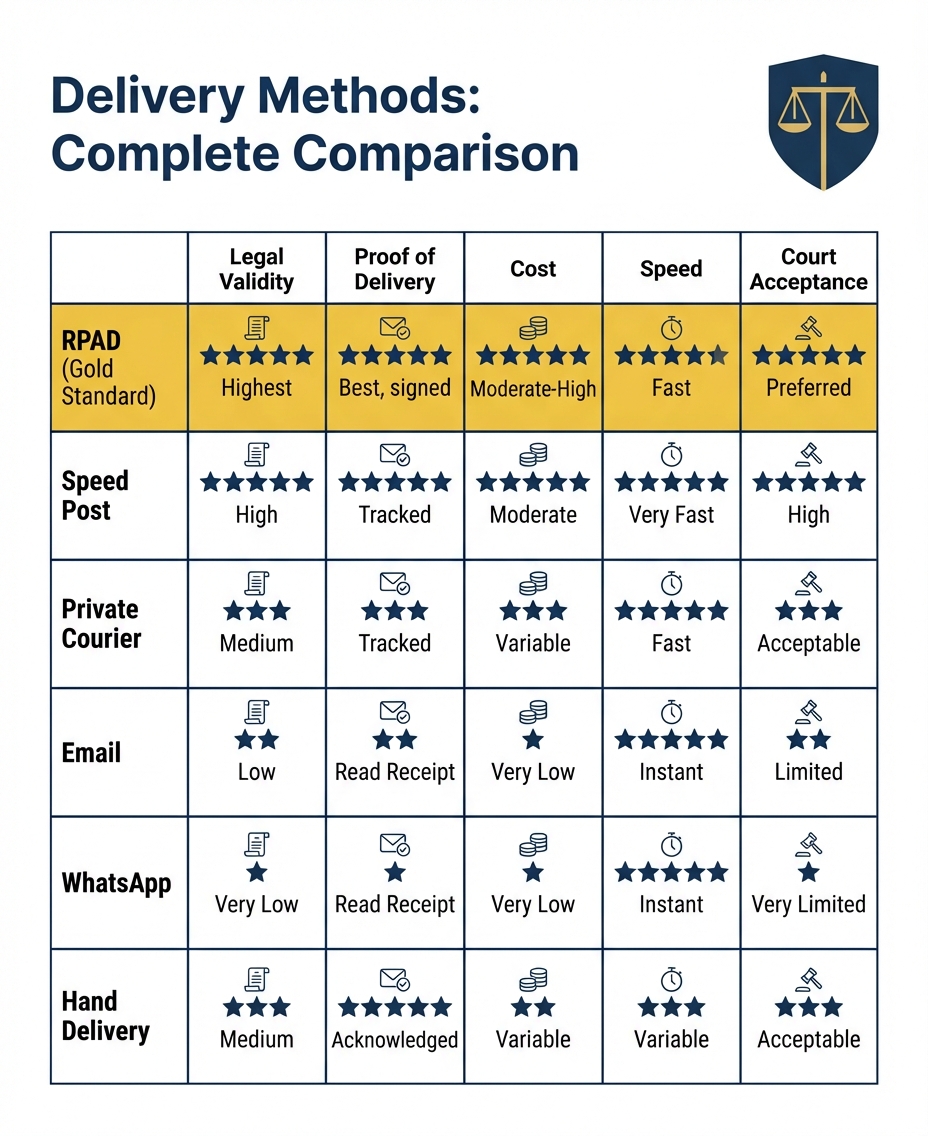
- RPAD (Registered Post with AD): Legal validity — Highest, universally accepted. Proof — Signed AD card. Cost — Rs. 80–180. Speed — 5–10 days. Recommended for — All legal notices, especially statutory notices (Section 138 NI Act, Section 80 CPC).
- Speed Post (with AD): Legal validity — High, widely accepted as equivalent to registered post. Proof — Online tracking + AD card (if requested). Cost — Rs. 50–150 + Rs. 30 AD. Speed — 2–4 days. Recommended for — Time-sensitive notices where RPAD timeline is too long.
- Private Courier: Legal validity — Moderate, accepted in general civil matters but not where statute requires "post." Proof — Courier POD receipt. Cost — Rs. 80–500. Speed — 1–3 days. Recommended for — Supplementary use only, alongside RPAD.
- Email: Legal validity — Valid under IT Act for most civil/commercial matters. Proof — Delivery/read receipts, email headers. Cost — Free. Speed — Instant. Recommended for — Supplementary to RPAD, or primary in contractual/commercial disputes with email history.
- WhatsApp: Legal validity — Emerging acceptance by High Courts. Proof — Blue tick read receipts, screenshots. Cost — Free. Speed — Instant. Recommended for — Supplementary to RPAD and email, useful for ensuring actual knowledge.
- Hand Delivery: Legal validity — High, recognised under CPC. Proof — Signed acknowledgment + witness testimony. Cost — Free to Rs. 2,000. Speed — Same day. Recommended for — When recipient is evading postal service, urgent matters.
- Substituted Service: Legal validity — Highest (court-ordered). Proof — Court order + newspaper publication/affixing proof. Cost — Rs. 5,000–20,000+. Speed — 2–4 weeks. Recommended for — Last resort when all other methods fail.
Not Sure Which Delivery Method to Use?
OpenVakil handles multi-channel dispatch for you — your legal notice is sent via RPAD, email, and WhatsApp simultaneously, ensuring maximum legal validity and complete delivery proof.
Create Your Legal NoticeWhat Happens If the Notice Is Refused or Unclaimed?
One of the most common situations senders face is the notice being returned by India Post with an endorsement such as "refused," "unclaimed," "addressee not found," or "left, address incomplete." Does this mean the notice was not served? Not necessarily.
Section 27 of the General Clauses Act, 1897 provides the key legal principle: where any Central Act or Regulation requires a document to be served by post, and the document is properly addressed, prepaid, and posted by registered post, then unless the contrary is proved, service is deemed to have been effected at the time when the letter would be delivered in the ordinary course of post. The Supreme Court has applied this principle consistently.
- "Refused": If the recipient deliberately refuses to accept the registered article, this is treated as deemed service. The refusal itself is evidence that the notice was tendered for delivery. Keep the returned envelope with the postal endorsement "Refused" intact.
- "Unclaimed": If the notice is returned as unclaimed after multiple delivery attempts by the postman, it is generally treated as deemed service, provided the correct address was used. Courts presume that a letter properly addressed and posted reaches the addressee.
- "Addressee not found" / "Left, address incomplete": These endorsements are more problematic. If the recipient no longer resides at the address, or the address was incorrect, deemed service may not apply. You may need to obtain the correct address and re-send the notice, or consider alternative delivery methods.
- "Intimation left": This means the postman left an intimation slip because the recipient was not available. The recipient has a specified period to collect the article from the post office. If they do not collect it, the article is returned as unclaimed, and deemed service may apply.
Preserve the Returned Envelope
If your RPAD notice is returned for any reason, do not open or discard the returned envelope. Preserve it in its original condition with all postal endorsements visible. This returned envelope — with endorsements like "Refused" or "Unclaimed" — is itself evidence that can be produced in court to establish deemed service. Courts regularly rely on postal endorsements to determine whether service was effected.
The Multi-Channel Strategy: RPAD + Email + WhatsApp
Given the strengths and limitations of each delivery method, the optimal strategy is to send your legal notice through multiple channels simultaneously. This approach — commonly referred to as the multi-channel strategy — provides the strongest possible legal position and maximises the likelihood that the recipient actually receives and reads the notice.
- Send by RPAD (primary): This satisfies all statutory requirements and provides the signed AD card as conclusive proof of delivery. Even if the recipient refuses or the notice is returned unclaimed, deemed service under Section 27 of the General Clauses Act protects you.
- Send by email (simultaneous): Email the notice as a signed PDF attachment to the recipient’s known email address on the same day you dispatch the RPAD. Enable delivery and read receipts. This ensures the recipient has immediate access to the notice content while the physical copy is in transit.
- Send by WhatsApp (simultaneous): Send the PDF via WhatsApp to the recipient’s known phone number. The blue tick confirmation provides proof that the recipient actually read the notice. Screenshot the delivery and read receipts immediately.
- Send by speed post (optional, for urgency): If the matter is time-sensitive and you cannot wait 5–10 days for RPAD delivery, also send a copy by speed post with AD for faster physical delivery.
- Send by courier (optional, as additional layer): In high-stakes disputes, you may also send a copy by private courier with POD as an additional layer of proof.
By deploying multiple channels simultaneously, you create an overwhelming body of evidence that the notice was dispatched and received. The recipient cannot credibly claim ignorance when they have received the notice through three or more independent channels, each with its own proof of delivery.
Special Cases: NRIs, Government Entities, and Companies
Certain categories of recipients require special attention when it comes to serving legal notices. The delivery method and address requirements vary depending on whether you are sending to an NRI, a government body, or a company.
Notices to NRIs (Non-Resident Indians)
Serving legal notices on NRIs presents unique challenges because the recipient is located outside India. The following approaches are commonly used:
- International registered post / speed post: India Post provides international registered post and international speed post (EMS) services to most countries. Send the notice via international RPAD to the NRI’s overseas address. Delivery times range from 7–21 days depending on the destination country.
- Indian address (if available): If the NRI has a known address in India — such as a family home, a registered property address, or an address mentioned in the relevant agreement — send the notice to that Indian address as well. Courts have accepted service at the NRI’s Indian address in many cases.
- Email: Email is particularly effective for NRI notices because it reaches the recipient instantly regardless of their location. Courts have accepted email service on NRIs in multiple cases, especially where physical delivery to a foreign address is uncertain.
- Private international courier: Services like FedEx, DHL, and UPS provide reliable international delivery with tracking and proof of delivery. Use as a supplementary method.
- Court-ordered service through Ministry of External Affairs: In litigation proceedings, if ordinary service fails, courts can direct service through the Ministry of External Affairs (MEA) or through the Indian embassy or consulate in the NRI’s country of residence, in accordance with the Hague Convention on Service Abroad (for signatory countries).
Government Entities — Section 80 CPC
Section 80 of the Code of Civil Procedure, 1908 imposes strict requirements for serving notice on government entities before filing a civil suit. The notice must be served on the specific authority designated by the provision:
- Central Government: The notice must be delivered to, or left at the office of, a Secretary to the Central Government. It may also be sent by registered post addressed to the Secretary.
- State Government: The notice must be delivered to, or left at the office of, a Secretary to the State Government. It may also be sent by registered post addressed to the Secretary.
- Public officer: The notice must be delivered to the officer personally, or left at his office. It may also be sent by registered post to the officer.
- Mandatory two-month waiting period: After serving the notice, you must wait at least two months before filing the suit, giving the government time to respond or remedy the grievance.
- Mode of service: Courts have consistently held that Section 80 CPC notices must be served through registered post or physical delivery. Sending only an email or WhatsApp to a government office does not satisfy Section 80 requirements. Use RPAD as the primary mode, and supplement with email if the authority has an official email address.
Companies — Service at Registered Office
When sending a legal notice to a company registered under the Companies Act, 2013, service must be effected at the company’s registered office address. This address is publicly available on the Ministry of Corporate Affairs (MCA) website and in the company’s annual filings.
- Registered office: Send the notice by RPAD to the company’s registered office as listed on the MCA portal. Under Section 12 of the Companies Act, 2013, a company is required to accept all communications and notices at its registered office.
- Directors and officers: In addition to the registered office, you may also send copies to the individual directors or officers involved in the dispute, addressed to them personally at the registered office or their known residential addresses.
- Corporate email: Send a copy by email to the company’s official email address (typically available on their website, letterhead, or MCA filings) and to the specific officer or director involved.
- Statutory demand notices (Section 271 Companies Act): A creditor’s statutory demand notice for winding up must be served at the registered office of the company by registered post or by leaving it at the office.
- IBC demand notices (Section 8): Demand notices under the Insolvency and Bankruptcy Code must be delivered to the registered office of the corporate debtor by hand, registered post, speed post, or electronic means to the email address shown in the Master Data on the MCA website.
How OpenVakil Handles Dispatch
Choosing the right delivery method, coordinating multiple channels, and preserving proof of service can be overwhelming — especially when you are already dealing with the stress of a legal dispute. OpenVakil eliminates this complexity by handling the entire dispatch process for you.
- Multi-channel dispatch: OpenVakil sends your legal notice via RPAD (with tracking and AD card), email (with delivery confirmation), and WhatsApp simultaneously. You get the legal certainty of postal service plus the instant delivery and read confirmation of digital channels — all coordinated in a single step.
- Automatic method selection: Based on the type of dispute and statutory requirements, OpenVakil automatically ensures that the correct delivery methods are used. For cheque bounce notices (Section 138 NI Act) and government notices (Section 80 CPC), RPAD is always included as the primary mode.
- Delivery dashboard: Track the real-time status of every delivery channel from your OpenVakil dashboard. View RPAD tracking updates, email delivery confirmations, and WhatsApp read receipt screenshots — all in one place.
- Court-ready documentation: OpenVakil maintains a comprehensive delivery record that includes the postal receipt, tracking history, AD card scan (when returned), email delivery report, and WhatsApp screenshot — all formatted and ready to be produced as evidence in court.
- NRI and company notices: For notices to NRIs or companies, OpenVakil identifies the correct address (including international addresses and MCA registered office addresses) and dispatches through the appropriate channels.
- Failed delivery handling: If a notice is returned as "refused" or "unclaimed," OpenVakil preserves the returned envelope and endorsements, documents the deemed service, and advises on next steps including re-dispatch or alternative delivery methods.
Let OpenVakil Handle Your Legal Notice Dispatch
From AI-powered drafting to multi-channel delivery with complete tracking and court-ready proof of service — OpenVakil manages the entire process so you can focus on your dispute, not logistics.
Get Started NowTips for Effective Legal Notice Delivery
Follow these practical tips to ensure your legal notice delivery is legally effective and practically reliable:
- Always verify the address before dispatch: An incorrect address is the most common reason for failed delivery. For individuals, verify through prior correspondence, Aadhaar records, or voter ID. For companies, check the MCA portal for the current registered office address.
- Use RPAD as the primary method in every case: Regardless of whether the statute requires it, RPAD provides the strongest proof of delivery. Treat it as your baseline and add other channels on top.
- Send through multiple channels on the same day: Dispatch RPAD, email, and WhatsApp on the same date. This creates a consistent record and prevents the recipient from claiming that the notice was sent piecemeal or at different times.
- Preserve all proof of dispatch and delivery: Keep the postal receipt, AD card (when returned), courier POD, email delivery/read receipts, WhatsApp screenshots, and returned envelopes. Store digital copies in a secure cloud service as backup.
- Photograph the notice and envelope before posting: Take clear photographs of the signed notice, the sealed envelope with the recipient’s address visible, and the postal receipt. This creates additional evidence of what was sent and when.
- Follow up if delivery is uncertain: If the RPAD tracking shows no movement for an extended period, or if WhatsApp shows only single grey ticks, follow up with an alternative delivery method rather than waiting indefinitely.
- Keep the original notice with you: Always retain at least two copies of the notice — one for your records and one for potential court submission. If sent through an advocate, ensure the advocate also retains a copy.
- Note the date of deemed service carefully: For time-bound statutory actions (e.g., the 15-day waiting period under Section 138 NI Act), the clock starts from the date of delivery or deemed service — not the date of dispatch. Calculate your timelines based on the delivery date shown on the AD card or tracking system.
- Do not send threatening or defamatory content: A legal notice must be factual and professional. Including threats, abusive language, or defamatory allegations can expose you to a counter-complaint under Section 499/500 of the Indian Penal Code (defamation) or Section 503 (criminal intimidation).
- Consult a lawyer for statutory notices: For notices where the law prescribes specific requirements — such as cheque bounce notices, government notices, eviction notices, or insolvency demands — always consult a qualified advocate to ensure procedural compliance. A single procedural defect can invalidate the entire notice.
The method by which you deliver your legal notice is not a mere logistical detail — it is a substantive legal requirement that can determine whether your notice is valid, whether it constitutes proper service, and whether your subsequent legal proceedings will succeed. By choosing the right delivery methods, using a multi-channel approach, and carefully preserving proof of service, you ensure that your legal notice achieves its intended purpose: bringing the matter to the recipient’s knowledge and establishing an irrefutable record that service was effected.
Whether you are sending a cheque bounce demand, a consumer complaint notice, a breach-of-contract claim, or a notice to a government entity, the principles remain the same: use RPAD as your baseline, supplement with email and WhatsApp for immediate delivery and read confirmation, and preserve every piece of evidence. With this approach, your legal notice will withstand any challenge to its validity — in negotiation and in court.