India’s e-commerce market has exploded in recent years, with millions of consumers shopping online for everything from electronics and clothing to flight tickets, hotel rooms, and food delivery. While the convenience is undeniable, disputes over refunds have become one of the most common consumer grievances in the country. Whether it is a defective product on Amazon, a cancelled flight booking on MakeMyTrip, a subscription service that won’t stop charging you, or a food delivery order that never arrived — the frustration of not receiving a legitimate refund is all too familiar.
The good news is that Indian law provides robust protections for consumers in these situations. The Consumer Protection Act 2019, the Consumer Protection (E-Commerce) Rules 2020, the Information Technology Act 2000, and RBI guidelines on chargebacks together create a comprehensive legal framework that empowers you to demand — and receive — the refund you are owed. A legal notice for refund is the most powerful pre-litigation tool at your disposal, and this guide will show you exactly how to use it.
This comprehensive guide covers everything you need to know about sending a legal notice for refund in India — from understanding when a refund dispute arises, to navigating the legal framework, drafting an effective notice, and escalating to consumer forums if necessary.
What Constitutes a Refund Dispute?
A refund dispute arises when a consumer has paid for goods or services and is legally entitled to a refund, but the seller, e-commerce platform, travel company, or service provider fails to process the refund within a reasonable time or refuses to issue one altogether. Under Indian law, refund disputes can be broadly categorized as follows:
- Non-delivery of goods or services: You paid for a product or service that was never delivered, or the delivery was incomplete.
- Defective or damaged goods: The product received was defective, damaged, or materially different from what was described or advertised.
- Cancellation by the seller or platform: The seller or platform cancelled your order but failed to process the refund.
- Cancellation by the consumer within policy: You cancelled within the stipulated cancellation window, but the refund was not issued.
- Overcharging or duplicate charges: You were charged more than the listed price, or your payment was debited multiple times.
- Service not rendered as promised: The service provided was substantially different from or inferior to what was promised at the time of purchase.
- Failed transactions: Your payment was debited but the transaction failed, and the amount was not reversed.
- Unauthorized charges: Charges made without your explicit consent, such as auto-renewals you did not authorize.
In each of these scenarios, the consumer has a right to a refund under the applicable legal provisions. When the entity responsible fails to honour this right despite reasonable attempts at resolution, sending a legal notice for refund becomes the logical next step.
Key Definition: "Consumer" Under the 2019 Act
Under Section 2(7) of the Consumer Protection Act 2019, a "consumer" includes any person who buys goods or avails services through offline or online transactions, including electronic means, teleshopping, direct selling, or multi-level marketing. This means every e-commerce purchase, travel booking, and digital subscription is covered.
Common Refund Dispute Scenarios in India
Understanding the most common refund disputes can help you identify your own situation and frame your legal notice more effectively. Below are the scenarios Indian consumers encounter most frequently.
Defective Product from E-Commerce Platforms (Amazon, Flipkart, Myntra, etc.)
This is the single most common e-commerce refund dispute in India. You order a smartphone, laptop, appliance, or piece of clothing from a platform like Amazon, Flipkart, or Myntra, and it arrives defective, damaged, counterfeit, or entirely different from the listing. You initiate a return, but the platform rejects it — perhaps claiming the return window expired, the product shows “signs of use,” or the seller disputes your claim.
Under Section 2(10) of the Consumer Protection Act 2019, a product is “defective” if it has any fault, imperfection, or shortcoming in quality, quantity, potency, purity, or standard. Under the E-Commerce Rules 2020, every e-commerce entity is required to provide information about the return, refund, and exchange policies, and must process legitimate refund claims. The platform cannot arbitrarily deny a refund when the product is genuinely defective or not as described.
Flight and Hotel Cancellation Refunds
Travel booking refund disputes surged during and after the COVID-19 pandemic and continue to be a major source of consumer grievances. Common scenarios include: an airline cancels your flight but offers only credit instead of a cash refund; you cancel a hotel booking within the free cancellation window but the travel portal (MakeMyTrip, Goibibo, Cleartrip, Yatra) refuses to process the refund; or you are charged a cancellation fee that exceeds what was disclosed at the time of booking.
The Directorate General of Civil Aviation (DGCA) has issued clear directives requiring airlines to provide full refunds for flights cancelled by the airline. Under the Civil Aviation Requirements (CAR) Section 3, Series M, Part IV, if an airline cancels a flight, the passenger is entitled to either a full refund or an alternative flight. Travel aggregators like MakeMyTrip, as intermediaries, are also subject to the Consumer Protection (E-Commerce) Rules 2020 and must ensure timely refunds.
Subscription Service Cancellation Refunds
With the rise of subscription-based services in India — streaming platforms (Netflix, Hotstar, Amazon Prime), ed-tech platforms (BYJU'S, Unacademy), fitness apps, cloud storage, and SaaS products — disputes over subscription cancellation refunds have become increasingly common. Consumers frequently report being unable to cancel subscriptions, being charged after cancellation, not receiving promised refunds for unused portions of a subscription, or being enrolled in auto-renewal without adequate notice.
Under Rule 4(4) of the E-Commerce Rules 2020, every e-commerce entity must provide clear information about cancellation and refund policies before the purchase is confirmed. Auto-renewal charges without explicit, informed consent may constitute an unfair trade practice under Section 2(47) of the Consumer Protection Act 2019. If a company continues to charge you after you have explicitly cancelled, you are entitled to a full refund of all post-cancellation charges.
Food Delivery Refund Issues
Food delivery platforms such as Zomato and Swiggy handle millions of orders daily, and refund disputes are an everyday occurrence. Common issues include: food arriving cold, stale, or inedible; receiving the wrong order; missing items from your order; food causing illness or containing foreign objects; or an order that simply never arrives despite being marked as “delivered.”
These platforms often have internal dispute resolution mechanisms, but they can be frustratingly inadequate — offering coupon credits instead of actual refunds, capping refund amounts, or outright rejecting legitimate claims. Under the Consumer Protection Act 2019, these platforms are e-commerce entities and bear responsibility for ensuring that consumers receive what they paid for. A legal notice citing deficiency of service under Section 2(11) and the platform’s obligations under the E-Commerce Rules can be highly effective in resolving these disputes.
Event Ticket Refunds
Purchasing tickets for concerts, sporting events, theatre shows, or conferences through platforms like BookMyShow, Insider, or Paytm Insider can lead to refund disputes when events are cancelled, postponed indefinitely, or rescheduled to a date that doesn’t work for you. Many ticketing platforms have “no refund” policies, but these are not absolute under Indian law.
If an event is cancelled by the organizer, the consumer is generally entitled to a full refund, regardless of any “no refund” clause in the terms and conditions. Under Section 2(46) of the Consumer Protection Act 2019, contract terms that are manifestly unfair to the consumer may be deemed an unfair contract. The CCPA and consumer commissions have the power to declare such terms void. A legal notice asserting your right to a refund under these provisions can compel the organizer or ticketing platform to process your refund.
Beware of "No Refund" Policies
Many e-commerce platforms, travel companies, and service providers include blanket "no refund" clauses in their terms and conditions. Under Section 2(46) of the Consumer Protection Act 2019, such clauses may be declared unfair contract terms if they are one-sided and unreasonable. A "no refund" policy does not override your statutory consumer rights.
Legal Framework for Refund Disputes in India
Understanding the legal framework governing refund disputes is essential for drafting an effective legal notice. Multiple statutes and regulations work together to protect Indian consumers. Here is a detailed overview of each.
Consumer Protection Act 2019
The Consumer Protection Act 2019 is the primary legislation governing consumer rights in India. It replaced the Consumer Protection Act 1986 and significantly expanded the scope of consumer protection. Key provisions relevant to refund disputes include:
- Section 2(11) — Deficiency of Service: Defines deficiency as any fault, imperfection, shortcoming, or inadequacy in the quality, nature, and manner of performance of a service. A failure to process a legitimate refund constitutes a deficiency of service.
- Section 2(47) — Unfair Trade Practices: Covers a wide range of deceptive or unfair practices, including making false representations about the quality of goods, refusing to issue refunds when obligated, and collecting payment without delivering the promised goods or services.
- Section 2(46) — Unfair Contracts: A contract is unfair if it requires manifestly excessive security deposits, imposes disproportionate penalties for breach, or includes terms that are one-sided and unreasonable. Blanket “no refund” clauses often fall into this category.
- Section 39 — Reliefs Available: Consumer commissions can order refund of the price paid, compensation for loss or injury suffered, punitive damages, and litigation costs.
- Section 2(7) — Consumer Definition: Includes any person who purchases goods or avails services through offline or online transactions, ensuring that all e-commerce purchases are covered.
Consumer Protection (E-Commerce) Rules 2020
The Consumer Protection (E-Commerce) Rules 2020, notified under the Consumer Protection Act 2019, specifically regulate online retail and impose stringent obligations on e-commerce entities. These rules apply to all e-commerce entities — whether marketplace models (Amazon, Flipkart) or inventory-based models — that offer goods or services to consumers in India, including foreign entities.
- Rule 4(1) — Mandatory Information Display: Every e-commerce entity must display the total price, any breakup of the price, return and refund policy, exchange policy, and terms and conditions of the transaction in a clear, accessible, and legible manner.
- Rule 4(4) — Cancellation Charges: E-commerce entities must not impose cancellation charges unless similar charges are borne by the entity itself for similar cancellations. Cancellation charges must be reasonable and clearly disclosed.
- Rule 4(9) — Grievance Redressal: Every e-commerce entity must appoint a grievance officer and display their name, contact details, and designation on its platform. The grievance officer must acknowledge complaints within 48 hours and resolve them within one month.
- Rule 5 — Duties of Marketplace E-Commerce Entities: Marketplace platforms must ensure that sellers on their platform do not adopt any unfair trade practice, and must provide consumers with information about the seller including their name, address, and customer care details.
- Rule 6 — Duties of Sellers on Marketplace: Sellers must honour refund and exchange policies as displayed, must not falsely represent themselves, and must provide accurate product descriptions.
No e-commerce entity shall impose cancellation charges on consumers cancelling after confirming purchase unless similar charges are also borne by the e-commerce entity, if they cancel the purchase order unilaterally for any reason.
— Rule 4(4), Consumer Protection (E-Commerce) Rules 2020
Information Technology Act 2000
The Information Technology Act 2000 is relevant to refund disputes in the digital economy in several ways. Section 43A requires body corporates (including e-commerce platforms) that handle sensitive personal data to implement reasonable security practices. If a data breach or system failure leads to unauthorized transactions or erroneous charges, the entity can be held liable for compensation.
Section 79 of the IT Act provides intermediary liability protections, but these protections are conditional on the intermediary observing due diligence. If an e-commerce marketplace fails to take action against fraudulent sellers or fails to resolve legitimate refund complaints, it may lose its intermediary protection. Additionally, Section 66D (cheating by personation using computer resources) can be invoked against fraudulent sellers who collect payment without intending to deliver goods.
RBI Guidelines on Chargebacks and Failed Transactions
The Reserve Bank of India (RBI) has issued several circulars and guidelines that are directly relevant to refund disputes, particularly for failed or unauthorized transactions:
- RBI Circular on Harmonisation of Turn Around Time (TAT) for Resolution of Failed Transactions (September 2019): Mandates that if a transaction fails (amount debited but service/goods not received), the refund must be processed within specific time frames — typically within T+5 working days for online transactions. If the refund is delayed beyond the TAT, the bank must pay compensation at Rs. 100 per day.
- RBI Master Direction on Digital Payment Security Controls (2021): Requires banks and payment service providers to have robust mechanisms for handling customer complaints about failed transactions and chargebacks.
- RBI Circular on Limiting Liability of Customers in Unauthorized Electronic Banking Transactions (2017): Limits customer liability for unauthorized transactions to zero if reported within three working days, and caps liability based on reporting timelines.
- Chargeback Mechanism: The chargeback process allows consumers to dispute a transaction through their bank or card issuer. This is a parallel remedy that can be pursued alongside a legal notice, and is particularly effective for credit and debit card transactions.
Use the Chargeback Route for Card Transactions
If you made a payment via credit or debit card and the merchant refuses a refund, contact your bank to initiate a chargeback. Under RBI guidelines, banks must process chargeback requests within prescribed timelines. The chargeback mechanism runs parallel to a legal notice and increases your leverage significantly.
Your Consumer Rights Under E-Commerce Rules
The Consumer Protection (E-Commerce) Rules 2020 grant specific rights to consumers engaging in online transactions. Understanding these rights is critical when framing your legal notice for refund:
- Right to Transparent Pricing: You have the right to see the complete price breakdown, including taxes, delivery charges, and handling fees, before confirming a purchase. Hidden charges after purchase are a violation.
- Right to Clear Refund/Return Policies: The platform must clearly display its return, refund, exchange, warranty, and guarantee policies before you complete a transaction.
- Right to a Grievance Officer: Every e-commerce platform must have a designated grievance officer whose contact details are publicly displayed. Your complaint must be acknowledged within 48 hours and resolved within one month.
- Right Against Manipulation: E-commerce entities must not manipulate the price of goods or services, use algorithms to discriminate against consumers, or post false or misleading reviews.
- Right to Country of Origin Information: For imported products, the platform must display the country of origin, enabling you to make informed purchase decisions.
- Right to Cancel Without Unreasonable Charges: Cancellation charges must be reasonable and proportionate, and must not be imposed if the platform itself does not bear similar charges for its own cancellations.
- Right to Refund for Failed Deliveries: If the product is not delivered within the promised time frame, you have the right to cancel and receive a full refund.
- Right Against Unfair Contracts: Terms that are excessively one-sided, impose unreasonable penalties, or waive your statutory rights may be challenged as unfair contracts.
Tired of Chasing Your Refund?
OpenVakil's AI-powered platform helps you draft a professional legal notice for refund in minutes. Answer a few simple questions about your dispute and get a lawyer-reviewed notice ready to send to any e-commerce platform, airline, or service provider.
Draft Your Refund Notice NowWhen Should You Send a Legal Notice for Refund?
Before sending a legal notice, it is important to exhaust the standard complaint channels. A legal notice is appropriate when these efforts have failed. Here is when you should consider sending one:
- The platform or seller has explicitly denied your refund request despite a legitimate claim.
- Your refund request has been pending for more than 15–30 days without resolution or meaningful communication.
- The platform’s grievance officer has failed to resolve your complaint within 30 days as mandated by the E-Commerce Rules.
- You have been offered store credit, coupons, or vouchers instead of a cash refund that you are legally entitled to.
- The platform has closed your complaint ticket without resolution or keeps providing automated responses.
- You have experienced repeated failed transactions where money was debited but never refunded.
- The company is refusing to honour its own published refund policy.
- You have escalated through internal channels (customer support, grievance officer, social media complaints) and received no satisfactory response.
A legal notice serves as a formal, documented warning that you intend to take legal action. In practice, it resolves a significant percentage of refund disputes without the need for litigation, because companies understand the legal and reputational consequences of a consumer forum case.
Key Elements of a Legal Notice for Refund
A well-drafted legal notice for refund should be comprehensive, factually accurate, and legally grounded. It must include the following elements:
- Sender’s Details: Full name, address, phone number, and email address of the consumer (or their authorized advocate).
- Recipient’s Details: The registered name and address of the company, e-commerce platform, or service provider. Include the name and designation of the grievance officer if known. For marketplace transactions, send the notice to both the platform and the seller.
- Subject Line: A clear, specific subject such as “Legal Notice for Refund of Rs. [Amount] — Order No. [Order ID] on [Platform Name].”
- Factual Narrative: A chronological account of the transaction — date of purchase, order ID, product/service description, price paid, mode of payment, expected delivery date, what went wrong, and all attempts at resolution (with dates and reference numbers).
- Legal Basis: Specific legal provisions that have been violated — cite relevant sections of the Consumer Protection Act 2019, E-Commerce Rules 2020, IT Act 2000, RBI circulars, or DGCA directives as applicable.
- Evidence Referenced: A list of supporting documents enclosed or available — order confirmation, payment receipts, screenshots of complaints, email correspondence, grievance officer responses, and any other relevant records.
- Demand for Relief: Clearly state the specific relief sought — full refund of the amount paid (specify the exact amount), interest from the date of payment, compensation for mental agony and harassment, and/or any other applicable relief.
- Time Frame for Compliance: A reasonable deadline of 15 to 30 days for the recipient to process the refund and respond.
- Consequences of Non-Compliance: A clear statement that failure to comply will result in the filing of a formal complaint before the appropriate consumer commission, and that the recipient will bear all costs, compensation, and legal consequences arising from the litigation.
Send to Both Platform and Seller
For marketplace transactions (e.g., a third-party seller on Amazon or Flipkart), always send the legal notice to both the marketplace platform and the individual seller. Under the E-Commerce Rules 2020, both have obligations to the consumer, and naming both parties strengthens your legal position.
Step-by-Step Process to Send a Legal Notice for Refund
Follow this structured process to send an effective legal notice for refund:
- Step 1 — Exhaust Internal Channels: Before sending a legal notice, contact the platform’s customer support, escalate to the grievance officer, and document every interaction. Many platforms resolve complaints at this stage to avoid legal proceedings.
- Step 2 — Gather All Evidence: Collect order confirmations, invoices, payment receipts (bank statements, UPI transaction IDs), screenshots of the product listing, photographs of the defective product, all email correspondence, chat transcripts with customer support, complaint ticket numbers, and the platform’s published refund policy.
- Step 3 — Draft the Legal Notice: Prepare a comprehensive notice that includes all the key elements described above. Use formal, professional language. You can draft it yourself, hire an advocate, or use OpenVakil’s AI-powered drafting platform for a quick, affordable, and legally sound notice.
- Step 4 — Review for Accuracy: Double-check all facts, dates, amounts, order IDs, and legal provisions. An inaccurate notice can undermine your credibility.
- Step 5 — Send via Registered Post / Speed Post AD: Send the notice through India Post’s registered post or speed post with acknowledgment due. This provides legally admissible proof of delivery. Note the postal receipt number and tracking ID.
- Step 6 — Send an Email Copy: Simultaneously email a scanned copy of the notice to the company’s official email address, the grievance officer’s email, and any customer support email addresses you have used.
- Step 7 — Retain Copies and Proof: Keep at least two physical copies of the notice, the postal receipt, the tracking details, and a copy of the sent email. These will be essential evidence if you need to escalate to the consumer forum.
- Step 8 — Wait for the Response Period: Allow the full stipulated period (15–30 days) for the recipient to respond. Many companies process refunds after receiving a legal notice to avoid forum proceedings.
- Step 9 — Escalate if Necessary: If the response is unsatisfactory or no response is received, proceed to file a formal complaint with the appropriate consumer commission via E-Daakhil or in person.
Escalation: Consumer Helpline, Consumer Forum & E-Court Filing
If your legal notice does not produce the desired result, Indian law provides multiple escalation mechanisms. Here is how to use each one effectively.
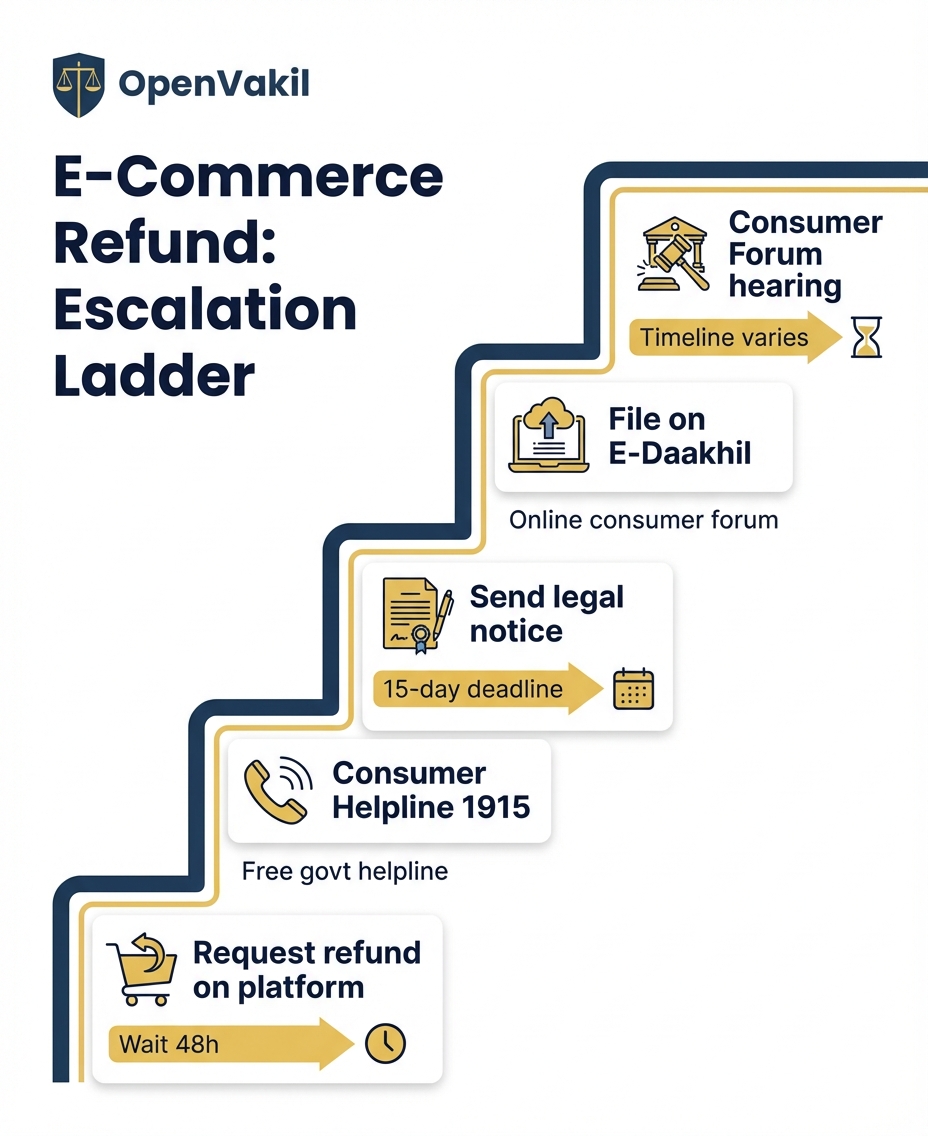
National Consumer Helpline (1915)
The National Consumer Helpline (NCH) is a government initiative that provides a pre-litigation mediation service. You can reach NCH by dialing 1915 (toll-free) or 1800-11-4000. You can also file complaints through the NCH mobile app or the website consumerhelpline.gov.in.
NCH has convergence agreements with hundreds of major companies, including Amazon, Flipkart, Zomato, Swiggy, MakeMyTrip, and various airlines and telecom providers. When you file a complaint through NCH, they forward it to the company with a request for resolution. While NCH recommendations are not legally binding, the involvement of a government body often prompts companies to resolve complaints faster.
Consumer Forum / Consumer Commission
If the legal notice and NCH intervention fail to resolve the dispute, you can file a formal complaint with the appropriate consumer commission (commonly called the consumer forum). The Consumer Protection Act 2019 established a three-tier system:
- District Consumer Disputes Redressal Commission: For claims up to Rs. 1 crore. This is where most e-commerce refund disputes are filed.
- State Consumer Disputes Redressal Commission: For claims between Rs. 1 crore and Rs. 10 crore, and appeals against District Commission orders.
- National Consumer Disputes Redressal Commission (NCDRC): For claims exceeding Rs. 10 crore, and appeals against State Commission orders.
You can file the complaint in the district where you reside or where the opposite party has its registered office or a branch office. The filing fee is nominal — ranging from Rs. 0 for claims up to Rs. 5 lakh, to Rs. 5,000 for claims between Rs. 5 lakh and Rs. 10 lakh. You are not required to hire a lawyer; consumers can represent themselves before consumer commissions.
E-Court Filing via E-Daakhil
E-Daakhil (edaakhil.nic.in) is the official e-filing portal for consumer complaints, launched by the Department of Consumer Affairs. It allows you to file complaints online with District, State, and National Consumer Commissions across India. The process is straightforward:
- Register on the E-Daakhil portal with your basic details.
- Select the appropriate consumer commission based on the claim value and jurisdiction.
- Fill in the online complaint form with details of the dispute, the opposite party, and the relief sought.
- Upload supporting documents — the legal notice sent, postal receipt, proof of delivery, order details, payment proof, correspondence with the company, and any other evidence.
- Pay the filing fee electronically (if applicable).
- Submit the complaint and note the case number for tracking.
- Track your case status, hearing dates, and orders online through the portal.
E-Daakhil has been operational in most districts and states and is continually expanding its coverage. It eliminates the need to physically visit the consumer commission, making the complaint process accessible from anywhere in India.
Limitation Period for Refund Disputes
Under Section 69(1) of the Consumer Protection Act 2019, a consumer complaint must be filed within two years from the date on which the cause of action arose. For refund disputes, the “cause of action” typically arises on the date the refund was denied or on the date the reasonable time for processing the refund expired.
For example, if you requested a refund on 1 January 2025 and the company denied it on 15 January 2025, the two-year limitation period runs from 15 January 2025 (the date of denial). If the company simply did not respond, the limitation period runs from the date when the reasonable time for response (as per the company’s policy or the 30-day grievance resolution period under the E-Commerce Rules) expired.
The consumer commission has discretion to condone the delay if sufficient cause is shown, but this is not guaranteed. It is always advisable to act promptly. The sooner you send a legal notice and file a complaint (if needed), the stronger your case and the fresher your evidence.
Limitation Period Quick Reference
Consumer complaint: 2 years from cause of action (Section 69, Consumer Protection Act 2019). Bank chargeback: Typically 120 days from transaction date (varies by card network). RBI failed transaction complaint: Report within 3 working days for zero liability. DGCA airline refund: File within 30 days of scheduled travel date.
Tips for Gathering Evidence: Screenshots, Order IDs & Emails
The strength of your legal notice and any subsequent consumer complaint depends heavily on the quality and completeness of your evidence. Here is a detailed checklist of what to collect and preserve:
- Order Confirmation and Invoice: Save the order confirmation email, the invoice/receipt generated by the platform, and any payment confirmation (UPI transaction screenshot, credit card statement, bank SMS alert).
- Product Listing Screenshots: Take screenshots of the product page at the time of purchase, including the description, images, price, seller details, and any promises made (e.g., “7-day return policy,” “genuine product guaranteed”).
- Photographs and Videos of the Defect: If the product is defective or damaged, take clear photographs and videos from multiple angles. Include packaging condition, shipping labels, and any visible damage.
- Customer Support Interactions: Save all communication with customer support — chat transcripts (take screenshots before closing the window), emails, and if you spoke on the phone, note the date, time, representative’s name (if provided), and a summary of the conversation.
- Complaint Ticket Numbers: Record every complaint ticket number, reference ID, or case number assigned by the platform.
- Grievance Officer Correspondence: If you escalated to the grievance officer, save the complaint submission confirmation and any responses received.
- Refund Policy Documentation: Screenshot the platform’s published refund, return, and cancellation policies at the time of your transaction. Policies can change, so capturing the version applicable to your purchase is important.
- Bank Statements: Obtain bank or credit card statements showing the debit for the transaction and the absence of any refund credit.
- Social Media Complaints: If you raised the issue on social media (Twitter, Facebook, etc.), save screenshots of your posts and any responses from the company.
- NCH or Consumer Helpline Records: If you filed a complaint with the National Consumer Helpline, save the complaint number and any communication received.
Pro Tip: Create an Evidence Folder
Create a dedicated folder (physical and digital) for your refund dispute. Organize all evidence chronologically. Label screenshots with dates and brief descriptions. This organized approach not only strengthens your legal notice but also makes it significantly easier to file a consumer commission complaint if needed.
Remember, the burden of proof in consumer complaints is relatively lighter than in civil courts. Consumer commissions follow summary trial procedures and are empowered to consider any evidence that they deem relevant, including electronic records. Under Section 65B of the Indian Evidence Act 1872 (as amended), electronic records — including screenshots, emails, and digital photographs — are admissible as evidence when accompanied by a certificate of authenticity.
How OpenVakil Helps You Get Your Refund
Navigating refund disputes can be complex, time-consuming, and intimidating — especially when you are up against large e-commerce platforms or multinational companies. OpenVakil simplifies the entire process, making it fast, affordable, and accessible to every Indian consumer.
With OpenVakil’s AI-powered legal notice drafting platform, you can generate a professional, legally comprehensive refund notice in minutes. Here is how it works:
- Tell Us About Your Dispute: Answer a few guided questions about your refund issue — the platform or company involved, the product or service, the order details, the amount in dispute, and what resolution attempts you have already made.
- AI Drafts Your Legal Notice: Our advanced AI engine generates a comprehensive legal notice that cites the relevant provisions of the Consumer Protection Act 2019, E-Commerce Rules 2020, RBI guidelines, or DGCA directives as applicable to your specific case.
- Legal Review: Every notice is reviewed for legal accuracy, proper formatting, and completeness, ensuring it meets the standards expected by companies and consumer commissions.
- Send and Track: We guide you through the process of sending the notice via registered post and email, and provide support for follow-up.
- Comprehensive Legal Coverage: Notices that cite all applicable laws and regulations specific to your type of dispute — e-commerce, travel, subscription, or food delivery.
- Affordable Pricing: Professional legal notice drafting at a fraction of the cost of traditional lawyer fees, with transparent pricing and no hidden charges.
- Fast Turnaround: Generate your notice in minutes, not days. When you are waiting for a refund, every day matters.
- User-Friendly Platform: No legal knowledge required. Our guided questionnaire collects the information needed, and our AI handles the legal language and formatting.
- All Dispute Types Covered: Whether your dispute is with Amazon, Flipkart, Zomato, Swiggy, MakeMyTrip, an airline, a hotel chain, a subscription service, or any other provider, OpenVakil has you covered.
A well-drafted legal notice is often all it takes to get your refund. Companies know that a consumer forum complaint is expensive, time-consuming, and damaging to their reputation. When they receive a professional legal notice that demonstrates your knowledge of the law and your willingness to escalate, they are far more likely to process your refund promptly.
Get Your Refund with a Legal Notice
Stop waiting and start acting. Draft a powerful, legally sound refund notice with OpenVakil today. Our AI-powered platform makes it simple, affordable, and effective — whether your dispute is with an e-commerce giant, a travel portal, or any service provider in India.
Draft Your Legal Notice NowIndian consumer protection law is designed to ensure that businesses honour their obligations to consumers. The Consumer Protection Act 2019 and the E-Commerce Rules 2020 have significantly strengthened the position of online shoppers, travellers, and subscribers. Armed with the right evidence, a well-drafted legal notice, and knowledge of your escalation options, you have the power to hold any company accountable and secure the refund you deserve. Do not let your hard-earned money go to waste — take action today.