If you need to send a legal notice in India, you are now faced with a choice that did not exist even five years ago: should you use an AI-powered legal platform or hire a traditional lawyer? It is a question worth asking honestly, because both options have genuine strengths — and genuine limitations.
The rise of AI legal drafting platforms has disrupted a market that was once the exclusive domain of advocates. Thousands of Indians now use platforms like OpenVakil to draft legal notices for everything from cheque bounce demands to consumer complaints, at a fraction of the cost and time of hiring a lawyer. But does that make AI the right choice for every situation? Not necessarily.
This article is an honest, transparent comparison. We are not going to pretend that AI is always better than a lawyer, or that lawyers are always better than AI. Instead, we will break down every dimension that matters — cost, speed, legal validity, quality, court acceptance, and more — so you can make the right choice for your specific situation. We will cite Indian legal statutes, analyse the Advocates Act, 1961, and give you a practical framework for deciding.
The Changing Landscape of Legal Notice Drafting in India
India's legal services market has been undergoing a quiet but profound transformation. For decades, the process of sending a legal notice was simple in theory but costly and slow in practice: you found a lawyer, visited their office during business hours, explained your problem, waited several days for a draft, paid a fee that varied wildly by city and lawyer, and then hoped the notice was effective.
Several factors have converged to change this. First, the Digital India initiative and the rapid penetration of smartphones and affordable internet have created a population that is comfortable transacting online. Second, the COVID-19 pandemic accelerated the adoption of virtual legal services, with even courts moving to e-filing and video hearings. Third, advances in artificial intelligence and natural language processing have made it possible to generate legally accurate documents based on user inputs, dramatically reducing the time and cost of drafting.
According to the India Justice Report 2022, India has approximately 1.4 million registered advocates for a population of over 1.4 billion — but their distribution is heavily skewed towards urban centres and higher courts. Millions of Indians in smaller towns and rural areas have limited practical access to legal services. AI-powered platforms are beginning to fill this access gap, offering professional-quality legal documents to anyone with a smartphone, regardless of where they live.
At the same time, the legal profession is adapting. Many progressive lawyers and law firms now use AI tools themselves to accelerate their own drafting processes. The question is no longer "AI or lawyer" in absolute terms — it is about understanding which approach best serves the client in a given situation. This nuanced understanding is what we aim to provide here.
India's Legal Access Gap
India has roughly one lawyer for every 1,000 citizens, but most advocates practise in metros and major cities. AI legal platforms are emerging as a critical tool for bridging this gap, making professional legal services accessible to millions who were previously underserved by the traditional legal system.
What Is an AI-Drafted Legal Notice?
An AI-drafted legal notice is a formal legal document generated with the assistance of artificial intelligence technology, specifically designed and trained for the Indian legal context. Unlike a generic template downloaded from the internet, an AI-drafted notice is created dynamically based on the specific facts you provide, the type of dispute you are dealing with, and the applicable Indian legal provisions.
It is important to understand what an AI-drafted notice is not. It is not a simple mail-merge that inserts your name into a pre-written template. Modern AI legal drafting platforms use large language models that have been trained on Indian statutes, legal precedents, and thousands of real legal notices. They understand the structure, language, and substantive requirements of different types of notices — from a demand under Section 138 of the Negotiable Instruments Act, 1881 to a consumer complaint under the Consumer Protection Act, 2019.
How AI Legal Notice Drafting Works
The process on a platform like OpenVakil typically follows these steps:
- You describe your situation in plain language: There is no need for legal jargon. You simply explain what happened — "My employer terminated me without notice and has not paid my last two months' salary and gratuity."
- The AI asks targeted follow-up questions: Based on your description, the system identifies the type of dispute (in this case, wrongful termination and non-payment of wages) and asks for specific details — dates of employment, salary amount, termination date, employer's name and registered address, any prior correspondence, and the specific relief you seek.
- The AI identifies applicable laws: The system maps your facts to the relevant legal framework. For the example above, it would identify the Industrial Disputes Act, 1947 (or state-specific Shops and Establishments Act), Payment of Wages Act, 1936, Payment of Gratuity Act, 1972, and applicable provisions of the Indian Contract Act, 1872.
- A complete notice is generated: Within minutes, you receive a professionally formatted legal notice that includes all mandatory elements — party details, chronological factual narration, legal basis with specific section numbers, clear demand, compliance deadline, and consequences of non-compliance.
- You review and refine: You can read the draft, request changes, add details, or adjust the tone. The platform allows iterative refinement until you are satisfied with the final product.
The AI + Legal Review Model
The most sophisticated AI legal platforms do not rely on AI alone. They employ a hybrid model where AI handles the initial drafting and a qualified human advocate reviews the output. This is the approach OpenVakil uses: the AI generates the first draft with remarkable speed and accuracy, and then a practising advocate reviews it for legal soundness, factual consistency, and strategic effectiveness.
This hybrid approach addresses the legitimate concern that AI, however advanced, may occasionally miss nuances that an experienced lawyer would catch. By combining AI efficiency with human legal judgment, the result is a notice that benefits from the strengths of both. The AI ensures speed, consistency, and coverage of all standard legal elements; the lawyer ensures that nothing has been overlooked and that the notice is strategically sound for your particular situation.
What Is a Traditional Lawyer-Drafted Notice?
A traditional lawyer-drafted legal notice is one where you personally engage an advocate, explain your dispute to them (usually in a face-to-face or phone consultation), and the advocate drafts the notice based on their understanding of the facts and the law. The notice is typically printed on the advocate's letterhead, signed by the advocate on your behalf (as your authorised legal counsel), and dispatched via registered post.
The traditional model has significant strengths. A good lawyer brings not just legal knowledge but strategic thinking — they can anticipate the opponent's likely response, frame demands in a way that strengthens your negotiating position, and advise you on the broader litigation landscape beyond the notice itself. They can ask questions you had not thought of, spot weaknesses in your own position, and tailor the notice's tone to the specific recipient.
However, the traditional model also has well-known limitations. Lawyer fees for a legal notice typically range from Rs. 3,000 to Rs. 15,000 for routine matters and can go up to Rs. 50,000 or more for complex disputes involving senior advocates in metros. Turnaround time is usually 3 to 7 working days, sometimes longer if the lawyer is busy with court appearances. And access is limited by geography and working hours — you typically need to be in the same city and available during office hours.
It is also worth acknowledging that quality varies enormously among lawyers. A notice from a diligent, experienced advocate is an invaluable document. But a hastily drafted notice from an overburdened junior advocate — which is often what you get at the lower end of the price range — may be no better than what a good AI platform produces. The legal profession, like any profession, has a wide distribution of quality, and price is not always a reliable indicator.
Try AI-Powered Legal Notice Drafting
See the quality for yourself. OpenVakil's AI drafts professional legal notices in minutes, citing the correct Indian laws and following the formal structure that recipients take seriously. Starting from just Rs. 299.
Draft Your Legal NoticeHead-to-Head Comparison: AI vs Lawyer
Let us now compare AI-drafted and lawyer-drafted legal notices across every dimension that matters. We will be straightforward about where each approach excels and where it falls short.
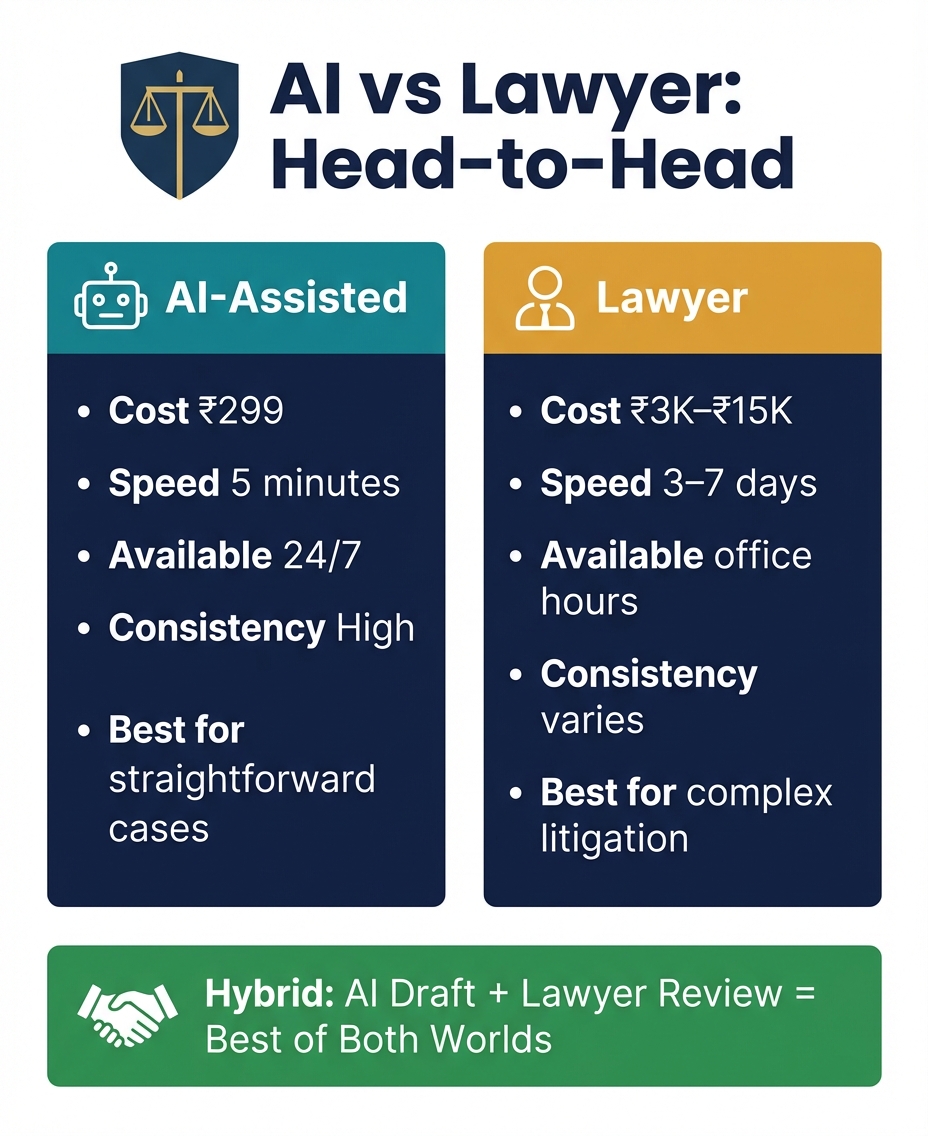
Cost Comparison
This is the dimension where the difference is most dramatic. The cost structures of AI platforms and traditional lawyers are fundamentally different:
- AI-drafted notice (OpenVakil): Rs. 299 to Rs. 999 for most standard notices, including AI drafting with correct legal provisions and professional formatting. Premium plans with lawyer review are available at Rs. 999 to Rs. 2,999 depending on complexity.
- Traditional lawyer-drafted notice: Rs. 3,000 to Rs. 15,000 for routine matters in most Indian cities. In metros like Mumbai and Delhi, fees from mid-level advocates start at Rs. 5,000 to Rs. 10,000. Senior advocates and established law firms may charge Rs. 15,000 to Rs. 50,000 or more for complex notices. These figures often do not include consultation fees, revision charges, or dispatch costs.
The cost advantage of AI is clear: it represents savings of 70% to 95% compared to a traditional lawyer for routine matters. This is not because the AI cuts corners, but because technology eliminates the overhead costs that make traditional legal services expensive — office rent in commercial districts, staff salaries, and the time-intensive manual drafting process.
The honest caveat: For high-stakes disputes where tens of lakhs or crores are involved, the cost of a good lawyer is a minor fraction of what is at stake. In such cases, the cost savings of AI are less relevant than the strategic advantage a seasoned advocate might provide.
Speed and Turnaround
Speed matters in legal matters, often more than people realise. Statutory deadlines are unforgiving — a demand notice under Section 138 of the Negotiable Instruments Act, 1881 must be sent within 30 days of the cheque return memo, or you lose the right to file a criminal complaint entirely.
- AI-drafted notice: 5 to 30 minutes for the initial draft, depending on the complexity of the dispute and how many follow-up questions the AI needs to ask. If you opt for lawyer review, add 24 to 48 hours. The entire process from start to dispatch-ready notice can be completed in under an hour for straightforward matters.
- Traditional lawyer-drafted notice: 2 to 7 working days is the typical turnaround. This includes scheduling the consultation (often 1-2 days), the consultation itself, the drafting period (2-3 days), and your review and any revisions. Busy lawyers handling court matters may take longer. Some lawyers offer expedited service, but at a premium of 25-50% above standard fees.
The honest caveat: Speed is valuable for straightforward disputes, but rushing a complex matter can lead to errors. For genuinely intricate disputes involving multiple legal issues, a lawyer who takes 5-7 days to research and draft carefully may produce a better result than a notice generated in 10 minutes. The key is matching the approach to the complexity of the situation.
Availability and Accessibility
- AI platform: Available 24 hours a day, 7 days a week, 365 days a year. You can start drafting your notice at 11 PM on a Sunday or at 5 AM before work. There are no office hours, no appointment scheduling, and no geographic restrictions. Whether you are in Mumbai, a small town in Madhya Pradesh, or abroad, you have equal access.
- Traditional lawyer: Generally available during business hours (10 AM to 6 PM, Monday to Saturday). Court appearances often consume the lawyer's mornings, leaving only afternoons for client consultations. If you work full-time, finding a mutually convenient time can be challenging. Geographic proximity matters — while phone and video consultations are increasingly common, many lawyers still prefer in-person meetings for the initial consultation.
For NRIs (Non-Resident Indians) dealing with legal matters back home, the accessibility advantage of AI platforms is especially significant. Time zone differences make it difficult to coordinate with Indian lawyers during their office hours. An AI platform lets you draft your notice at a time that suits you, regardless of where in the world you are.
Consistency and Quality
- AI platform: Delivers consistent quality across every notice. The AI applies the same legal framework, structure, and thoroughness whether it is the first notice of the day or the thousandth. It does not have bad days, forget to cite a provision, or rush because it has court in an hour. However, AI may occasionally produce language that is technically correct but lacks the strategic sharpness an experienced lawyer would bring.
- Traditional lawyer: Quality is variable and depends entirely on the individual advocate. An excellent lawyer produces an excellent notice; an overworked or inexperienced one may produce a mediocre one. There is no standardisation. You might get a brilliantly crafted notice or a generic template with your facts inserted. The challenge for the client is that quality is hard to assess upfront, especially if you are not legally trained yourself.
The honest assessment: The floor of AI quality is higher than the floor of lawyer quality — the worst AI-drafted notice is typically better than the worst lawyer-drafted notice. However, the ceiling of lawyer quality is higher than the ceiling of AI quality — the best lawyer-drafted notice, crafted by an experienced specialist, can be more strategically powerful than any AI output. For the vast majority of routine legal notices, the difference in quality between a good AI platform and an average lawyer is negligible.
Personalisation and Interaction
- Traditional lawyer: Can meet you face-to-face, read your body language, ask open-ended questions, and understand aspects of the dispute that you might not think to mention. A good lawyer acts as both a drafter and a counsellor — they can advise on whether sending the notice is even the right strategy, suggest alternative approaches, and prepare you for what might happen next. This human element is genuinely valuable, especially when the dispute has emotional or strategic dimensions.
- AI platform: Uses a guided questionnaire or conversational interface to gather information. While modern AI asks intelligent follow-up questions and adapts to your responses, it cannot replicate the intuitive understanding that comes from a face-to-face conversation with an experienced advocate. However, AI platforms are increasingly sophisticated in their questioning, and for straightforward disputes, the guided process captures all the information needed for an effective notice.
Getting the Most from an AI Platform
When using an AI platform like OpenVakil, provide as much detail as possible. Include dates, amounts, names, addresses, the history of the dispute, prior communication, and exactly what relief you seek. The more context you provide, the closer the AI output will be to what an experienced lawyer would draft after a detailed consultation.
Legal Validity: The Advocates Act Analysis
This is the question most people worry about: Is an AI-drafted legal notice legally valid in India? The unequivocal answer is yes. Let us examine why, with reference to the relevant statutes.
The Advocates Act, 1961 is the primary legislation governing the legal profession in India. Section 29 of the Act restricts the right to practise law to advocates enrolled with a State Bar Council. Section 33 further provides that only advocates may appear, act, or plead before courts and certain authorities. However, Section 30 (which has not been notified uniformly) and the overall scheme of the Act make a critical distinction: these restrictions apply to practising in courts and before tribunals, not to drafting communications between private parties.
A legal notice is not a court filing. It is not a plaint, written statement, petition, or application. It is a formal letter from one party to another, asserting legal rights and demanding action. Sending such a letter does not constitute "practising law" within the meaning of the Advocates Act. Any person — or any tool used by a person — can draft a legal notice. The notice derives its legal validity from its content, accuracy, and proper service, not from the identity or designation of the person who drafted it.
Section 30 of the Advocates Act, 1961 grants advocates the right to practise in any court or before any authority or tribunal. A legal notice, being a pre-litigation communication and not a court proceeding, falls outside this exclusive domain. Any individual is free to draft and send a legal notice, whether personally, through an advocate, or with the assistance of technology.
— Advocates Act, 1961 — Section 30, read with Sections 29 and 33
Indian courts have never held that a legal notice is invalid because it was not drafted by an advocate. What courts examine is whether the notice was served properly (typically via registered post with acknowledgement due), whether it contains the mandatory substantive requirements (for statutory notices like those under Section 138 NI Act or Section 80 CPC), and whether the facts and demands stated are clear and specific. The method or tool used to draft the notice is irrelevant to its legal validity.
Court Acceptance
Both AI-drafted and lawyer-drafted notices are equally accepted by Indian courts. When a legal notice is produced as evidence in court proceedings, the judge examines the content of the notice and the proof of service — not the software or method used to create it.
Consider the practical reality: when you produce a legal notice in court, it is submitted as a document. The court sees the text, the date, the postal receipt, and the AD card. There is no field for "drafted by AI" or "drafted by lawyer." The notice is evaluated on its merits — does it correctly state the facts, cite the relevant law, make a specific demand, and was it served within the required timeline? Whether it was typed by a lawyer, dictated to a secretary, written by the sender themselves, or generated by an AI platform is simply not a factor that courts consider.
This is consistent with how courts treat other documents. A contract is not less valid because it was drafted using a template rather than by a lawyer from scratch. An affidavit is not less valid because the deponent typed it themselves rather than having a lawyer draft it. The principle is the same for legal notices: substance matters, not the method of creation.
Complex Cases
Here is where we give credit where it is due: for highly complex cases, a good lawyer has an advantage that AI cannot fully replicate — at least not yet.
- Multi-party disputes with conflicting interests: When a dispute involves multiple parties with different and sometimes opposing interests (e.g., a partnership dissolution or a multi-stakeholder property dispute), a lawyer can navigate the strategic complexity of how the notice to one party might affect your position with another.
- Matters requiring ongoing litigation strategy: If the notice is the opening move in a broader litigation strategy, a lawyer who will handle the entire case can craft the notice as part of that larger strategy. The notice might deliberately include or exclude certain facts to set up the strongest possible court case.
- Disputes involving novel or unsettled legal questions: In areas where the law is evolving or where there is conflicting jurisprudence, a lawyer's judgment about how to frame the issues can make a material difference. AI models are trained on existing law and may not navigate genuinely novel legal territory as effectively.
- High-stakes negotiations: When the notice is really a negotiation tool in a high-value dispute, the psychological and strategic dimensions matter as much as the legal content. An experienced lawyer understands how to calibrate the tone, what to threaten, what to concede, and how to leave room for settlement.
Our honest view: For the estimated 70-80% of legal notices that involve straightforward facts and well-settled law, AI platforms produce results that are comparable to or better than what an average lawyer delivers. For the remaining 20-30% involving genuine complexity, a skilled lawyer adds value that justifies the higher cost. The key is knowing which category your dispute falls into.
Confidentiality
- Traditional lawyer: Bound by the advocate-client privilege under the Indian Evidence Act, 1872 (Sections 126-129) (now Sections 127-130 of the Bharatiya Sakshya Adhiniyam, 2023). This is a well-established legal protection that prevents your lawyer from disclosing your confidential communications without your consent. Additionally, the Bar Council of India Rules impose professional ethics obligations on advocates regarding client confidentiality.
- AI platform: Maintains confidentiality through data protection policies, encryption, and technical safeguards. Reputable platforms like OpenVakil implement industry-standard security measures to protect user data. While this is not technically "advocate-client privilege" in the statutory sense, the practical protection of your information is robust. With India's Digital Personal Data Protection Act, 2023 (DPDP Act) now in effect, platforms also have statutory obligations to protect your personal data.
The practical reality: Both approaches maintain your confidentiality, but through different legal mechanisms. If your dispute involves extremely sensitive information (trade secrets, personal matters with reputation implications), the formal advocate-client privilege offers a stronger legal shield. For the vast majority of disputes, the data protection measures of a reputable platform are more than adequate.
Legal Validity of AI-Drafted Notices in India
Given how frequently this question comes up, it deserves its own dedicated section with a thorough legal analysis.
The legal validity of a notice in India depends on three factors: (1) the content of the notice — whether it correctly states the facts, cites applicable law, and makes a clear demand; (2) the mode of service — whether it was sent through a legally recognised channel (registered post with AD being the gold standard); and (3) compliance with statutory requirements — for notices that are prerequisites to legal action (such as under Section 138 NI Act, Section 80 CPC, or Section 8 of the Insolvency and Bankruptcy Code, 2016), whether the notice meets the specific requirements of that provision.
Notice what is not on that list: who drafted the notice, what tool was used to create it, or whether an advocate was involved. This is not an oversight — it reflects the settled legal position. A legal notice is a communication, not a court document. Its validity flows from its content and service, not from the qualifications of its drafter.
The Critical Distinction
Under the Advocates Act, 1961, only enrolled advocates may appear, act, or plead in courts and before certain tribunals. But a legal notice is not a court appearance — it is a pre-litigation communication between private parties. Drafting and sending a legal notice does not require any professional licence or qualification. This is why AI-drafted notices carry the same legal validity as any other notice.
For statutory notices that serve as mandatory prerequisites to legal proceedings, the requirements are substantive, not procedural in terms of who drafts them. For instance, a demand notice under Section 138 of the Negotiable Instruments Act must: (a) be sent within 30 days of the cheque return; (b) demand payment of the cheque amount; and (c) be sent to the correct address of the drawer. Whether a lawyer drafted it, you drafted it yourself, or an AI platform generated it is immaterial. What matters is whether the three substantive requirements are met.
Similarly, a notice under Section 80 of the Code of Civil Procedure, 1908 to a government body must state the cause of action, the relief sought, the sender's details, and must be served at least two months before filing the suit. Again, these are content and timing requirements, not requirements about the drafter's identity.
When to Choose an AI-Drafted Notice
An AI-drafted legal notice is the optimal choice in the following situations:
- Straightforward disputes with clear facts: Cheque bounce demands, money recovery where the amount and debtor are known, tenant security deposit recovery, consumer refund demands, non-payment of salary or freelance invoices. When the facts are not in dispute and the law is well-settled, AI handles these as well as any lawyer.
- Cost-sensitive situations: When the amount at stake does not justify spending Rs. 5,000 to Rs. 15,000 on a lawyer. If someone owes you Rs. 50,000, spending Rs. 299 to Rs. 999 on an AI-drafted notice is proportionate. Spending Rs. 10,000 on a lawyer is not.
- Time-sensitive matters: When a statutory deadline is approaching and you cannot wait days for a lawyer's availability. The 30-day deadline for Section 138 NI Act notices is a common example. An AI platform can generate your notice in minutes, not days.
- After-hours or weekend needs: When you need to act outside normal business hours. Legal emergencies do not respect office schedules, and AI platforms are available 24/7.
- Tech-comfortable users: If you are comfortable with online platforms and can clearly articulate your situation through a guided questionnaire or conversational interface, AI drafting is efficient and intuitive.
- First-time notice senders: If you have never sent a legal notice before and feel overwhelmed by the process, the guided, step-by-step approach of an AI platform can be less intimidating than navigating the traditional lawyer engagement process.
- NRIs dealing with Indian legal matters: For Non-Resident Indians who need to send notices regarding property disputes, tenancy issues, or financial recovery back in India, the remote accessibility of AI platforms is a major advantage over coordinating with a lawyer across time zones.
When to Choose a Lawyer
There are situations where hiring a traditional lawyer is the better choice, and we believe in being honest about that:
- Highly complex litigation strategy: When the notice is part of a broader legal strategy that may involve multiple proceedings, interim applications, or settlement negotiations, a lawyer who understands the full picture can craft the notice as a strategic first move. The notice might deliberately frame the dispute to set up the strongest possible case in court.
- Need for ongoing representation: If you anticipate that the matter will proceed to court and you will need an advocate to represent you, engaging a lawyer from the notice stage ensures continuity. The same lawyer who drafts the notice will file the case, appear in court, and manage the litigation — this seamless approach has real advantages.
- Multi-party disputes with conflicting interests: When a dispute involves three or more parties with different positions and interests, the strategic complexity of crafting a notice that accounts for all these dynamics is something a lawyer handles better than an AI system.
- Unfamiliarity with technology: If you are not comfortable with digital platforms, prefer face-to-face interaction, or feel more confident when a human professional explains the process to you, a traditional lawyer is the right choice. There is no shame in preferring human interaction for something as important as a legal matter.
- Extremely high-value disputes: When the stakes are in the range of lakhs or crores, the incremental cost of a good lawyer (even Rs. 25,000 to Rs. 50,000) is a trivial percentage of what you stand to gain or lose. In such cases, optimise for quality and strategic value, not cost.
- Disputes involving criminal strategy: When the notice is the first step towards filing a criminal complaint and the strategy needs to account for the requirements of the Bharatiya Nyaya Sanhita, 2023 (which replaced the IPC), the Code of Criminal Procedure (now Bharatiya Nagarik Suraksha Sanhita, 2023), and criminal court practice, a lawyer's guidance is valuable.
Knowing When You Need a Lawyer
A good rule of thumb: if you can explain your dispute in 2-3 sentences and the facts are undisputed, an AI-drafted notice is likely sufficient. If explaining the dispute takes 10 minutes and involves multiple parties, conflicting documents, or strategic considerations about future litigation, consult a lawyer.
The Hybrid Approach: AI Drafting + Lawyer Review
There is a third option that combines the best of both worlds, and it is increasingly becoming the smart choice for a wide range of disputes: use an AI platform to generate the initial draft, then have a lawyer review it.
This hybrid approach offers several compelling advantages:
- Speed of AI + judgment of a lawyer: The AI generates a comprehensive first draft in minutes, covering all standard legal elements. The lawyer then reviews it in a fraction of the time they would need to draft from scratch, focusing their expertise on the strategic and nuanced aspects rather than the routine structure and formatting.
- Cost savings of 50-70% over pure lawyer drafting: Because the lawyer's time is reduced from several hours of drafting to a focused review session, the overall cost is significantly lower than engaging a lawyer to draft from scratch. On OpenVakil, the Premium plan with lawyer review is priced at Rs. 999 to Rs. 2,999 — far less than the Rs. 5,000 to Rs. 15,000 a lawyer would charge for end-to-end drafting.
- Consistent base quality with human refinement: The AI ensures that all standard elements are included and correctly formatted. The lawyer adds the strategic nuance, catches any edge cases, and fine-tunes the language for maximum impact.
- Best approach for moderate-complexity disputes: For disputes that are not entirely straightforward but not so complex that they require full lawyer engagement — say, a breach of contract notice with some factual complexity, or a property notice with a few complicating factors — the hybrid approach hits the sweet spot.
This is the model that OpenVakil was designed around. We believe the future of legal services is not "AI versus lawyers" but "AI and lawyers working together." The AI handles what it does best — speed, consistency, coverage of standard requirements. The lawyer handles what they do best — judgment, strategy, and nuanced adaptation to unique facts.
The Smart Middle Ground
Even many practising lawyers now use AI tools to generate first drafts, which they then review and refine. The hybrid approach is not a compromise — it is an optimisation. You get the speed and cost advantage of AI with the quality assurance of a human legal professional.
Myths Debunked: Separating Fact from Fiction
Several misconceptions persist about AI-drafted legal notices. Let us address them with facts:
Myth 1: "AI-drafted legal notices are not legally valid in India."
Fact: This is categorically false. As we have established, a legal notice's validity depends on its content, accuracy, and proper service — not on who or what drafted it. There is no provision in any Indian statute — not the Advocates Act, 1961, not the Code of Civil Procedure, 1908, not the Indian Evidence Act, 1872 (or its replacement, the Bharatiya Sakshya Adhiniyam, 2023) — that requires a legal notice to be drafted by an advocate. Indian courts have consistently upheld notices sent by individuals themselves, and there is no basis for treating an AI-assisted notice differently.
Myth 2: "A lawyer-drafted notice is always better than an AI-drafted one."
Fact: This depends entirely on the lawyer and the AI platform. A notice from an experienced, diligent advocate who specialises in your type of dispute is likely excellent. But a hastily drafted notice from an overburdened junior advocate who uses a generic template may be no better — and sometimes worse — than what a well-designed AI platform produces. The legal profession, like any field, has a wide distribution of quality. Blanket statements that "lawyers are always better" ignore this reality.
Myth 3: "AI cannot handle my specific type of case."
Fact: Modern AI legal platforms cover the full spectrum of common legal notice types in India — cheque bounce (Section 138 NI Act), money recovery (Indian Contract Act, 1872), consumer complaints (Consumer Protection Act, 2019), employment disputes (Industrial Disputes Act, 1947; Payment of Wages Act, 1936; Payment of Gratuity Act, 1972), property disputes (Transfer of Property Act, 1882; RERA, 2016; state Rent Control Acts), defamation (Bharatiya Nyaya Sanhita, 2023), and more. For genuinely unusual or novel disputes, the hybrid approach (AI draft + lawyer review) addresses this effectively.
Myth 4: "Courts will reject a notice that was not sent on a lawyer's letterhead."
Fact: Courts evaluate legal notices based on their content and proof of service, not on whose letterhead they appear on. A notice sent on plain paper by an individual is just as admissible and valid as one sent on the letterhead of a top-tier law firm. The Supreme Court and various High Courts have repeatedly upheld notices sent by individuals themselves without any advocate involvement. What matters is whether the notice meets the substantive requirements of the applicable law.
Myth 5: "AI platforms just use generic templates."
Fact: While basic online template services do exist (and should be approached with caution), sophisticated AI legal platforms like OpenVakil generate notices dynamically based on your specific inputs. The AI analyses your facts, identifies the applicable legal provisions, and creates a customised notice tailored to your dispute. This is fundamentally different from filling in blanks on a static template.
How OpenVakil Bridges the Gap
OpenVakil was built with a clear philosophy: the choice between AI and a lawyer should not be binary. Our platform is designed to give you the speed and affordability of AI-powered drafting with the quality assurance of professional legal review, so you never have to compromise.
- AI drafting trained on Indian law: Our AI models are specifically trained on Indian legal statutes, established notice formats, and thousands of real legal scenarios. When you describe a cheque bounce situation, the AI does not just know that Section 138 of the NI Act applies — it understands the 30-day notice requirement, the 15-day compliance period, the correct demand language, and the consequences clause that courts expect to see.
- Optional lawyer review for every notice: Every notice generated on OpenVakil can be reviewed by a qualified, practising Indian advocate from our empanelled panel. The lawyer verifies legal accuracy, strengthens the language where needed, and flags any issues specific to your case that the AI may have missed. This is available as part of our Premium plans.
- Covers 25+ notice types: From simple money recovery to complex property disputes, from consumer complaints to employment matters, OpenVakil handles the full range of legal notices that Indians commonly need. Each notice type has been developed with input from practising advocates who specialise in that area of law.
- Transparent pricing with no surprises: Our pricing is displayed clearly on the platform. There are no hidden consultation fees, no surprise revision charges, and no per-page billing. You know exactly what you are paying before you start.
- 24/7 availability from anywhere: Whether you are in Bangalore, Bhopal, or Boston, you can access OpenVakil at any time. The platform works on any device with an internet connection, and you can complete the entire process — from intake to final notice — in a single sitting.
- Digital record-keeping: Every notice, every draft, every revision is stored securely in your account. You have a complete digital trail of your legal notice, including dispatch details and tracking information, accessible whenever you need it.
Our goal is not to replace lawyers — it is to make professional-quality legal services accessible to the millions of Indians who cannot afford traditional legal fees or who do not have convenient access to a lawyer. For routine matters, we provide a complete solution. For complex matters, we provide an efficient starting point that saves time and money even if you ultimately involve a lawyer.
Experience the Difference Yourself
Whether you choose AI drafting, lawyer review, or both — OpenVakil gives you a professional legal notice that protects your rights. Starting from just Rs. 299. No lock-in, no hidden fees.
Start Your Legal Notice NowFrequently Asked Questions
Q1: Is an AI-drafted legal notice admissible as evidence in Indian courts?
Yes. When a legal notice is produced as evidence, the court examines the document's content, the proof of service (postal receipt, AD card, tracking records), and whether it meets statutory requirements. The court does not inquire into what tool or method was used to draft the notice. An AI-drafted notice dispatched via registered post carries the same evidentiary value as any other notice. Under the Bharatiya Sakshya Adhiniyam, 2023 (which replaced the Indian Evidence Act, 1872), electronic records are admissible evidence — further supporting the validity of notices generated through digital platforms.
Q2: Can a lawyer refuse to represent me in court because my notice was AI-drafted?
No. A lawyer's decision to take up your case is based on the merits of the dispute, not on who drafted the initial notice. In fact, many lawyers appreciate receiving clients who come with a well-drafted notice already in hand, as it saves them time and demonstrates that the client is organised and serious. If your matter proceeds to litigation, any advocate you engage will work with the existing notice and build the court case accordingly.
Q3: Should I tell the recipient that my notice was AI-drafted?
There is no legal obligation to disclose how your notice was drafted. The notice speaks for itself through its content and the authority under which it is sent. If the notice is sent through OpenVakil's Premium plan with lawyer review, it carries the professional credibility of an advocate-reviewed document. If sent in your own name without lawyer involvement, it is still valid — the content is what matters, not the drafting method.
Q4: What if my dispute falls outside the standard categories offered by AI platforms?
Good AI platforms like OpenVakil handle a wide range of dispute types. However, if your situation is genuinely unusual — for example, involving a novel legal question, international jurisdiction issues, or multiple intersecting areas of law — the hybrid approach is recommended. Use the AI to generate an initial draft that covers the basics, then engage a lawyer to review and adapt it to the unique aspects of your case. Alternatively, for very unusual disputes, engaging a specialised lawyer from the outset may be the most efficient path.
Q5: How does OpenVakil ensure the quality of AI-drafted notices?
OpenVakil employs multiple quality safeguards. The AI models are trained specifically on Indian legal frameworks, statutes, and established notice formats. The drafting logic incorporates the mandatory requirements for each type of notice (for example, the specific elements required in a Section 138 NI Act demand notice). All notice templates and AI outputs are developed and periodically reviewed by practising Indian advocates. Additionally, the Premium plan includes a human lawyer review for every notice, adding a final layer of professional quality assurance.
Q6: Can I switch from AI to a lawyer midway through the process?
Absolutely. Many users start with an AI-drafted notice and then decide they want a lawyer's input for additional confidence. On OpenVakil, you can upgrade to the Premium plan with lawyer review at any point before finalising your notice. The AI draft serves as an excellent starting point for the lawyer's review, often reducing the review time and cost compared to engaging a lawyer from scratch.
Q7: Is it ethical for a lawyer to use AI tools to draft notices?
Yes. There is nothing in the Bar Council of India Rules or the Advocates Act, 1961 that prohibits advocates from using technology, including AI, as a tool in their practice. Just as lawyers use legal databases, word processors, and template libraries, they can use AI drafting tools. What matters is that the advocate exercises professional judgment over the final product and takes responsibility for its accuracy. Many progressive law firms in India already use AI tools to increase efficiency without compromising quality.
The choice between an AI-drafted legal notice and a lawyer-drafted legal notice in India is not about which option is universally "better" — it is about which option is right for your specific situation. For the vast majority of routine disputes, AI platforms offer a compelling combination of speed, affordability, and consistent quality that makes them the smart choice. For genuinely complex or high-stakes matters, a good lawyer's strategic judgment remains invaluable.
The most important thing is to take action. Too many valid legal claims go unenforced because people are paralysed by the cost, complexity, or confusion of engaging the legal system. Whether you choose AI, a lawyer, or a hybrid approach, sending a well-drafted legal notice is the single most cost-effective legal step you can take — and it resolves nearly half of all disputes before they reach a courtroom.
With platforms like OpenVakil starting from just Rs. 299, the barrier to protecting your legal rights has never been lower. Do not let cost or confusion stop you from asserting the rights that Indian law gives you. The technology exists, the law supports it, and the choice is yours.