Workplace harassment remains one of the most underreported violations of employee rights in India. Whether it takes the form of sexual harassment, bullying, intimidation, or a hostile work environment, employees often suffer in silence due to fear of retaliation, lack of awareness about their legal rights, or uncertainty about the complaint process. The Sexual Harassment of Women at Workplace (Prevention, Prohibition and Redressal) Act, 2013 — commonly known as the POSH Act — was enacted to address this critical gap and provide a robust legal framework for prevention and redressal of sexual harassment at the workplace.
This comprehensive guide explains your rights as an employee under the POSH Act and other Indian laws, when and how to send a legal notice for workplace harassment, the role of the Internal Complaints Committee (ICC), the step-by-step complaint process, and the remedies available to you. Whether you are considering filing an ICC complaint or sending a formal legal notice to your employer, understanding the legal framework is the essential first step toward protecting yourself.
Understanding Workplace Harassment Under Indian Law
Indian law recognizes workplace harassment as a violation of the fundamental right to equality and the right to life and personal liberty guaranteed under Articles 14, 15, 19, and 21 of the Constitution of India. The landmark Supreme Court judgment in Vishaka v. State of Rajasthan (1997) first laid down guidelines for the prevention of sexual harassment at the workplace, which eventually led to the enactment of the POSH Act in 2013.
Beyond the POSH Act, workplace harassment may also attract provisions under the Bharatiya Nyaya Sanhita (BNS) (previously the Indian Penal Code), the Indian Contract Act, 1872, and various labour welfare legislations. The legal framework is designed to ensure that every employee — regardless of their position, employment type, or industry — can work in an environment free from harassment, intimidation, and discrimination.
The Vishaka Guidelines: A Turning Point
In Vishaka v. State of Rajasthan (1997), the Supreme Court of India recognized sexual harassment at the workplace as a violation of fundamental rights. The Court laid down binding guidelines for employers, which remained in force until the POSH Act was enacted in 2013. The Vishaka judgment established that employers have a duty to prevent and address sexual harassment, and that the absence of legislation is no excuse for inaction.
What Constitutes Sexual Harassment at the Workplace?
Section 2(n) of the POSH Act defines sexual harassment to include any one or more of the following unwelcome acts or behaviour, whether directly or by implication. It is important to note that the perception of the complainant is central — conduct that is unwelcome to the recipient constitutes harassment, regardless of the intent of the respondent.
Physical Contact and Advances
Any unwelcome physical contact of a sexual nature constitutes harassment under the POSH Act. This includes touching, groping, brushing against the body, hugging without consent, blocking someone's path, or any form of physical advance that is unwanted. Even seemingly minor physical contact — such as repeated touching of hands, shoulders, or hair — can constitute harassment if it is unwelcome and of a sexual nature.
Demand or Request for Sexual Favours
A demand or request for sexual favours — whether explicit or implied — falls squarely within the definition of sexual harassment. This is particularly serious when it involves quid pro quo harassment, where employment benefits such as promotions, salary increments, favourable assignments, or continued employment are conditioned upon the victim's submission to sexual demands. Such conduct constitutes a grave abuse of power and authority.
Sexually Coloured Remarks
Sexually coloured remarks include comments about a person's appearance, body, clothing, or personal life that have a sexual undertone. This extends to sexual jokes, innuendos, suggestive comments, whistling, catcalling, or making remarks about someone's sexual orientation or gender identity in a derogatory manner. Such remarks need not be directed at a specific individual — creating a sexually charged atmosphere in the workplace through general comments or jokes also constitutes harassment.
Showing Pornography
Showing pornography to a colleague or displaying sexually explicit material in the workplace — whether on a computer screen, mobile phone, printed material, or any other medium — constitutes sexual harassment. This includes sharing pornographic content via email, messaging apps, or social media, even outside regular working hours, if it pertains to the workplace relationship.
Any Other Unwelcome Conduct of Sexual Nature
The POSH Act includes a broad residual category covering any other unwelcome physical, verbal, or non-verbal conduct of a sexual nature. This encompasses stalking, persistent unwanted attention, sending unsolicited messages of a sexual nature, making sexual gestures, staring or leering, spreading sexual rumours about a colleague, and any other behaviour that creates an intimidating, hostile, or offensive work environment. The Act also specifically recognizes implied or explicit threats of detrimental treatment and humiliating treatment likely to affect health or safety as forms of sexual harassment.
Facing Workplace Harassment? Take Action Now
Draft a legally sound complaint or legal notice for workplace harassment with OpenVakil. Our AI-powered platform helps you document incidents and assert your rights under the POSH Act.
Draft Your NoticeThe POSH Act, 2013: Key Provisions
The Sexual Harassment of Women at Workplace (Prevention, Prohibition and Redressal) Act, 2013 is the principal legislation governing sexual harassment at the workplace in India. It applies to all workplaces across the country and places specific obligations on employers to prevent and address harassment. Here are its key provisions:
Who Is Protected?
The POSH Act protects any woman who is employed at a workplace, irrespective of her age or employment status. This includes regular employees, temporary workers, contract workers, apprentices, interns (with or without remuneration), volunteers, women working in the unorganized sector, domestic workers, and even women visiting the workplace in any capacity — such as clients, customers, or patients. The protection extends to all women regardless of their designation, department, or nature of employment.
POSH Act Covers Women Only — But Other Laws Apply
The POSH Act, 2013 is specifically designed to protect women from sexual harassment at the workplace. However, men and persons of other genders who face sexual harassment can seek remedies under the Bharatiya Nyaya Sanhita (BNS), service rules, or through civil suits. Several High Courts have also recognized that workplace sexual harassment policies should ideally be gender-neutral.
What Is a "Workplace" Under POSH?
The POSH Act defines "workplace" very broadly under Section 2(o). It includes any office, factory, shop, establishment, hospital, educational institution, sports facility, or any place visited by an employee arising out of or during the course of employment. This encompasses government offices, private companies, NGOs, trusts, societies, cooperatives, and even the unorganized sector. The definition also covers transportation provided by the employer, dwelling places or houses when used in connection with work, and any place where an employee travels for work-related purposes.
Crucially, with the rise of remote work, courts have recognized that harassment through digital communications — such as emails, video calls, messaging apps, and social media — that occur in the context of the employment relationship can also fall within the scope of "workplace" harassment under the Act.
Internal Complaints Committee (ICC)
Under Section 4 of the POSH Act, every employer with 10 or more employees is mandated to constitute an Internal Complaints Committee (ICC). The ICC is the primary body responsible for receiving and investigating complaints of sexual harassment within the organization. The composition requirements are strict:
- Presiding Officer: A senior woman employee of the organization.
- Two or more members: Employees preferably committed to the cause of women or having experience in social work or legal knowledge.
- External member: At least one member from an NGO or association committed to the cause of women, or a person familiar with issues relating to sexual harassment. This external member ensures independence and objectivity.
At least half the total members of the ICC must be women. The ICC has the powers of a civil court for the purpose of inquiry, including the power to summon and examine witnesses, require production of documents, and any other matter as may be prescribed.
Local Complaints Committee (LCC)
For workplaces with fewer than 10 employees, or where the complaint is against the employer himself, or where the aggrieved woman is a domestic worker, the complaint is to be filed before the Local Complaints Committee (LCC). The LCC is constituted by the District Officer (usually the District Magistrate or Collector) at the district level. It comprises a Chairperson (an eminent woman in the field of social work), one member each from amongst women working in the block, taluk, or ward, and two members from NGOs or associations committed to the cause of women.
Other Forms of Workplace Harassment
While the POSH Act specifically addresses sexual harassment, the Indian legal framework also recognizes other forms of workplace harassment that can be addressed through legal notices and complaints:
- Workplace bullying: Persistent, aggressive behaviour intended to intimidate, degrade, or humiliate an employee. This includes verbal abuse, unreasonable criticism, exclusion from meetings, withholding information, setting impossible deadlines, and undermining someone's work. While India does not have a standalone anti-bullying law, such conduct can be addressed through employment contracts, company policies, and civil suits for damages.
- Discrimination: Treating an employee unfavourably based on their religion, caste, gender, disability, age, or any other protected characteristic. The Constitution of India (Articles 14-16), the Equal Remuneration Act, 1976, and the Rights of Persons with Disabilities Act, 2016 provide legal protections against workplace discrimination.
- Hostile work environment: Creating or allowing conditions that make it unreasonably difficult for an employee to perform their job. This includes persistent offensive conduct, intimidation, interference with work, verbal or physical threats, and any behaviour that makes the workplace toxic or unbearable for the targeted employee.
- Retaliation: Taking adverse action against an employee who has filed a complaint, cooperated in an investigation, or exercised their legal rights. Retaliatory conduct includes termination, demotion, transfer, pay cuts, unfavourable assignments, or social ostracism.
When to Send a Legal Notice for Workplace Harassment
A legal notice is a formal written communication that puts the recipient on notice of a legal claim and demands specific action. In the context of workplace harassment, you may consider sending a legal notice in the following situations:
- The employer has failed to constitute an ICC as required under the POSH Act.
- The ICC has not acted on your complaint or has failed to complete the inquiry within the prescribed 90-day period.
- The employer has not implemented the ICC's recommendations within the mandated 60-day period.
- You have faced retaliation after filing a complaint — such as termination, demotion, transfer, or hostile treatment.
- The employer has failed to provide a safe working environment despite being aware of the harassment.
- The harassment involves criminal conduct (such as assault, stalking, or criminal intimidation) and you wish to put the employer on notice before pursuing legal proceedings.
- You wish to formally document the harassment and the employer's inaction to preserve evidence for future legal proceedings.
File an ICC Complaint First
In most cases, the recommended first step is to file a written complaint with the Internal Complaints Committee (ICC) within 3 months of the last incident of harassment (extendable by a further 3 months in certain circumstances). If the ICC process fails or the employer is non-compliant, a legal notice becomes a powerful tool to escalate the matter and demonstrate the seriousness of your claim.
Key Elements of a Workplace Harassment Notice
A well-drafted legal notice for workplace harassment must be comprehensive, factually accurate, and legally sound. The following elements are essential:
- Full name, designation, and address of the complainant (the aggrieved employee sending the notice).
- Full name and address of the recipient (the employer, company, or individual respondent).
- Details of employment — date of joining, designation, department, and nature of employment.
- Factual account of the harassment — a detailed, chronological description of each incident, including dates, times, locations, and the identity of the harasser(s). Be specific and factual.
- Evidence referenced — mention any documentary evidence, such as emails, messages, CCTV footage, witness statements, or medical reports that support your claim.
- Previous complaints and actions taken — describe any prior complaints made to the ICC, HR, or management, and the response (or lack thereof) received.
- Legal provisions invoked — cite the relevant sections of the POSH Act, 2013, the Bharatiya Nyaya Sanhita, the Indian Contract Act, and any other applicable legislation.
- Specific demands — clearly state what you are demanding, such as constitution of an ICC, completion of a pending inquiry, implementation of ICC recommendations, compensation, reinstatement, or an apology.
- Timeline for compliance — specify the period within which the recipient must respond or take action (typically 15 to 30 days).
- Consequences of non-compliance — state that you will pursue legal remedies, including filing a complaint with the District Officer, approaching the Labour Commissioner, or filing a civil or criminal case.
Step-by-Step Process
Addressing workplace harassment involves a structured process. Following these steps ensures that your complaint is properly documented and your legal rights are preserved:
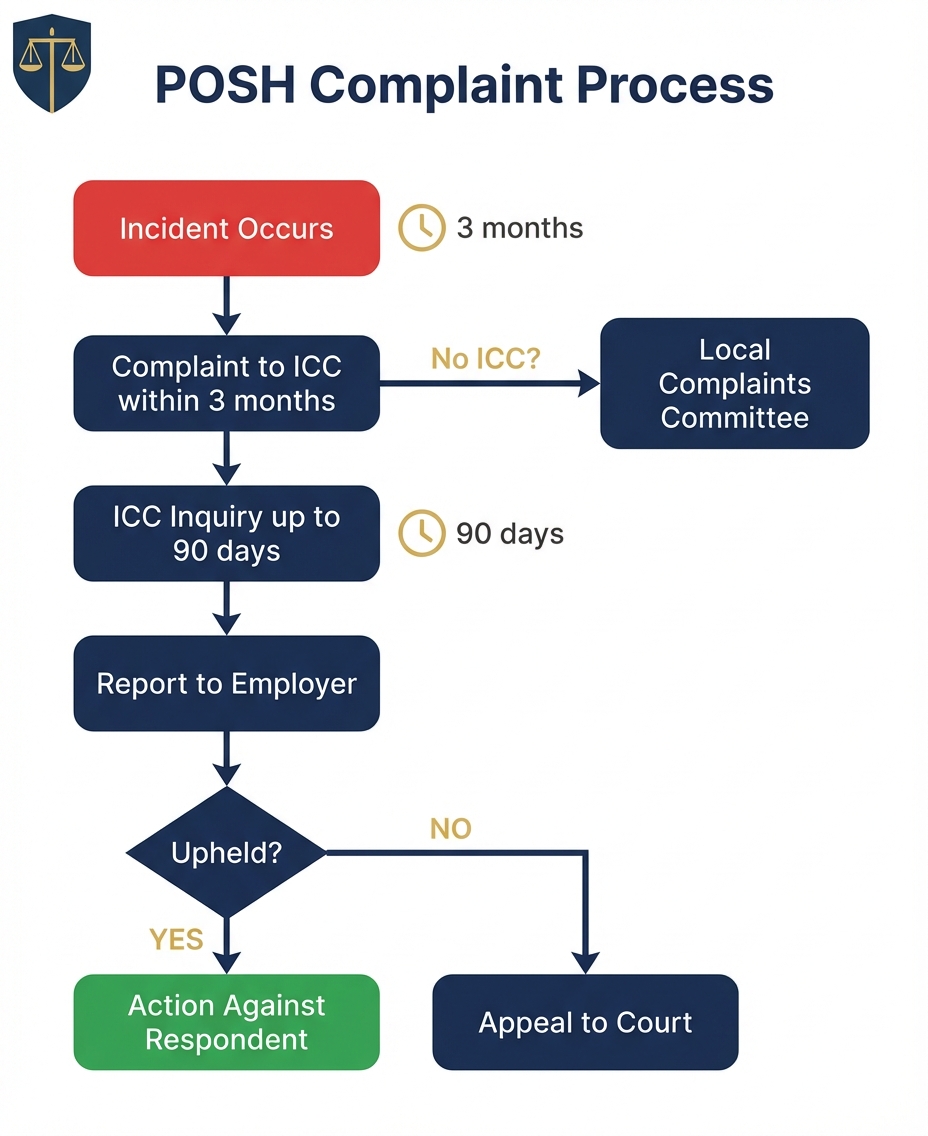
- Document every incident: Maintain a detailed written record of each incident of harassment — date, time, location, what happened, what was said, who was present, and how you felt. Preserve all evidence including emails, text messages, screenshots, and photographs.
- Report internally: If your organization has a POSH policy, follow the prescribed reporting mechanism. Inform your immediate supervisor, HR department, or the ICC Presiding Officer about the harassment in writing.
- File a written complaint with the ICC: Submit a formal written complaint to the Internal Complaints Committee within 3 months of the last incident (extendable by 3 months if you can show sufficient cause for the delay). The complaint should describe each incident in detail and be accompanied by supporting documents and a list of witnesses.
- ICC inquiry process: The ICC must complete its inquiry within 90 days. During the inquiry, both the complainant and the respondent are given an opportunity to present their case. The ICC may also attempt conciliation at the request of the complainant (no monetary settlement is permitted in conciliation). If conciliation fails, the inquiry proceeds.
- ICC recommendations: Upon completing the inquiry, the ICC submits its findings and recommendations to the employer. If harassment is proven, recommendations may include disciplinary action against the respondent, compensation to the complainant, and changes to workplace policies.
- Employer action: The employer must act on the ICC's recommendations within 60 days. Failure to do so is a violation of the POSH Act.
- Send a legal notice (if necessary): If the employer fails to constitute an ICC, does not act on your complaint, fails to implement ICC recommendations, or retaliates against you, draft and send a legal notice through a registered advocate via Registered Post with Acknowledgement Due (RPAD).
- File a complaint with the District Officer: Under Section 18 of the POSH Act, if the employer fails to comply with the Act's provisions, you can file a complaint with the District Officer (typically the District Magistrate).
- File a criminal complaint (if applicable): If the harassment involves criminal conduct — such as assault, outraging modesty, stalking, or criminal intimidation — file an FIR at the nearest police station under the relevant sections of the Bharatiya Nyaya Sanhita.
- Approach the civil court: You may also file a civil suit for damages, injunction, or other relief against the harasser and/or the employer for negligence in providing a safe workplace.
No woman shall be subjected to sexual harassment at any workplace. Every employer shall provide a safe working environment at the workplace which shall include safety from the persons coming into contact at the workplace.
— Section 3, Sexual Harassment of Women at Workplace (Prevention, Prohibition and Redressal) Act, 2013
Employer Obligations Under POSH
The POSH Act places significant obligations on employers to prevent, prohibit, and redress sexual harassment at the workplace. Non-compliance can result in penalties, cancellation of business licences, and reputational damage. The key obligations include:
- Constitute an Internal Complaints Committee (ICC) at every office or branch with 10 or more employees.
- Display the POSH policy and the penal consequences of sexual harassment at a conspicuous place in the workplace.
- Organize regular awareness programmes and workshops on the provisions of the POSH Act for all employees.
- Provide necessary facilities to the ICC for dealing with complaints, conducting inquiries, and ensuring confidentiality.
- Assist the complainant in filing a complaint with the police if the harassment amounts to a criminal offence.
- Ensure no retaliation against the complainant, witnesses, or any person assisting in the inquiry process.
- Act on ICC recommendations within 60 days of receiving the inquiry report.
- File an annual report with the District Officer containing details of the number of complaints received, disposed of, and pending, along with the action taken.
- Include POSH compliance in the Annual Report of the company (for listed companies and those required to file annual returns).
Penalties for Non-Compliance
Under Section 26 of the POSH Act, failure to constitute an ICC or non-compliance with other provisions of the Act is punishable with a fine of up to Rs. 50,000. Repeated non-compliance can result in a higher penalty and cancellation of the business licence or registration. Despite these provisions, enforcement remains a challenge, making legal notices a critical tool for holding employers accountable.
Remedies and Penalties
If workplace harassment is established through the ICC inquiry or through legal proceedings, the following remedies and penalties may be available to the aggrieved employee:
- Disciplinary action against the respondent: The employer may take action as per the service rules, including written warning, withholding of promotion or increment, suspension, transfer, or termination of employment.
- Compensation: The ICC may recommend compensation to the complainant, calculated based on the mental trauma, pain, suffering and emotional distress caused, the loss of career opportunity, medical expenses incurred, and the income and financial status of the respondent. Under Section 15 of the POSH Act, compensation may be deducted from the respondent's salary or wages.
- Interim relief: During the pendency of the inquiry, the ICC may recommend transfer of the complainant or the respondent, granting leave to the complainant, or restraining the respondent from reporting on the complainant's work.
- Criminal prosecution: If the harassment amounts to a criminal offence under the BNS — such as outraging the modesty of a woman (Section 74 BNS), assault with intent to disrobe (Section 76 BNS), voyeurism (Section 77 BNS), or stalking (Section 78 BNS) — the harasser can be prosecuted and, upon conviction, sentenced to imprisonment and/or a fine.
- Civil damages: The employee can file a civil suit for damages against the harasser and/or the employer for negligence, breach of duty of care, or breach of employment contract.
Protect Your Rights at the Workplace
Do not let workplace harassment go unchallenged. Use OpenVakil to draft a legally compliant notice or complaint that holds your employer accountable under the POSH Act.
Start Your Legal NoticeProtection Against Retaliation
One of the biggest fears employees face when reporting harassment is retaliation from the employer or the harasser. The POSH Act and Indian law provide several protections against such retaliation:
- Confidentiality: Section 16 of the POSH Act mandates that the identity of the complainant, respondent, and witnesses, the details of the complaint, the inquiry proceedings, and the recommendations of the ICC must be kept strictly confidential. Any breach of confidentiality is punishable under the Act.
- Protection from adverse action: The employer is duty-bound to ensure that the complainant is not subjected to any adverse employment action — such as termination, demotion, transfer, or unfavourable changes in working conditions — as a consequence of filing the complaint.
- Interim relief during inquiry: The ICC can recommend interim measures to protect the complainant during the inquiry, including transfer, granting of leave, or restraining the respondent from having any contact with the complainant.
- Legal recourse for retaliation: If an employer retaliates against a complainant, the employee can send a legal notice, file a complaint with the District Officer, approach the Labour Commissioner, or institute a civil suit for wrongful termination or constructive dismissal.
Preserve Evidence of Retaliation
If you experience retaliation after filing a harassment complaint, document everything meticulously. Save all communications (emails, messages, letters), note any changes in your responsibilities or treatment, record conversations where legally permissible, and collect statements from colleagues who witnessed the retaliatory conduct. This evidence is critical if you need to pursue legal action for retaliation.
Common Mistakes to Avoid
Employees dealing with workplace harassment often make mistakes that can weaken their case or delay justice. Here are the most common pitfalls to avoid:
- Delaying the complaint: Under the POSH Act, the complaint must be filed within 3 months of the last incident (extendable by 3 months for sufficient cause). Waiting too long can result in your complaint being time-barred and makes evidence harder to gather.
- Not documenting incidents: Relying solely on verbal accounts weakens your case. Always maintain a contemporaneous written record of each incident with dates, times, details, and witnesses.
- Not preserving evidence: Deleting messages, emails, or other digital evidence can be irreversible. Preserve all evidence in multiple secure locations — take screenshots, save emails, and back up files.
- Making only verbal complaints: Always put your complaint in writing. A verbal complaint to a manager or HR has no legal standing and is easily denied. A written complaint to the ICC creates a formal record.
- Not understanding your employer's POSH policy: Familiarize yourself with your organization's POSH policy and ICC details before a situation arises. Know who the ICC members are, where to file a complaint, and what the process entails.
- Resigning impulsively: Do not resign in frustration without first securing your legal position. If you resign, you may lose certain remedies. If the harassment makes it impossible to continue working, document the hostile conditions and consult a lawyer about constructive dismissal before resigning.
- Sending a defective legal notice: A legal notice that is vague, legally inaccurate, or fails to cite the correct provisions can undermine your credibility. Always have your notice drafted or reviewed by a qualified advocate.
- Ignoring criminal remedies: If the harassment involves physical assault, stalking, or criminal intimidation, do not limit yourself to the ICC process. File an FIR with the police in addition to your ICC complaint.
How OpenVakil Helps
Dealing with workplace harassment is emotionally draining, and navigating the legal process can feel overwhelming. OpenVakil is here to simplify and empower that process. Our AI-powered legal platform helps you draft professionally worded, legally accurate notices and complaints so you can take the first step toward justice with confidence.
- Legally accurate notices: Every notice is drafted in accordance with the POSH Act, 2013, the Bharatiya Nyaya Sanhita, and applicable employment laws, ensuring your communication carries legal weight.
- Customized to your situation: Our guided process captures the specific details of your case — the nature of harassment, the incidents, your employer's response — and generates a notice tailored to your circumstances.
- ICC complaint assistance: Beyond legal notices, OpenVakil can help you draft a comprehensive written complaint to the Internal Complaints Committee with all the necessary details and supporting references.
- Confidential and secure: Your information is treated with the utmost confidentiality. We understand the sensitivity of harassment complaints and ensure your data is protected.
- Fast and affordable: Generate your legal notice or ICC complaint in minutes at a fraction of the cost of traditional legal consultation.
- Download-ready format: Download your completed notice as a professional PDF, ready to be sent via Registered Post or submitted to the ICC.
Whether you need to file an ICC complaint, send a legal notice to a non-compliant employer, or escalate a matter to the District Officer, OpenVakil gives you the legal tools to stand up against workplace harassment — the right way. You deserve a safe and dignified workplace, and the law is on your side.
Take the First Step Against Workplace Harassment
Stop suffering in silence. Use OpenVakil to draft a legally compliant workplace harassment notice or ICC complaint in minutes. Assert your rights under the POSH Act today.
Get Started for Free