India's startup ecosystem has grown at an extraordinary pace, with over 1,00,000 DPIIT-recognised startups as of 2024. Yet behind the headlines of billion-dollar valuations and successful exits lies a far less glamorous reality — legal disputes between co-founders, investors, and stakeholders are among the most common reasons startups fail. From equity disagreements and IP ownership battles to investor-founder conflicts and breach of shareholders' agreements, startup disputes can destroy years of hard work in a matter of weeks.
A legal notice is often the first formal step a founder must take to protect their rights, recover what is owed, or compel a defaulting party to honour their obligations. Whether you are a founder dealing with a co-founder who has walked away with proprietary code, an investor who is violating the terms of the shareholders' agreement, or a client who refuses to pay for delivered services — understanding when and how to send a legal notice is critical. This comprehensive guide covers the legal framework, common dispute types, key processes, and remedies available to startup founders under Indian law.
Why Startups Face Unique Legal Disputes
Startups operate in a fundamentally different environment from established businesses. They are characterised by rapid decision-making, informal structures, fluid roles, and heavy reliance on trust among a small group of founders. This informality, while essential for speed and agility in the early stages, becomes a significant liability when relationships break down. Unlike large corporations with dedicated legal departments and well-documented processes, startups often lack the basic legal infrastructure — written agreements, IP assignment deeds, vesting schedules, and board resolutions — needed to resolve disputes cleanly.
The most dangerous disputes in startups typically arise from ambiguity: ambiguity about who owns the intellectual property, ambiguity about what happens when a co-founder leaves, ambiguity about investor rights versus founder autonomy, and ambiguity about equity allocation. Indian law provides a robust framework for resolving these disputes, but founders must understand their rights and act decisively when conflicts emerge. Delay and inaction can result in loss of control over the company, erosion of IP rights, and significant financial damage.
Startup Disputes Are More Common Than You Think
Studies consistently show that co-founder conflict is one of the top three reasons startups fail globally. In India, where many startups begin as informal partnerships between friends or former colleagues, the absence of formal agreements makes these disputes even more dangerous. A 2023 survey by a leading Indian venture capital firm found that over 40% of early-stage startups had experienced at least one significant legal dispute within their first three years of operation.
Common Startup Legal Disputes in India
Startup disputes in India span a wide spectrum, from internal conflicts between founders and investors to external disputes with vendors, clients, and employees. Understanding the most common categories of disputes helps founders prepare for and, ideally, prevent them.
Co-Founder Exit and Equity Disputes
Co-founder disputes are the most emotionally charged and legally complex disputes in the startup world. They typically arise when a co-founder decides to leave the company (voluntarily or involuntarily) and disputes arise over equity ownership, vesting of shares, valuation of the departing founder's stake, non-compete obligations, and the return of company assets. In many Indian startups, equity is allocated informally at the beginning — sometimes on a napkin or over a WhatsApp conversation — without a formal shareholders' agreement or vesting schedule. When the relationship breaks down, this informality creates enormous legal uncertainty.
Key questions that arise in co-founder exit disputes include: Does the departing co-founder retain their full equity, or does unvested equity revert to the company? Can the remaining founders force a buyback of the departing founder's shares, and at what valuation? Is the departing founder bound by a non-compete clause? Can the departing founder use the company's intellectual property, client relationships, or trade secrets to start a competing venture? These questions are answered by the shareholders' agreement (SHA), the articles of association (AoA), and, in the absence of written agreements, the applicable provisions of the Companies Act, 2013 and the Indian Contract Act, 1872.
IP Ownership Disputes
Intellectual property is often the most valuable asset a startup possesses — its source code, algorithms, brand name, product designs, trade secrets, and proprietary processes. Disputes over IP ownership are particularly common when a co-founder who contributed significantly to the development of the product or technology leaves the company. Under Indian law, the question of who owns IP created during the startup's operation depends on several factors: Was there a written IP assignment agreement? Was the IP created by the founder in their capacity as an employee or director of the company? Was the IP developed using company resources, or independently?
Under the Copyright Act, 1957, copyright in a work created by an employee in the course of employment belongs to the employer (Section 17). However, if a co-founder is not formally an employee but a partner or consultant, the position is different — the creator retains copyright unless there is a written assignment. Similarly, under the Patents Act, 1970, an invention made by an employee using the employer's resources generally belongs to the employer, but disputes arise when the boundaries of employment are unclear. For startups, the critical lesson is clear: IP assignment agreements must be executed from day one.
Investor-Founder Conflicts
The relationship between founders and investors is governed by a complex web of agreements — the term sheet, shareholders' agreement (SHA), share subscription agreement (SSA), and articles of association. Disputes arise when either party violates the terms of these agreements. Common investor-founder conflicts include: investors exercising anti-dilution rights or liquidation preferences in ways that disadvantage founders; investors blocking key business decisions through veto rights or affirmative voting provisions; founders misrepresenting the company's financial position or key metrics (constituting fraud); investors demanding board seats or control beyond what was agreed; and disputes over down-rounds, bridge financing, or forced exits.
For startups that have received institutional investment, the Securities and Exchange Board of India (SEBI) regulations may also apply — particularly SEBI (Alternative Investment Funds) Regulations, 2012 and SEBI (Issue of Capital and Disclosure Requirements) Regulations, 2018. Violations of these regulations by investors or the company can give rise to regulatory complaints and enforcement actions in addition to contractual remedies.
Employee Poaching and Non-Compete Issues
When a co-founder or key employee leaves a startup, they often attempt to poach other team members or solicit the company's clients for a competing venture. While non-compete clauses are common in employment agreements and shareholders' agreements, their enforceability in India is limited. Section 27 of the Indian Contract Act, 1872 declares every agreement in restraint of trade to be void, with the sole exception of the sale of goodwill. Indian courts have consistently held that post-termination non-compete clauses in employment contracts are unenforceable. However, non-solicitation clauses (which restrict a departing founder or employee from soliciting the company's clients or employees, rather than from engaging in a competing business generally) have been upheld by courts as reasonable restrictions, provided they are limited in scope, geography, and duration.
Non-Compete Clauses Are Largely Unenforceable in India
Unlike the United States and certain other jurisdictions, India does not generally enforce post-employment non-compete agreements. Section 27 of the Indian Contract Act, 1872 renders such clauses void. However, non-solicitation clauses and confidentiality obligations may be enforced. If your co-founder agreement includes a non-compete clause, consult a lawyer to understand what is actually enforceable before sending a legal notice based on it.
Vendor Contract Breaches
Startups rely heavily on vendors and service providers — from cloud hosting providers and software development agencies to marketing firms and logistics partners. When a vendor fails to deliver services as agreed, delivers substandard work, misses critical deadlines, or breaches confidentiality obligations, the startup suffers disproportionately. A breach of contract by a key vendor can delay product launches, compromise data security, and cause significant financial loss. Under Sections 73 and 74 of the Indian Contract Act, 1872, the aggrieved party is entitled to compensation for loss or damage caused by the breach, and any amount specified in the contract as liquidated damages may be recoverable.
Client Non-Payment
Cash flow is the lifeblood of any startup, and non-payment by clients can be existentially threatening for early-stage companies. Whether it is a large enterprise client that has failed to pay for delivered software, a B2B customer that has disputed an invoice, or a client that has unilaterally terminated a contract without paying for work already completed — founders need to act quickly to recover outstanding dues. A legal notice under Section 62 of the Indian Contract Act (for novation or breach) or Order 37 of the Code of Civil Procedure (for summary suit for recovery of money) is often the first step. For amounts under Rs. 1 crore, the Micro, Small and Medium Enterprises Development (MSMED) Act, 2006 provides a fast-track recovery mechanism through the MSME Facilitation Council.
Facing a Startup Dispute?
Whether it is a co-founder exit, IP ownership battle, or investor conflict, OpenVakil helps you draft a legally sound notice in minutes. Protect your startup before it is too late.
Draft Your Legal Notice NowLegal Framework Governing Startup Disputes
Startup disputes in India are governed by a combination of statutes depending on the nature of the entity (private limited company, LLP, or partnership firm), the type of dispute, and the relief sought. Understanding the applicable legal framework is essential for drafting an effective legal notice and pursuing the correct remedy.
Companies Act, 2013
Most funded startups in India are incorporated as private limited companies, making the Companies Act, 2013 the primary governing statute. Key provisions relevant to startup disputes include:
- Section 241–246 (Oppression and Mismanagement): Shareholders holding at least 10% of the issued share capital can approach the National Company Law Tribunal (NCLT) for relief against oppressive conduct or mismanagement by the majority shareholders or the board of directors.
- Section 58–59 (Transfer and Transmission of Shares): Disputes over the refusal to register a transfer of shares or rectification of the register of members can be adjudicated by the NCLT.
- Section 111 (Register of Members): Any person aggrieved by an entry in the register of members, or by the refusal of the company to make an entry, may apply to the Tribunal for rectification.
- Section 168 (Resignation of Directors): Governs the process and legal consequences of a director's resignation, relevant when a co-founder resigns from the board.
- Section 447 (Fraud): Prescribes severe penalties including imprisonment of up to 10 years and fines of up to 3 times the amount of fraud for any person found guilty of fraud in relation to a company.
Indian Partnership Act, 1932
Many early-stage startups in India begin as informal partnerships before incorporating as companies. The Indian Partnership Act, 1932 governs the rights and duties of partners, including profit sharing (Section 13), mutual rights and duties (Sections 12–17), implied authority (Section 19), and dissolution (Sections 32–44). If your startup operates as a partnership firm and a dispute arises over the terms of the partnership or a partner's conduct, this Act provides the legal framework for resolution. Under Section 69, an unregistered partnership firm cannot file a suit to enforce a contractual right, making registration critically important.
Indian Contract Act, 1872
The Indian Contract Act, 1872 is the foundational statute governing all contractual relationships in India, including those between co-founders, investors, vendors, and clients. Key provisions relevant to startup disputes include Section 73 (compensation for loss or damage caused by breach of contract), Section 74 (compensation for breach of contract where penalty is stipulated), Section 27 (void agreements in restraint of trade), and Sections 17–18 (fraud and misrepresentation, which may invalidate contracts or give rise to claims for damages). Every co-founder agreement, SHA, employment contract, and vendor agreement is ultimately a contract governed by this Act.
Copyright Act, 1957 and Patents Act, 1970
For technology startups, intellectual property is typically the core asset. The Copyright Act, 1957 protects original literary works (including software source code under Section 2(o)), artistic works (logos and designs), and other creative outputs. Section 17 establishes the default rule that the employer owns copyright in works created during employment, but this must be read carefully in the context of co-founders who may not have a formal employment relationship. The Patents Act, 1970 governs inventions, with Section 36 covering employee inventions and Sections 104–115 dealing with infringement proceedings. Trade secrets, while not governed by a specific Indian statute, are protected through contractual obligations (NDAs and confidentiality clauses) and the common law duty of confidence recognised by Indian courts.
SEBI Regulations and Investor Disputes
When investor disputes involve entities regulated by the Securities and Exchange Board of India, additional regulatory frameworks come into play. The SEBI (Alternative Investment Funds) Regulations, 2012 govern venture capital and private equity funds that invest in startups. The SEBI (Issue of Capital and Disclosure Requirements) Regulations, 2018 apply when a startup seeks to raise capital through public or private placement. Violations of SEBI regulations — such as non-disclosure of material information, insider trading, or manipulation of financial statements — can lead to enforcement actions, penalties, and disgorgement orders by SEBI. Founders should be aware that investor disputes may have a regulatory dimension beyond the contractual realm.
In the case of a company, the shareholders' agreement operates as a binding contract between the parties. The rights and obligations of the shareholders are to be determined by the terms of the shareholders' agreement, read with the articles of association of the company.
— Supreme Court of India — Vodafone International Holdings B.V. v. Union of India, (2012) 6 SCC 613
Co-Founder Agreements and Shareholders Agreements
The two most critical documents for preventing and resolving startup disputes are the Co-Founder Agreement and the Shareholders' Agreement (SHA). While these terms are sometimes used interchangeably, they serve distinct functions. A co-founder agreement is typically executed at the inception of the startup, before formal incorporation, and covers the initial understanding between the co-founders regarding equity split, roles, IP assignment, and exit terms. The SHA is a more comprehensive document, usually executed at the time of incorporation or upon receiving investment, that governs the relationship between all shareholders (including investors) and covers issues such as:
- Equity allocation and vesting schedules: How equity is divided among founders and what vesting conditions apply (e.g., 4-year vesting with a 1-year cliff).
- Board composition and voting rights: How the board of directors is constituted, who has the right to appoint directors, and what decisions require board or shareholder approval.
- Anti-dilution protection: Mechanisms to protect investors from dilution in subsequent funding rounds (full ratchet, weighted average, or broad-based weighted average).
- Liquidation preference: The order and priority in which proceeds from a sale, merger, or liquidation of the company are distributed among shareholders.
- Drag-along and tag-along rights: Rights that allow majority shareholders to force minority shareholders to participate in a sale (drag-along), or allow minority shareholders to participate in a sale initiated by majority shareholders (tag-along).
- Right of first refusal (ROFR): The right of existing shareholders to purchase shares before they are offered to external parties.
- Information rights: The right of investors to receive financial statements, board minutes, and other information about the company's operations.
- Non-compete and non-solicitation clauses: Restrictions on founders engaging in competing businesses or soliciting the company's employees and clients.
- Dispute resolution mechanism: Whether disputes are to be resolved through mediation, arbitration (under the Arbitration and Conciliation Act, 1996), or litigation, and the seat and governing law of the arbitration.
Always Have a Shareholders' Agreement Before Taking Investment
Never accept investment without a comprehensive shareholders' agreement in place. The SHA is your primary legal shield against investor overreach, co-founder disputes, and exit complications. It should be drafted or reviewed by a qualified corporate lawyer who understands startup dynamics. The cost of a good SHA is a fraction of the cost of litigating disputes that arise from its absence.
IP Ownership: Who Owns the Code and Brand When a Co-Founder Leaves?
One of the most contentious and high-stakes disputes in startup law is the question of IP ownership when a co-founder departs. This is especially critical in technology startups where the departing co-founder may have written the core source code, developed the product architecture, designed the user interface, or created the brand identity. The answer depends on the legal structure and the agreements in place.
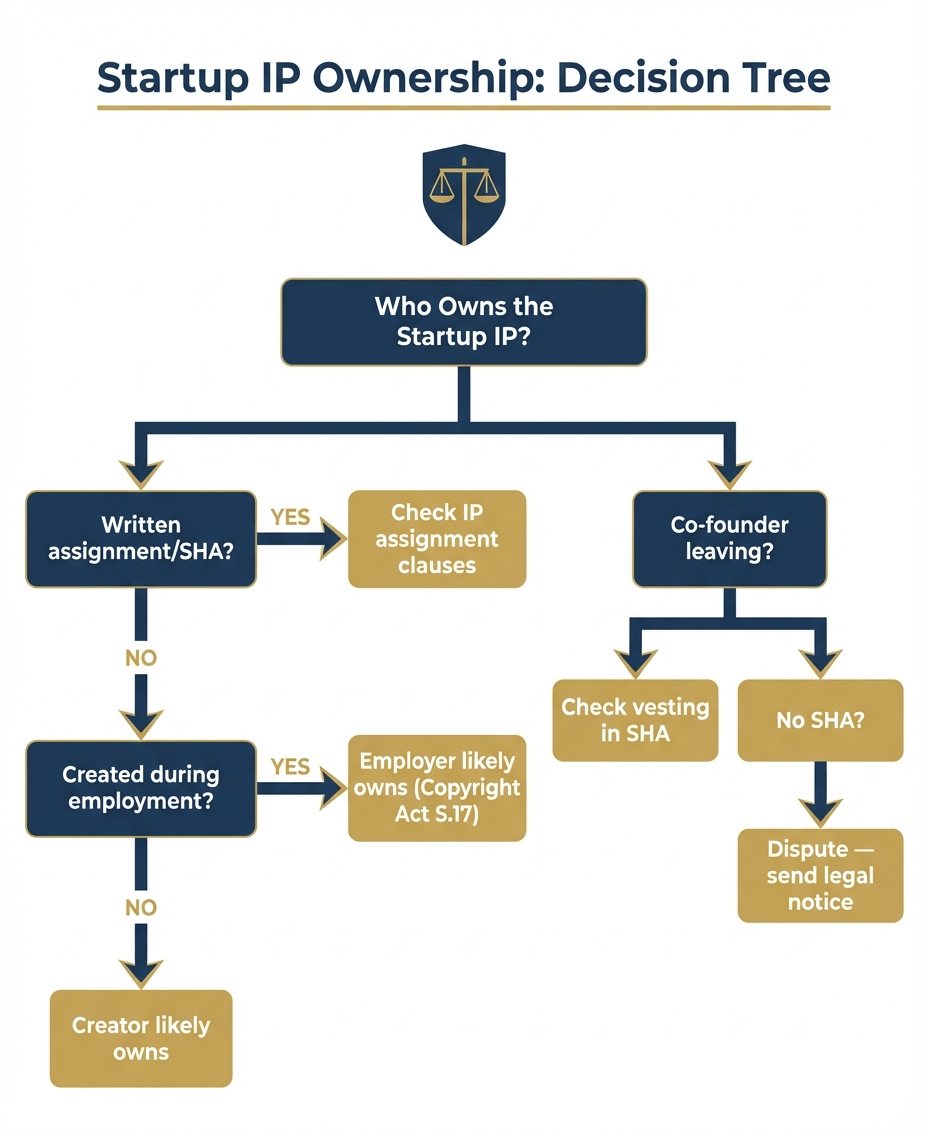
Scenario 1: IP Assignment Agreement Exists. If the co-founder executed a written IP assignment agreement (also called an Invention Assignment Agreement or PIIA — Proprietary Information and Inventions Agreement) assigning all IP created during their tenure to the company, the position is clear. The company owns all assigned IP, and the departing co-founder has no right to use, copy, or commercialise it. This is the ideal scenario and the reason why every startup must have IP assignment agreements in place from day one.
Scenario 2: No Written IP Assignment. In the absence of a written assignment, the position becomes complicated. Under Section 17 of the Copyright Act, 1957, if the co-founder was an employee (i.e., had a contract of service, not a contract for service), copyright in works created in the course of employment belongs to the employer (the company). However, if the co-founder was a partner, consultant, or independent contractor, the creator retains copyright unless there is a written assignment. Many Indian startups operate in a grey area where co-founders are neither formal employees nor independent contractors, making this determination fact-specific and contentious.
Scenario 3: Trademarks and Brand Assets. If the startup's trademark was registered in the name of the company, it remains with the company regardless of which co-founder conceived or designed it. However, if the trademark was registered in an individual co-founder's name (a common mistake in early-stage startups), the departing co-founder may claim ownership. Under the Trade Marks Act, 1999, the registered proprietor has exclusive rights, and any transfer must be by way of written assignment (Section 37).
Scenario 4: Trade Secrets and Confidential Information. Trade secrets — including customer lists, pricing strategies, proprietary algorithms, and business plans — are protected under common law principles of confidence and through non-disclosure agreements (NDAs). If the departing co-founder misappropriates trade secrets, the company can seek injunctive relief and damages through civil proceedings, and may also file a criminal complaint under Section 405 of the Bharatiya Nyaya Sanhita (BNS) (criminal breach of trust) or Section 318 BNS (cheating).
Register Your Startup's IP in the Company's Name
A surprisingly common mistake in Indian startups is registering trademarks, domain names, or patents in an individual founder's name rather than the company's name. This creates a ticking time bomb: if that founder leaves, they may claim personal ownership of the IP. Always register all intellectual property — trademarks, copyrights, patents, and domain names — in the company's name, and execute IP assignment agreements with every founder, employee, and contractor.
When Should a Startup Founder Send a Legal Notice?
A legal notice is a formal written communication served upon the opposing party, setting out the grievance, the legal basis for the claim, and the demand for specific action within a stipulated timeframe. For startup founders, the following situations warrant sending a legal notice:
- Co-founder has left and is refusing to return company IP: The departing co-founder has taken source code, designs, customer data, or other proprietary assets and refuses to return or assign them to the company.
- Co-founder is competing in violation of non-solicitation or confidentiality obligations: The departing co-founder has started a competing venture, is soliciting the company's employees or clients, or is using confidential information.
- Equity dispute after a co-founder's exit: Disagreement over whether the departing co-founder's unvested shares should be forfeited, the valuation at which shares should be bought back, or the applicability of vesting acceleration clauses.
- Investor is violating the SHA: An investor is exercising rights beyond those agreed in the shareholders' agreement, blocking legitimate business decisions, demanding board control, or failing to fund committed tranches.
- Fraud or misrepresentation: A co-founder, investor, or business partner has made false representations about their qualifications, financial position, or the company's performance, causing loss to the startup.
- Client non-payment: A client has failed to pay for services rendered or products delivered despite repeated reminders and the contractual payment terms.
- Vendor breach: A vendor has failed to deliver services as per the contract, delivered defective work, or breached confidentiality or data protection obligations.
- Employee poaching: A former co-founder or competitor is systematically poaching the startup's employees in violation of non-solicitation obligations.
Key Elements of a Startup Legal Notice
A legal notice for a startup dispute must be precise, well-documented, and legally authoritative. Poorly drafted notices can weaken your position and undermine your credibility. The following elements are essential:
- Identity of the parties: Full legal names and addresses of the sender (founder/company) and the recipient (co-founder, investor, vendor, or client). For companies, include the CIN number and registered office address.
- Details of the relationship: Date of incorporation, nature of the relationship (co-founder, investor, vendor, employee), and the governing agreements (SHA, co-founder agreement, service agreement, etc.).
- Specific agreements referenced: Cite the exact clauses of the SHA, co-founder agreement, employment contract, or vendor agreement that have been breached, with dates of execution.
- Chronological factual narrative: A clear, detailed account of the events leading to the dispute, with specific dates, actions, amounts, and communications referenced.
- Legal basis for the claim: Reference to the applicable provisions of the Companies Act 2013, Indian Contract Act 1872, Copyright Act 1957, Patents Act 1970, or other relevant statutes that support your claim.
- Evidence summary: A brief description of the documentary and electronic evidence supporting your claim (emails, WhatsApp messages, board resolutions, financial records, code repositories, etc.).
- Specific demand: A clear statement of what you require the recipient to do — return IP, transfer shares, pay dues, cease competing activity, render accounts, etc.
- Time limit for compliance: A deadline of typically 15 to 30 days from receipt of the notice for the recipient to comply with the demands.
- Consequences of non-compliance: A statement that failure to comply will result in civil proceedings, NCLT petition, arbitration, criminal complaint, or other legal action, as applicable.
- Signature and dispatch details: Signed by the founder or their authorised advocate, with details of dispatch via Registered Post with Acknowledgement Due (RPAD).
Step-by-Step Process for Sending a Legal Notice
The process of sending a legal notice for a startup dispute must be systematic and evidence-driven. Follow these steps to maximise the effectiveness and legal impact of your notice:
- Gather and preserve all evidence: Before any formal action, collect and securely store all relevant documents — shareholders' agreement, co-founder agreement, email correspondence, WhatsApp chats, Slack messages, board resolutions, financial statements, bank statements, code commit logs (Git), IP registration certificates, and any other records. Take screenshots with timestamps and consider notarisation of critical documents. Evidence preservation is paramount as parties may attempt to destroy or alter records once they receive the notice.
- Review all governing agreements: Carefully read the SHA, co-founder agreement, AoA, employment contracts, and any other relevant agreements. Identify the specific clauses that have been breached, the dispute resolution mechanism (arbitration vs. litigation), the governing law, and any notice requirements or cure periods specified in the agreements.
- Assess the legal position: Consult with a qualified corporate or startup lawyer to assess the strength of your claim, identify potential defences the other party may raise, and determine the most effective legal strategy. Consider whether the dispute is best resolved through negotiation, mediation, arbitration, or litigation.
- Draft the legal notice: Prepare a comprehensive notice covering all the key elements described above. The notice should be factual, firm, and professionally worded. Avoid emotional language, personal attacks, or unsubstantiated allegations. Cite specific contractual clauses and statutory provisions.
- Dispatch via Registered Post (RPAD): Send the notice via Registered Post with Acknowledgement Due (RPAD) to the recipient's registered address (and, for companies, to the registered office). Retain the postal receipt and the acknowledgement card as proof of dispatch and delivery.
- Send copies via additional channels: As supplementary service, send a copy of the notice via email to the recipient's official email address, and via courier if necessary. While RPAD is the primary mode of service for legal purposes, additional channels ensure the recipient cannot plausibly deny receipt.
- Monitor and wait for the compliance period: Allow the full period specified in the notice (15 to 30 days) for the recipient to respond. During this period, continue to preserve evidence and document any further actions by the recipient.
- Evaluate the response and escalate if necessary: If the recipient complies, document the resolution formally in writing. If the recipient responds with a counter-notice or denial, evaluate the response with your lawyer and determine the next steps — negotiation, mediation, arbitration, NCLT petition, civil suit, or criminal complaint.
Remedies Available to Startup Founders
Indian law provides multiple avenues for resolving startup disputes, depending on the nature of the claim, the relief sought, and the agreements between the parties. Founders should understand the full spectrum of remedies available to them.
Arbitration, NCLT, Civil Court, and Criminal Complaints
- Arbitration (Arbitration and Conciliation Act, 1996): If the SHA or co-founder agreement contains an arbitration clause, disputes must typically be referred to arbitration. Arbitration is generally faster and more confidential than court proceedings. The arbitral award is binding and enforceable as a decree of a civil court under Section 36 of the Act. Institutional arbitration (e.g., through the Mumbai Centre for International Arbitration or the Delhi International Arbitration Centre) is increasingly popular for startup disputes.
- National Company Law Tribunal (NCLT): For disputes involving oppression and mismanagement (Sections 241–246, Companies Act 2013), rectification of the register of members, winding up of companies, or any matter specifically assigned to the NCLT, founders must approach the Tribunal. The NCLT has specialised expertise in company law matters and can grant wide-ranging relief including restraining the company or its directors from taking certain actions, ordering the purchase of shares at fair value, and modifying the articles of association.
- Civil Court: For breach of contract claims, recovery of money, injunctions against use of IP, and damages claims, founders can file a civil suit in the appropriate District Court or High Court. Under Order 37 of the Code of Civil Procedure, summary suits can be filed for recovery of debts based on written contracts, providing a faster route to judgment. High Courts also entertain original civil suits involving substantial amounts or complex legal questions.
- Criminal Complaint: Where the dispute involves fraud, cheating, criminal breach of trust, forgery, or misappropriation, the aggrieved founder can file a First Information Report (FIR) with the police or a criminal complaint before the jurisdictional Magistrate. Relevant provisions include Section 316 BNS (criminal breach of trust), Section 318 BNS (cheating), Section 336 BNS (forgery), and Section 447 of the Companies Act, 2013 (fraud in relation to a company, punishable with imprisonment of up to 10 years). Criminal proceedings can serve as a powerful deterrent and can run parallel to civil remedies.
- SEBI Complaint: If an investor regulated by SEBI has violated SEBI regulations, the founder can file a complaint with SEBI's SCORES (SEBI Complaint Redress System) portal. SEBI can investigate, issue show-cause notices, and impose penalties on the violating entity.
- Mediation: Before or during litigation, parties may opt for mediation as an alternative dispute resolution mechanism. The Mediation Act, 2023 provides a statutory framework for mediation in India, and mediated settlements have the same enforceability as court decrees.
Where a dispute arises between shareholders of a private company and the dispute involves allegations of oppression and mismanagement, the appropriate forum is the National Company Law Tribunal under Sections 241 to 246 of the Companies Act, 2013, and not the civil court.
— Cyrus Investments Pvt. Ltd. v. Tata Sons Ltd., NCLAT (2020)
Essential Tips for Startup Founders
Prevention is invariably better and cheaper than litigation. The following best practices can help founders protect themselves and their startups from the most common legal pitfalls:
- Document everything from day one: Treat every significant decision, agreement, and communication as a legal record. Document equity splits, role allocations, financial contributions, IP assignments, and business decisions in writing. Use email and formal documents rather than verbal agreements.
- Execute a comprehensive shareholders' agreement (SHA): Before accepting investment or even at the co-founder stage, put an SHA in place that covers equity allocation, vesting schedules, decision-making authority, exit mechanisms, drag-along/tag-along rights, and dispute resolution.
- Implement equity vesting: Never allocate equity without a vesting schedule. The industry standard is a 4-year vesting period with a 1-year cliff — meaning no equity vests until the co-founder has stayed for at least one year, after which equity vests monthly or quarterly over the remaining three years. Vesting protects the company from a co-founder who leaves early but retains a significant equity stake without having contributed proportionately.
- Register all IP in the company's name: Ensure that all intellectual property — trademarks, copyrights, patents, domain names, and social media handles — is registered in the name of the company, not any individual founder. Execute IP assignment agreements with every founder, employee, and contractor who creates IP for the company.
- Use NDAs and confidentiality agreements: Before sharing proprietary information with potential co-founders, employees, contractors, or investors, have them sign a non-disclosure agreement (NDA). For employees and contractors, include confidentiality clauses in employment contracts and service agreements.
- Maintain clear financial records: Use professional accounting software, engage a qualified chartered accountant, and maintain transparent financial records accessible to all directors and shareholders as required by law. Financial opacity is one of the most common triggers for co-founder and investor disputes.
- Have a clear exit mechanism: Your SHA and AoA should clearly define what happens when a co-founder exits — voluntarily or involuntarily. Address equity buyback rights, valuation methodology (fair market value, book value, or formula-based), the forfeiture of unvested shares, and post-exit obligations (non-compete, non-solicitation, confidentiality).
- Seek legal advice proactively: Engage a startup-focused lawyer early — ideally at the time of incorporation or first funding round. The cost of preventive legal advice is negligible compared to the cost of litigation. Many law firms and legal-tech platforms, including OpenVakil, offer affordable corporate legal services tailored to startups.
The "Bus Test" for Your Startup
Ask yourself: if any one co-founder were to leave the company tomorrow, would the remaining founders have clear legal ownership of all IP, access to all code repositories and systems, clarity on equity allocation, and the legal authority to continue operating the business without interruption? If the answer is no, you have critical legal gaps that need to be addressed immediately through proper agreements and documentation.
How OpenVakil Helps Startups
Startup founders face a unique challenge: they need fast, reliable, and affordable legal support, but they often cannot afford the fees charged by top-tier law firms. OpenVakil was built to solve this problem. Our AI-powered legal platform is designed to help founders take decisive legal action quickly, without the cost and delay of traditional legal processes.
- AI-Powered Legal Notice Drafting: Describe your dispute in plain language, and our platform generates a comprehensive, legally sound legal notice tailored to your specific situation — whether it involves a co-founder exit, IP theft, investor conflict, vendor breach, or client non-payment. The notice cites the correct statutory provisions and contractual clauses.
- Startup-Specific Templates: Our platform includes templates and drafting intelligence specific to startup disputes — including co-founder equity disputes, SHA breaches, IP assignment demands, non-compete enforcement, and investor rights violations.
- Citing the Right Laws: OpenVakil's AI is trained on Indian corporate law, IP law, contract law, and SEBI regulations, ensuring that every notice references the correct legal framework — Companies Act 2013, Indian Contract Act 1872, Copyright Act 1957, Patents Act 1970, and more.
- Fast Turnaround: Generate your legal notice in minutes, not days. In the startup world, speed is critical — especially when IP is being misappropriated or a co-founder is competing against you.
- Affordable for Startups: Our pricing is designed for startup budgets. Get a professionally drafted legal notice at a fraction of what a law firm would charge, without compromising on quality or legal accuracy.
- Escalation Support: If the legal notice does not resolve the dispute, our platform and network of lawyers can assist with filing NCLT petitions, initiating arbitration proceedings, civil suits, or criminal complaints.
Whether you are a solo founder protecting your IP from a departing co-founder, a founding team dealing with an aggressive investor, or a bootstrapped startup chasing unpaid invoices — OpenVakil gives you the legal tools to protect your rights, your equity, and your company.
Startup disputes are inevitable, but how you handle them defines whether your company survives and thrives. A well-drafted legal notice, backed by a solid understanding of Indian law and proper documentation, is the most powerful first step you can take. Do not wait for disputes to escalate — act decisively, protect your interests, and build your startup on a foundation of legal certainty.
Protect Your Startup Today
From co-founder disputes to investor conflicts and IP theft, OpenVakil helps startup founders draft powerful, legally compliant notices in minutes. Take the first step toward resolution.
Get Started for Free