Business partnerships are built on trust, shared vision, and mutual commitment. However, when disagreements arise over profit sharing, management decisions, or the terms of the partnership deed, what was once a thriving collaboration can quickly turn into a bitter legal dispute. In India, partnership disputes are among the most common forms of commercial litigation — and a well-drafted legal notice is often the first and most critical step toward resolution.
Whether you are dealing with a partner who has breached the partnership deed, misappropriated funds, or is blocking the dissolution of the firm, understanding your legal rights and the proper process for sending a legal notice can make the difference between a swift resolution and years of protracted litigation. This guide covers everything you need to know about sending a legal notice for business and partnership disputes in India.
What Is a Partnership Dispute?
A partnership dispute arises when two or more partners in a business firm disagree on matters related to the management, finances, operations, or dissolution of the partnership. Under Indian law, a partnership is defined by Section 4 of the Indian Partnership Act, 1932 as the relation between persons who have agreed to share the profits of a business carried on by all or any of them acting for all.
Partnership disputes can range from minor disagreements over day-to-day operations to serious allegations of fraud, embezzlement, or breach of fiduciary duty. When informal discussions and negotiations fail, the aggrieved partner must resort to formal legal mechanisms — starting with a legal notice — to protect their interests and enforce their rights under the partnership deed and applicable law.
Partnership vs. Company Disputes
Partnership disputes are distinct from shareholder or director disputes in a company. Partnerships are governed by the Indian Partnership Act, 1932 (or the LLP Act, 2008 for LLPs), while company disputes fall under the Companies Act, 2013 and are adjudicated by the National Company Law Tribunal (NCLT). The legal remedies and forums differ significantly, so it is important to identify the correct legal framework before taking action.
Common Types of Partnership Disputes
Partnership disputes can take many forms, depending on the nature of the business, the terms of the partnership deed, and the conduct of the partners involved. The following are the most frequently encountered types of partnership disputes in India.
Breach of Partnership Deed
The partnership deed is the foundational document governing the relationship between partners. It sets out each partner's rights, obligations, profit-sharing ratios, capital contributions, and decision-making authority. A breach occurs when a partner violates any term of this deed — for example, by failing to contribute agreed capital, engaging in a competing business in violation of a non-compete clause, or refusing to perform their duties as specified in the deed. Under Section 9 of the Indian Partnership Act, 1932, partners are bound by the terms of the partnership deed, and any deviation constitutes an actionable breach.
Profit-Sharing and Financial Disputes
Disagreements over profits, losses, and financial management are the most common trigger for partnership disputes. These may involve disputes over the calculation of profits, allegations that a partner is siphoning funds, disagreements over reinvestment of profits versus distribution, or claims that one partner is drawing more than their entitled share. Section 13 of the Indian Partnership Act entitles every partner to share equally in the profits unless the deed provides otherwise. Financial opacity or manipulation by any partner can quickly erode trust and lead to formal disputes.
Mismanagement and Fraud
When a partner engages in mismanagement, embezzlement, or fraud, it strikes at the very core of the partnership relationship. Examples include falsifying accounts, diverting business opportunities for personal gain, making unauthorized expenditures, or concealing liabilities from other partners. Under Section 10 of the Indian Partnership Act, every partner has a duty to carry on the business to the greatest common advantage, and any deviation from this fiduciary standard constitutes a serious breach that may warrant both civil and criminal action.
Unauthorized Actions by a Partner
Partners in a firm have implied authority under Section 19 of the Indian Partnership Act to bind the firm in the ordinary course of business. However, disputes arise when a partner exceeds this authority — for example, by entering into contracts that are outside the scope of the partnership business, taking on excessive debt without consent, selling partnership assets unilaterally, or admitting a new partner without the agreement of all existing partners. Such unauthorized actions can expose the firm and the other partners to significant financial and legal liability.
Dissolution Disputes
Disputes frequently arise during the dissolution of a partnership firm. Partners may disagree on whether the firm should be dissolved at all, how the assets and liabilities should be divided, the valuation of partnership assets (especially goodwill), the settlement of accounts, or the treatment of ongoing contracts and obligations. Sections 32 to 44 of the Indian Partnership Act, 1932 lay down detailed provisions governing dissolution, but in practice, the process can be contentious and protracted, especially when partners have unequal bargaining power or when the partnership deed is silent on dissolution procedures.
Facing a Partnership Dispute?
Draft a legally compliant partnership dispute notice in minutes with OpenVakil. Our AI-powered platform ensures your notice meets all requirements under the Indian Partnership Act, 1932.
Draft Your Legal NoticeLegal Framework Governing Partnership Disputes
Partnership disputes in India are governed by a combination of central statutes. Understanding the applicable legal framework is essential for drafting an effective legal notice and pursuing the appropriate remedies.
Indian Partnership Act, 1932
The Indian Partnership Act, 1932 is the primary legislation governing traditional partnership firms in India. Key sections relevant to disputes include:
- Section 4 — Defines "partnership" as the relation between persons who have agreed to share the profits of a business carried on by all or any of them acting for all.
- Section 9 — States that partners are bound by the terms of the partnership deed and, in the absence of a deed, by the provisions of the Act.
- Sections 12–17 — Outline the mutual rights and duties of partners, including the right to share profits equally, the duty to act in good faith, and the obligation to render true accounts.
- Section 19 — Defines the implied authority of a partner to bind the firm in the ordinary course of business.
- Sections 32–44 — Contain detailed provisions on the dissolution of a firm, including grounds for dissolution by court order (Section 44), settlement of accounts (Section 48), and the right of a partner to restrain the use of the firm name after dissolution.
Limited Liability Partnership Act, 2008
The Limited Liability Partnership (LLP) Act, 2008 governs LLPs, which are an increasingly popular business structure in India due to the limited liability protection they offer. Disputes in an LLP are governed by the LLP Agreement (equivalent to a partnership deed) and the provisions of the Act. The LLP Act provides for winding up of LLPs by the National Company Law Tribunal (NCLT) and allows partners to approach the Tribunal in case of disputes. Unlike traditional partnerships, LLP partners are not personally liable for the acts of other partners beyond their agreed contribution.
Indian Contract Act, 1872
Since a partnership is fundamentally a contractual relationship, the general principles of the Indian Contract Act, 1872 apply to partnership disputes. Provisions relating to breach of contract (Sections 73–75), fraud and misrepresentation (Sections 17–18), and the consequences of void agreements are frequently invoked in partnership litigation. Where the partnership deed is silent on a particular matter, courts often fall back on Contract Act principles to resolve disputes.
Arbitration and Conciliation Act, 1996
Many modern partnership deeds include an arbitration clause requiring disputes to be resolved through arbitration rather than litigation. Where such a clause exists, the Arbitration and Conciliation Act, 1996 governs the arbitration process. Arbitration can be significantly faster and more cost-effective than court proceedings. Under this Act, the arbitral award is binding on the parties and enforceable as a decree of a civil court.
Check Your Partnership Deed for an Arbitration Clause
Before sending a legal notice or filing a court case, review your partnership deed carefully. If it contains an arbitration clause, you may be required to resolve the dispute through arbitration first. Filing a court case in the presence of a valid arbitration clause may result in the case being referred to arbitration under Section 8 of the Arbitration and Conciliation Act, 1996, causing unnecessary delays and additional costs.
The relation of partners to one another is one of utmost good faith. Every partner must render true accounts and full information of all things affecting the firm to any partner or his legal representative.
— Section 9, Indian Partnership Act, 1932 — read with Sections 12 and 13
When to Send a Legal Notice for a Partnership Dispute
A legal notice is a formal written communication sent by one party to another, expressing a grievance and demanding specific action within a stipulated timeframe. In the context of partnership disputes, a legal notice serves as the first step in the legal process and is typically sent when informal discussions have failed to resolve the matter. You should consider sending a legal notice in the following situations:
- Breach of partnership deed: When a partner has violated specific terms of the deed and has failed to rectify the breach despite verbal or written requests.
- Financial irregularities: When you suspect or have evidence of misappropriation of funds, falsification of accounts, or unauthorized financial transactions by a partner.
- Demand for accounts: When a partner refuses to share financial statements, books of accounts, or other financial information that you are entitled to under the deed or the Act.
- Profit-sharing disputes: When a partner has failed to distribute profits as per the agreed ratio or is withholding your share without justification.
- Unauthorized actions: When a partner has taken actions that are beyond their authority under the deed or the Act, and those actions have caused or may cause harm to the firm or other partners.
- Before dissolution: When you wish to dissolve the partnership but the other partner(s) are unwilling, or when you want to formally record your intention to exit the firm.
- Post-dissolution settlement: When the partnership has been dissolved but disputes remain over the settlement of accounts, valuation of assets, or distribution of proceeds.
Do Not Delay Sending a Legal Notice
Partnership disputes tend to worsen over time. A partner who is mismanaging funds or acting in bad faith may continue to cause damage to the firm while you deliberate. Sending a legal notice promptly creates a formal record of your grievance, puts the defaulting partner on notice, and can serve as crucial evidence if the matter escalates to arbitration or litigation. Under the Limitation Act, 1963, certain claims have a limitation period of 3 years, so timely action is essential.
Key Elements of a Partnership Dispute Notice
A well-drafted legal notice for a partnership dispute must be precise, comprehensive, and legally sound. The following are the essential elements that every partnership dispute notice should include:
- Name and address of the sender (the aggrieved partner), along with their designation in the firm.
- Name and address of the recipient(s) (the partner(s) against whom the grievance is directed).
- Details of the partnership firm — name, registration number (if registered), principal place of business, and date of formation.
- Reference to the partnership deed — date of execution, key terms, and the specific clauses that have been breached.
- Factual background — a clear, chronological account of the events leading to the dispute, including dates, amounts, and specific actions or omissions.
- Legal basis — reference to the specific provisions of the Indian Partnership Act, 1932 (or LLP Act, 2008) and the partnership deed that support your claim.
- Specific demand — clearly state what you require the recipient to do (e.g., render accounts, pay dues, cease unauthorized activity, agree to dissolution).
- Time limit for compliance — typically 15 to 30 days from receipt of the notice.
- Consequences of non-compliance — state that you will initiate legal proceedings (civil suit, arbitration, or criminal complaint, as applicable) if the demand is not met within the stipulated period.
- Date and signature of the sender or their authorized advocate.
Step-by-Step Process for Sending a Legal Notice
Sending a legal notice for a partnership dispute is a formal legal process that must be executed correctly to be effective. Follow these steps:
- Gather evidence and documents: Collect all relevant documents, including the partnership deed, financial statements, correspondence, bank statements, and any evidence of the breach or misconduct. Organize them chronologically.
- Review the partnership deed: Carefully examine the deed for dispute resolution clauses (arbitration, mediation), notice requirements, grounds for dissolution, and any specific procedures that must be followed before taking legal action.
- Consult a lawyer (recommended): While not legally mandatory, having a qualified advocate draft or review the notice ensures it is legally accurate, properly structured, and strategically effective.
- Draft the legal notice: Prepare a comprehensive notice covering all the essential elements listed above. The notice should be firm but professional, factual rather than emotional, and legally precise.
- Send the notice via Registered Post (RPAD): Dispatch the notice through Registered Post with Acknowledgement Due to the recipient's address. This provides proof of dispatch and delivery. Keep the postal receipt and acknowledgement card safely.
- Send a copy via email or courier (optional): As an additional measure, you may also send a copy via email or reputed courier service. While RPAD is the preferred method for legal purposes, additional channels ensure the recipient cannot claim non-receipt.
- Wait for the response period to expire: Allow the recipient the full period specified in the notice (typically 15–30 days) to respond. During this time, the recipient may comply, negotiate, or send a reply notice.
- Evaluate the response and next steps: If the recipient complies, the matter is resolved. If they respond with a counter-notice or rejection, evaluate the response with your lawyer and decide whether to proceed with arbitration, mediation, or litigation.
Partnership Dissolution Process
Dissolution of a partnership firm is a significant step that ends the legal relationship between the partners and the firm. The Indian Partnership Act, 1932 provides for two main modes of dissolution: voluntary dissolution and court-ordered dissolution.
Voluntary dissolution can occur in several ways under Sections 40–42 of the Act. All partners may agree to dissolve the firm by mutual consent (Section 40). The firm may be dissolved automatically upon the expiry of a fixed term, completion of the underlying venture, the death or insolvency of a partner, or by a partner giving notice of dissolution in a partnership at will (Section 43). In voluntary dissolution, the partners typically negotiate the settlement of accounts, division of assets, and discharge of liabilities among themselves.
Court-ordered dissolution under Section 44 is sought when partners cannot agree on dissolution or its terms. A court may order dissolution on grounds including:
- Insanity of a partner — when a partner becomes of unsound mind (Section 44(a)).
- Permanent incapacity — when a partner becomes permanently incapable of performing their duties (Section 44(b)).
- Misconduct — when a partner's conduct is likely to prejudicially affect the business (Section 44(c)).
- Persistent breach — when a partner wilfully or persistently commits breaches of the partnership agreement (Section 44(d)).
- Transfer of interest — when a partner transfers their entire interest to a third party (Section 44(e)).
- Loss-making business — when the business can only be carried on at a loss (Section 44(f)).
- Just and equitable grounds — when the court considers it just and equitable to dissolve the firm (Section 44(g)).
Settlement of Accounts After Dissolution
Under Section 48 of the Indian Partnership Act, after dissolution, the assets of the firm (including goodwill) must be applied in paying the debts and liabilities of the firm to third parties first, then in paying each partner ratably what is due to them from the firm for advances, and finally in paying each partner their capital contribution. Any surplus or deficiency is divided or borne in the profit-sharing ratio. Disputes over asset valuation and goodwill are extremely common and often require professional valuation.
Need Help with Partnership Dissolution?
Whether you are seeking voluntary dissolution or need to send a legal notice demanding dissolution, OpenVakil can help you draft the right notice quickly and affordably.
Start Your Notice NowRemedies Available in Partnership Disputes
Partners involved in a dispute have access to a range of legal remedies depending on the nature and severity of the dispute. The following remedies may be pursued individually or in combination:
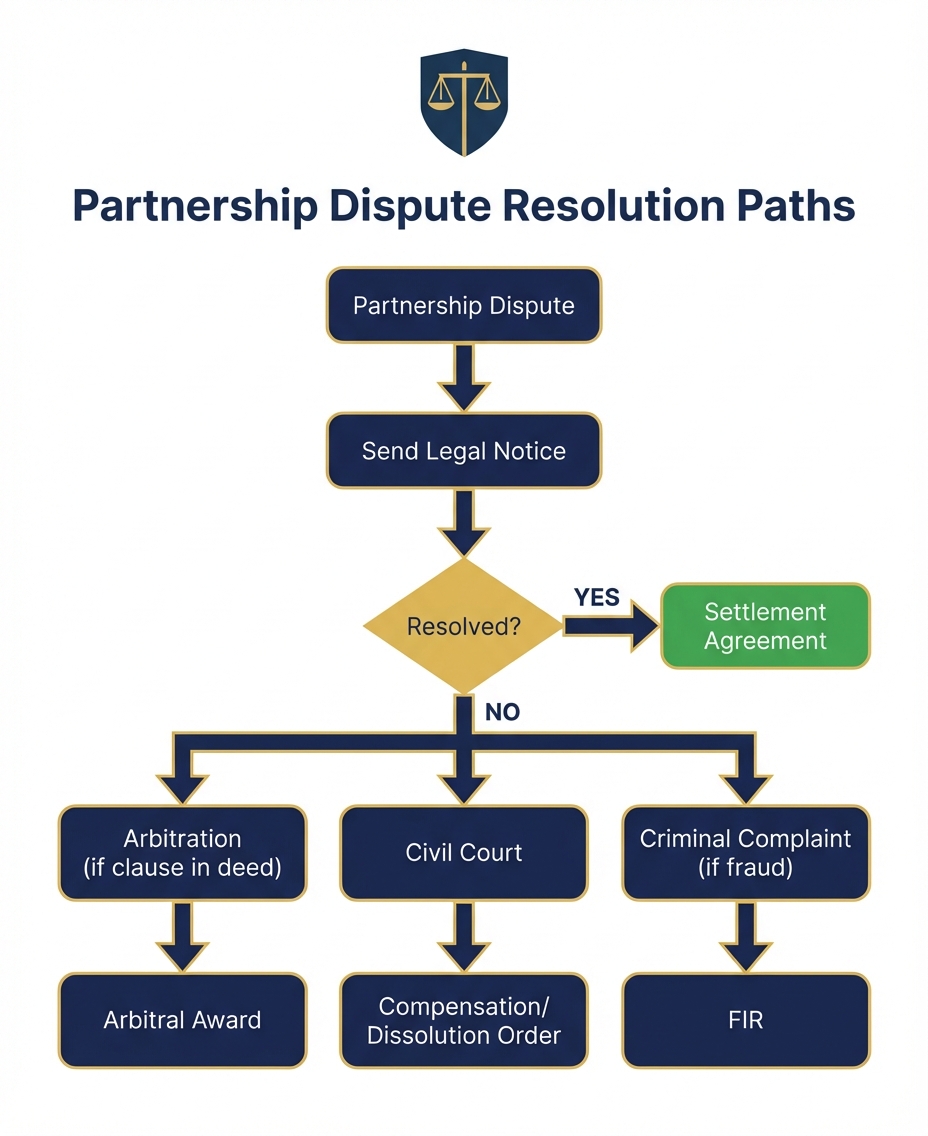
- Suit for accounts: A partner can file a suit demanding that the other partner(s) render true and proper accounts of the partnership business. This is particularly useful when financial irregularities are suspected.
- Suit for dissolution: Under Section 44 of the Indian Partnership Act, a partner can approach the court to dissolve the firm on the grounds specified in the Act.
- Injunction: A partner can seek an interim or permanent injunction from the court to prevent another partner from taking actions that are harmful to the firm — such as disposing of assets, withdrawing funds, or entering into unauthorized contracts.
- Damages for breach: Under Section 73 of the Indian Contract Act, a partner who has suffered loss due to another partner's breach of the partnership deed can claim compensation by way of damages.
- Arbitration: If the partnership deed contains an arbitration clause, the aggrieved partner can invoke arbitration under the Arbitration and Conciliation Act, 1996 for a binding resolution.
- Criminal complaint: In cases involving fraud, embezzlement, forgery, or criminal breach of trust, the aggrieved partner can file a criminal complaint under the relevant provisions of the Bharatiya Nyaya Sanhita (BNS) (previously IPC), including Sections 316 (criminal breach of trust) and 318 (cheating).
- Mediation: Parties may voluntarily opt for mediation as an alternative dispute resolution method, which can be faster and less adversarial than litigation.
Tips for Preventing Partnership Disputes
Prevention is always better than cure, especially in business relationships. The following best practices can significantly reduce the risk of partnership disputes:
- Draft a comprehensive partnership deed: A detailed, well-drafted partnership deed is the single most important safeguard against disputes. It should clearly define each partner's roles, responsibilities, capital contributions, profit-sharing ratios, decision-making authority, and exit mechanisms.
- Include a dispute resolution clause: Your partnership deed should specify a clear mechanism for resolving disputes — whether through mediation, arbitration, or a designated forum. This prevents ambiguity and delays when a dispute arises.
- Maintain transparent financial records: Ensure that all financial transactions are properly recorded, audited regularly, and accessible to all partners. Use professional accounting software and engage a qualified chartered accountant.
- Hold regular partner meetings: Schedule periodic meetings to discuss the firm's performance, financial position, strategic decisions, and any concerns. Document the minutes of these meetings.
- Define authority limits clearly: Specify in the deed the monetary and operational limits within which each partner can act independently, and the matters that require unanimous or majority consent.
- Plan for exits and dissolution: Include clear provisions for the retirement, expulsion, or death of a partner, as well as the valuation methodology for buyouts and the dissolution process.
- Register your partnership firm: While registration is not mandatory under the Indian Partnership Act, a registered firm enjoys certain legal advantages — including the right to file suits against third parties and other partners (Section 69).
- Seek legal advice proactively: Consult a business lawyer when forming the partnership, making significant changes, or at the first sign of a disagreement. Early intervention can prevent minor issues from escalating into full-blown disputes.
Section 69 — Unregistered Firms Cannot Sue
Under Section 69 of the Indian Partnership Act, 1932, an unregistered partnership firm cannot file a suit against any third party or against any partner in a court of law. This means that if your firm is not registered, you will first need to get it registered before you can enforce any rights through civil litigation. This is a critical consideration for partners contemplating legal action.
How OpenVakil Helps with Partnership Dispute Notices
Drafting a legal notice for a partnership dispute requires a clear understanding of partnership law, precise legal language, and attention to procedural requirements. Many business owners and partners struggle to articulate their grievances in a legally effective manner, leading to notices that are either too vague to be actionable or so aggressive that they foreclose the possibility of amicable resolution. OpenVakil bridges this gap.
With OpenVakil's AI-powered legal notice platform, you can generate a professionally drafted partnership dispute notice in minutes. Simply provide the details of your partnership, the nature of the dispute, and the relief you seek — and our platform will produce a comprehensive, legally sound notice tailored to your situation.
- Legally accurate: Every notice is drafted in accordance with the Indian Partnership Act, 1932, the LLP Act, 2008, and relevant provisions of the Indian Contract Act, ensuring full legal compliance.
- Customized to your dispute: Whether your dispute involves breach of the partnership deed, financial irregularities, unauthorized actions, or dissolution, our platform generates a notice tailored to your specific situation.
- Fast and affordable: Generate your legal notice in minutes at a fraction of the cost of hiring a lawyer for drafting alone.
- Professionally formatted: Every notice follows standard legal formatting conventions and includes all essential elements required for enforceability.
- Ready to send: Download your completed notice as a PDF, ready to be dispatched via Registered Post with Acknowledgement Due.
Whether you are a partner seeking to enforce the terms of your partnership deed, demanding an accounting of the firm's finances, or initiating the dissolution process, OpenVakil gives you the legal tools to take decisive, informed action — quickly and affordably.
Draft Your Partnership Dispute Notice Today
Stop letting partnership disputes drain your business. Use OpenVakil to create a professionally drafted, legally compliant legal notice in minutes. Protect your rights and take the first step toward resolution.
Get Started for Free