Contracts form the bedrock of virtually every business and personal transaction in India — from employment agreements and vendor contracts to real estate deals and freelance engagements. When one party fails to honour its contractual obligations, the consequences can be financially devastating and legally complex. A legal notice for breach of contract is the critical first step toward enforcing your rights, recovering losses, and compelling the defaulting party to either perform its obligations or compensate you for the breach.
This comprehensive guide explains everything you need to know about breach of contract under Indian law, including the types of breach, the relevant provisions of the Indian Contract Act, 1872, the remedies available to the aggrieved party, the step-by-step process for sending a legal notice, and the strategic considerations that can make the difference between a swift resolution and years of litigation.
What Is a Breach of Contract?
A breach of contract occurs when one party to a valid, legally binding contract fails to fulfil its obligations as specified in the agreement — either wholly or in part — without any lawful excuse. Under Indian law, a contract is defined by Section 2(h) of the Indian Contract Act, 1872 as "an agreement enforceable by law." When a party violates any term of such an enforceable agreement, it constitutes a breach that gives the aggrieved party the right to seek legal remedies.
A breach can take many forms: a party may refuse to perform its obligations entirely, perform them partially or defectively, perform them late, or make it impossible for the other party to perform its obligations. The breach may be deliberate (wilful default) or unintentional (failure due to negligence or changed circumstances). Regardless of the cause, the Indian Contract Act provides robust remedies to the injured party, including compensation, specific performance, and injunctive relief.
Essential Elements of a Valid Contract
Before alleging a breach, ensure that a valid contract exists. Under the Indian Contract Act, a valid contract requires: (1) an offer and acceptance (Sections 3-9), (2) lawful consideration (Section 23), (3) capacity to contract (Section 11), (4) free consent (Sections 13-22), (5) a lawful object (Section 23), and (6) the agreement must not be expressly declared void (Sections 24-30). A breach of contract claim will fail if the underlying agreement does not meet these requirements.
All agreements are contracts if they are made by the free consent of parties competent to contract, for a lawful consideration and with a lawful object, and are not hereby expressly declared to be void.
— Section 10, Indian Contract Act, 1872
Types of Breach of Contract
Indian contract law recognises several distinct types of breach, each with its own legal implications and remedies. Understanding the type of breach you are dealing with is essential for drafting an effective legal notice and choosing the right legal strategy.
Actual Breach of Contract
An actual breach occurs when a party fails to perform its obligations on the date when performance is due, or performs them defectively. This is the most common form of breach and can occur in two ways:
- Breach at the time of performance: The promisor fails to perform the contract on the agreed date. For example, a vendor fails to deliver goods by the contractual delivery date, or a service provider fails to complete the project by the agreed deadline.
- Breach during the course of performance: The promisor begins performing but fails to complete performance, or performs in a manner that is inconsistent with the terms of the contract. For instance, a contractor uses substandard materials instead of the specified grade, or a software developer delivers a product that does not meet the agreed specifications.
In both cases, the aggrieved party acquires the right to claim compensation under Section 73 of the Indian Contract Act from the date the breach occurs.
Anticipatory Breach of Contract
An anticipatory breach (also called anticipatory repudiation) occurs when a party to a contract declares, before the date of performance, that it will not perform its obligations, or renders itself unable to do so through its own actions. This concept is recognised under Section 39 of the Indian Contract Act, 1872, which states:
When a party to a contract has refused to perform, or disabled himself from performing, his promise in its entirety, the promisee may put an end to the contract, unless he has signified, by words or conduct, his acquiescence in its continuance.
— Section 39, Indian Contract Act, 1872
When an anticipatory breach occurs, the aggrieved party has two options: (1) treat the contract as terminated immediately and sue for damages without waiting for the performance date, or (2) keep the contract alive and wait for the performance date, after which the aggrieved party can sue if the promisor indeed fails to perform. The right to claim compensation for anticipatory breach is confirmed by Section 75 of the Act.
Risks of Waiting After Anticipatory Breach
If the aggrieved party elects to keep the contract alive after an anticipatory breach, they assume the risk that the contract may become impossible to perform due to supervening events (such as frustration under Section 56). In such a case, the aggrieved party may lose the right to claim damages. The landmark case of Frost v. Knight (1872) established this principle, which has been adopted by Indian courts. Therefore, it is often strategically advisable to act promptly upon an anticipatory breach rather than wait.
Material Breach vs. Minor Breach
While the Indian Contract Act does not explicitly use the terms "material" and "minor" breach, Indian courts have recognised this distinction in interpreting contractual disputes:
- Material breach (fundamental breach): A breach that goes to the root of the contract and substantially deprives the aggrieved party of the benefit it was entitled to receive. A material breach entitles the innocent party to terminate the contract and claim full damages. For example, a landlord's failure to provide possession of the leased property is a material breach of the lease agreement.
- Minor breach (partial breach): A breach that does not go to the root of the contract and does not substantially deprive the aggrieved party of the expected benefit. In the case of a minor breach, the contract remains in force, but the aggrieved party can claim damages for the specific loss caused by the breach. For example, a slight delay in delivery (where time is not of the essence) may constitute a minor breach.
The distinction between material and minor breach is critical because it determines whether the aggrieved party can rescind (terminate) the contract or is limited to claiming damages while keeping the contract alive. Courts examine the nature and extent of the breach, the terms of the contract, and the consequences of the breach to make this determination.
Dealing with a Breach of Contract?
Draft a professionally worded legal notice for breach of contract in minutes using OpenVakil's AI-powered platform. Ensure your notice is legally compliant with the Indian Contract Act, 1872.
Draft Your Legal NoticeIndian Contract Act 1872: Key Provisions
The Indian Contract Act, 1872 is the primary statute governing contractual obligations and remedies for breach in India. While the entire Act is relevant to contract law, three sections are particularly important in the context of breach of contract and the assessment of compensation:
Section 73: Compensation for Breach
Section 73 is the cornerstone provision for claiming compensation upon breach of contract. It states that when a contract has been broken, the party who suffers by such breach is entitled to receive compensation for any loss or damage caused to him thereby, which naturally arose in the usual course of things from such breach, or which the parties knew, when they made the contract, to be likely to result from the breach of it.
Key principles under Section 73 include:
- Direct and natural losses: Compensation covers losses that flow naturally and directly from the breach (similar to the first limb of the rule in Hadley v. Baxendale).
- Foreseeable losses: Compensation also covers losses that were within the contemplation of both parties at the time of entering the contract as the probable result of a breach (similar to the second limb of Hadley v. Baxendale).
- Remote and indirect losses are excluded: The aggrieved party cannot claim compensation for losses that are too remote or were not foreseeable at the time of contracting.
- Duty to mitigate: The aggrieved party is under an obligation to take reasonable steps to minimise the loss arising from the breach. Failure to mitigate may reduce the quantum of compensation.
When a contract has been broken, the party who suffers by such breach is entitled to receive, as compensation for any loss or damage caused to him thereby, such compensation as would naturally arise in the usual course of things from such breach, or which the parties knew, when they made the contract, to be likely to result from the breach of it.
— Section 73, Indian Contract Act, 1872
Section 74: Liquidated Damages and Penalty
Section 74 addresses situations where the contract itself specifies a sum to be paid in the event of a breach (commonly known as a liquidated damages clause or penalty clause). Unlike English law, which distinguishes sharply between liquidated damages and penalties, Indian law under Section 74 adopts a unified approach: whether the sum named in the contract is by way of penalty or liquidated damages, the court will award only reasonable compensation not exceeding the amount so named.
The Supreme Court of India, in the landmark judgment of Maula Bux v. Union of India (1970), clarified that under Section 74, the party complaining of breach is entitled to receive reasonable compensation whether or not actual damage or loss is proved. However, the compensation awarded must be reasonable and cannot exceed the amount specified in the contract. This means that even if a contract specifies a penalty of Rs. 10 lakhs, the court may award a lesser sum if it considers the actual loss to be lower.
Drafting Liquidated Damages Clauses
When drafting a contract, ensure that any liquidated damages clause reflects a genuine pre-estimate of the loss likely to result from a breach. While Indian courts are not strictly bound by the distinction between penalties and liquidated damages (unlike English courts), a clause that is grossly disproportionate to the foreseeable loss may be reduced by the court to a "reasonable" amount under Section 74. A well-calibrated clause strengthens your bargaining position and makes enforcement more predictable.
Section 75: Compensation for Anticipatory Breach
Section 75 provides that a person who rightfully rescinds a contract is entitled to compensation for any damage which he has sustained through the non-fulfilment of the contract. This section works in conjunction with Section 39 (which deals with anticipatory breach) and confirms that the aggrieved party can claim compensation even when the contract is terminated before the performance date arrives.
Section 75 is particularly important in commercial contracts where one party's anticipatory repudiation can cause the other party to incur costs in securing alternative arrangements. For example, if a supplier informs the buyer three months before the delivery date that it will not supply the agreed goods, the buyer can immediately rescind the contract and claim compensation for the additional cost of procuring the goods from an alternative supplier.
When Should You Send a Legal Notice?
A legal notice for breach of contract is a formal written communication sent by the aggrieved party (or their advocate) to the defaulting party, demanding that the breach be rectified or that compensation be paid. While sending a legal notice is not always a statutory prerequisite for filing a civil suit, it is an essential strategic and procedural step for several reasons:
- Creates a formal record: The notice establishes a documented record of the breach, the aggrieved party's grievance, and the demand for redress. This serves as critical evidence in subsequent legal proceedings.
- Demonstrates bona fide intent: Courts look favourably upon parties who have attempted to resolve disputes through pre-litigation communication. Sending a legal notice demonstrates that you acted in good faith and gave the other party a fair opportunity to remedy the breach.
- Triggers the statutory limitation clock: In certain cases, the legal notice can serve as a reference point for computing the limitation period under the Limitation Act, 1963.
- Facilitates out-of-court settlement: Many breach of contract disputes are resolved after the legal notice is received, as the defaulting party recognises the seriousness of the situation and prefers to settle rather than face litigation.
- Strengthens your legal position: A well-drafted legal notice outlines the legal basis for your claim and the remedies you intend to pursue, putting the defaulting party on notice and limiting their ability to feign ignorance or raise procedural defences.
You should consider sending a legal notice in the following scenarios:
- The other party has failed to deliver goods or services as per the contract terms.
- The other party has failed to make payment despite the payment terms being clearly specified.
- The other party has delivered defective goods or substandard services that do not conform to contractual specifications.
- The other party has announced or indicated its intention not to perform (anticipatory breach).
- The other party has violated a non-compete, confidentiality, or exclusivity clause in the contract.
- The contract has been terminated or repudiated unilaterally without lawful justification.
- You have suffered quantifiable financial loss as a direct result of the other party's breach.
Do Not Delay — Time Is of the Essence
Under the Limitation Act, 1963, the limitation period for filing a suit for breach of contract is 3 years from the date the breach occurs (or from the date the aggrieved party becomes aware of it). Delaying the legal notice can weaken your claim, allow evidence to be destroyed or lost, and may ultimately bar your suit if the limitation period expires. Act promptly once you identify a breach.
Essential Elements of a Breach of Contract Notice
A legally effective breach of contract notice must be comprehensive, precise, and professionally drafted. The following are the essential components that every notice should include:
- Full names and addresses: The complete name and address of the sender (aggrieved party) and the recipient (defaulting party). If the defaulting party is a company, include the registered office address and the name of the authorised representative.
- Subject line and reference: A clear subject line indicating that it is a legal notice for breach of contract, along with reference to the contract number, date, and any other identifying details.
- Details of the contract: A summary of the relevant contract — the date of execution, the parties involved, the key terms and obligations, the consideration, and the duration of the contract.
- Description of the breach: A factual, detailed, and chronological account of the breach — what obligation was breached, when the breach occurred, how it was discovered, and any prior communications or warnings about the breach.
- Supporting evidence: References to documentary evidence supporting the claim, such as copies of the contract, correspondence, invoices, delivery receipts, bank statements, or third-party reports.
- Legal basis: Specific references to the provisions of the Indian Contract Act, 1872 (particularly Sections 73, 74, or 75) and any specific contractual clauses that have been violated.
- Quantification of loss: A clear statement of the financial loss or damage suffered as a result of the breach, with a breakdown of how the loss has been calculated.
- Specific demand: A precise statement of what you require the defaulting party to do — whether it is to perform the contract, pay compensation, cure the breach, or agree to a specific resolution.
- Time limit for response: A reasonable time period (typically 15 to 30 days from receipt) within which the defaulting party must respond or comply with the demand.
- Consequences of non-compliance: A statement that civil and/or criminal proceedings will be initiated if the demand is not met within the stipulated period, and that all costs of litigation will be borne by the defaulting party.
- Date, place, and signature: The notice must be dated, signed by the sender or their advocate, and include the place from which it is being dispatched.
Keep the Tone Professional and Factual
A legal notice should be firm but restrained. Avoid using threatening, abusive, or emotional language. Courts and opposing parties take professionally drafted notices more seriously. The notice should stick to facts, legal provisions, and a clear statement of demand. An aggressive or poorly drafted notice can undermine your credibility and may even expose you to counter-claims of defamation or harassment.
Step-by-Step Process to Send the Notice
Sending a legal notice for breach of contract is a structured process that must be followed carefully to ensure the notice is legally valid and strategically effective. Here is the step-by-step process:
- Review the contract thoroughly: Read the entire contract, paying close attention to the specific clauses that have been breached, the dispute resolution mechanism (arbitration clause, jurisdiction clause, governing law), notice requirements specified in the contract (some contracts require notices to be sent to a specific address or in a specific manner), and any force majeure or limitation of liability clauses that the other party might invoke.
- Gather and organise evidence: Collect all documentary evidence of the breach, including the signed contract, all correspondence (emails, messages, letters), invoices, delivery challans, payment records, photographs, third-party reports, and any other relevant documents. Organise them chronologically for easy reference.
- Calculate your losses: Prepare a detailed calculation of the financial losses you have suffered as a result of the breach. Include direct losses, consequential losses (if foreseeable), and the cost of mitigation. Be prepared to substantiate every claim with documentary evidence.
- Draft the legal notice: Prepare a comprehensive notice incorporating all the essential elements described in the previous section. Ensure the notice is factually accurate, legally sound, and clearly states your demand and the consequences of non-compliance.
- Engage a lawyer for review (recommended): While you can draft and send a legal notice yourself, having a qualified advocate review it ensures legal accuracy and strategic effectiveness. A lawyer's letterhead also conveys seriousness and professionalism.
- Send via Registered Post with Acknowledgement Due (RPAD): Dispatch the notice via India Post's Registered Post with Acknowledgement Due service. This provides proof of dispatch (postal receipt) and proof of delivery (the signed acknowledgement card returned to you). Keep both safely — they are admissible as evidence in court.
- Send via additional channels (optional but recommended): Simultaneously send a copy of the notice via email (to the recipient's official email address) and/or via a reputed courier service with tracking. This creates multiple proof points and eliminates any defence of non-receipt.
- Retain a copy of the notice: Keep a signed copy of the notice, along with all postal receipts, courier tracking details, and email delivery confirmations in a safe place. These documents will be essential if the matter proceeds to litigation.
- Wait for the response period: Allow the recipient the full period specified in the notice (usually 15–30 days) to respond. Be prepared for any of the following outcomes: full compliance, partial compliance, a counter-notice or reply, a request for negotiation, or complete silence.
- Evaluate and decide on next steps: Based on the recipient's response (or lack thereof), consult with your lawyer and decide whether to proceed with filing a civil suit, initiating arbitration, pursuing mediation, or accepting a settlement offer.
Remedies Available for Breach of Contract
Indian law provides a comprehensive range of remedies for breach of contract, designed to restore the aggrieved party to the position they would have been in had the contract been performed. The choice of remedy depends on the nature of the contract, the type and severity of the breach, and the specific loss suffered.
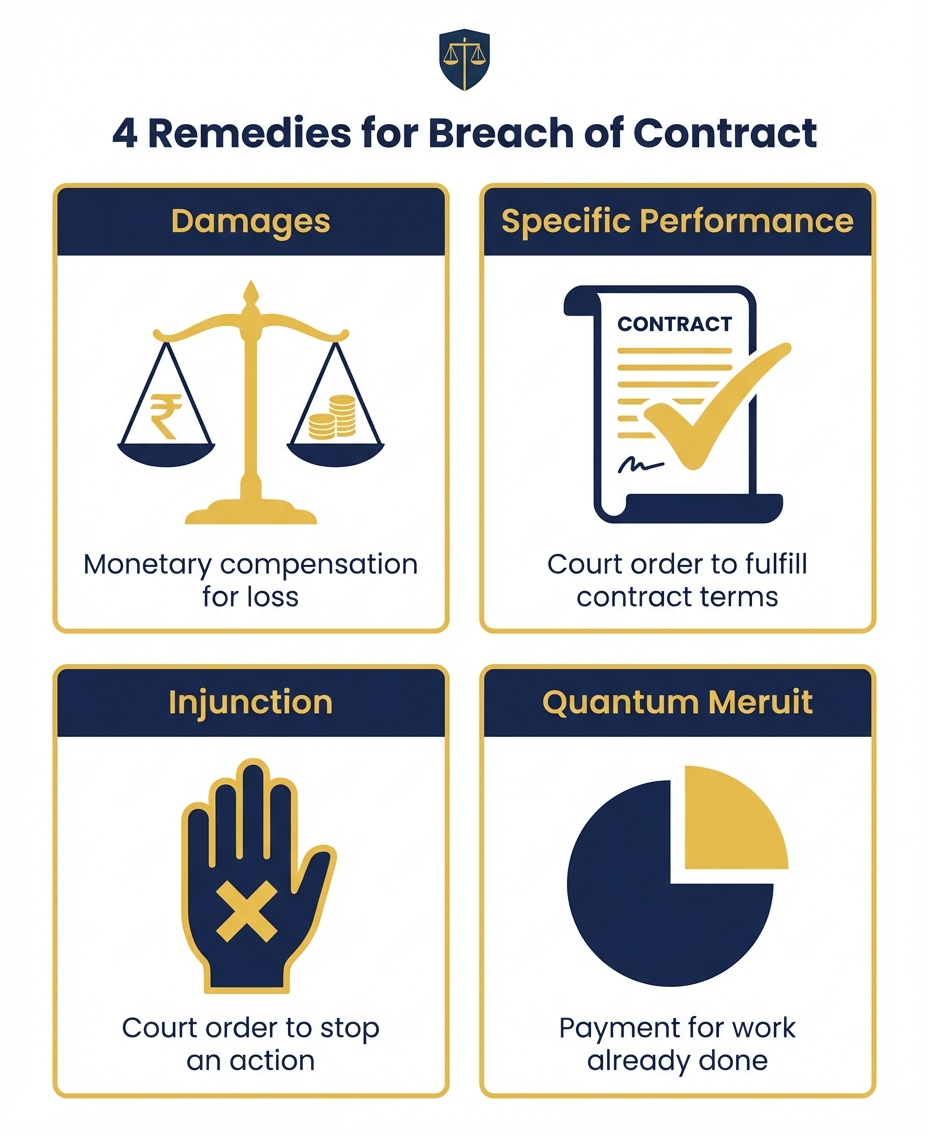
Damages (Monetary Compensation)
Damages are the most common remedy for breach of contract. The objective is to place the aggrieved party in the position they would have occupied had the contract been performed. Indian law recognises several categories of damages:
- Ordinary (general) damages: These compensate for the direct and natural consequences of the breach, calculated under Section 73 of the Indian Contract Act. For example, the difference between the contract price and the market price of goods that were not delivered.
- Special damages: These compensate for losses arising from special or unusual circumstances that were within the knowledge of both parties at the time of contracting. For example, loss of a specific sub-contract that the buyer intended to fulfil using the undelivered goods, provided the seller was aware of this arrangement.
- Liquidated damages: Where the contract specifies a sum payable upon breach (under Section 74), the court may award this amount or a lesser sum that it considers reasonable compensation.
- Nominal damages: Where a breach is proved but no actual loss is suffered, the court may award a token amount to acknowledge the breach of the aggrieved party's legal right.
- Exemplary (punitive) damages: Indian courts rarely award exemplary damages for breach of contract. However, in cases involving breach of a promise to marry or wrongful dishonour of a cheque by a banker, courts have occasionally awarded damages beyond mere compensation.
Specific Performance
Specific performance is an equitable remedy under the Specific Relief Act, 1963 (as amended in 2018), whereby the court directs the defaulting party to actually perform its contractual obligations. After the 2018 amendment, specific performance has become the default remedy rather than a discretionary one — the court must grant specific performance unless it falls within the specified exceptions.
Specific performance is particularly relevant in contracts involving unique or irreplaceable subject matter, such as the sale of immovable property or a specific piece of art. It is generally not granted for contracts of personal service, contracts that are determinable in nature, or contracts where performance involves continuous supervision by the court.
2018 Amendment to the Specific Relief Act
The Specific Relief (Amendment) Act, 2018 brought a paradigm shift. Prior to 2018, specific performance was a discretionary remedy and courts could refuse it if monetary damages were deemed adequate. After the amendment, Section 10 of the Act now mandates that specific performance shall be granted as a matter of course, and the court may refuse it only on specific grounds enumerated in Sections 11(2), 14, and 16. This amendment significantly strengthens the position of aggrieved parties in breach of contract cases.
Injunction
An injunction is a court order that restrains a party from doing a specific act (prohibitory injunction) or compels a party to do a specific act (mandatory injunction). In the context of breach of contract, injunctions are commonly sought to:
- Enforce non-compete clauses: Prevent a former employee or business partner from engaging in competing activities in violation of a contractual restraint.
- Protect confidential information: Restrain a party from disclosing or using trade secrets, proprietary information, or confidential data in breach of a confidentiality agreement.
- Prevent disposal of assets: Prevent the defaulting party from transferring, selling, or dissipating assets that may be needed to satisfy a future damages award.
- Maintain status quo: Preserve the existing state of affairs pending the resolution of the dispute, especially in ongoing contractual relationships.
Injunctions are governed by Sections 36-42 of the Specific Relief Act, 1963 and Order XXXIX of the Code of Civil Procedure, 1908. To obtain an interim injunction, the applicant must demonstrate: (1) a prima facie case, (2) the balance of convenience lies in their favour, and (3) irreparable injury would result if the injunction is not granted.
Quantum Meruit
Quantum meruit (Latin for "as much as is deserved") is a claim for reasonable compensation for work done or services rendered before the contract was breached or terminated. This remedy is applicable when:
- A party has partially performed its obligations before the other party breaches or repudiates the contract.
- The contract is found to be void or unenforceable, but one party has already performed work or provided services under it.
- Work has been done at the request of another party without a fixed price being agreed upon.
For example, if a contractor has completed 60% of a construction project before the property owner wrongfully terminates the contract, the contractor can claim quantum meruit for the reasonable value of the work already completed. This principle is recognised under Section 70 of the Indian Contract Act, which states that where a person lawfully does anything for another person, or delivers anything to him, the latter is bound to make compensation to the former in respect of, or to restore, the thing so done or delivered.
Limitation Period for Breach of Contract
The Limitation Act, 1963 prescribes strict time limits within which legal proceedings must be initiated. For breach of contract claims, the relevant limitation periods are as follows:
- Suit for compensation for breach of contract (Article 55): 3 years from the date when the contract is broken, or (where there are successive breaches) from the date of the breach in respect of which the suit is instituted.
- Suit for specific performance of a contract (Article 54): 3 years from the date fixed for performance, or if no date is fixed, from the date when the plaintiff has notice that performance is refused.
- Suit on a registered instrument (Article 68): 6 years from the date when the right to sue accrues, applicable when the contract is in the form of a registered document.
- Suit for an account in respect of partnership (Article 10): 3 years from the date of dissolution or the date when the plaintiff's right to an account is denied.
The 3-Year Limitation Period Is Strictly Enforced
Indian courts strictly enforce the limitation period. Under Section 3 of the Limitation Act, 1963, every suit filed after the prescribed period of limitation shall be dismissed, regardless of the merits of the claim. The court is required to dismiss such suits even if the defendant does not raise the plea of limitation. There are limited grounds for condonation of delay (Section 5), and these apply only in exceptional circumstances. Therefore, it is critical to send your legal notice and initiate proceedings well within the limitation period.
Every suit instituted, appeal preferred, and application made after the prescribed period of limitation shall be dismissed, although limitation has not been set up as a defence.
— Section 3, Limitation Act, 1963
What Happens After Sending the Notice?
Once the legal notice has been dispatched, several outcomes are possible. Understanding these possibilities helps you prepare for each scenario and respond effectively:
- Full compliance by the defaulting party: The recipient acknowledges the breach and fully complies with the demand stated in the notice — whether by performing the contractual obligation, paying the claimed compensation, or curing the defect. This is the best-case scenario and resolves the matter without litigation.
- Partial compliance or settlement offer: The recipient may offer to settle the dispute by partially complying with the demand, proposing a reduced payment, or suggesting alternative terms. You should carefully evaluate such offers with your lawyer, weighing the cost and uncertainty of litigation against the certainty of a negotiated settlement.
- Reply notice (counter-notice): The recipient may respond with their own legal notice, denying the breach, raising defences (such as force majeure, frustration, or contributory fault), or making counter-claims. This often leads to a phase of negotiation between the parties' lawyers.
- Request for negotiation or mediation: The recipient may propose an amicable resolution through direct negotiation or third-party mediation. Mediation can be a cost-effective and time-efficient alternative to litigation.
- Complete silence (no response): If the recipient fails to respond within the stipulated period, this is treated as non-compliance with the demand. You can then proceed to file a civil suit, initiate arbitration (if applicable), or pursue any other legal remedy. The recipient's silence can be used as evidence of their unwillingness to resolve the matter amicably.
- Filing of a civil suit: If the notice does not achieve the desired result, the aggrieved party can file a civil suit for damages, specific performance, or injunctive relief in the appropriate civil court, based on the pecuniary and territorial jurisdiction. The legal notice and proof of service will form part of the plaint (statement of claim).
Keep Records of All Post-Notice Communications
After sending the legal notice, meticulously document all subsequent communications with the defaulting party — including phone calls (maintain a written log), emails, letters, and meeting notes. These records can serve as valuable evidence in litigation and may demonstrate the other party's willingness (or unwillingness) to resolve the dispute in good faith.
Common Types of Contract Disputes
Breach of contract disputes arise across virtually every industry and type of contractual relationship. The following are the most commonly encountered types of contract disputes in India:
- Service agreements: Disputes over the quality, scope, timeliness, or pricing of services rendered by consultants, agencies, IT service providers, or other service professionals. Common issues include failure to meet deliverables, scope creep without agreed compensation, and premature termination.
- Employment contracts: Disputes between employers and employees over terms of employment, including wrongful termination, non-payment of salary or benefits, breach of non-compete or non-solicitation clauses, and violation of confidentiality obligations. Employment contracts are also governed by labour-specific legislation.
- Vendor and supply agreements: Disputes between buyers and suppliers over delivery schedules, product quality, pricing, payment terms, and minimum order quantities. These are particularly common in manufacturing, retail, and e-commerce sectors.
- Real estate and construction contracts: Disputes over possession, delivery timelines, specifications, quality of construction, and payment milestones. These are among the most litigated contract disputes in India, often involving large sums and extended timelines.
- Freelancer and independent contractor agreements: Disputes between businesses and freelancers or independent contractors over scope of work, payment, intellectual property ownership, and confidentiality. The gig economy has led to a significant increase in these disputes.
- Franchise and distribution agreements: Disputes between franchisors and franchisees, or between distributors and manufacturers, over territorial rights, performance targets, pricing, royalty payments, and termination clauses.
- Joint venture and collaboration agreements: Disputes arising from joint ventures or strategic collaborations, including disagreements over management control, profit-sharing, exit mechanisms, and intellectual property rights.
- Loan and financial agreements: Disputes over repayment schedules, interest rates, default clauses, and security enforcement in lending and financing transactions.
Common Mistakes to Avoid
Many breach of contract claims fail or are weakened not because of the merits of the case, but because of avoidable mistakes made during the notice stage or the litigation process. Be aware of the following common pitfalls:
- Sending a vague or incomplete notice: A notice that fails to clearly describe the breach, specify the demand, or cite the relevant legal provisions is unlikely to be taken seriously and may even weaken your position in court. Every notice must be specific and comprehensive.
- Delaying the notice beyond the limitation period: As discussed, the Limitation Act prescribes strict deadlines. Sending a notice after the limitation period has expired renders your claim unenforceable, regardless of its merits.
- Failing to preserve evidence: Contracts, correspondence, invoices, and other documents may be lost, destroyed, or altered over time. Always preserve original documents and create digital backups immediately upon discovering a breach.
- Not sending the notice via RPAD: Sending the notice only by email or ordinary post, without Registered Post with Acknowledgement Due, makes it difficult to prove that the notice was actually delivered. Always use RPAD as the primary dispatch method.
- Using aggressive or defamatory language: A notice that contains threats, abusive language, or defamatory statements can expose you to counter-claims and undermine your credibility. Maintain a professional, factual, and legally precise tone throughout.
- Ignoring contractual dispute resolution clauses: Many commercial contracts contain arbitration or mediation clauses that require the parties to attempt alternative dispute resolution before approaching a court. Ignoring such clauses can result in your court case being stayed under Section 8 of the Arbitration and Conciliation Act, 1996.
- Failing to quantify damages: A notice that does not clearly state the quantum of loss suffered makes it easier for the defaulting party to dispute or minimise your claim. Always include a specific, well-calculated figure with a supporting breakdown.
- Not consulting a lawyer: While not legally mandatory, failing to consult a lawyer can result in technical errors, missed legal arguments, or strategic missteps that could have been easily avoided with professional guidance.
- Sending the notice to the wrong address or entity: Ensure the notice is addressed to the correct legal entity (not just an individual who signed on behalf of a company) and is sent to the contractually specified address for notices, or the registered office address if the defaulting party is a company.
- Neglecting the duty to mitigate: Under Section 73, the aggrieved party must take reasonable steps to minimise losses. Failing to mitigate can reduce the compensation awarded by the court. Document all mitigation efforts.
Protect Your Contractual Rights Today
Don't let a breach of contract go unchallenged. Use OpenVakil's AI-powered platform to draft a legally sound, comprehensive breach of contract notice in minutes — saving you time, money, and the risk of avoidable mistakes.
Create Your Notice NowHow OpenVakil Helps
Navigating a breach of contract dispute can be overwhelming — especially when you need to understand the legal framework, gather evidence, calculate damages, and draft a legally compliant notice, all while managing the commercial and emotional stress of a broken agreement. OpenVakil simplifies this entire process.
OpenVakil's AI-powered legal notice platform is specifically designed to help individuals and businesses draft professional, legally accurate breach of contract notices in a matter of minutes. Here is how OpenVakil can help you:
- Legally compliant notices: Every notice generated by OpenVakil is drafted in accordance with the Indian Contract Act, 1872, the Specific Relief Act, 1963, and other applicable Indian laws. The platform ensures that all essential legal elements are included and correctly cited.
- Tailored to your specific situation: Whether your dispute involves a service agreement, employment contract, vendor dispute, real estate transaction, or freelance engagement, OpenVakil generates a notice that is customised to the specific facts and circumstances of your case.
- Proper legal language and formatting: Our platform uses precise legal terminology and standard formatting conventions, ensuring your notice is taken seriously by the recipient and is admissible as evidence in court.
- Fast and cost-effective: Generate a comprehensive breach of contract notice in minutes, at a fraction of the cost of engaging a lawyer for the same task. This is particularly valuable for small businesses, startups, and individuals who need affordable access to quality legal resources.
- Guidance on next steps: Beyond the notice itself, OpenVakil provides guidance on how to dispatch the notice, what to expect after sending it, and the legal options available to you if the recipient does not comply.
- Secure and confidential: All information you provide is handled with strict confidentiality and secured using industry-standard encryption protocols.
Whether you are a business owner dealing with a defaulting vendor, an employee whose employer has breached the terms of employment, a freelancer chasing unpaid invoices, or a buyer who has received defective goods, OpenVakil equips you with the legal tools to take swift, decisive, and informed action. Do not let a breach of contract go unchallenged — protect your rights and recover what you are owed.