Buying a home is one of the most significant financial decisions an individual makes in their lifetime. Unfortunately, thousands of homebuyers across India find themselves trapped in projects where builders fail to deliver possession on time, breach contractual promises, or engage in unfair practices. The Real Estate (Regulation and Development) Act, 2016 — commonly known as RERA — was enacted precisely to address these issues and protect homebuyers from unscrupulous developers. If your builder has delayed possession of your flat or violated the terms of your agreement, sending a legal notice under RERA is the essential first step toward enforcing your rights.
This comprehensive guide explains everything you need to know about sending a legal notice to a builder for delayed possession under RERA — from understanding your rights and the complaint process, to the remedies available, the differences between RERA and consumer forums, and how to avoid common mistakes that weaken your case.
What Is RERA?
The Real Estate (Regulation and Development) Act, 2016 is a landmark legislation enacted by the Indian Parliament to regulate the real estate sector, protect the interests of homebuyers, and promote transparency and accountability among builders and developers. Before RERA, homebuyers had limited recourse against developers who delayed projects, diverted funds, changed project plans without consent, or made misleading promises. The Act came into full effect on 1 May 2017 and applies to both residential and commercial real estate projects across India.
RERA mandates that every real estate project (with certain exemptions for smaller projects) must be registered with the respective State RERA Authority before the developer can advertise, market, or sell any unit. The Act establishes a Real Estate Regulatory Authority in each state to oversee compliance, a Real Estate Appellate Tribunal to hear appeals, and provides for stringent penalties against developers who violate its provisions. Key sections that protect homebuyers include Section 18 (delay in handing over possession), Section 19 (rights of allottees), and Section 31 (filing of complaints).
Did You Know?
Under RERA, builders are required to deposit 70% of the funds collected from homebuyers into a separate escrow account, which can only be used for the construction and land costs of that specific project. This provision was introduced to prevent the common practice of fund diversion, where developers used money from one project to finance another, causing cascading delays.
Common Builder Complaints
Homebuyers across India face a range of grievances against builders and developers. Understanding the most common complaints helps in framing an effective legal notice and, if necessary, a formal RERA complaint.
Delayed Possession
Delayed possession is the single most prevalent complaint against builders in India. Developers routinely promise possession within a specific timeline — typically mentioned in the buyer-builder agreement — but fail to deliver on time. Delays of two to five years beyond the committed date are alarmingly common, particularly in large metropolitan projects. Under Section 18 of RERA, if a builder fails to hand over possession by the date specified in the agreement for sale, the allottee is entitled to either withdraw from the project and receive a full refund with interest, or continue in the project and receive interest for every month of delay until possession is actually handed over.
Deviation from Approved Plans
Builders sometimes alter the layout, floor plan, or specifications of a project after the sale agreement has been executed, without obtaining the consent of the allottees. This can include changes to the carpet area, relocation of amenities, reduction in open spaces, or modification of common facilities. Under RERA, a developer cannot make any changes to the sanctioned plans or the layout plan without the prior written consent of at least two-thirds of the allottees. Any deviation without such consent is a violation of the Act and gives the homebuyer grounds for a complaint.
False Promises and Misleading Advertisements
Many developers lure homebuyers with glossy brochures, model flats, and advertisements that promise world-class amenities such as swimming pools, clubhouses, landscaped gardens, gymnasiums, and sports facilities. However, the actual delivered product often falls far short of what was advertised. Under Section 12 of RERA, if a promoter makes any false or misleading statement in the advertisement or prospectus, the allottee is entitled to compensation. Additionally, Section 13 stipulates that the advertisement and prospectus issued by the promoter shall form part of the agreement for sale.
Hidden Charges and Unfair Contract Terms
A common grievance among homebuyers is the imposition of hidden charges that were not disclosed at the time of booking. These may include preferential location charges (PLC), club membership fees, infrastructure development charges, car parking fees, maintenance deposits, and electrification charges that were never part of the original quoted price. RERA requires that the builder clearly disclose all charges and costs in the agreement for sale. Unilateral clauses that allow the builder to charge extra amounts at will, or that impose disproportionate penalties on the buyer for delayed payments while offering minimal compensation for builder delays, are considered unfair contract terms and can be challenged.
Defective Construction
Even after possession is delivered, many homebuyers discover structural defects, water seepage, poor-quality fittings, cracked walls, faulty plumbing, or electrical issues. Under Section 14(3) of RERA, the developer is liable to rectify structural defects or other deficiencies in workmanship, quality, or service that are brought to their notice within five years from the date of handing over possession. The builder must rectify such defects within 30 days, failing which the allottee is entitled to receive appropriate compensation.
Facing Builder Delays or Defects?
OpenVakil helps you draft a professionally crafted legal notice to your builder under RERA. Get started in minutes with our AI-assisted platform and verified advocate review.
Draft Your RERA NoticeHomebuyer Rights Under RERA
Section 19 of RERA enumerates the rights of allottees (homebuyers) in detail. These rights form the legal foundation for any notice or complaint against a builder. Every homebuyer in India is entitled to the following rights under the Act:
- Right to obtain information: The allottee has the right to obtain information relating to the sanctioned plans, layout plans, along with specifications, and the stage-wise completion schedule of the project.
- Right to know the stage of completion: The allottee can demand to know the stage-wise time schedule of completion of the project, including the provisions for civic infrastructure like water, electricity, and sanitation.
- Right to claim possession: The allottee is entitled to claim possession of the apartment, plot, or building as the case may be, on the date of possession disclosed by the promoter.
- Right to claim refund with interest: If the promoter fails to deliver possession on time, or the project is cancelled, the allottee is entitled to a full refund of the amount paid, along with interest at the prescribed rate.
- Right to claim compensation: The allottee can claim compensation for any loss or damage caused due to any defect in the title of the land, or due to the promoter's negligence or default.
- Right to have the builder rectify defects: As discussed, structural defects or quality issues reported within five years of possession must be rectified by the builder within 30 days.
- Right to a fair agreement: The agreement for sale must be in the form prescribed under RERA, ensuring that the terms are not one-sided in favour of the builder.
Important: RERA Registration Check
Before sending a legal notice, verify that the project is registered under RERA by checking the respective State RERA Authority's website. If the project is unregistered despite being required to be registered, this itself is a serious violation under Section 3 of RERA, and the builder can face penalties of up to 10% of the estimated project cost.
When to Send a Legal Notice to a Builder
While it is not strictly mandatory to send a legal notice before filing a RERA complaint, doing so is highly advisable for several reasons. A legal notice puts the builder on formal notice, demonstrates the seriousness of your intent, creates a documented record of your demand, and often prompts the builder to engage in meaningful dialogue. You should consider sending a legal notice to your builder in the following situations:
- The builder has failed to deliver possession by the date promised in the agreement for sale.
- The builder has made significant changes to the project layout, floor plan, or specifications without your consent.
- The quality of construction is substandard, with visible defects in structure, fittings, or finishes.
- The builder is demanding additional charges that were not part of the original agreement.
- The builder has failed to provide promised amenities such as parking, clubhouse, or landscaping.
- The builder is not responding to your complaints or is providing vague timelines for resolution.
- You wish to withdraw from the project and seek a full refund with interest due to excessive delay or breach of terms.
- The builder has not registered the project under RERA despite being legally required to do so.
Key Elements of a RERA Legal Notice
A well-drafted legal notice to a builder under RERA should be precise, factual, and legally sound. The following elements are essential for an effective notice:
- Advocate's letterhead: The notice should be printed on the letterhead of the advocate, containing their name, enrolment number, address, and contact details.
- Date and place: The date of drafting and the city from which the notice is being sent.
- Builder's details: Full name of the builder/developer company, its registered office address, the name of the promoter or managing director, and the RERA registration number of the project.
- Homebuyer's details: Full name, address, and contact information of the allottee (homebuyer) on whose behalf the notice is being sent.
- Project and unit details: Name of the project, RERA registration number, the specific unit or flat number, tower and floor, carpet area, and the date of the buyer-builder agreement.
- Chronological facts: A clear narration of events — when the booking was made, the total consideration agreed upon, the amounts paid to date, the promised date of possession, and the extent of the delay or breach.
- Legal provisions relied upon: Cite specific sections of the RERA Act, particularly Section 18 (return of amount and compensation), Section 19 (rights of allottees), and Section 31 (right to file a complaint).
- Demand or relief sought: Clearly state your demand — whether it is delivery of possession within a specific timeframe, refund of the entire amount with interest, compensation for mental agony and financial loss, or any combination thereof.
- Deadline for compliance: Specify a reasonable period, typically 15 to 30 days, within which the builder must respond or comply.
- Consequences of non-compliance: State that failure to comply will result in filing a formal complaint before the RERA Authority and/or consumer forum, and that all costs and consequences will be borne by the builder.
A legal notice to a builder is not just a letter of complaint — it is a strategic document that establishes your timeline, demonstrates your awareness of your legal rights, and lays the foundation for any proceedings before the RERA Authority or Appellate Tribunal.
— Real Estate Law Practice, Indian Bar Council
Step-by-Step Process
Follow these steps to effectively send a legal notice to your builder under RERA and prepare for a formal complaint if the builder fails to respond:
- Gather all documents: Collect your buyer-builder agreement, allotment letter, payment receipts, bank loan documents, correspondence with the builder (emails, letters, WhatsApp messages), brochures, advertisements, and any other relevant records.
- Verify the RERA registration: Check the respective State RERA Authority's website to confirm that the project is registered and note the RERA registration number. Also check the project status and any orders passed by the Authority.
- Calculate the delay and damages: Determine the exact period of delay from the agreed possession date. Calculate the interest payable under RERA (typically the State Bank of India's highest marginal cost of lending rate plus 2%), the EMIs paid during the delay period, rent for alternative accommodation, and any other consequential losses.
- Consult a qualified advocate: Engage an advocate experienced in RERA matters to draft the legal notice. A professionally drafted notice carries significantly more weight and ensures that all relevant legal provisions are correctly cited.
- Draft the legal notice: The notice should contain all the essential elements listed above. Ensure the tone is firm but professional, and that every claim is supported by facts and documents.
- Send via Registered Post with AD: Dispatch the notice through Registered Post with Acknowledgement Due to the builder's registered office address. Simultaneously send a copy via email to the builder's official email address and, if available, via speed post to the project site office.
- Retain copies and proof of dispatch: Keep at least three copies of the notice — one for your records, one for the RERA Authority (if you need to file a complaint), and one for the consumer forum. Retain the postal receipt, tracking number, and acknowledgement card.
- Wait for the response: Allow the builder 15 to 30 days to respond. If the builder responds with a willingness to resolve the issue, negotiate in good faith. If there is no response or the response is unsatisfactory, proceed with filing a formal RERA complaint.
Pro Tip: Send to Multiple Addresses
For maximum impact, send the legal notice to the builder's registered office, the project site office, the personal address of the promoter or managing director, and via email. This eliminates any excuse from the builder that they did not receive the notice and creates multiple layers of proof of service.
Filing a RERA Complaint
If the builder fails to respond to your legal notice or the response is unsatisfactory, the next step is to file a formal complaint before the Real Estate Regulatory Authority in your state. Under Section 31 of RERA, any aggrieved person may file a complaint with the Authority for any violation of the Act or the rules and regulations made thereunder. The complaint process is as follows:
- Identify the correct Authority: File the complaint with the RERA Authority of the state where the real estate project is located. For example, MahaRERA for projects in Maharashtra, UP RERA for Uttar Pradesh, HRERA for Haryana, and so on.
- Prepare the complaint: Draft a detailed complaint stating the facts, the violations by the builder, the relief sought, and attach all supporting documents including the buyer-builder agreement, payment receipts, legal notice, proof of dispatch, and any builder correspondence.
- File online or offline: Most State RERA Authorities have online portals for filing complaints. For instance, MahaRERA (maharera.mahaonline.gov.in) and UP RERA (up-rera.in) have dedicated online complaint filing systems. Pay the prescribed filing fee, which is typically nominal (Rs. 1,000 to Rs. 5,000 depending on the state).
- Attend hearings: The Authority will schedule hearings and provide both parties an opportunity to present their case. Hearings may be conducted in person or via video conference.
- Obtain the order: The Authority will examine the evidence and pass an order. Under Section 18, the Authority can direct the builder to refund the amount paid with interest, pay compensation, deliver possession, or any combination of these remedies.
- Appeal if necessary: If you are not satisfied with the Authority's order, you can file an appeal before the Real Estate Appellate Tribunal within 60 days of the order. Further appeals lie before the relevant High Court.
It is important to note that RERA proceedings are designed to be faster and more accessible than traditional civil litigation. The Authority is required to dispose of complaints within 60 days from the date of filing, though in practice, complex cases may take longer. Unlike civil courts, RERA proceedings do not require the payment of ad valorem court fees, making them significantly more affordable for homebuyers.
Remedies Available Under RERA
The RERA Act provides a comprehensive set of remedies for homebuyers who have been wronged by builders. Depending on the nature of the violation and the relief sought, the RERA Authority can order the following:
- Full refund with interest (Section 18): If the builder fails to complete the project or deliver possession on time, the allottee can withdraw from the project and receive a full refund of the amount paid along with interest at the prescribed rate from the date of each payment until the date of refund. The interest rate is typically the SBI MCLR plus 2%.
- Interest for delayed possession (Section 18): If the allottee chooses to continue in the project despite the delay, the builder must pay interest for every month of delay from the promised possession date until actual possession is handed over.
- Compensation for loss or damage (Section 18): The allottee can claim compensation for any loss or damage suffered due to the builder's default. This may include rent paid for alternative accommodation, EMIs on home loans during the delay period, mental agony, and other consequential losses.
- Penalty on the builder (Sections 59-61): The RERA Authority can impose penalties on the builder for non-compliance with the Act. Under Section 59, failure to register a project can attract a penalty of up to 10% of the estimated project cost. Under Section 60, providing false information can lead to a penalty of up to 5% of the project cost. Under Section 61, non-compliance with RERA orders can result in imprisonment of up to three years, a fine of up to 10% of the project cost, or both.
- Rectification of defects (Section 14): For defective construction reported within five years of possession, the builder must rectify the defects within 30 days at no cost to the allottee. If the builder fails to do so, the allottee is entitled to appropriate compensation.
- Execution of RERA orders: If the builder fails to comply with the RERA Authority's order, the allottee can file an execution application. Under Section 40, RERA orders are deemed to be decrees of a civil court and can be executed accordingly, including attachment and sale of the builder's properties.
Interest Rate Under RERA
The interest payable by the builder for delayed possession is the same rate that the builder charges the homebuyer for delayed payments. This ensures parity and prevents one-sided agreements where builders impose high interest on buyers but offer negligible compensation for their own delays. Most states have prescribed the SBI highest MCLR plus 2% as the applicable rate.
RERA vs Consumer Forum: Which to Choose?
Homebuyers often face the dilemma of whether to file a complaint before the RERA Authority or the Consumer Disputes Redressal Commission (consumer forum) under the Consumer Protection Act, 2019. Both forums have jurisdiction over real estate disputes, and the Supreme Court of India has clarified that the remedies under RERA and the Consumer Protection Act are not mutually exclusive. However, each forum has its advantages and limitations:
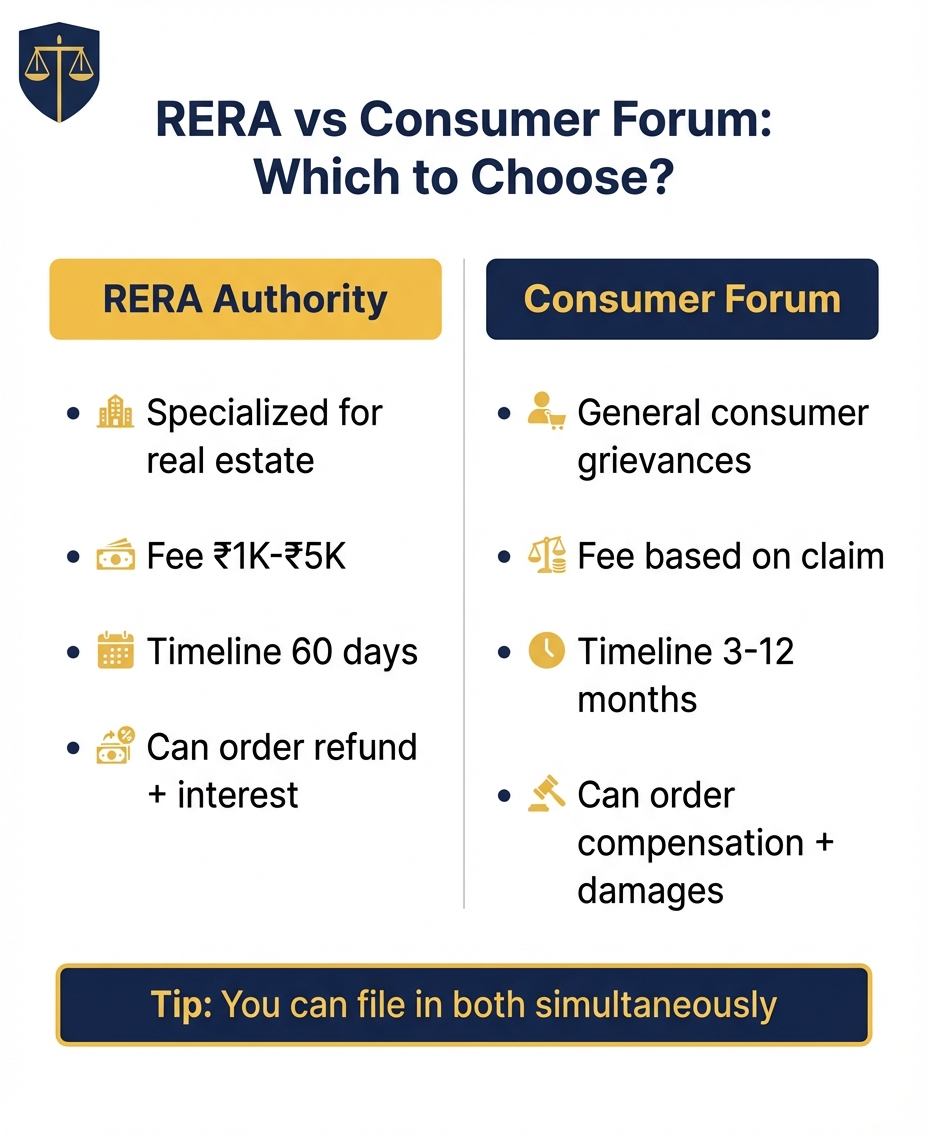
- RERA Authority: Specialised forum for real estate disputes. Faster disposal (mandated within 60 days). Lower filing fees. Can impose penalties on the builder under RERA-specific provisions. However, RERA can only address violations of the RERA Act and may not cover broader claims for mental agony, harassment, or consequential damages as effectively as consumer forums.
- Consumer Forum: Broader jurisdiction covering deficiency in service and unfair trade practices. Can award compensation for mental agony, harassment, and litigation costs. No upper limit on compensation. The three-tier system (District, State, National Commission) provides multiple levels of appeal. However, consumer forum proceedings tend to be slower than RERA, and filing fees for high-value claims can be significant.
- Filing in both forums: The Supreme Court in Imperia Structures Ltd. v. Anil Patni & Anr. (2020) held that homebuyers can approach either RERA or the consumer forum, or even both in certain circumstances, though they cannot claim double relief for the same cause of action. Many advocates recommend filing before RERA first for the specific reliefs under the Act (refund, interest, penalties) and approaching the consumer forum for additional compensation claims.
The choice between RERA and the consumer forum depends on the specific facts of your case, the relief you are seeking, and strategic considerations. In cases of simple delayed possession where you primarily want a refund with interest, RERA is usually the faster and more cost-effective option. For cases involving broader claims for mental agony, harassment, and significant consequential damages, the consumer forum may offer more comprehensive relief.
Common Mistakes to Avoid
Many homebuyers weaken their case against builders by making avoidable errors in the legal notice stage or complaint process. Here are the most common mistakes to watch out for:
- Not preserving documents: Failing to keep copies of the buyer-builder agreement, allotment letter, payment receipts, correspondence, and advertisements. These documents are critical evidence before the RERA Authority.
- Sending the notice to the wrong address: The legal notice must be sent to the registered office of the builder or developer company as mentioned in the agreement and in MCA records. Sending it to a project site or sales office alone may not constitute proper service.
- Vague or emotional language: A legal notice must be factual, specific, and professional. Avoid emotional outbursts, threats, or defamatory statements. Every claim must be supported by documentary evidence.
- Not citing RERA provisions: Failing to reference the specific sections of the RERA Act (such as Section 18, 19, and 31) that have been violated weakens the legal impact of the notice.
- Delay in taking action: Waiting too long after the agreed possession date to send a legal notice or file a complaint. While RERA does not prescribe a strict limitation period for complaints (unlike the three-year limit under the Limitation Act for civil suits), unreasonable delay can be used against you by the builder.
- Accepting partial possession or OC without protest: If the builder offers possession of an incomplete unit or obtains an Occupancy Certificate (OC) for a project that is not fully ready, accepting it without a written protest can prejudice your claim for compensation.
- Not calculating interest correctly: Many homebuyers underestimate the interest they are entitled to. The interest under Section 18 accrues from the date of each payment made to the builder, not just from the promised possession date. Have your advocate calculate the exact amount.
- Ignoring the builder's reply: If the builder sends a reply to your legal notice, it is important to send a rebuttal through your advocate if the reply contains inaccurate or misleading statements. Failing to respond may be construed as acceptance of the builder's version.
Do Not Sign Indemnity or Settlement Deeds Without Legal Review
Builders often pressure homebuyers into signing indemnity bonds, settlement agreements, or supplementary agreements that waive the homebuyer's right to claim compensation or interest for delays. Never sign any such document without having it reviewed by your advocate. Many such clauses have been struck down by RERA Authorities and courts as being one-sided and unconscionable.
Do Not Let the Builder Off the Hook
Every day of delay costs you money. Get a professionally drafted RERA legal notice from OpenVakil and take the first step toward holding your builder accountable.
Start Your RERA NoticeHow OpenVakil Helps
Dealing with a builder who has delayed your dream home is stressful and overwhelming. The legal process can seem daunting, especially when you are up against a large developer with deep pockets and a team of lawyers. OpenVakil levels the playing field by making professional legal assistance accessible, affordable, and efficient.
With OpenVakil's AI-powered legal notice platform, you can generate a comprehensive, legally sound notice to your builder in minutes. Simply provide the details of your case — the project name, unit details, agreement date, promised possession date, amounts paid, and the relief you seek — and our platform will produce a detailed notice citing all relevant RERA provisions. Every notice is then reviewed by an experienced real estate advocate to ensure accuracy and legal compliance.
- RERA-specific expertise: Our advocates specialise in real estate disputes and are well-versed in the nuances of RERA across different states, including MahaRERA, UP RERA, HRERA, KRERA, and others.
- AI-assisted drafting: Our technology generates a comprehensive initial draft based on your inputs, saving time while ensuring that no critical detail is missed.
- Advocate-reviewed quality: Every notice is reviewed and refined by a qualified advocate to ensure it meets the standards expected by RERA Authorities and courts.
- End-to-end support: From drafting the legal notice to guidance on filing a RERA complaint, attending hearings, and executing orders, OpenVakil supports you throughout the process.
- Affordable pricing: Our services start at just Rs. 1,499, making professional RERA legal notices accessible to homebuyers across India who may already be under financial strain due to builder delays.
- Quick turnaround: Most notices are drafted, reviewed, and dispatched within 2 to 3 business days, ensuring that you take timely action against the builder.
Whether you are dealing with a builder who has delayed possession by years, delivered a substandard flat, charged hidden amounts, or refused to honour promises made in advertisements, OpenVakil equips you with the legal tools to assert your rights under RERA and demand the justice you deserve.
Protect Your Investment Today
Your home is your most valuable asset. Do not let a defaulting builder hold it hostage. Draft a powerful legal notice under RERA with OpenVakil and take the first step toward reclaiming what is rightfully yours.
Get Started NowThe RERA Act has fundamentally transformed the real estate landscape in India by placing homebuyers' rights at the centre of the regulatory framework. Armed with the right knowledge, proper documentation, and a well-drafted legal notice, you can hold any builder accountable for delays, defects, and broken promises. Remember — Section 18, Section 19, and Section 31 of RERA are powerful provisions designed specifically to protect your interests. Take action today, and do not let delays erode either your investment or your peace of mind.