You opened an envelope — or received a message from the postman — and inside was a document full of formal legal language, printed on an advocate's letterhead, with words like "hereby called upon," "failing which," "appropriate legal proceedings," and "at your own risk and cost." Your heart rate spiked. Your hands went cold. You immediately thought: "Am I in trouble? Am I going to court? Can I go to jail?"
We understand that feeling. Thousands of people across India receive legal notices every single day, and almost all of them experience the same moment of panic. The formal language is deliberately intimidating. The advocate's name at the bottom makes it feel official and final. The deadline makes it feel urgent.
But here is the truth that no one tells you in that moment of panic: a legal notice is not what you think it is. It is not an arrest warrant. It is not a court summons. It is not a conviction. It is not even a court case. It is, at its core, a letter — a formal, structured, legally documented letter that someone has chosen to send you. And once you understand what it actually is and what your options are, the panic will start to fade.
This guide is written specifically for people who have just received a legal notice and are feeling scared or confused. We will walk you through exactly what a legal notice means, what it does not mean, what your rights are, what you should do (and what you absolutely should not do), whether you need to respond, how to respond, and when to genuinely worry versus when to relax. By the end, you will have a clear plan of action.
Take a Deep Breath
Before we get into the legal details, let us address the emotional reality. If you are reading this article right now, you have probably just received a legal notice and you are looking for answers. So let us start with the most important thing: you are going to be fine.
Receiving a legal notice is not a rare or extraordinary event. It is one of the most common pre-litigation steps in the Indian legal system. Lakhs of legal notices are sent every year in India — between neighbours, between landlords and tenants, between employers and employees, between businesses, between family members, between consumers and companies. The vast majority of these notices are resolved without ever going to court. Many are resolved with a simple conversation, a payment, a compromise, or a well-drafted reply.
Here Is a Fact That Will Help You Breathe
An estimated 40-50% of all disputes in India are resolved at the legal notice stage itself, without any court case being filed. The legal notice you just received is, in all likelihood, the beginning of a conversation — not the beginning of a court battle.
What a Legal Notice Is NOT
Let us be absolutely clear about what you have not received:
- It is NOT an arrest warrant. No one is coming to arrest you. A legal notice is a civil communication, not a criminal order. The police are not involved.
- It is NOT a court order. No court has issued any direction against you. No judge has seen this document. No judicial authority is compelling you to do anything.
- It is NOT a court summons. You are not required to appear before any court or tribunal. There is no hearing date. There is no case number.
- It is NOT a conviction or a judgment. You have not been found guilty of anything. No legal finding has been made against you.
- It is NOT an FIR or a police complaint. Receiving a legal notice does not mean a criminal case has been registered against you. It is not a police matter.
- It is NOT a final demand with automatic legal consequences. If you do not comply with the notice, the world does not end. The sender still has to take separate legal steps (like filing a case) before anything happens.
Read that list again if you need to. Let it sink in. The document in your hands is a letter — a formal, important letter that deserves your attention, but a letter nonetheless. Nothing has happened to you legally. Your status before the law is exactly the same as it was before you received this notice.
What a Legal Notice Actually Is
A legal notice is a formal written communication from one person (or their advocate) to another person, stating a grievance, making a demand, and warning that legal action may follow if the demand is not met within a specified period. Think of it as the legal equivalent of a formal complaint letter — but one that can be used as evidence in court later.
In plain language, the person who sent you this notice is saying: "I believe you owe me something (or you did something wrong). I want you to fix it within X days. If you do not, I may take legal action." That is all. They are not suing you. They have not filed a case. They have not gone to the police. They are telling you about a problem and giving you a chance to resolve it.
In fact, this is one of the most civilised mechanisms in the Indian legal system. Instead of ambushing you with a court case (which they could do in many situations), the sender has chosen to warn you first and give you an opportunity to respond, explain, negotiate, or comply. It is a chance to resolve the matter before things escalate.
The Legal Framework
Legal notices in India do not operate under a single law. They derive their authority from several statutes depending on the context. The General Clauses Act, 1897 defines the meaning of "notice" and how it is served. Section 80 of the Code of Civil Procedure (CPC), 1908 makes legal notices mandatory before suing any government body. Section 138 of the Negotiable Instruments Act, 1881 requires a demand notice before filing a cheque bounce complaint. The Indian Contract Act, 1872, the Transfer of Property Act, 1882, and the Consumer Protection Act, 2019 all contemplate situations where notices are part of the dispute resolution process.
But here is what matters for you right now: regardless of which law the notice cites, receiving it does not create any legal obligation on you beyond reading and understanding it. You have the right to respond, the right not to respond (in most cases), the right to deny the claims, the right to negotiate, and the right to seek legal advice. The notice is the sender's opening move. It is not the final word.
Just Received a Legal Notice? We Can Help
OpenVakil helps you understand the legal notice you have received and draft a professional reply that protects your rights. Describe your situation in plain language and get a clear, actionable plan in minutes — no legal jargon, no confusion.
Understand Your NoticeWhy Someone Sent You a Legal Notice
Understanding why someone sent you a legal notice can help reduce your anxiety. In most cases, people send legal notices for practical, everyday disputes — not because something catastrophic has happened. Here are the most common reasons people receive legal notices in India:
- Money disputes: This is the single most common reason. Someone believes you owe them money — an unpaid loan, an outstanding invoice, an unreturned security deposit, an unpaid salary, or a bounced cheque. The notice demands payment within a specified period.
- Property disputes: A landlord wants you to vacate a property, a neighbour claims you have encroached on their land, a co-owner wants partition, or a buyer claims you have not transferred possession despite receiving payment.
- Consumer complaints: You sold a product or service that the buyer claims was defective, incomplete, or not as described. They want a refund, replacement, or compensation under the Consumer Protection Act, 2019.
- Defamation: Someone claims that you made statements (written or spoken, including on social media) that damaged their reputation. They want a retraction, apology, or compensation under Sections 499-500 of the Indian Penal Code (now Sections 356-357 of the Bharatiya Nyaya Sanhita, 2023).
- Employment and workplace issues: An employer alleging breach of non-compete or confidentiality clauses, an employee claiming wrongful termination, unpaid dues, or harassment under the Payment of Wages Act, 1936, the Industrial Disputes Act, 1947, or the POSH Act, 2013.
- Family and matrimonial disputes: Disputes over maintenance, stridhan (wife's personal property), divorce-related claims, or disputes over ancestral property among family members under the Hindu Marriage Act, 1955, the Hindu Succession Act, 1956, or personal laws.
- Breach of contract: Someone claims you entered into an agreement and failed to fulfil your obligations under it, whether it is a service agreement, a sale contract, a partnership deed, or any other contractual arrangement under the Indian Contract Act, 1872.
- Cheque bounce: If you issued a cheque that bounced, the payee is legally required to send you a demand notice under Section 138 of the Negotiable Instruments Act, 1881 before they can file a criminal complaint.
As you can see, these are all ordinary disputes that happen to ordinary people in the course of everyday life. Receiving a legal notice does not mean you are a criminal or that you have done something terrible. It means someone has a grievance against you and has chosen the formal legal route to communicate it.
What Receiving a Notice Means Legally
Now let us address the legal reality of your situation with absolute clarity:
- No case has been filed against you. A legal notice is a pre-litigation step. It comes before any court case. At this moment, there is no case pending against you in any court, tribunal, or forum.
- No court or authority is involved yet. The notice was sent by a private party (or their advocate). No judge, magistrate, or government authority has reviewed it, approved it, or ordered it.
- You have no obligation to go to court. You do not need to appear before any authority. There is no hearing date. There is no case number.
- You have not been "charged" with anything. Even if the notice mentions criminal provisions (like Section 138 NI Act or Section 420 IPC), the notice itself is not a criminal charge. It is a warning that the sender may initiate such proceedings in the future.
- The claims in the notice are just the sender's version. Nothing in the notice has been proven or established. The sender is stating their version of events. You have every right to have a completely different version, and the truth will only be determined if and when the matter goes to court.
Your Rights Are Fully Intact
This is crucial to understand: receiving a legal notice does not diminish any of your legal rights. You retain:
- The right to deny all claims made in the notice
- The right to present your own version of the facts
- The right to send a reply notice through your own advocate
- The right to negotiate and settle the dispute on your terms
- The right to send a counter-notice with your own claims against the sender
- The right to choose not to respond (though this is not always advisable)
- The right to consult a lawyer and take professional legal advice
- The right to take your own time (within the deadline) to decide how to respond
Remember This
A legal notice is the sender's move. Your reply is your move. Right now, the ball is in your court — and you have time, options, and rights. The worst thing you can do is panic. The best thing you can do is understand the situation, gather your facts, and respond thoughtfully.
What to Do Immediately After Receiving a Legal Notice
Now that you understand what a legal notice is (and what it is not), here is a practical, step-by-step guide on what to do in the hours and days after receiving one:
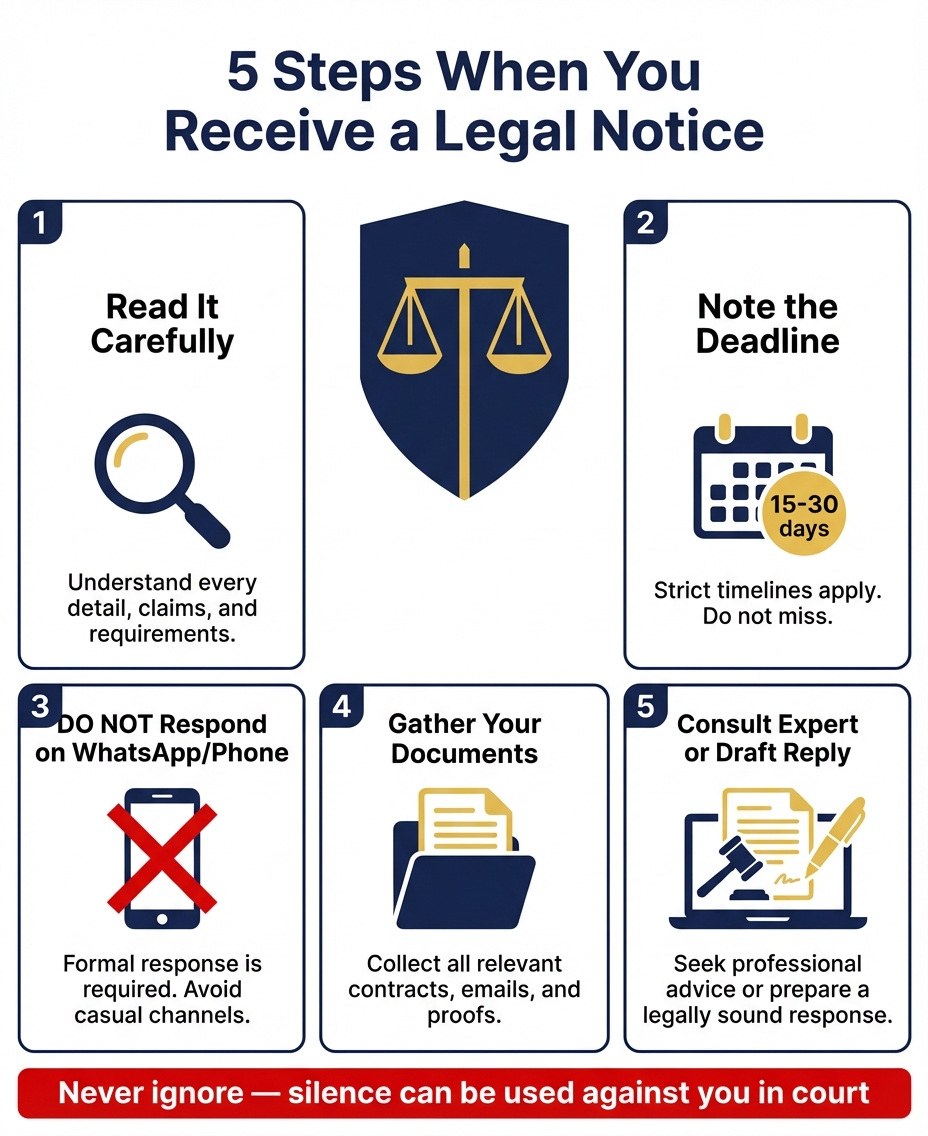
Read the Notice Carefully
Read the entire notice from start to finish. Read it twice. Then read it a third time with a pen in hand, marking the key points. Identify the following: who is sending it (the person and/or their advocate), what specific claims or allegations are being made, what specific action is being demanded (pay money, vacate property, apologise, cease an activity), what is the deadline they have given you to respond or comply, and what legal provisions (sections of law) they are citing.
Understanding the notice thoroughly is the foundation for everything that follows. Do not skim it. Do not let the formal language intimidate you — break it down paragraph by paragraph and understand what each part is saying.
Note the Deadline
Every legal notice specifies a deadline — typically 15 to 30 days from the date of receipt — within which the sender expects you to respond or comply. Write this date down. Set a reminder. This deadline is important not because something automatically happens if you miss it, but because the sender may use the expiry of the deadline as a trigger to take the next legal step (such as filing a case). Having the deadline clearly noted gives you a timeline within which to plan your response.
A critical exception: if the notice is a cheque bounce demand notice under Section 138 of the NI Act, the 15-day window is legally significant. If you owe the amount and pay within 15 days of receiving the notice, the sender cannot file a criminal complaint against you. Miss this window, and the criminal complaint becomes possible.
What NOT to Do
What you do not do in the first few days is just as important as what you do. Here are the things you must avoid:
- Do NOT ignore the notice. Putting it in a drawer and hoping it goes away is one of the worst things you can do. The notice will not disappear, and your silence may be used against you later.
- Do NOT panic-call the sender. Calling the person who sent you the notice while you are upset or emotional can be disastrous. Anything you say over the phone — admissions, apologies, promises, threats — can be recorded and used against you. Communicate only in writing, and only after consulting a lawyer.
- Do NOT post about it on social media. Posting about the notice, the sender, or the dispute on Facebook, Instagram, Twitter, or any other platform can create additional legal liability for you (defamation, contempt) and can be used as evidence against you in court.
- Do NOT immediately comply with the demands. Just because someone demands something in a legal notice does not mean they are legally entitled to it. The demands may be inflated, baseless, or legally unsound. Assess the merits before acting.
- Do NOT destroy any documents or evidence. If the notice relates to a contract, agreement, transaction, or communication, preserve all related documents, emails, messages, receipts, and records. Destroying evidence can have serious legal consequences, including adverse inference under Section 114 of the Indian Evidence Act, 1872 (now Section 119 of the Bharatiya Sakshya Adhiniyam, 2023).
- Do NOT send an angry or threatening reply on your own. A hastily written, emotional response without legal guidance can contain admissions, threats, or defamatory statements that create more problems than the original notice.
The Golden Rule After Receiving a Legal Notice
Do not say anything, do not write anything, do not post anything, and do not destroy anything. Read the notice, note the deadline, and get professional advice. Every other action should wait until you have a clear understanding of the situation and a plan.
Should You Respond to a Legal Notice?
This is one of the first questions everyone asks. The answer is: it depends on the situation. There is no general law that compels you to reply to every legal notice. But whether you should reply is a strategic decision that depends on the nature of the claims, the strength of your position, and what outcome you want.
When You Must Respond
- Cheque bounce notices (Section 138 NI Act): If you received a demand notice for a dishonoured cheque and you owe the amount, paying within 15 days prevents criminal prosecution entirely. Even if you dispute the claim, you must respond within the window to protect your legal position.
- Notices that are a legal prerequisite to a case: Some notices are mandatory steps before the sender can file a case. For instance, notices under Section 80 CPC (against government bodies) or Section 106 of the Transfer of Property Act (eviction). While the obligation to send the notice is on the sender, your response (or lack thereof) may affect the proceedings that follow.
- Notices containing serious criminal allegations: If the notice accuses you of fraud, cheating (Section 420 IPC / Section 318 BNS), criminal breach of trust, or any other criminal offence, silence can be dangerous. Your failure to deny the allegations may be treated as an implied admission if the matter reaches court.
When Responding Is Advisable
- When you have a strong defence: If the claims against you are false, exaggerated, or legally flawed, a well-drafted reply can demolish the sender's case before it even reaches court. Sometimes a strong reply is enough to make the sender abandon the matter entirely.
- When you want to negotiate or settle: A reply can open the door to negotiations. You can propose a compromise, offer partial payment, suggest mediation, or present alternative solutions. Many disputes are resolved through the back-and-forth of notices and replies.
- When the notice involves your business or professional reputation: Unanswered allegations against a business or professional can cause reputational damage. A reply placing your version on record is important for protecting your standing.
- When you want to prevent a court case: Courts look favourably on parties who engaged constructively before litigation. A reply showing willingness to resolve the dispute can work in your favour if the matter does go to court.
When You Can Safely Not Respond
- Clearly frivolous or harassment notices: Some notices are sent purely to intimidate, with no genuine legal claim behind them. If your lawyer assesses that the notice has no legal basis and the sender is unlikely to take further action, silence may be the appropriate response.
- When responding would reveal your strategy: In some complex disputes, responding to the notice may prematurely disclose your evidence, legal arguments, or defence strategy. Your lawyer may advise strategic silence to preserve your advantage if the matter goes to court.
- When the claims are clearly time-barred: If the claims are beyond the limitation period prescribed by the Limitation Act, 1963, your lawyer may advise that no response is needed since the sender cannot file a valid case anyway.
The decision to reply or not reply to a legal notice is a strategic one and should be made only after consulting a qualified advocate who can assess the specific facts, the applicable law, and the likely consequences of each course of action.
— Legal Practice Principle
How to Respond to a Legal Notice
If you have decided to respond (which, as we discussed, is the right move in most situations), here is how to do it properly:
The standard practice is to send your reply through an advocate. While there is no legal requirement for this — you can reply in your own name — having an advocate draft and send the reply carries several advantages. The reply will use proper legal language and format, it will correctly cite relevant laws, it will avoid inadvertent admissions, and it signals to the sender that you have legal representation and are taking the matter seriously. Platforms like OpenVakil offer an affordable alternative by generating professional-quality reply notices using AI, reviewed for legal accuracy.
Key Elements of a Reply Notice
A well-drafted reply notice should contain the following elements:
- Your details: Full name, address, and the capacity in which you are responding.
- Reference to the original notice: The date of the notice, the advocate who sent it, and the date you received it.
- Your advocate's details: If you are responding through an advocate, include their name, enrolment number, and address.
- Paragraph-by-paragraph response: Address each allegation specifically. For each claim, state whether you admit, deny, or partially admit it, and provide your version of the facts with supporting details.
- Your version of the facts: A clear, chronological narrative of events as they actually happened, with dates and references to supporting documents.
- Legal defences: If applicable, raise defences such as limitation (claim is time-barred under the Limitation Act, 1963), lack of jurisdiction, lack of standing, or any other legal defence.
- Counter-claims (if any): If you have your own grievances against the sender, state them. You may also reserve the right to send a separate counter-notice.
- Clear denial of liability: If you deny the claims, state your denial in unambiguous terms.
- Your demand or proposal: State what you want — withdrawal of the notice, a settlement offer, or a warning that you will contest any proceedings.
- Reservation of rights: State that you reserve all legal rights and remedies available to you under law.
Timeline for Your Reply
The timeline for your reply depends on the type of notice and the deadline specified:
- Cheque bounce notice (Section 138 NI Act): You have 15 days from receipt to make the payment. If you are disputing the claim, consult a lawyer immediately — the window is very tight.
- General legal notices (money recovery, property, contract, consumer): Respond within the deadline specified in the notice, which is typically 15 to 30 days. If no deadline is specified, a response within 15-30 days is considered reasonable.
- Notices under Section 80 CPC (to government bodies): Government entities have 2 months to respond before the sender can file a suit.
Send your reply via registered post with acknowledgement due (RPAD) to create legally admissible proof of dispatch and delivery. You can supplement this with an email copy for faster communication, but the physical copy via RPAD is the primary method. Keep copies of everything — the signed reply, the postal receipt, and the acknowledgement card.
Common Mistakes People Make When Receiving a Notice
In the stress and confusion of receiving a legal notice, people often make mistakes that can seriously harm their legal position. Here are the most common ones — and why you should avoid them:
- Ignoring the notice completely: This is the number one mistake. People assume that if they do not respond, the problem will disappear. It will not. Your silence can be used against you in court as evidence that you had no defence or that you accepted the claims by implication. The sender may proceed to file a case, and your failure to engage will be noted.
- Sending an aggressive or emotional response: Angry replies filled with threats, insults, or accusations create additional legal liability. They can constitute defamation, criminal intimidation, or contempt. They also demonstrate to a court (if the matter reaches there) that you are not a reasonable party. Your reply should be firm and factual, never emotional.
- Inadvertently admitting fault: This is a subtle but devastating mistake. Statements like "I was going to pay but I lost my job" or "The product was late because our vendor failed us" may sound like explanations, but legally they are admissions. Every word in your reply must be vetted for unintended admissions.
- Missing the deadline: The deadline in the notice is not arbitrary. If you miss it, the sender may immediately proceed to the next step — filing a case. In cheque bounce cases under Section 138 NI Act, missing the 15-day window can have criminal consequences. Always respond within the stipulated time.
- Destroying evidence: Some people panic and delete messages, throw away documents, or destroy records related to the dispute. This is a terrible idea. Destruction of evidence can lead to adverse inference under the Bharatiya Sakshya Adhiniyam, 2023 (Section 119), and in some cases, can constitute a separate offence.
- Calling the sender to "sort it out": Verbal conversations are not documented and can be recorded by the other party. Anything you say — admissions, promises, threats — can be used against you. All communication should be in writing, preferably through an advocate.
- Discussing the matter publicly or on social media: Posting about the dispute online can create defamation claims, can be used as evidence of your attitude, and can complicate your legal position. Keep the matter private until it is resolved.
- Trying to draft a reply without professional help: Legal notices involve specific legal language, strategic considerations, and potential pitfalls that laypeople are unlikely to navigate successfully. The cost of a poorly drafted reply far exceeds the cost of professional help.
What Happens If You Ignore a Legal Notice?
Let us address this directly, because many people want to know: "What if I just do nothing?"
First, the reassuring news: there is no automatic legal penalty for not responding to a legal notice. You will not be arrested, fined, or summoned just because you did not reply. The legal notice itself has no enforcement power. It is not a court order, and ignoring it is not contempt of court.
However, ignoring a legal notice can have several indirect but significant consequences:
- The sender may file a case in court: If the sender does not receive a response, they are more likely to proceed with legal action. Your silence gives them no reason to believe the matter can be resolved without court intervention.
- Your silence may be used as evidence: In court, the sender will argue that they gave you a fair opportunity to respond and resolve the matter, and you chose to ignore it. Courts often draw an adverse inference from this — meaning they may presume that you had no valid defence and that the sender's claims have merit.
- You lose the opportunity to settle: A legal notice is often the best opportunity to settle a dispute quickly and cheaply. Once a case is filed, settlement becomes more expensive, more complicated, and more time-consuming.
- You miss the chance to put your version on record: If the sender files a case, the court's first impression of the dispute will be entirely shaped by the sender's notice and the complaint they file. Your version will not be on record, and you will have to present it defensively in response to the sender's narrative.
- In cheque bounce cases, criminal prosecution becomes possible: Under Section 138 of the NI Act, if you do not pay the demanded amount within 15 days of receiving the notice, the sender can file a criminal complaint. This can result in imprisonment for up to 2 years or a fine of up to twice the cheque amount, or both.
So while ignoring a notice is not illegal in itself, it is almost always a bad strategic decision. It closes the door on resolution and opens the door to escalation.
When to Worry and When Not To
Not all legal notices are created equal. Some deserve serious attention and immediate action. Others are not worth losing sleep over. Here is how to tell the difference:
Notices You Can Usually Relax About
- Vague notices with no specific claims: If the notice makes broad, unspecific allegations without citing particular facts, dates, amounts, or legal provisions, it may be a pressure tactic rather than a genuine legal move. Notices that say things like "you have wronged my client" without specifying how are often sent to intimidate, not to initiate real proceedings.
- Notices from individuals in personal disputes: In personal disagreements (neighbours, acquaintances, minor disputes), people sometimes send legal notices in the heat of the moment. These often go nowhere once tempers cool down. A polite, measured reply can resolve the matter.
- Notices with clearly inflated or absurd claims: If someone is demanding Rs. 50 lakh in "damages" for a minor consumer complaint, the claim is likely inflated for effect. While you should still respond, the likelihood of such a claim succeeding in court is very low.
- Notices where the sender has no standing: If the person sending you the notice has no legal relationship to the dispute (e.g., a stranger claiming rights over your property without any documentation), the notice may lack legal foundation.
- Notices where the claims are clearly time-barred: Under the Limitation Act, 1963, different types of claims have specific time limits within which they must be pursued. For example, suits for breach of contract must be filed within 3 years, suits for recovery of moveable property within 3 years, and so on. If the underlying dispute is beyond the limitation period, the sender cannot file a valid case regardless of the notice.
Notices You Should Take Seriously
- Cheque bounce notices under Section 138 NI Act: These carry criminal consequences (up to 2 years imprisonment and/or fine). The 15-day timeline is strict. Take immediate action.
- Notices from government authorities or statutory bodies: Notices from SEBI, the Income Tax Department, the Registrar of Companies, RERA, or similar regulatory bodies carry institutional weight and may be precursors to enforcement action.
- Notices alleging criminal conduct: If the notice accuses you of fraud, cheating, criminal breach of trust, or other criminal offences and threatens to file an FIR or criminal complaint, you need to take it seriously and consult a criminal lawyer immediately.
- Notices involving large sums of money with documented evidence: If the notice demands payment of a significant amount and references specific contracts, invoices, or agreements that you know exist, the sender likely has a strong case and may proceed to court.
- Notices from well-known law firms or advocates: When a notice comes from a reputable law firm, it typically indicates that the sender has already invested in legal advice and is likely prepared to follow through with litigation if the notice is not addressed.
- Notices related to ongoing business relationships: If the notice comes from a client, vendor, partner, or employer with whom you have a documented business relationship, the claims are more likely to be substantive and the sender more likely to pursue them.
The Best Way to Assess a Notice
Do not try to assess the seriousness of a legal notice on your own. What looks frivolous may have genuine legal implications, and what looks serious may be a bluff. Consult a qualified advocate or use a platform like OpenVakil to get a professional assessment of the notice you have received. The cost of a consultation is negligible compared to the cost of getting it wrong.
How OpenVakil Helps You Respond
We built OpenVakil for exactly this situation — when you have received a legal notice, you are not sure what to do, and you need help quickly and affordably. Here is how OpenVakil helps you navigate this situation:
- Understand the notice: Tell us about the legal notice you received in plain language. Our AI analyses the claims, the legal provisions cited, and the demands made, and explains them to you in simple, clear terms.
- Draft a professional reply: OpenVakil generates a comprehensive, legally sound reply notice tailored to your specific situation. The reply addresses every allegation, raises appropriate defences, avoids inadvertent admissions, and uses the formal legal language expected in such communications.
- Send your own legal notice: If you have counter-claims against the sender, OpenVakil can draft a counter-notice asserting your own rights and demands. Sometimes the best defence is a strong offence.
- Works for every type of dispute: Whether you have received a cheque bounce notice, a money recovery demand, a property dispute notice, an employment matter, a consumer complaint, a defamation notice, or any other type of legal notice, OpenVakil handles it.
- Fast turnaround: Legal notices come with deadlines. You do not have weeks to find a lawyer, schedule an appointment, explain the situation, and wait for a draft. OpenVakil delivers your reply in minutes, giving you ample time to review and send it within the deadline.
- Affordable: Professional legal reply drafting at a fraction of the traditional cost. You should not have to choose between protecting your legal rights and paying your bills.
- Confidential: Your information is private and secure. We do not share your details with anyone.
The goal is simple: do not let a legal notice go unanswered because you were scared, confused, or could not afford a lawyer. OpenVakil makes professional legal reply drafting accessible to everyone, so you can respond with confidence and protect your rights.
Received a Legal Notice? Respond with Confidence
Do not panic, do not ignore it, and do not try to handle it alone. OpenVakil helps you understand the notice, draft a professional reply, and protect your legal rights — all in minutes. Answer a few simple questions about your situation and get your reply notice drafted by AI, reviewed for legal accuracy, and ready to send.
Draft Your Reply NowIf you have read this far, you are no longer the person who was panicking 11 minutes ago. You now understand that a legal notice is a formal letter, not a death sentence. You know that no case has been filed, no court is involved, and your rights are fully intact. You know what to do (read it, note the deadline, get advice) and what not to do (panic, call the sender, post on social media, destroy evidence). You know when to respond and how to respond. And you know when to worry and when to relax.
The most important thing is this: do not let fear paralyse you into inaction. A legal notice is an opportunity — an opportunity to present your side, to negotiate, to settle, or to prepare a strong defence. How you respond in the next few days can determine whether this matter is resolved quickly or drags on for years. Take the time to respond thoughtfully, get the right help, and protect your interests.
You have got this.