Living next to a noisy neighbour can turn your home — the one place that should offer peace and quiet — into a source of constant stress. Whether it is blaring loudspeakers during festivals, late-night parties, construction work that starts at dawn, a persistently barking dog, or a factory operating in a residential zone, noise pollution is not just an annoyance — it is a legally recognised violation of your fundamental rights under Indian law.
The Supreme Court of India, in the landmark case of In Re: Noise Pollution (2005) 5 SCC 733, explicitly recognised that the right to live in a pollution-free environment — including freedom from noise pollution — is a part of the Right to Life under Article 21 of the Constitution. This means that excessive noise is not merely a civic inconvenience; it is a violation of your fundamental rights.
This comprehensive guide explains everything you need to know about sending a legal notice for noise pollution and neighbour disputes in India — the legal framework, permissible noise levels, when and how to send a notice, the key elements it must contain, and the full range of remedies available to you, from police complaints to the National Green Tribunal.
What Constitutes Noise Pollution Legally?
Under Indian law, noise pollution is defined as any sound that exceeds the ambient noise standards prescribed by the Central Pollution Control Board (CPCB) for a particular area category. The Noise Pollution (Regulation and Control) Rules, 2000 — framed under the Environment Protection Act, 1986 — categorise areas into four zones: industrial, commercial, residential, and silence zones. Each zone has prescribed maximum permissible noise levels during daytime (6:00 AM to 10:00 PM) and nighttime (10:00 PM to 6:00 AM).
Beyond the technical decibel limits, Indian courts have interpreted noise pollution broadly. Any sound that causes annoyance, disturbance, discomfort, or injury to the health of persons in the vicinity can constitute noise pollution. This includes not only obviously loud sources like construction machinery or loudspeakers but also persistent lower-level disturbances such as a dog barking continuously through the night, a generator running for extended hours, or a neighbour playing music at unreasonable volumes.
Noise Pollution Is a Fundamental Rights Issue
The Supreme Court of India has held that the right to a peaceful environment free from noise pollution flows from Article 21 (Right to Life) and Article 19(1)(a) (Freedom of Speech and Expression — which does not include the right to use loudspeakers). In Church of God (Full Gospel) in India v. KKR Majestic Colony Welfare Association (2000), the Court held that no one has the right to create noise even in the name of religion. This precedent is powerful when dealing with loudspeaker-related neighbour disputes.
Types of Neighbour Disputes in India
While this guide focuses primarily on noise-related disputes, it is important to understand the broader landscape of neighbour disputes in India, as many of these issues overlap and may need to be addressed together in a single legal notice.
Noise-Related Disputes
- Loudspeaker and music noise: Neighbours playing loud music, using amplifiers or loudspeakers during parties, religious events, or celebrations beyond permissible hours or decibel limits. Under the Noise Pollution Rules, loudspeakers cannot be used between 10:00 PM and 6:00 AM, and even during daytime, they must not exceed prescribed limits.
- Construction noise: Renovation or construction work by a neighbour that generates excessive noise, especially during early morning, late evening, or nighttime hours. Most municipal corporations have specific bylaws restricting construction hours in residential areas.
- Barking dogs and pet noise: A neighbour's dog that barks incessantly, particularly at night, causing sleep deprivation and distress. While pet ownership is a right, it comes with the responsibility to ensure the pet does not create a nuisance for neighbours.
- Generator and machinery noise: Diesel generators, air conditioning units, industrial machines, or other equipment operated by a neighbour or nearby business that produces continuous or intermittent noise beyond acceptable levels.
- Commercial activity in residential zones: A neighbour running a noisy commercial operation — such as a workshop, godown, or manufacturing unit — in a residential area, violating zoning laws and creating noise nuisance.
- Vehicle-related noise: Neighbours who honk excessively, rev engines, or operate noisy vehicles (especially modified silencers) in residential lanes and parking areas.
Non-Noise Neighbour Disputes
Noise disputes rarely exist in isolation. You may face one or more of the following related issues with your neighbour that can be addressed in the same legal notice or through parallel legal proceedings:
- Encroachment: A neighbour extending their construction, boundary wall, or garden onto your property or onto common areas. This is actionable under the Specific Relief Act and relevant municipal laws.
- Water seepage and drainage: A neighbour's faulty plumbing, overflowing tanks, or improper drainage causing water seepage, dampness, or flooding in your flat or house. This is a common dispute in apartment complexes and can be addressed through the housing society or civil court.
- Parking disputes: Conflicts over allocated parking spaces in residential societies, encroachment on common parking areas, or a neighbour blocking your access to your designated parking spot.
- Common area disputes: Disputes over the use, maintenance, or modification of common areas such as staircases, terraces, gardens, corridors, and lifts in housing societies and apartment complexes.
- Privacy violations: A neighbour installing CCTV cameras that capture your private areas, constructing windows or balconies overlooking your property, or engaging in other activities that infringe on your privacy.
Legal Framework for Noise Pollution in India
India has a robust multi-layered legal framework to address noise pollution. A well-drafted legal notice should cite the specific statutes and provisions applicable to your situation. This not only demonstrates seriousness but also puts the recipient on notice of the legal consequences they face.
Noise Pollution (Regulation and Control) Rules, 2000
The Noise Pollution (Regulation and Control) Rules, 2000 are the primary delegated legislation governing noise pollution in India. Framed under the Environment (Protection) Act, 1986, these rules were notified by the Ministry of Environment, Forest and Climate Change and have been amended several times (notably in 2002, 2006, and 2010). Key provisions include:
- Rule 3 — Ambient air quality standards for noise: Prescribes the maximum permissible noise levels for Industrial Areas (75/70 dB day/night), Commercial Areas (65/55 dB), Residential Areas (55/45 dB), and Silence Zones (50/40 dB).
- Rule 4 — Responsibility of authorities: Makes the State Pollution Control Board (SPCB) and the District Magistrate/Police Commissioner responsible for enforcement.
- Rule 5 — Restrictions on use of loudspeakers/public address systems: Loudspeakers shall not be used at night (10 PM to 6 AM). Even during the day, a loudspeaker must not exceed the ambient noise standard by more than 10 dB for the area.
- Rule 5A — Consequences for violations: The authority shall act on complaints of noise pollution within the prescribed standards.
- Rule 6 — Complaints: Any person affected by noise beyond the prescribed limits can file a complaint with the authorities, which must be investigated.
Environment Protection Act, 1986
The Environment (Protection) Act, 1986 is the umbrella legislation under which the Noise Pollution Rules are framed. Key provisions relevant to noise disputes include:
- Section 2(a): Defines "environment" to include water, air, and land, and the interrelationship which exists among these and human beings, other living creatures, plants, micro-organisms, and property. Noise is recognised as an environmental pollutant.
- Section 3: Empowers the Central Government to take measures for environmental protection, including setting noise standards.
- Section 7: Prohibits carrying on any industry, operation, or process or handling any hazardous substance in excess of prescribed standards — which includes noise emission standards.
- Section 15: Prescribes penalties for violations — imprisonment up to 5 years, a fine up to Rs. 1,00,000, or both. If the violation continues, an additional fine of up to Rs. 5,000 per day may be imposed.
- Section 19: Provides that any person can file a complaint regarding violations, provided 60 days' prior notice is given to the Central Government or the prescribed authority.
60-Day Notice Requirement Under the Environment Protection Act
Section 19 of the Environment Protection Act, 1986 requires that no court shall take cognizance of an offence under the Act except on a complaint made by the Central Government or an authority authorised by it, OR by a person who has given at least 60 days' notice to the Central Government or the authority of their intention to file such a complaint. This makes the legal notice an essential prerequisite if you intend to pursue criminal prosecution under the EPA.
IPC Sections 268–290 / BNS Equivalents (Public Nuisance)
The Indian Penal Code, 1860 (IPC) — and its replacement, the Bharatiya Nyaya Sanhita, 2023 (BNS), which came into effect on 1st July 2024 — contain important provisions on public nuisance that are directly applicable to noise pollution:
- Section 268 IPC / Section 292 BNS (Public Nuisance): Defines a "public nuisance" as an act or illegal omission that causes common injury, danger, or annoyance to the public or people in general who dwell or occupy property in the vicinity. Excessive noise that affects a neighbourhood squarely falls within this definition.
- Section 269 IPC / Section 293 BNS: Whoever commits a public nuisance that is not otherwise punishable shall be punished with a fine which may extend to Rs. 200.
- Section 278 IPC / Section 302 BNS (Making atmosphere noxious to health): Applicable where the noise pollution is so severe as to be injurious to the health of persons living in the vicinity.
- Section 290 IPC / Section 310 BNS (Punishment for public nuisance in cases not otherwise provided for): Prescribes punishment with a fine up to Rs. 200 for public nuisance cases not covered under other specific sections.
While the fines prescribed under these sections may appear modest, a criminal complaint for public nuisance is a powerful deterrent. The nuisance-maker can be arrested, and the Magistrate can order them to cease the nuisance and take remedial measures. The mere threat of criminal proceedings in a legal notice often motivates compliance.
Section 133 CrPC / BNSS Section 163 (Removal of Nuisances)
Section 133 of the Code of Criminal Procedure, 1973 (CrPC) — now replaced by Section 163 of the Bharatiya Nagarik Suraksha Sanhita, 2023 (BNSS) — provides a swift and effective remedy for public nuisances. Under this provision, a Sub-Divisional Magistrate or Executive Magistrate can issue a conditional order directing a person to:
- Remove or abate a public nuisance within a specified time.
- Refrain from carrying on any trade, occupation, or activity that causes the nuisance.
- Take specific steps to prevent or abate the nuisance.
This is one of the fastest remedies available for noise pollution. Unlike a civil suit, which may take years, a Magistrate can pass orders under Section 133 CrPC / Section 163 BNSS within days or weeks. The Magistrate can act on a police report, a complaint by a Magistrate, or on the application of any person. If the person fails to comply with the order, they can be punished with imprisonment.
State-Specific Rules, Municipal Bylaws, and Society Bylaws
In addition to central legislation, several state and local laws regulate noise pollution and neighbour disputes:
- State Police Acts: Most states have police acts (e.g., Mumbai Police Act, 1951; Karnataka Police Act, 1963; Tamil Nadu City Police Act, 1888) that empower the police to regulate noise-related public nuisances. Section 31 of the Mumbai Police Act, for example, empowers the Police Commissioner to issue directions regarding noise.
- Municipal Corporation Acts: The BMC Act (Mumbai), GHMC Act (Hyderabad), MCD Act (Delhi), BBMP Act (Bangalore), and similar municipal laws contain provisions for regulating noise, issuing licences for loudspeakers, restricting construction hours, and penalising nuisance-creating activities.
- Development Control Regulations (DCR): These regulations govern land use and construction standards, including noise insulation requirements and restrictions on commercial activities in residential zones.
- Housing Society Bylaws: Under the respective state cooperative society acts (Maharashtra Cooperative Societies Act, 1960; Karnataka Cooperative Societies Act, 1959, etc.) and the Model Bylaws, housing societies have the power to frame rules regarding noise levels, quiet hours, renovation timings, pet management, and parking. Violation of society bylaws can result in penalties and even expulsion from the society.
- Apartment Ownership Acts: States like Maharashtra, Karnataka, and Tamil Nadu have apartment ownership legislation that regulates the rights and duties of apartment owners, including restrictions on activities that cause nuisance to other residents.
Need to Send a Noise Pollution Legal Notice?
Draft a professionally worded legal notice for noise pollution or neighbour disputes in minutes with OpenVakil. Our AI-powered platform ensures your notice cites the correct statutes and covers all essential legal elements.
Draft Your Legal Notice NowPermissible Noise Levels in India
The Noise Pollution (Regulation and Control) Rules, 2000 prescribe the following ambient air quality standards in respect of noise for different categories of areas. These limits form the legal benchmark for determining whether a noise source constitutes pollution:
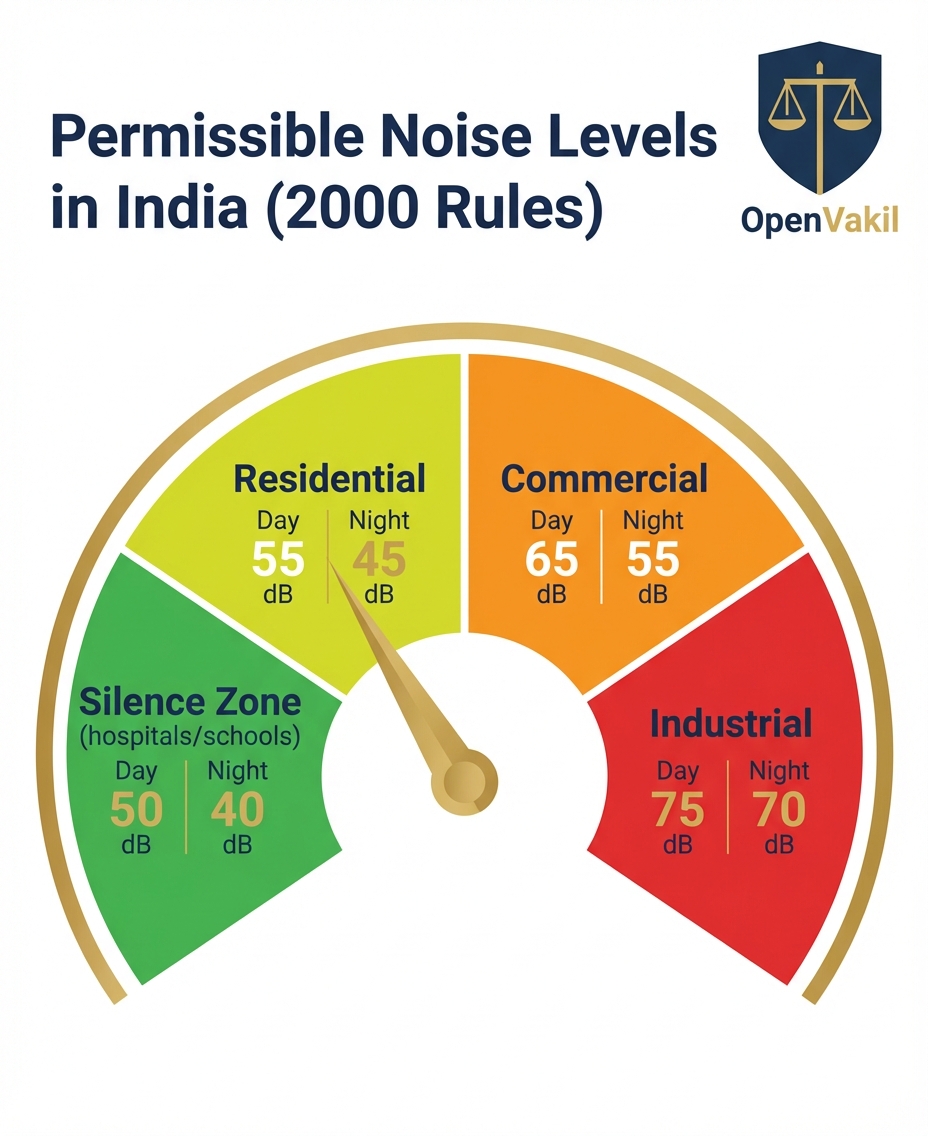
- Industrial Area: Daytime limit — 75 dB(A) Leq; Nighttime limit — 70 dB(A) Leq.
- Commercial Area: Daytime limit — 65 dB(A) Leq; Nighttime limit — 55 dB(A) Leq.
- Residential Area: Daytime limit — 55 dB(A) Leq; Nighttime limit — 45 dB(A) Leq.
- Silence Zone: Daytime limit — 50 dB(A) Leq; Nighttime limit — 40 dB(A) Leq. (Silence zones are areas within 100 metres of hospitals, educational institutions, courts, and places of worship.)
To put these numbers in perspective: normal conversation is about 60 dB, a washing machine is about 70 dB, a lawnmower is about 90 dB, and a rock concert can exceed 110 dB. The nighttime limit of 45 dB for residential areas is very low — even a moderately loud television can breach it if doors and windows are open. This means that many common sources of neighbour noise do exceed the legally prescribed limits, giving you legitimate legal grounds to take action.
How to Measure Noise Levels for Evidence
You do not need expensive professional equipment to measure noise levels. Several free smartphone apps (such as NIOSH Sound Level Meter, Decibel X, or Sound Meter) can provide reasonably accurate decibel readings that serve as preliminary evidence. For stronger evidence, you can hire a licensed environmental auditor or approach the State Pollution Control Board (SPCB) to conduct an official noise level assessment. Record measurements at multiple times of day and night, and maintain a written log with dates, times, locations, and readings.
When Should You Send a Legal Notice?
A legal notice for noise pollution or a neighbour dispute should be sent when informal attempts at resolution have failed and the situation is causing you ongoing harm. Specifically, consider sending a legal notice in the following situations:
- Repeated verbal requests ignored: You have spoken to the neighbour multiple times about the noise, but they continue the offending behaviour without making any effort to reduce it.
- Written complaints to society/RWA unsuccessful: You have complained to the housing society managing committee or Resident Welfare Association (RWA) in writing, but no effective action has been taken.
- Police complaint not acted upon: You have lodged a complaint with the local police station, but the police have either not acted or the neighbour has resumed the noise after a brief pause.
- Health impact: The noise is affecting your health, causing sleep deprivation, anxiety, headaches, hearing issues, or other medical problems that can be documented.
- Persistent or habitual noise: The noise is not a one-time event but a regular or continuous pattern that shows no signs of stopping.
- Violation of society bylaws or municipal regulations: The neighbour is clearly violating prescribed construction hours, loudspeaker restrictions, or other specific regulations, and has been put on notice by the relevant authority but continues to violate.
- Before filing a court case: As a matter of good practice and to demonstrate that you exhausted pre-litigation remedies, a legal notice should be sent before initiating any civil suit, criminal complaint, or NGT application.
It is important to note that a legal notice is not merely a threat letter — it is a formal pre-litigation document that serves as evidence in subsequent proceedings. Courts consistently view a prior legal notice favourably, as it shows that you acted reasonably and gave the other party an opportunity to resolve the matter amicably before resorting to litigation.
Key Elements of a Noise Pollution Legal Notice
A well-drafted legal notice for noise pollution must be specific, factual, legally grounded, and actionable. Vague or emotional language weakens the notice and reduces its effectiveness. Your notice must contain the following elements:
- Full name and address of the sender (the aggrieved party) and the advocate, if being sent through an advocate.
- Full name and address of the recipient (the noise-creating neighbour, business, or entity).
- Description of the premises: The address of both the sender's and recipient's residences or premises, including the flat number, building name, street, locality, city, and pin code.
- Detailed description of the noise nuisance: Describe the nature of the noise (music, construction, dog barking, machinery, etc.), its frequency (daily, weekly, specific occasions), approximate duration, and the time periods during which it occurs (especially if it occurs during nighttime hours between 10 PM and 6 AM).
- Impact on the complainant: Describe how the noise has affected you — sleep deprivation, inability to work from home, health issues (with medical evidence if available), impact on children's studies, distress to elderly family members, etc.
- Previous attempts at resolution: Mention any informal conversations, written complaints to the society or RWA, police complaints, or other steps you have taken before resorting to the legal notice.
- Legal provisions violated: Cite the specific statutes and rules being violated — Noise Pollution (Regulation and Control) Rules, 2000 (specifying the applicable zone and limits), Environment Protection Act, 1986, IPC Section 268/BNS Section 292 (public nuisance), relevant municipal bylaws, and society bylaws.
- Specific demand: Clearly state what you require the recipient to do — cease the noise immediately, limit noise-creating activities to permissible hours, install noise insulation measures, remove the source of noise, etc.
- Time period for compliance: Specify a reasonable deadline, typically 7 to 15 days from receipt of the notice. For urgent matters involving nighttime disturbances, a shorter period of 48 to 72 hours may be appropriate.
- Consequences of non-compliance: State that you will initiate civil and/or criminal proceedings, including filing a complaint under the Environment Protection Act, an FIR for public nuisance, an application under Section 133 CrPC/Section 163 BNSS, a civil suit for injunction and damages, and/or a complaint to the NGT or State Pollution Control Board.
- Date, place, and signature of the advocate or the sender.
The right to live in an atmosphere free from noise pollution is a right guaranteed under Article 21 of the Constitution. Nobody can claim a fundamental right to create noise by amplifying the sound of his speech with the help of loudspeakers.
— Supreme Court of India, In Re: Noise Pollution (2005) 5 SCC 733
Step-by-Step Process to Send a Legal Notice
Follow this structured process to ensure your legal notice for noise pollution is effective, enforceable, and strengthens your legal position:
- Document the noise thoroughly: Before anything else, build your evidence base. Record the noise using audio or video recordings (with timestamps). Measure decibel levels using a sound meter app. Maintain a detailed log noting the dates, times, duration, and nature of the noise. Obtain statements from other affected neighbours if possible.
- Attempt informal resolution first: Speak to the neighbour politely and request them to reduce the noise. Follow up in writing (letter, email, or WhatsApp message) so there is a documented record. If you live in a housing society, file a written complaint with the managing committee.
- File a police complaint (optional but recommended): Visit the local police station and file a written complaint about the noise nuisance. Obtain an acknowledgement or diary entry number. If the police do not act, this documented inaction strengthens your case for further legal action.
- Gather supporting documents: Collect all evidence — noise recordings, decibel readings, your written complaints to the neighbour and society, police complaint acknowledgement, medical reports (if health is affected), society bylaws, and any municipal regulations that are being violated.
- Engage an advocate or use OpenVakil: Consult a lawyer experienced in environmental or civil law, or use OpenVakil's AI-powered platform to draft your notice. Provide all facts and evidence to ensure the notice is accurate and comprehensive.
- Review the draft carefully: Verify that every factual detail — names, addresses, dates, times, and legal provisions — is accurate. Ensure the demand is clear and the timeline for compliance is reasonable.
- Send the notice via RPAD: Dispatch the notice through Registered Post with Acknowledgement Due (RPAD) to the recipient's address. If the recipient has multiple known addresses, send copies to all of them. Retain the postal receipt and acknowledgement card.
- Send copies to relevant authorities: Consider marking copies to the local police station, the municipal corporation's nuisance department, the housing society secretary, and the State Pollution Control Board. This puts additional pressure on the recipient and creates an official record.
- Wait for the response: Allow the specified time period for the recipient to comply or respond. They may comply, send a counter-reply through their advocate, seek a discussion, or ignore the notice altogether.
- Take further legal action if necessary: If the recipient does not comply within the stipulated period, proceed with the appropriate legal remedy — police complaint, Magistrate application under Section 133 CrPC, civil suit, SPCB complaint, or NGT application, as advised by your advocate.
Remedies Available Beyond the Legal Notice
If the legal notice fails to produce the desired result, Indian law provides multiple avenues of redress for noise pollution and neighbour disputes. You may pursue one or more of these remedies simultaneously:
Police Complaint
You can file a complaint at the local police station under the following provisions:
- Section 268 read with Section 290 IPC / Section 292 read with Section 310 BNS: Public nuisance due to excessive noise. The police can arrest the offender or issue warnings.
- Section 278 IPC / Section 302 BNS: Making the atmosphere noxious to health through excessive noise.
- Relevant provisions of the State Police Act: For example, Section 31 of the Mumbai Police Act empowers the Police Commissioner to regulate loudspeakers and noise-creating activities.
If the police refuse to register your complaint or take action, you can approach the Superintendent of Police (SP) or file a complaint before the Judicial Magistrate under Section 156(3) CrPC / Section 175(3) BNSS, directing the police to investigate the matter.
Municipal Corporation Complaint
Municipal bodies have dedicated departments for handling public nuisance complaints. You can file a written complaint with the ward office or nuisance detection squad of your municipal corporation. The municipal authorities have the power to:
- Issue show-cause notices to the noise-creating party.
- Revoke or refuse licences for loudspeakers, generators, or commercial activities that cause noise.
- Impose fines and penalties for violation of municipal bylaws.
- Order the removal or seizure of noise-creating equipment.
- Seal premises being used for unauthorised commercial activities in residential zones.
National Green Tribunal (NGT) Complaint
The National Green Tribunal (NGT), established under the National Green Tribunal Act, 2010, has jurisdiction over all civil cases involving substantial questions relating to the environment, including noise pollution. Filing an application before the NGT is a powerful remedy because:
- The NGT has original jurisdiction over disputes involving the Environment Protection Act, 1986 and the rules framed thereunder (including the Noise Pollution Rules).
- Proceedings are relatively fast compared to civil courts — the NGT is mandated to dispose of applications within 6 months.
- No court fee is required for filing an application involving environmental issues.
- The NGT can grant injunctions, direct remediation, impose penalties, and award compensation to the affected parties.
- The NGT follows the principles of "polluter pays" and "precautionary principle", which are favourable to complainants in noise pollution cases.
To file an application before the NGT, you must approach the relevant bench (Principal Bench in New Delhi or Zonal Benches in Bhopal, Pune, Kolkata, and Chennai) within the prescribed limitation period. The application must clearly state the environmental issue, the violation of specific statutory provisions, and the relief sought.
Civil Suit for Injunction and Damages
You can file a civil suit in the appropriate civil court seeking the following remedies:
- Permanent injunction (Section 38, Specific Relief Act, 1963): An order from the court permanently restraining the neighbour from creating excessive noise or engaging in the nuisance-causing activity.
- Temporary injunction (Order 39, CPC): An interim order to immediately stop the noise while the main suit is pending. This can be obtained within days if you can demonstrate urgency and irreparable harm.
- Damages and compensation: Monetary compensation for the physical and mental suffering, medical expenses, and loss of enjoyment of your property caused by the noise pollution.
- Mandatory injunction: An order directing the neighbour to take specific positive action — such as installing soundproofing, relocating noisy equipment, or constructing a noise barrier.
A civil suit is particularly appropriate when you need a permanent solution and when the noise source is a structural or ongoing issue (e.g., a factory, workshop, or commercial establishment operating in a residential zone). The disadvantage is that civil suits can be time-consuming, but the interim relief of a temporary injunction provides immediate protection.
Combine Multiple Remedies for Maximum Impact
Indian law does not restrict you to a single remedy. For maximum effectiveness, consider a multi-pronged approach: send a legal notice, file a police complaint, complain to the municipal corporation, and if the issue persists, file a civil suit or NGT application. The cumulative pressure from multiple legal proceedings often compels even the most stubborn offenders to take corrective action. Discuss the optimal strategy with your advocate based on the specific facts of your case.
Tips for Taking Effective Legal Action
Noise pollution and neighbour disputes require a methodical approach. Here are practical tips to strengthen your case and increase your chances of a favourable resolution:
- Always document first, then act: Before sending a legal notice or filing a complaint, ensure you have sufficient evidence. Recordings, photographs, decibel measurements, written complaints, and witness statements are your strongest tools.
- Maintain a detailed noise diary: Keep a written log recording every incident of noise disturbance — date, time, duration, nature of the noise, and its impact on you. This contemporaneous record is powerful evidence in court.
- Get other affected neighbours on board: A complaint or legal action involving multiple affected residents carries far more weight than an individual complaint. Coordinate with other neighbours and consider filing a joint complaint or notice.
- Understand the zone classification of your area: Check with the local municipal corporation or development authority whether your area is classified as residential, commercial, or industrial. The applicable noise limits depend entirely on this classification.
- Check housing society bylaws: If you live in a housing society or apartment complex, review the society bylaws for specific provisions on noise, quiet hours, renovation timings, and pet management. Violations of society bylaws can be acted upon by the managing committee, including imposing fines.
- Obtain medical evidence if health is affected: If the noise is causing health problems — sleep disorders, anxiety, hearing issues, hypertension, etc. — obtain a medical certificate from your doctor specifically linking the health issue to the noise exposure. Medical evidence significantly strengthens your claim for damages.
- Be specific in your demands: A legal notice that says "stop making noise" is too vague. Instead, specify exactly what you require — "cease operating the industrial grinder between 10 PM and 6 AM," "install soundproofing in your flat within 15 days," or "remove the loudspeaker permanently from the terrace."
- Do not engage in self-help or retaliation: Never resort to confrontation, threats, or retaliatory noise. This can expose you to counter-complaints and weaken your moral and legal standing. Let the law take its course.
- Preserve all postal receipts and acknowledgements: The RPAD receipt and acknowledgement card are proof that the legal notice was duly served. Keep these documents safely as they will be required if you file a court case.
- Act promptly: Do not allow the situation to continue for months or years before taking action. Courts may question why you tolerated the nuisance for so long if you delay excessively. Prompt action also prevents the other party from arguing that you acquiesced to the noise.
How OpenVakil Helps
Dealing with a noisy neighbour is stressful enough without the added burden of navigating complex environmental and criminal laws. OpenVakil simplifies the entire process of drafting and sending a legal notice for noise pollution and neighbour disputes.
Our AI-powered legal notice platform is specifically designed for Indian law and covers the full spectrum of noise pollution and neighbour dispute scenarios. Simply describe your situation, and OpenVakil generates a comprehensive, professionally worded legal notice that cites the correct provisions of the Noise Pollution Rules, Environment Protection Act, IPC/BNS, CrPC/BNSS, and applicable municipal and society bylaws.
- Legally precise: Every notice references the exact statutes, rules, and regulations applicable to your noise pollution or neighbour dispute, including the correct decibel limits for your area zone.
- Tailored to your situation: Whether the issue is loudspeaker noise, construction work, a barking dog, a generator, or a commercial establishment — the notice is customised to address your specific grievance.
- Includes all essential elements: Factual description, legal provisions, specific demand, compliance deadline, and consequences of non-compliance — all structured to maximise impact and enforceability.
- Fast and affordable: Generate your legal notice in minutes at a fraction of the cost of a traditional lawyer consultation. No appointments, no waiting.
- Ready to dispatch: Download your completed notice as a PDF, print it, and send it via RPAD. The notice is ready to use — no additional formatting or editing needed.
- Guidance on next steps: OpenVakil does not just draft your notice — it guides you on the entire process, including how to send the notice, what to do if the recipient does not respond, and what remedies are available to you.
Your home should be a place of peace, not a source of constant distress. Whether you are dealing with a thoughtless neighbour, an illegal commercial operation, or a systemic noise problem in your locality, OpenVakil gives you the legal tools to reclaim your right to a quiet and peaceful environment — a right guaranteed to you under the Constitution of India.
Reclaim Your Right to Peace and Quiet
Do not suffer in silence. Use OpenVakil to draft a legally sound noise pollution notice and take the first step towards resolving your neighbour dispute. Our AI-powered platform makes it fast, easy, and affordable.
Get Started for Free