Loan recovery harassment has become one of the most widespread and distressing forms of abuse faced by borrowers in India. Whether you have taken a personal loan, home loan, credit card, vehicle loan, or borrowed through a digital lending app, the moment you miss a payment or default on an EMI, you may find yourself subjected to relentless phone calls, threats, visits to your home or workplace, abuse directed at your family members, and in some cases, outright physical intimidation. Such practices are not only unethical — they are illegal under Indian law and violate explicit guidelines issued by the Reserve Bank of India (RBI).
This comprehensive guide explains everything you need to know about sending a legal notice against loan recovery harassment and bank harassment in India. We cover the RBI guidelines that protect you, your constitutional and statutory rights as a borrower, the step-by-step process for drafting and sending a legal notice, where to lodge complaints (including the Banking Ombudsman, police, and consumer forums), and the legal actions you can take to hold banks, NBFCs, and their recovery agents accountable. If you are being harassed by a recovery agent or a bank, you have every right to fight back — and the law is firmly on your side.
What is Loan Recovery Harassment?
Loan recovery harassment refers to any illegal, unethical, or intimidating conduct employed by banks, Non-Banking Financial Companies (NBFCs), digital lending platforms, or their appointed recovery agents while attempting to recover dues from a borrower. While lenders have a legitimate right to recover money owed to them, they must do so within the bounds of the law. The RBI has laid down strict guidelines that govern how recovery must be conducted, and any deviation from these rules constitutes harassment that is actionable under both civil and criminal law.
Loan recovery harassment is not limited to traditional banks. In recent years, digital lending apps and fintech companies have been among the worst offenders, often employing aggressive and deeply invasive tactics such as accessing borrowers' phone contacts, sending defamatory messages to the borrower's friends and family, and even circulating morphed photographs on social media. The RBI has taken strong cognisance of these practices and issued specific guidelines for digital lenders, making it clear that such conduct will attract severe regulatory and legal consequences.
Important: Default Does Not Strip Your Rights
Even if you have genuinely defaulted on your loan, your fundamental rights remain intact. A bank or recovery agent cannot use coercive, threatening, or humiliating tactics to recover dues under any circumstances. Defaulting on a loan is a civil matter — it does not give anyone the right to treat you like a criminal. You retain your right to dignity, privacy, and due process at all times.
Common Tactics Used by Recovery Agents
Understanding the common harassment tactics used by recovery agents helps you identify when your rights are being violated. The following are frequently reported illegal practices:
- Incessant Phone Calls: Calling borrowers multiple times a day, at odd hours (before 8 AM or after 7 PM), and repeatedly calling even after being asked to stop.
- Threatening and Abusive Language: Using foul language, threatening to file criminal cases, threatening to have the borrower arrested, or using violent language to intimidate.
- Contacting Family Members, Friends & Colleagues: Calling the borrower's parents, spouse, siblings, friends, or workplace colleagues to disclose the loan default and humiliate the borrower.
- Visiting Home or Workplace: Showing up unannounced at the borrower's residence or place of employment, often in a deliberately intimidating manner, causing embarrassment and distress.
- Physical Intimidation or Violence: Using musclemen or goons who physically threaten, manhandle, or assault the borrower to coerce payment.
- Defamation and Public Shaming: Pasting notices on the borrower's door, distributing pamphlets in the neighbourhood, sending bulk SMS or WhatsApp messages to the borrower's contacts, or posting defamatory content on social media.
- Seizure of Property Without Due Process: Illegally seizing or towing the borrower's vehicle, entering the borrower's premises without authorisation, or confiscating personal belongings without following the legal process under the SARFAESI Act.
- Threats of Criminal Action: Falsely threatening that the borrower will be arrested, jailed, or face criminal prosecution for loan default — when in reality, loan default is a civil matter, not a criminal offence.
- Access to Phone Data (Digital Lenders): Unauthorised access to borrowers' phone contacts, photos, and messages by digital lending apps, followed by sending threatening or defamatory messages to the borrower's entire contact list.
The bank or its agents shall not resort to intimidation or harassment of any kind, either verbal or physical, against any person in their debt collection efforts.
— RBI Master Circular on Loan and Advances — Statutory and Other Restrictions
RBI Guidelines on Loan Recovery
The Reserve Bank of India (RBI) has issued comprehensive guidelines that govern how banks, NBFCs, and digital lenders must conduct their loan recovery operations. These guidelines are legally binding, and any violation by the lender or its agents can be reported to the RBI and may result in regulatory action, including penalties, cancellation of licence, and directions to pay compensation to the affected borrower.
Fair Practices Code for Lenders
The RBI Fair Practices Code (issued under various master circulars and directions) mandates that all banks and NBFCs must adopt a board-approved Fair Practices Code that governs their interactions with borrowers, including the loan recovery process. Key requirements under this code include:
- All communication with the borrower must be in a respectful, decent, and civil manner.
- The lender must provide a written notice to the borrower before initiating recovery proceedings, giving the borrower a reasonable opportunity to make arrangements for repayment.
- The lender must clearly inform the borrower of the outstanding amount, the applicable interest and charges, and the consequences of non-payment.
- Recovery agents must carry proper authorisation (appointment letter/ID card) from the lender and present it to the borrower upon request.
- The lender is vicariously responsible for the actions of its recovery agents and cannot disclaim liability by outsourcing recovery to third parties.
Prohibited Recovery Practices
The RBI has explicitly prohibited the following practices in loan recovery, and any lender or recovery agent engaging in these is in direct violation of regulatory norms:
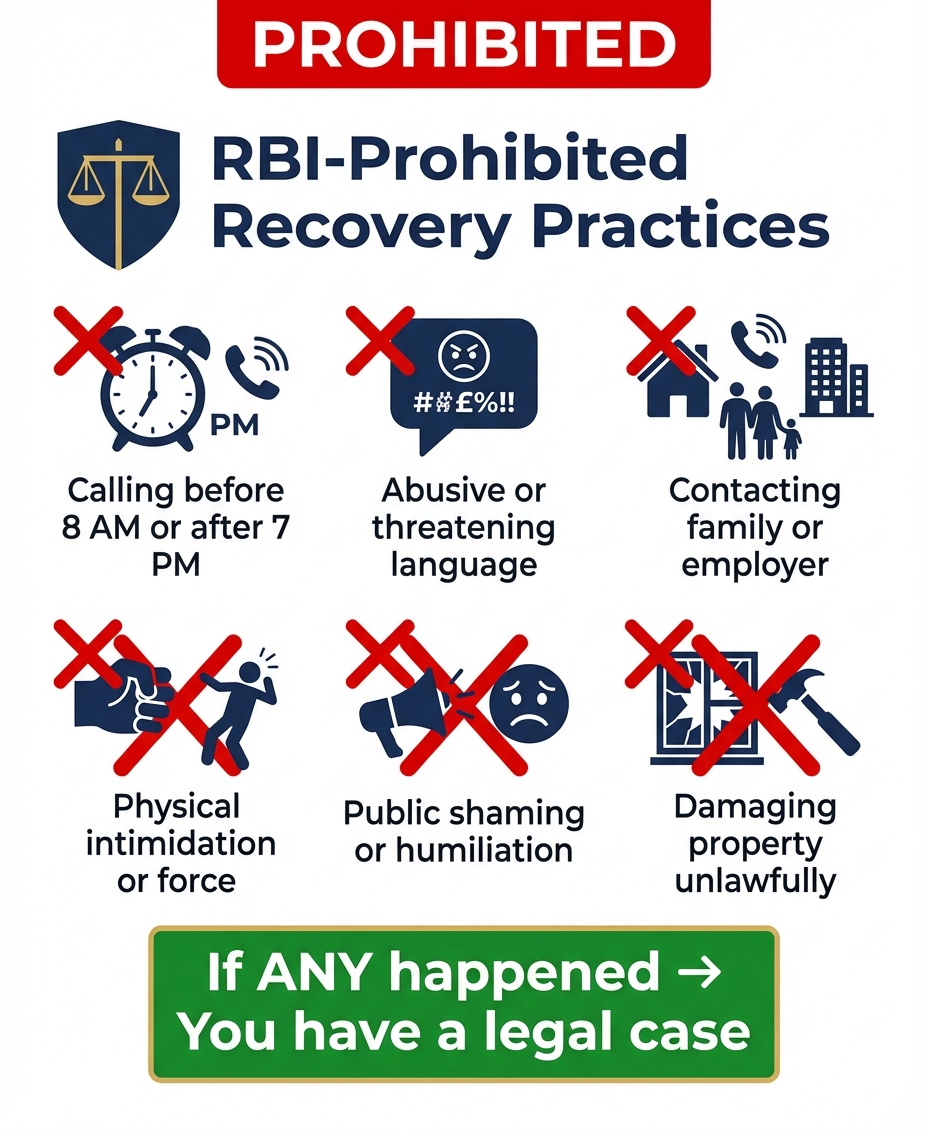
- No calls before 8:00 AM or after 7:00 PM — Recovery agents must not contact borrowers outside these hours.
- No use of muscle power or intimidation — Any form of physical violence, threat of violence, or use of hired goons is strictly prohibited.
- No harassment of family members — Recovery agents must not contact or harass any person other than the borrower and co-borrower/guarantor.
- No public humiliation — Agents must not display or distribute any notice or communication regarding the borrower's default in any public place, social media, or to third parties.
- No misrepresentation of legal position — Agents must not falsely claim that the borrower will be arrested or face criminal charges for non-payment of a loan.
- No seizure of property without legal process — Repossession of secured assets must strictly follow the procedure laid down in the SARFAESI Act, 2002, and the relevant RBI guidelines.
RBI Circular on Outsourcing of Recovery Activities
As per the RBI circular dated November 3, 2007, and subsequent guidelines, banks must ensure that their outsourced recovery agents are properly trained and comply with all applicable laws and regulations. The bank remains fully responsible for the actions of its agents. If a recovery agent violates the guidelines, the bank cannot wash its hands of liability by claiming the agent acted independently.
Recovery Agent Conduct Rules
The RBI has prescribed specific conduct rules that every recovery agent must follow:
- Recovery agents must identify themselves with a valid authorisation letter and photo identity card issued by the lender.
- Agents must maintain complete records of all interactions with the borrower, including dates, times, and the nature of communication.
- They must not visit the borrower's workplace unless the borrower has failed to respond to repeated attempts at communication at the residence address.
- Agents must respect the borrower's privacy and not disclose the borrower's financial information to any third party, including family members who are not co-borrowers or guarantors.
- They must provide the borrower with adequate information about the outstanding amount, including a breakup of principal, interest, and charges, if requested.
- Any repossession of assets must be conducted in strict compliance with the SARFAESI Act and relevant court orders, with prior notice to the borrower.
Your Legal Rights as a Borrower
Indian law provides borrowers with a comprehensive set of rights that protect them against harassment, intimidation, and illegal recovery practices. Knowing your rights is the first and most important step in protecting yourself against abusive recovery tactics.
- Right to Dignity (Article 21, Constitution of India): The Supreme Court has repeatedly held that the right to live with dignity is part of the fundamental right to life under Article 21. No recovery agent or bank can subject you to treatment that violates your dignity as a human being.
- Right to Privacy: Your financial information, including details of your loan and default, is confidential. The lender and its agents cannot disclose this information to your family members, friends, neighbours, colleagues, or any third party who is not a co-borrower or guarantor.
- Right Against Intimidation: Criminal intimidation is an offence under Section 503 of the Indian Penal Code (IPC) / Section 351 of the Bharatiya Nyaya Sanhita (BNS). Any threat to your life, body, property, or reputation to coerce you into paying constitutes criminal intimidation.
- Family Members Are Not Liable: Unless a family member is a co-borrower, co-applicant, or guarantor on the loan, they have absolutely no legal liability for your debt. Recovery agents contacting or pressuring your family members is a direct violation of RBI guidelines and may constitute harassment.
- Right to Reasonable Notice: Before taking any recovery action, the lender must provide you with a reasonable written notice specifying the amount due, the deadline for payment, and the consequences of non-payment.
- Right Against Illegal Seizure: For secured loans, the lender must follow the procedure under the SARFAESI Act to take possession of the secured asset. This includes issuing a 60-day notice under Section 13(2), providing an opportunity to object, and following due process. Any seizure without following this procedure is illegal.
- Right to Complaint: You have the right to file a complaint against the lender or its recovery agents with the RBI Banking Ombudsman, the police, the Consumer Forum, and civil and criminal courts.
- Right to One-Time Settlement (OTS): If you are unable to repay the full outstanding amount, you have the right to negotiate a one-time settlement with the lender. RBI guidelines encourage lenders to offer reasonable settlement options to distressed borrowers.
The right to life enshrined in Article 21 of the Constitution includes the right to live with dignity. Any action by a creditor or its agent that causes humiliation, mental agony, or infringes upon the debtor's dignity in the process of debt recovery is unconstitutional and actionable.
— Supreme Court of India, various rulings on right to dignity
When to Send a Legal Notice
A legal notice is a formal written communication that puts the bank, NBFC, or recovery agent on notice that their conduct is illegal and that you intend to pursue legal remedies if the harassment does not stop immediately. You should strongly consider sending a legal notice in any of the following situations:
- Recovery agents are making threatening or abusive phone calls, using foul language, or threatening you with arrest, criminal prosecution, or physical harm.
- You are receiving calls before 8 AM or after 7 PM, in direct violation of RBI guidelines.
- Recovery agents have visited your workplace, causing embarrassment and potentially jeopardising your employment.
- Agents have contacted your family members, friends, or colleagues and disclosed your loan default, violating your privacy.
- Recovery agents have physically intimidated you, trespassed on your property, or used musclemen to threaten you.
- A digital lending app has accessed your phone contacts and sent defamatory messages to your contacts about your loan default.
- The lender has seized your vehicle or other property without following due legal process under the SARFAESI Act.
- You have been publicly shamed or defamed through notices pasted on your door, pamphlets distributed in your area, or social media posts.
- The lender is charging excessive interest or hidden charges that were not disclosed at the time of loan sanction.
- You are being harassed despite having made a settlement or repayment arrangement with the lender.
Pro Tip: Document Everything
Before sending a legal notice, gather all evidence of harassment. Save call recordings, screenshots of threatening messages and WhatsApp chats, photographs or videos of agents visiting your home or workplace, and written records of any abusive interactions. This evidence will be critical for your legal notice, police complaint, and any subsequent court proceedings.
Being Harassed by Recovery Agents?
OpenVakil's AI-powered platform helps you draft a professional legal notice against loan recovery harassment in minutes. Stop the abuse and assert your legal rights today.
Draft Your Legal Notice NowEssential Elements of a Legal Notice Against Loan Harassment
A well-drafted legal notice is your most powerful first step in stopping loan recovery harassment. The notice must be precise, legally grounded, and assertive. Here are the essential elements your notice should contain:
- Sender's Details: Full name, address, and contact information of the borrower (you). If the notice is being sent through an advocate, include the advocate's details as well.
- Recipient's Details: Name, designation, and registered office address of the bank/NBFC/digital lender. Also include the specific branch from which the loan was taken and the details of the recovery agency involved (if known).
- Loan Account Details: Loan account number, type of loan (personal, home, vehicle, credit card), date of disbursement, sanctioned amount, EMI amount, and current outstanding balance.
- Detailed Statement of Facts: A chronological account of the harassment — dates, times, nature of calls, names of agents (if known), details of visits, specific threats made, messages sent, and any other harassing conduct. Be as specific and factual as possible.
- Evidence Referenced: List all supporting evidence — call recordings, screenshots, photographs, videos, copies of threatening messages, records of calls to family members, and any written communication from the lender.
- RBI Guidelines Violated: Cite the specific RBI circulars and guidelines that the lender and its agents have violated — the Fair Practices Code, the guidelines on outsourcing of recovery activities, the digital lending guidelines, and the restrictions on calling hours and conduct.
- Legal Provisions Violated: Reference the specific provisions of Indian law that have been breached — including Sections 503, 506, 509 of the IPC (or corresponding sections under the BNS), the Information Technology Act (for digital harassment), and the right to privacy and dignity under Article 21 of the Constitution.
- Relief Demanded: Clearly state what you are demanding — immediate cessation of harassment, a written apology, compensation for mental agony and defamation, withdrawal of recovery agents, and assurance that all future communication will be through proper legal channels only.
- Time Frame: Provide a deadline of 15 days for the lender to respond and comply with your demands.
- Consequence of Non-Compliance: Clearly state that failure to comply within the stipulated time will result in filing a complaint with the RBI Banking Ombudsman, a police complaint under the relevant IPC/BNS sections, a civil suit for damages, and a consumer complaint.
Keep the Notice Professional
While it is natural to feel angry and frustrated about harassment, your legal notice must be firm but professional. Avoid emotional language, personal attacks, or exaggeration. A well-reasoned, factual notice citing specific incidents and legal provisions carries far more weight than an angry letter. Courts and regulators respect professionalism.
Step-by-Step Process to Send the Notice
Follow these steps to effectively send a legal notice against loan recovery harassment:
- Gather All Evidence: Compile all evidence of harassment — call recordings, screenshots of messages, photographs of agents at your home or workplace, video recordings, copies of defamatory messages sent to your contacts, and any written communication from the lender or its agents. Organise them chronologically.
- Identify the Respondents: Determine exactly who you will send the notice to. This should include the bank/NBFC/digital lender (addressed to the Managing Director or Grievance Redressal Officer), the specific branch, and the recovery agency (if identifiable). You can also address a copy to the RBI for regulatory notice.
- Draft the Legal Notice: Prepare a comprehensive legal notice incorporating all the essential elements described above. You may draft this yourself, engage an advocate, or use OpenVakil's AI-powered platform for fast, legally sound drafting.
- Have It Reviewed: If you have drafted the notice yourself, consider having it reviewed by a qualified advocate to ensure it is legally sound, cites the correct provisions, and is appropriately assertive without being defamatory.
- Send via Registered Post / Speed Post (AD): The primary mode of sending a legal notice is through Registered Post with Acknowledgment Due (RPAD) or Speed Post. Send it to the registered office of the bank/NBFC, the branch office, and the recovery agency (if applicable). Retain the postal receipt and tracking slip.
- Send a Copy via Email: Additionally, email a scanned PDF copy to the bank's official grievance email address, the Nodal Officer, and the recovery agency. Request a delivery/read receipt.
- Send a Copy to RBI (Optional but Recommended): Consider sending a copy to the Reserve Bank of India's Consumer Education and Protection Department. This signals to the bank that regulatory authorities are being kept in the loop, which often accelerates resolution.
- Maintain a Record: Keep copies of the notice, all postal receipts, tracking information, email delivery confirmations, and a log of all subsequent communications. This creates a paper trail that will be invaluable in any subsequent legal proceedings.
- Wait for Response: Allow the stipulated 15-day period for the bank/NBFC to respond. Many lenders, upon receiving a properly drafted legal notice, will instruct their recovery agents to cease harassment and may offer a settlement.
- Escalate if No Response: If the lender does not respond within 15 days or continues the harassment, proceed to file complaints with the RBI Banking Ombudsman, the police, and the Consumer Forum as outlined in the subsequent sections.
Where to Complain: RBI Ombudsman, Banking Ombudsman & Police
If your legal notice does not produce the desired result, or if the harassment is severe enough to warrant immediate escalation, India has multiple forums where you can lodge complaints against banks, NBFCs, and their recovery agents. Here is a comprehensive overview of your options:
RBI Banking Ombudsman
The RBI Integrated Ombudsman Scheme, 2021 provides a free, expeditious, and effective mechanism for resolving complaints against banks, NBFCs, and other regulated entities. The Ombudsman can entertain complaints related to loan recovery harassment, unfair lending practices, excessive charges, and any violation of RBI guidelines. Key features include:
- The complaint can be filed online at the RBI's Complaint Management System (CMS) portal at cms.rbi.org.in, or by email, post, or in person at any RBI office.
- There is no cost to the complainant.
- The Ombudsman can award compensation up to Rs. 20 lakh for loss suffered by the complainant, and up to Rs. 1 lakh for mental agony and harassment.
- The complaint must be filed within one year of receiving the final reply from the bank, or within one year and one month of filing the complaint with the bank if no reply is received.
- You must first approach the bank's internal grievance mechanism and either receive an unsatisfactory response or no response within 30 days before approaching the Ombudsman.
One Nation, One Ombudsman
Under the RBI Integrated Ombudsman Scheme, 2021, a single centralised Ombudsman handles complaints against all RBI-regulated entities — banks, NBFCs, payment system operators, and credit information companies. You no longer need to identify the specific Ombudsman office; simply file your complaint at cms.rbi.org.in and it will be routed automatically.
RBI Complaint Portal (CMS)
The RBI Complaint Management System (CMS) is the centralised online platform for filing complaints against all RBI-regulated entities. You can file a complaint directly at cms.rbi.org.in. Select the nature of complaint (e.g., "Recovery Agents/Practices"), provide details of the bank/NBFC, upload supporting documents, and track the status of your complaint online. The RBI forwards the complaint to the concerned entity and monitors the resolution. If the entity fails to resolve the complaint satisfactorily, it is escalated to the Ombudsman for adjudication.
You can also reach the RBI through its toll-free number 14448 (for complaints against regulated entities) or write to the Consumer Education and Protection Cell (CEPC) of the RBI regional office in your area.
Police Complaint and Criminal Sections
When loan recovery harassment involves criminal conduct — such as physical assault, criminal intimidation, trespass, defamation, or extortion — you have the right to file a First Information Report (FIR) or a police complaint. The following criminal provisions under the Indian Penal Code (IPC) and the Bharatiya Nyaya Sanhita (BNS), 2023 are commonly invoked:
- Criminal Intimidation: Section 503 IPC / Section 351 BNS — Threatening any person with injury to their person, reputation, or property to cause alarm or compel them to do an act. Punishable with imprisonment up to 2 years and/or fine.
- Criminal Intimidation by Threatening with Death or Grievous Hurt: Section 506 IPC / Section 351(2) BNS — Aggravated form with enhanced punishment of up to 7 years imprisonment.
- Assault or Use of Criminal Force: Section 352 IPC / Section 74 BNS — Any physical assault or use of force by recovery agents. Punishable with imprisonment up to 3 months and/or fine.
- Criminal Trespass: Section 441 IPC / Section 329 BNS — Entering the borrower's property without permission or remaining after being asked to leave. Punishable with imprisonment up to 3 months and/or fine.
- House Trespass: Section 442 IPC / Section 329 BNS — Entering the borrower's residence as a trespasser. Punishable with imprisonment up to 1 year and/or fine.
- Extortion: Section 383 IPC / Section 308 BNS — Intentionally putting a person in fear of injury to obtain money or property. Punishable with imprisonment up to 3 years and/or fine.
- Defamation: Section 499 IPC / Section 356 BNS — Making or publishing any statement intended to harm the reputation of the borrower (e.g., sending messages to contacts, pasting notices). Punishable with imprisonment up to 2 years and/or fine.
- Intentional Insult with Intent to Provoke Breach of Peace: Section 504 IPC / Section 352 BNS — Using abusive or insulting language. Punishable with imprisonment up to 2 years and/or fine.
- Word, Gesture, or Act Intended to Insult Modesty of a Woman: Section 509 IPC / Section 79 BNS — If a female borrower is subjected to obscene or indecent remarks by recovery agents. Punishable with imprisonment up to 3 years and fine.
- Offences under the IT Act, 2000: Section 66E (violation of privacy) and Section 67 (publishing obscene material) of the Information Technology Act apply when digital lending apps access phone data, share morphed images, or send defamatory messages electronically.
If the Police Refuse to File an FIR
If the local police station refuses to register your FIR, you have the following options: (1) approach the Superintendent of Police (SP) or Commissioner of Police with a written complaint; (2) file a complaint before the Judicial Magistrate under Section 156(3) of the Code of Criminal Procedure (CrPC) / Section 175(3) of the Bharatiya Nagarik Suraksha Sanhita (BNSS), who can direct the police to register an FIR and investigate; or (3) file a private criminal complaint directly before the Magistrate under Section 200 CrPC / Section 223 BNSS.
Legal Actions Against Recovery Agents
Beyond sending a legal notice and filing complaints, Indian law provides multiple legal remedies to hold banks, NBFCs, and recovery agents accountable for harassment. Here are the key legal actions available to you:
- Compensation for Mental Agony and Harassment: You can claim compensation for the mental agony, emotional distress, and humiliation caused by the harassment. Consumer Forums and civil courts regularly award compensation ranging from Rs. 25,000 to several lakhs, depending on the severity of the harassment.
- Criminal Complaint: As outlined above, you can file an FIR or criminal complaint against the recovery agent(s) and the authorising bank/NBFC officers under the relevant IPC/BNS provisions. A criminal case can result in arrest, bail conditions that restrain further harassment, and ultimately imprisonment and fine upon conviction.
- Civil Suit for Damages: You can file a civil suit before the appropriate civil court seeking monetary damages for the harm caused, including compensation for loss of reputation, mental agony, loss of employment (if applicable), and punitive damages. You can also seek a permanent injunction restraining the lender and its agents from continuing the harassment.
- Consumer Complaint: Loan recovery harassment constitutes a deficiency in service and an unfair trade practice under the Consumer Protection Act, 2019. You can file a complaint before the District Consumer Disputes Redressal Commission, State Commission, or National Commission (depending on the claim value) seeking compensation, costs, and direction to the bank to cease the harassment.
- Writ Petition (High Court): In cases of extreme harassment involving violation of fundamental rights under Article 21 (right to life and dignity), you can file a writ petition before the High Court under Article 226 of the Constitution seeking directions against the bank and its agents.
- Complaint to the Bank's Board / Senior Management: In many cases, escalating the complaint directly to the bank's Managing Director, Chairman, or Board of Directors through a formal letter (with copies to the RBI) can prompt swift action, as senior management is often unaware of the ground-level misconduct of recovery agents.
Banks and financial institutions should not engage in recovery practices that amount to harassment of borrowers. Any such practices by banks or their agents are a violation of RBI guidelines, and the bank shall be held responsible for the actions of its recovery agents.
— Reserve Bank of India, Guidelines on Recovery Agents engaged by Banks
What Happens After Sending the Notice?
After you send a legal notice against loan recovery harassment, several outcomes are possible. Understanding these scenarios helps you prepare for the next steps:
- Harassment Stops Immediately: In many cases, the mere receipt of a legal notice from a borrower (especially through an advocate) compels the bank or NBFC to instruct its recovery agents to stop the harassment. Banks do not want regulatory complaints or litigation, and a professional legal notice signals that you are serious about pursuing your rights.
- Bank Responds with a Settlement Offer: The bank may respond by offering a one-time settlement (OTS), a restructured repayment plan, or a reduction in the outstanding amount. This is often a favourable outcome, as it allows you to resolve the debt on more reasonable terms while the harassment stops.
- Bank Issues a Written Apology and Takes Action Against Agents: Some banks, particularly larger and more compliance-conscious institutions, may issue a formal apology and confirm that action has been taken against the recovery agents in question. They may also assign a dedicated relationship manager to handle your account going forward.
- Bank Sends a Reply Denying the Allegations: The bank may respond through its legal team denying the harassment or claiming that their agents acted within guidelines. In this case, your documentary evidence (call recordings, screenshots, videos) becomes crucial. You should then escalate the matter to the RBI Ombudsman, file a police complaint, and/or approach the Consumer Forum.
- Bank Does Not Respond: If the bank fails to respond within the 15-day period stipulated in the notice, this non-response itself strengthens your case in any subsequent proceedings. You should proceed to file complaints with the Banking Ombudsman, the police, and the Consumer Forum.
- Harassment Continues Despite the Notice: If the harassment continues even after the legal notice, this is an aggravating factor that courts and regulators take very seriously. Document the continued harassment carefully and proceed immediately with a police complaint (FIR), a Banking Ombudsman complaint, and a Consumer Forum complaint. Courts are likely to award enhanced compensation when harassment persists despite a legal notice.
Stay Calm and Stay the Course
The period after sending a legal notice can be stressful. The bank may initially escalate its attempts to contact you, or the recovery agents may try one last push before standing down. Continue documenting everything and do not engage in heated arguments. Your legal notice has put you in a position of strength — let the process work.
Ready to Take Action Against Loan Harassment?
Don't suffer in silence. OpenVakil helps you draft a legally powerful notice against bank harassment, citing RBI guidelines and relevant laws. Answer a few questions and get your notice ready in minutes.
Start Drafting NowRights Under SARFAESI Act and DRT
For borrowers with secured loans (such as home loans, loan against property, or vehicle loans), it is essential to understand the framework under the Securitisation and Reconstruction of Financial Assets and Enforcement of Security Interest (SARFAESI) Act, 2002 and the Debt Recovery Tribunal (DRT). These laws govern how lenders can recover secured assets, and they impose strict procedural requirements that protect borrowers from arbitrary seizure.
The SARFAESI Act allows banks and financial institutions to recover Non-Performing Assets (NPAs) without court intervention, but only by following a specific procedure. If the lender classifies your loan as an NPA (generally after 90 days of default), it must issue a demand notice under Section 13(2) giving you 60 days to repay the outstanding amount. If you fail to repay within this period, the lender can take possession of the secured asset under Section 13(4). However, you have the right to make a representation or objection within the 60-day period, and the lender is required to consider your representation and provide a reasoned response.
If you believe the lender's actions under SARFAESI are unjustified, you can file an appeal before the Debt Recovery Tribunal (DRT) under Section 17 of the SARFAESI Act within 45 days of the lender taking any action under Section 13(4). The DRT can grant a stay on the lender's actions, order the lender to restore the asset, and provide other appropriate relief. Appeals from DRT orders lie before the Debt Recovery Appellate Tribunal (DRAT).
Secured vs Unsecured Loans
The distinction between secured and unsecured loans is critical in understanding your rights against recovery action:
- Secured Loans (home loan, loan against property, vehicle loan, gold loan): These are backed by collateral. The lender can take action under the SARFAESI Act to recover the secured asset, but only by following the prescribed legal procedure. Even for secured loans, the lender cannot resort to muscle power, intimidation, or self-help remedies. Due process must always be followed.
- Unsecured Loans (personal loan, credit card debt, education loan, digital app loans): These are not backed by any collateral. The lender has no right to seize any property of the borrower for non-payment. The only legal recourse for the lender is to file a civil suit or approach the DRT (if the amount exceeds Rs. 20 lakh) or the Lok Adalat for recovery. Any seizure of property, vehicle, or belongings for an unsecured loan default is completely illegal.
SARFAESI Does Not Apply to All Loans
The SARFAESI Act does not apply to: (1) loans below Rs. 20 lakh; (2) agricultural land used for farming; (3) a security interest in any residential property where the loan amount is below Rs. 20 lakh; and (4) any loan given by a cooperative bank (unless it is a multi-state cooperative bank). If the lender is trying to invoke SARFAESI for a loan that falls outside these parameters, it is acting illegally and you should challenge it immediately.
It is worth noting that even under the SARFAESI Act, the lender must act in good faith and in a commercially reasonable manner. The Supreme Court has held in multiple decisions that the SARFAESI Act is a serious intrusion into the property rights of the borrower and must be construed strictly. Any procedural lapse by the lender — such as failure to issue a proper Section 13(2) notice, failure to consider the borrower's representation, or failure to follow due process in taking possession — renders the lender's action void and can be challenged before the DRT.
Common Mistakes to Avoid
When dealing with loan recovery harassment, borrowers often make mistakes that weaken their legal position or fail to effectively stop the harassment. Avoiding these common pitfalls will significantly improve your chances of a successful resolution:
- Ignoring the Harassment: Many borrowers endure the harassment silently, hoping it will stop on its own. It rarely does. The longer you wait, the more emboldened the recovery agents become. Take action early by sending a legal notice and filing complaints.
- Engaging in Arguments with Recovery Agents: Do not get into heated verbal arguments or physical confrontations with recovery agents. This can be used against you and may escalate the situation. Instead, calmly inform them that their conduct violates RBI guidelines, ask for their authorisation documents, and record the interaction.
- Not Preserving Evidence: Failing to record calls, save messages, or document visits is a critical mistake. Without evidence, your legal notice and complaints will lack the specificity and proof needed to establish harassment. Start documenting from the very first instance of misconduct.
- Paying Under Coercion: Do not make payments under duress or intimidation. Payments made under coercion can be challenged as void, but it is better to avoid the situation altogether. Assert your rights and negotiate on your terms through proper legal channels.
- Not Reading the Loan Agreement: Your loan agreement contains the terms governing recovery, default consequences, and dispute resolution. Understanding these terms helps you identify when the lender is acting beyond its contractual rights.
- Sending an Unprofessional or Threatening Notice: A legal notice that contains emotional outbursts, exaggerated claims, or threats is counterproductive. Keep it professional, factual, and legally grounded.
- Failing to Approach the Right Forum: Many borrowers file complaints with the wrong authority or skip important steps (such as approaching the bank's grievance cell first before going to the Ombudsman). Follow the proper escalation path for the most effective resolution.
- Assuming Loan Default is a Criminal Offence: Recovery agents often exploit borrowers' fear by threatening arrest. Remember that loan default is a civil matter, not a criminal offence. You cannot be arrested for not paying a loan (except in specific cases involving fraud or cheque bounce). Do not let recovery agents use this fear against you.
- Not Seeking Legal Help: Handling loan harassment entirely on your own can be overwhelming. Engaging a lawyer or using a platform like OpenVakil to draft your legal notice ensures that your rights are properly asserted and the notice carries legal weight.
- Overlooking Digital Evidence in App-Based Loans: If you were harassed through a digital lending app, take screenshots of the app's permissions (especially contact access), save all messages sent by the app, and document any defamatory communications sent to your contacts. Also, report the app to the Google Play Store or Apple App Store and the RBI.
Key Takeaway
The three pillars of successfully fighting loan recovery harassment are: (1) thorough documentation of every instance of harassment, (2) timely action through legal notices and complaints, and (3) knowing your rights under RBI guidelines and Indian law. If you have these three, you are in a strong position to stop the harassment and hold the lender accountable.
How OpenVakil Helps
Dealing with loan recovery harassment is an exhausting and demoralising experience, especially when you are already under financial stress. OpenVakil is designed to give you the legal tools you need to fight back effectively, without the delays and high costs associated with traditional legal services.
Our AI-powered platform helps you draft a comprehensive, legally accurate legal notice tailored to your specific situation — whether you are being harassed by a bank, NBFC, digital lending app, or recovery agency. Simply answer a series of guided questions about your loan, the harassment you have faced, and the relief you seek, and OpenVakil generates a professional notice citing the relevant RBI guidelines, IPC/BNS provisions, and constitutional protections.
- AI-Powered Legal Notice Drafting: Generate a professionally worded, legally sound notice against loan recovery harassment in minutes, customised to your specific facts and circumstances.
- Cites All Relevant Laws & RBI Guidelines: Your notice will reference the specific RBI circulars, Fair Practices Code provisions, IPC/BNS sections, and constitutional rights that apply to your case.
- Covers All Loan Types: Whether it is a personal loan, home loan, vehicle loan, credit card debt, or digital app loan, OpenVakil handles legal notices for all categories of lending harassment.
- Guidance on Filing Complaints: Beyond the legal notice, OpenVakil guides you on how to file complaints with the RBI Banking Ombudsman, the police, and the Consumer Forum.
- Affordable & Transparent: Access high-quality legal drafting at a fraction of the cost of engaging a traditional lawyer, with no hidden charges or surprise fees.
- End-to-End Support: From understanding your rights to drafting the notice, sending it to the right authorities, and preparing for the next steps — OpenVakil is with you at every stage.
Thousands of borrowers across India have successfully used legal notices to stop recovery harassment and negotiate fair settlements with their lenders. A well-drafted legal notice is often the most cost-effective and quickest way to resolve the situation without going to court. You do not have to endure harassment in silence — the law is on your side, and OpenVakil makes it easy to exercise your rights.
Stop Loan Recovery Harassment Today
You have the right to be treated with dignity, even if you owe money. Draft a powerful legal notice with OpenVakil, backed by RBI guidelines and Indian law. Take the first step toward freedom from harassment.
Get Started for FreeLoan recovery is a legitimate process, but harassment is not. The Reserve Bank of India has drawn a clear line between lawful recovery and unlawful intimidation, and Indian criminal and civil law provides robust remedies for borrowers whose rights are violated. Whether you are dealing with abusive phone calls, threats from musclemen, defamation by digital lending apps, or illegal seizure of your property, you have multiple legal avenues to fight back. A legal notice is the critical first step — it puts the lender on formal notice, creates a legal record, and often leads to immediate cessation of harassment. Do not wait for the harassment to get worse. Know your rights, document everything, and take action today.