Domestic violence is one of the most pervasive yet underreported human rights violations in India. For decades, women suffering abuse within the confines of their homes had limited legal recourse, as existing criminal provisions primarily focused on physical cruelty and failed to address the full spectrum of abuse that occurs within domestic relationships. The enactment of the Protection of Women from Domestic Violence Act, 2005 (PWDVA) marked a watershed moment in Indian law, providing a comprehensive civil remedy to women subjected to domestic violence in any form — physical, emotional, verbal, sexual, or economic.
A legal notice for domestic violence is often the critical first step toward asserting your rights and compelling an abusive partner or family member to take your claims seriously. Whether you are considering seeking a protection order, residence order, monetary relief, or custody of your children, understanding the legal framework is essential to protecting yourself effectively. This guide provides a thorough, step-by-step explanation of your rights under the PWDVA 2005, the process of sending a legal notice, and the remedies available to survivors of domestic violence in India.
If you or someone you know is facing domestic violence, please remember that the law is firmly on the side of the survivor. No one deserves to live in fear within their own home, and the Indian legal system provides robust mechanisms to ensure safety, dignity, and justice.
What Is Domestic Violence Under Indian Law?
Under Section 3 of the Protection of Women from Domestic Violence Act, 2005, domestic violence is defined broadly to include any act, omission, or commission, or conduct of the respondent that harms or injures or endangers the health, safety, life, limb or well-being — whether mental or physical — of the aggrieved person, or tends to do so. The definition is deliberately expansive, recognizing that domestic violence is not limited to physical assault but encompasses a wide range of abusive behaviours.
The PWDVA marked a paradigm shift in Indian law by acknowledging that domestic violence occurs across a spectrum of abuse — from overt physical beatings to subtle forms of economic deprivation and emotional manipulation. Critically, the Act also treats threats of violence as domestic violence, meaning the abuser need not have actually carried out the act for the law to apply.
Scope of the PWDVA 2005
The Protection of Women from Domestic Violence Act, 2005 is a civil law that provides immediate relief to women facing domestic violence. It does not replace criminal provisions such as Section 498A of the IPC (now Section 85/86 of BNS) but operates alongside them. A woman can simultaneously seek civil remedies under the PWDVA and pursue criminal prosecution under the BNS/IPC, giving her access to a comprehensive toolkit for protection and justice.
The Act defines "domestic relationship" under Section 2(f) as a relationship between two persons who live or have, at any point of time, lived together in a shared household, when they are related by consanguinity, marriage, or through a relationship in the nature of marriage, adoption, or are family members living together as a joint family. This broad definition ensures that the Act covers not just married women but also women in live-in relationships, widows, mothers, sisters, and other female relatives living in a shared household.
Any act, omission or commission or conduct of the respondent shall constitute domestic violence in case it harms or injures or endangers the health, safety, life, limb or well-being, whether mental or physical, of the aggrieved person or tends to do so and includes causing physical abuse, sexual abuse, verbal and emotional abuse and economic abuse.
— Section 3, Protection of Women from Domestic Violence Act, 2005
Types of Domestic Violence Under Section 3 of PWDVA
The PWDVA recognizes four distinct categories of domestic violence, each of which constitutes a legally actionable offence. Understanding these categories is essential for accurately describing the nature of abuse in your legal notice and court application.
Physical Abuse
Physical abuse is defined under the Act as any act or conduct that is of such a nature as to cause bodily pain, harm, or danger to life, limb, or health, or that impairs the health or development of the aggrieved person. It includes assault, criminal intimidation, and criminal force. Physical abuse encompasses:
- Beating, slapping, hitting, kicking, punching, or pushing
- Burning, scalding, or causing injuries with weapons or household objects
- Strangulation, choking, or attempted suffocation
- Pulling hair, biting, or scratching
- Throwing objects at the aggrieved person
- Forcing the consumption of intoxicants, drugs, or other harmful substances
- Any other act that causes or is likely to cause physical injury
Emotional and Verbal Abuse
Verbal and emotional abuse under the PWDVA includes conduct that is insulting, ridiculing, humiliating, or demeaning in nature — particularly in relation to the aggrieved person not having a male child. It also covers repeated threats to cause physical pain, and encompasses a range of psychologically harmful behaviours:
- Insults, name-calling, constant criticism, and ridicule — whether in private or in the presence of others
- Threats to injure, harm, or kill the aggrieved person or her relatives
- Threats of suicide or self-harm to emotionally manipulate the aggrieved person
- Accusations of infidelity, character assassination, and attacks on the woman's moral character
- Humiliation related to not bearing a male child or not bringing sufficient dowry
- Preventing the aggrieved person from communicating with her family, friends, or social network (isolation)
- Repeated derogatory remarks about the aggrieved person's appearance, intelligence, or capabilities
- Gaslighting, controlling behaviour, and psychological manipulation
Emotional Abuse Is Legally Recognized
Many survivors do not realize that emotional and verbal abuse is a legally recognized form of domestic violence under the PWDVA. You do not need to show physical injuries to seek legal protection. Persistent insults, threats, humiliation, isolation, and controlling behaviour all constitute domestic violence under Indian law and entitle you to the full range of remedies available under the Act.
Sexual Abuse
Sexual abuse under the PWDVA includes any conduct of a sexual nature that abuses, humiliates, degrades, or otherwise violates the dignity of the aggrieved person. While the Indian Penal Code (and now the BNS) historically did not recognize marital rape as a criminal offence (except in cases of judicial separation), the PWDVA provides civil remedies for sexual abuse within a domestic relationship. Sexual abuse includes:
- Forced sexual intercourse or sexual acts against the will of the woman
- Forcing the woman to watch pornography or engage in degrading sexual acts
- Any unwanted sexual contact, touching, or advances within the domestic relationship
- Humiliating sexual behaviour, including taunts and insults of a sexual nature
- Using sex as a tool for punishment, control, or coercion
- Denying the woman the right to use contraception or make autonomous reproductive choices
- Forcing pregnancy or forcing abortion
Economic Abuse
Economic abuse is one of the most significant additions made by the PWDVA, addressing a form of abuse that was largely invisible under earlier Indian law. It includes deprivation of all or any economic or financial resources to which the aggrieved person is entitled or requires for her basic necessities. Economic abuse encompasses:
- Denying or restricting access to household finances, bank accounts, or income
- Prohibiting or restricting the aggrieved person from accessing employment or earning a livelihood
- Not providing maintenance, food, clothing, medicines, or other basic necessities despite having the means to do so
- Disposing of, alienating, or encumbering stridhan (the woman's property, jewellery, and possessions) without her consent
- Prohibiting or restricting access to resources or facilities that the aggrieved person is entitled to use by virtue of the domestic relationship
- Forcing the woman out of the shared household or preventing her from accessing any part of it
- Not paying rent or other bills related to the shared household, causing deprivation
- Disposing of or transferring property belonging to the shared household without consent
Who Can File a Complaint?
Under the PWDVA, the aggrieved person is defined under Section 2(a) as any woman who is, or has been, in a domestic relationship with the respondent and who alleges to have been subjected to any act of domestic violence by the respondent. The complaint can be filed by:
- The aggrieved woman herself — the primary complainant in any case of domestic violence.
- Any person on behalf of the aggrieved woman — including a relative, friend, neighbour, or any other person, with the leave of the Magistrate. This is particularly important when the woman is unable to file the complaint herself due to physical or mental incapacity, fear, or any other reason.
- A Protection Officer — appointed under the Act, who can file an application on behalf of the aggrieved person.
- A Service Provider — an organization registered under the Act that provides legal aid, medical, financial, or other assistance to women facing domestic violence.
Live-In Partners Are Protected
The Supreme Court of India, in its landmark judgment in D. Velusamy v. D. Patchaiammal (2010), held that a woman in a "relationship in the nature of marriage" (live-in relationship) is entitled to protection under the PWDVA. The relationship must, however, resemble a marriage — meaning the couple must have held themselves out to the world as being akin to spouses, must be of legal age to marry, must be otherwise qualified to enter into a legal marriage, and must have voluntarily cohabited for a significant period of time.
The respondent under the Act is defined as any adult male person who is, or has been, in a domestic relationship with the aggrieved person. However, following the Supreme Court's ruling in Hiral P. Harsora v. Kusum Narottamdas Harsora (2016), the words "adult male" were struck down as unconstitutional, meaning that a complaint can now be filed against any person — male or female, including a mother-in-law, sister-in-law, or other female relative. This expanded the scope of the Act significantly to address the reality that domestic violence is often perpetrated by multiple members of the household.
Facing Domestic Violence? Get Legal Help Now
Do not suffer in silence. Use OpenVakil to draft a legally accurate domestic violence legal notice or court application. Our AI-powered platform guides you through the process step by step, ensuring your rights are fully protected under the PWDVA 2005.
Draft Your NoticeProtection of Women from Domestic Violence Act, 2005 — Key Provisions
The PWDVA is a landmark piece of legislation that provides a range of civil remedies to women facing domestic violence. Below are the key sections of the Act that every aggrieved person and legal practitioner should be familiar with:
Section 12: Application to Magistrate
Section 12 is the gateway provision of the PWDVA that allows the aggrieved person (or a Protection Officer or Service Provider on her behalf) to present an application to the Magistrate seeking one or more of the reliefs available under the Act. The application may seek a protection order, residence order, monetary relief, custody order, or compensation order. The Magistrate is required to endeavour to dispose of every application within 60 days from the date of its first hearing. Importantly, the application may be filed before the Magistrate having jurisdiction over the area where the aggrieved person resides, where the respondent resides or carries on business, or where the cause of action has arisen.
Section 17: Right to Reside in a Shared Household
Section 17 enshrines the right of every woman in a domestic relationship to reside in the shared household, regardless of whether she has any title or beneficial interest in the property. This is one of the most significant provisions of the PWDVA, as it addresses the common practice of women being thrown out of the marital or shared home. The aggrieved woman cannot be evicted or excluded from the shared household or any part of it by the respondent, except in accordance with the procedure established by law. This right subsists whether or not the woman has any legal right, title, or interest in the shared household.
Notwithstanding anything contained in any other law for the time being in force, every woman in a domestic relationship shall have the right to reside in the shared household, whether or not she has any right, title or beneficial interest in the same.
— Section 17(1), Protection of Women from Domestic Violence Act, 2005
Section 18: Protection Orders
Section 18 empowers the Magistrate to pass a protection order in favour of the aggrieved person, prohibiting the respondent from committing any act of domestic violence, aiding or abetting the commission of domestic violence, entering the aggrieved person's place of employment or educational institution, attempting to communicate with the aggrieved person (including by phone, email, or letter), alienating any assets or operating bank accounts held jointly or individually, causing violence to the dependants or relatives of the aggrieved person, or committing any other act as specified in the protection order. A breach of a protection order is a cognizable and non-bailable offence punishable under Section 31 of the Act with imprisonment up to one year and/or a fine up to Rs. 20,000.
Section 19: Residence Orders
Section 19 empowers the Magistrate to pass a residence order, which may restrain the respondent from dispossessing or disturbing the aggrieved person's possession of the shared household, direct the respondent to remove himself from the shared household, restrain the respondent or his relatives from entering any portion of the shared household where the aggrieved person resides, restrain the respondent from alienating or disposing of the shared household or encumbering it, restrain the respondent from renouncing rights in the shared household, or direct the respondent to secure alternative accommodation for the aggrieved person of the same level as enjoyed by her in the shared household, or to pay rent for such alternative accommodation.
Section 20: Monetary Relief
Section 20 allows the Magistrate to direct the respondent to pay monetary relief to the aggrieved person to meet her expenses, including the loss of earnings, medical expenses, loss caused due to destruction, damage, or removal of any property from the shared household, and maintenance for the aggrieved person and her children. The monetary relief must be adequate, fair and reasonable and consistent with the standard of living to which the aggrieved person is accustomed. The Magistrate may also direct the employer or debtor of the respondent to directly pay the aggrieved person or deposit it with the court.
Section 21: Custody Orders
Section 21 empowers the Magistrate to grant temporary custody of any child or children to the aggrieved person at any stage of the proceedings. This provision is crucial because domestic violence often directly affects children, and ensuring their safety and well-being is a paramount concern. The Magistrate may also grant visitation rights to the respondent, but no order for visitation shall be passed if the Magistrate is of the opinion that such visitation would be harmful to the interests of the child. The welfare of the child is the primary consideration in all custody determinations.
Section 22: Compensation Orders
Section 22 provides for compensation orders, under which the Magistrate may direct payment of compensation and damages for the injuries — including mental torture and emotional distress — caused by the acts of domestic violence committed by the respondent. This compensation is in addition to any other relief granted under the Act and can also be awarded in addition to punishment under Section 31 for breach of a protection order. The quantum of compensation is determined based on the nature and gravity of the domestic violence, the suffering and emotional distress caused, and the financial circumstances of the parties.
When and Why to Send a Legal Notice
While the PWDVA provides for direct application to the Magistrate, sending a legal notice before or alongside formal proceedings can be a highly effective strategic step. A legal notice serves multiple critical purposes in domestic violence cases:
- Formal documentation of abuse: A legal notice creates a formal, time-stamped record of the domestic violence, the specific incidents, and the demands of the aggrieved person. This serves as powerful evidence in subsequent court proceedings.
- Demonstrating seriousness of intent: A notice drafted by a lawyer signals to the respondent and his family that the aggrieved person is aware of her legal rights and is prepared to pursue them. This often prompts a more constructive response than verbal complaints alone.
- Opportunity for settlement: In many cases, a well-drafted legal notice opens the door for negotiated resolution — particularly regarding maintenance, return of stridhan, custody arrangements, or a mutual separation — without the need for prolonged litigation.
- Pre-litigation step for monetary claims: If the aggrieved person is seeking monetary relief, maintenance, or return of her property, a legal notice establishes the claim formally and gives the respondent a reasonable opportunity to comply before the matter is taken to court.
- Establishing timeline: The legal notice records the timeline of events, helping to counter any future attempts by the respondent to deny or minimize the abuse.
- Protecting property rights: A notice can specifically demand that the respondent refrain from alienating, disposing of, or encumbering the shared household or the aggrieved person's belongings, creating a documented record of such demand.
Legal Notice vs. Direct Court Application
A legal notice is not a mandatory precondition to filing an application under the PWDVA. In cases of immediate danger, the aggrieved person should directly approach the Magistrate or the Protection Officer without delay. However, in cases where there is no immediate physical threat and the aggrieved person wishes to explore resolution before litigation, a legal notice is a strategic and effective first step. In many cases, the legal notice and court application are pursued simultaneously for maximum protection.
Essential Elements of a Domestic Violence Legal Notice
A domestic violence legal notice must be drafted with precision, sensitivity, and legal accuracy. The following elements are essential for a notice that is both legally effective and practically impactful:
- Full details of the sender (aggrieved person): Name, address, and relevant personal details of the woman sending the notice through her advocate.
- Full details of the recipient (respondent): Name, address, and relationship with the aggrieved person. If the notice is addressed to multiple respondents (e.g., husband and in-laws), each should be separately identified.
- Description of the domestic relationship: Details of the marriage or relationship, including date of marriage/commencement of cohabitation, nature of the domestic relationship, and the shared household.
- Chronological account of domestic violence: A detailed, factual, and chronological narration of each incident of domestic violence — physical, emotional, sexual, or economic — including specific dates, descriptions, witnesses, and any injuries suffered. Avoid vague or generalized allegations; specificity strengthens the notice.
- Details of stridhan and belongings: A comprehensive list of the aggrieved person's stridhan (jewellery, gifts, and property given to her at or around the time of marriage), personal belongings, and any other property left in the shared household.
- Previous complaints (if any): Reference to any prior complaints made to police, Protection Officer, women's cell, family counselling centre, or any other authority, along with their outcomes.
- Medical records and evidence: Reference to any medical treatment, hospital visits, injury reports, or psychological counselling undergone as a result of the domestic violence.
- Legal provisions invoked: Citation of relevant sections of the Protection of Women from Domestic Violence Act, 2005, the Bharatiya Nyaya Sanhita (BNS) or Indian Penal Code (IPC), the Hindu Marriage Act / Special Marriage Act (if applicable), and any other relevant legislation.
- Specific demands: Clearly articulate the demands — such as cessation of all forms of violence, payment of maintenance, return of stridhan, access to the shared household, custody of children, or monetary compensation.
- Time period for compliance: A reasonable deadline (typically 15 to 30 days) for the respondent to comply with the demands or respond to the notice.
- Consequences of non-compliance: A clear statement that failure to comply will result in the aggrieved person initiating legal proceedings under the PWDVA, filing a criminal complaint under BNS/IPC, and/or pursuing any other legal remedies available.
Accuracy Is Critical
Every allegation in the legal notice must be truthful and accurate. False or exaggerated claims can undermine the credibility of the aggrieved person in subsequent court proceedings and may also attract counter-allegations. Ensure that every incident described in the notice can be substantiated with evidence — whether documentary, medical, or testimonial.
Step-by-Step Process to Send the Notice
The following step-by-step process will guide you through preparing, drafting, and sending a legal notice for domestic violence:
- Ensure your immediate safety: Before initiating any legal process, ensure that you and your children (if any) are in a safe location. If you are in immediate danger, call the police (dial 100), contact the Women Helpline (181), or reach out to a nearby shelter home or NGO.
- Document the abuse: Prepare a detailed written account of all incidents of domestic violence, with specific dates, times, descriptions, and witnesses. Collect and preserve all evidence — medical reports, photographs of injuries, screenshots of threatening messages, recordings (where legally permissible), and statements from witnesses.
- Consult a lawyer: Engage an advocate with experience in domestic violence and family law matters. Share all details of the abuse, your evidence, your current situation (including financial condition, custody of children, and housing), and your objectives.
- Draft the legal notice: Your advocate will draft a comprehensive legal notice incorporating all the essential elements described above. Review the draft carefully to ensure factual accuracy and completeness. The notice should be on the advocate's letterhead and signed by the advocate.
- Send the notice via RPAD: Dispatch the legal notice via Registered Post with Acknowledgement Due (RPAD) to each respondent at their known address. RPAD provides proof of dispatch and delivery, which is important evidence for the court. Retain a copy of the notice, the postal receipt, and the acknowledgement card.
- Consider sending via courier and email: In addition to RPAD, you may also send the notice via speed post, private courier (with tracking), or email to ensure receipt. While RPAD remains the gold standard for legal notices, supplementary modes of delivery provide additional assurance.
- Wait for the response period: Allow the stipulated time period (usually 15 to 30 days) for the respondent to respond. During this period, continue to document any further incidents of abuse or intimidation.
- Proceed with legal action if necessary: If the respondent fails to respond or comply, or if the violence continues, proceed to file an application under Section 12 of the PWDVA before the Magistrate, file a Domestic Incident Report (DIR) through the Protection Officer, and/or file a criminal complaint (FIR) under the relevant BNS/IPC sections.
Remedies Available Under the PWDVA
The PWDVA provides a comprehensive suite of civil remedies that can be sought individually or in combination. The Magistrate has wide discretion to grant relief that is appropriate to the circumstances of each case:
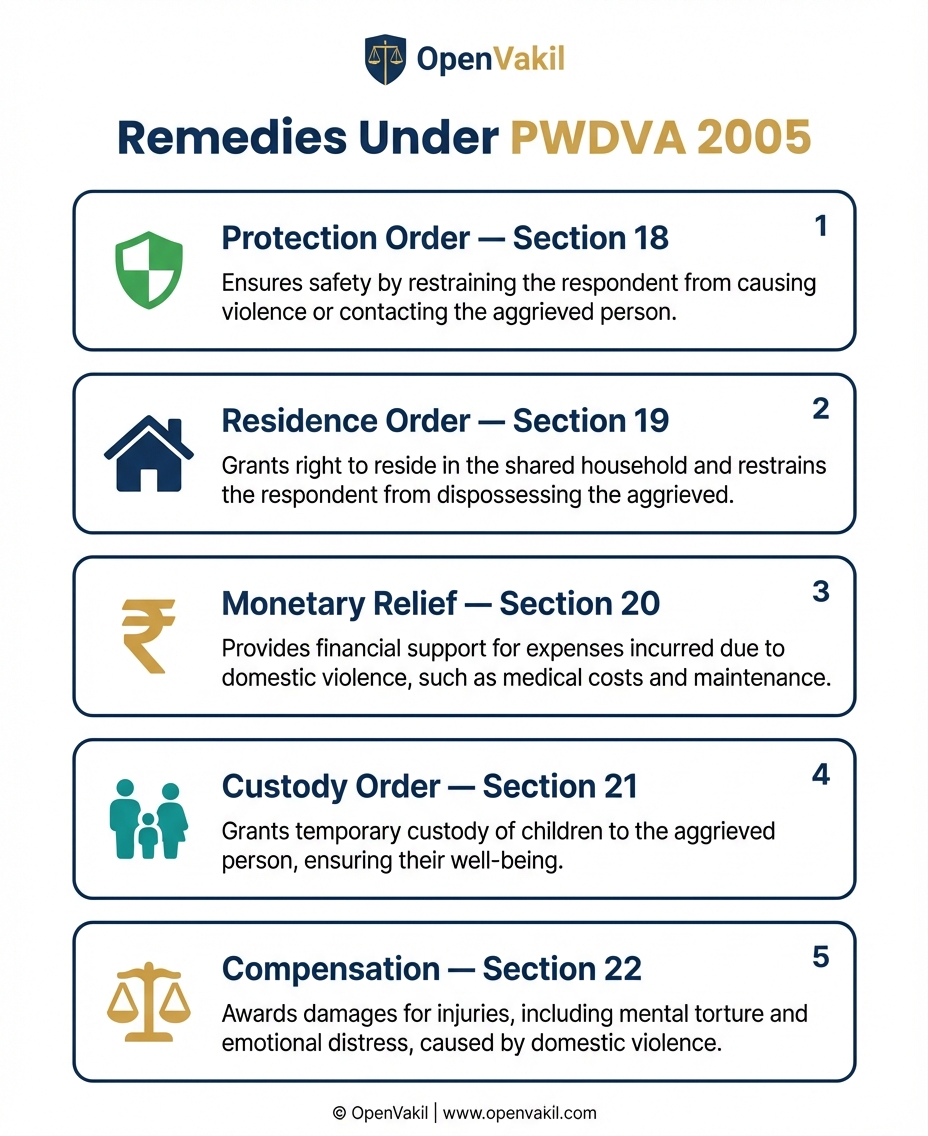
- Protection Order (Section 18): Prohibits the respondent from committing further acts of domestic violence, contacting the aggrieved person, entering her workplace or educational institution, alienating assets, or causing violence to her dependants. A breach is punishable with imprisonment up to 1 year and/or fine up to Rs. 20,000.
- Residence Order (Section 19): Prevents eviction from the shared household, directs the respondent to vacate the premises, restrains alienation of the shared household, or directs the respondent to provide alternative accommodation of the same standard.
- Monetary Relief (Section 20): Covers loss of earnings, medical expenses, property damage, and maintenance for the aggrieved person and her children. The relief must be adequate and consistent with the standard of living to which the woman is accustomed.
- Custody Order (Section 21): Grants temporary custody of children to the aggrieved person. Visitation rights may be granted to the respondent only if it is not harmful to the child.
- Compensation Order (Section 22): Awards compensation for mental trauma, emotional distress, and injuries suffered as a result of domestic violence. This is in addition to any other relief under the Act.
- Ex Parte Orders (Section 23): The Magistrate may grant interim or ex parte orders on the basis of an affidavit filed by the aggrieved person if there is a prima facie case and if the Magistrate is satisfied that the application discloses domestic violence or the respondent is likely to commit domestic violence. This ensures immediate protection even before the respondent is heard.
The Magistrate may, on being satisfied that domestic violence has taken place, pass a protection order in favour of the aggrieved person and prohibit the respondent from committing any act of domestic violence.
— Section 18, Protection of Women from Domestic Violence Act, 2005
Role of Protection Officer and Service Providers
The PWDVA creates a support infrastructure through Protection Officers and Service Providers, who play a vital role in assisting women facing domestic violence. Understanding their roles is essential for effectively navigating the legal process.
Protection Officers are appointed by the State Government under Section 8 of the PWDVA. Their responsibilities include:
- Assisting the aggrieved person in filing a Domestic Incident Report (DIR) in Form I under the Act
- Forwarding copies of the DIR to the Magistrate and the police in the jurisdiction where the domestic violence has taken place
- Making an application under Section 12 on behalf of the aggrieved person, if required
- Ensuring that the aggrieved person is provided with legal aid under the Legal Services Authorities Act, 1987
- Assisting in obtaining medical examination and treatment for the aggrieved person
- Ensuring the aggrieved person is provided with access to a shelter home if she requires temporary accommodation
- Assisting the Magistrate in enforcement of orders, including service of notices and protection orders on the respondent
- Maintaining a list of all service providers offering legal, medical, financial, and shelter assistance in the area
Service Providers are organizations registered under Section 10 of the PWDVA that provide assistance to women facing domestic violence. They are authorized to:
- Record Domestic Incident Reports on behalf of the aggrieved person
- Provide medical assistance, counselling, legal aid, and shelter to women facing domestic violence
- Forward the DIR to the Magistrate and Protection Officer
- Assist the aggrieved person in obtaining legal representation and pursuing remedies under the Act
Locating Your Protection Officer
Every district in India has a designated Protection Officer under the PWDVA. You can contact the office of the District Magistrate, the District Legal Services Authority, the nearest police station, or a women's helpline (dial 181) to obtain the contact details of the Protection Officer in your area. Many states also publish this information on their official websites.
Filing a DIR (Domestic Incident Report) and Court Application
The Domestic Incident Report (DIR) is a standardized form (Form I under the Protection of Women from Domestic Violence Rules, 2006) that records the details of domestic violence. Filing a DIR is a critical step in the legal process under the PWDVA:
- Preparation of the DIR: The DIR can be prepared by the aggrieved person herself, by the Protection Officer, by a Service Provider, or by any other person authorized under the Act. It must contain the details of the aggrieved person, the respondent, the nature of the domestic relationship, a detailed description of each incident of domestic violence, any injuries sustained, any previous history of domestic violence, and the relief sought.
- Filing with the Protection Officer: The completed DIR is submitted to the Protection Officer, who is responsible for forwarding copies to the Magistrate having jurisdiction and to the local police station.
- Magistrate's jurisdiction: The application under Section 12 can be filed before the Magistrate within whose jurisdiction (a) the aggrieved person permanently or temporarily resides, (b) the respondent resides or carries on business, or (c) the cause of action has arisen.
- Filing the court application: Along with or following the DIR, the aggrieved person (or the Protection Officer on her behalf) files an application under Section 12 before the Magistrate, accompanied by an affidavit. The application must specify the relief sought — protection order, residence order, monetary relief, custody order, and/or compensation.
- First hearing and notice: The Magistrate fixes a date for the first hearing and issues notice to the respondent. The Act mandates that the Magistrate endeavour to dispose of the matter within 60 days from the date of first hearing.
- Ex parte orders: If the Magistrate is satisfied that an ex parte order is necessary to protect the aggrieved person from further domestic violence, such an order can be passed based on the affidavit alone, even before the respondent is heard.
- Final order: After hearing both parties and examining evidence, the Magistrate passes appropriate orders granting relief under one or more sections of the Act.
No Limitation Period Under PWDVA
Unlike certain criminal provisions that have a limitation period for filing complaints, the PWDVA does not prescribe a strict limitation period for filing an application under Section 12. However, it is always advisable to file the application as soon as possible after the occurrence of domestic violence, as delay can affect the credibility of the claim and the availability of evidence. Some High Courts have observed that the application should be filed within a reasonable time.
BNS/IPC Sections for Criminal Complaint
While the PWDVA provides civil remedies, domestic violence may also constitute criminal offences under the Bharatiya Nyaya Sanhita (BNS) and the Indian Penal Code (IPC). The aggrieved person can simultaneously pursue criminal prosecution alongside civil remedies under the PWDVA. The key criminal provisions applicable to domestic violence cases include:
- Section 498A IPC / Section 85-86 BNS — Cruelty by husband or his relatives: This is the primary criminal provision for domestic violence. It penalizes any husband or relative of the husband who subjects a woman to cruelty — defined as any wilful conduct likely to drive the woman to commit suicide or cause grave injury to her life, limb, or health (physical or mental), or harassment with a view to coercing her or her relatives to meet any unlawful demand for property or dowry. The offence is cognizable, non-bailable, and non-compoundable, punishable with imprisonment up to 3 years and a fine.
- Section 304B IPC / Section 80 BNS — Dowry death: If a woman dies within 7 years of marriage under circumstances that are not natural, and it is shown that she was subjected to cruelty or harassment in connection with dowry, it is presumed to be a dowry death. Punishable with imprisonment of not less than 7 years, which may extend to life imprisonment.
- Section 354 IPC / Section 74 BNS — Assault or criminal force to woman with intent to outrage her modesty: Punishable with imprisonment of 1 to 5 years and a fine.
- Section 506 IPC / Section 351 BNS — Criminal intimidation: Threatening to cause injury to the person, property, or reputation of the aggrieved person. Punishable with imprisonment up to 2 years and/or fine (up to 7 years if the threat is to cause death or grievous hurt).
- Section 323 IPC / Section 115 BNS — Voluntarily causing hurt: Punishable with imprisonment up to 1 year and/or fine up to Rs. 1,000.
- Section 325 IPC / Section 117 BNS — Voluntarily causing grievous hurt: Punishable with imprisonment up to 7 years and a fine.
- Dowry Prohibition Act, 1961: Giving or taking of dowry is punishable with imprisonment of not less than 5 years and a fine. Demanding dowry (Section 4) is also separately punishable with imprisonment of 6 months to 2 years and a fine.
Section 498A: Cognizable and Non-Bailable
Section 498A of the IPC (now corresponding provisions under BNS) is a cognizable offence, meaning the police can arrest without a warrant. It is also non-bailable, meaning bail is not a matter of right but is at the discretion of the court. The Supreme Court in Arnesh Kumar v. State of Bihar (2014) has laid down guidelines to prevent automatic arrest, requiring the police to first be satisfied that arrest is necessary. However, the provision remains a powerful tool for women facing severe domestic cruelty.
It is important to understand that civil remedies under the PWDVA and criminal remedies under the BNS/IPC are not mutually exclusive. An aggrieved woman can simultaneously file a DIR and apply for a protection order under the PWDVA while also filing an FIR under Section 498A or other applicable sections. The two proceedings operate independently, and the outcome of one does not automatically affect the other. In many cases, pursuing both civil and criminal remedies concurrently provides the most comprehensive protection.
Common Mistakes to Avoid
Navigating domestic violence proceedings can be complex and emotionally taxing. The following are common mistakes that can weaken a case or delay the relief process:
- Not documenting incidents of abuse: Relying solely on oral accounts makes it difficult to establish a pattern of abuse. Maintain a written diary documenting each incident with dates, times, descriptions, witnesses, and photographs of any injuries. This contemporaneous record is invaluable evidence.
- Delaying action out of fear or shame: Many women delay seeking legal help due to social stigma, fear of retaliation, family pressure, or hope that the situation will improve. Delay weakens your case, makes evidence harder to gather, and prolongs your suffering. The law is designed to protect you — use it.
- Leaving the shared household without legal advice: While your immediate safety is paramount, leaving the shared household without first securing a residence order or legal documentation can complicate your right to return. If possible, consult a lawyer before leaving, or file for a residence order immediately after leaving.
- Not preserving evidence of stridhan: Keep records of all stridhan (jewellery, gifts, and property received at or around the time of marriage) including photographs, purchase receipts, gift deeds, and witness statements. Stridhan recovery is a significant component of domestic violence proceedings.
- Filing vague or generalized complaints: Complaints and legal notices that contain vague allegations without specific dates, incidents, or details are less likely to be taken seriously by the court. Be specific and detailed in describing each act of domestic violence.
- Ignoring economic abuse: Many women focus solely on physical violence and overlook the economic dimensions of the abuse. Document all instances of economic deprivation — denial of finances, refusal to provide maintenance, misappropriation of your earnings, and alienation of property.
- Not seeking ex parte orders when needed: If there is an immediate threat to your safety, do not wait for the respondent to be served notice. Apply for ex parte interim orders under Section 23 of the PWDVA, which the Magistrate can grant without hearing the respondent.
- Relying only on police complaints: While filing an FIR is important in criminal matters, the PWDVA provides civil remedies that are often faster and more comprehensive. Always pursue PWDVA proceedings alongside criminal complaints for maximum protection.
- Not involving the Protection Officer: The Protection Officer can be a valuable ally — assisting with the DIR, facilitating access to shelter and medical care, and ensuring enforcement of court orders. Engage the Protection Officer early in the process.
- Sending a defective legal notice: A notice that fails to cite the correct legal provisions, contains factual inaccuracies, or is poorly drafted can undermine your credibility. Always have your legal notice drafted or reviewed by an experienced family law advocate.
How OpenVakil Helps
Dealing with domestic violence requires not only emotional strength but also access to reliable, affordable, and confidential legal assistance. OpenVakil is committed to empowering survivors with the legal tools they need to break free from abuse and secure justice.
- Legally accurate notices and applications: Every domestic violence legal notice generated by OpenVakil is drafted in strict compliance with the Protection of Women from Domestic Violence Act, 2005, the Bharatiya Nyaya Sanhita, the Dowry Prohibition Act, and all other applicable laws — ensuring your communication carries the full weight of the law.
- Tailored to your specific situation: Our guided process carefully captures the details of your case — the nature and history of abuse, the domestic relationship, the shared household, stridhan details, children's custody needs, and your specific objectives — to generate a notice that is customized to your circumstances.
- DIR and court application assistance: Beyond legal notices, OpenVakil can help you prepare a comprehensive Domestic Incident Report and court application under Section 12, complete with all necessary details, supporting documents, and affidavit structure.
- Guidance on multiple remedies: Our platform helps you understand and pursue all available remedies — protection orders, residence orders, monetary relief, custody orders, and compensation — so that you receive comprehensive protection.
- Strictly confidential: We understand the deeply sensitive nature of domestic violence cases. All information shared on the platform is treated with the highest level of confidentiality and security.
- Fast and affordable: Generate your legal notice, DIR, or court application in minutes — at a fraction of the cost of traditional legal consultation — without compromising on legal accuracy or quality.
- Download-ready professional format: Download your completed documents as professional PDFs, ready to be sent via Registered Post, submitted to the Protection Officer, or filed with the Magistrate.
No one should have to endure domestic violence, and no one should face the legal system alone. OpenVakil gives you the legal tools to protect yourself, your children, and your future — with dignity, precision, and confidence. The law is on your side, and we are here to help you use it.
Take the First Step Toward Safety and Justice
You deserve to live free from violence and fear. Use OpenVakil to draft a legally compliant domestic violence legal notice, Domestic Incident Report, or court application under the PWDVA 2005. Your safety and dignity matter.
Get Started Now