Divorce is one of the most emotionally and legally complex processes an individual can face. In India, where marriage is considered both a sacred institution and a legally binding contract, the decision to dissolve a marriage carries profound personal and legal consequences. A divorce legal notice is typically the first formal step in the process — a written communication sent by one spouse (or their advocate) to the other, expressing the intention to seek dissolution of the marriage and outlining the grounds and grievances that have led to this decision.
Whether you are considering a mutual consent divorce or a contested divorce, understanding how to draft, send, and respond to a divorce legal notice is essential. A well-drafted notice sets the tone for the entire proceeding, preserves your legal rights, and can often facilitate an amicable resolution without prolonged litigation. This comprehensive guide covers every aspect of the divorce legal notice process under Indian law, including the relevant statutes, grounds for divorce across different personal laws, essential elements of the notice, and what to expect after the notice is sent.
What Is a Divorce Legal Notice?
A divorce legal notice is a formal written document sent by one spouse (referred to as the "sender" or "aggrieved party") to the other spouse, communicating the sender's intention to seek a divorce. It is prepared and dispatched by a licensed advocate on behalf of the sender and is governed by the provisions of Section 80 of the Code of Civil Procedure, 1908 (where applicable) as well as the relevant personal law or matrimonial statute.
The notice serves as a precursor to formal divorce proceedings. While sending a legal notice is not a mandatory precondition for filing a divorce petition in most cases, it is a widely recognised best practice in Indian matrimonial law. It demonstrates the seriousness of the sender's intent, provides an opportunity for negotiation and settlement, and creates an official record that can be presented as evidence before the Family Court.
When Is a Divorce Legal Notice Needed?
A divorce legal notice is typically sent in the following situations:
- When one spouse wants to formally communicate their intention to seek divorce before filing a petition.
- When attempts at verbal or informal reconciliation have failed and a formal step is required.
- When one spouse wishes to document specific grievances — such as cruelty, desertion, adultery, or domestic violence — as a precursor to litigation.
- When the sender wants to initiate settlement discussions regarding alimony, child custody, and property division before court proceedings begin.
- When one spouse has been unresponsive to informal communication and a formal notice is needed to compel a response.
Purpose and Legal Significance
The legal notice serves multiple important purposes in the divorce process:
- Formal communication of intent: It places the other spouse on official notice that the sender intends to seek dissolution of the marriage, eliminating any ambiguity about the sender's intentions.
- Documentation of grievances: The notice creates a written, time-stamped record of the specific grounds and facts relied upon by the sender, which becomes valuable evidence in subsequent proceedings.
- Opportunity for resolution: By outlining the grievances and proposed terms, the notice opens the door for negotiation, mediation, or mutual consent divorce without the need for protracted litigation.
- Demonstration of good faith: Courts view the sending of a legal notice favourably, as it shows that the sender attempted to resolve the matter before burdening the judicial system.
- Establishing a timeline: The date of the notice can be significant for calculating periods of desertion, separation, or other time-dependent grounds for divorce.
Is a Legal Notice Mandatory Before Filing for Divorce?
Under most Indian personal laws, sending a legal notice is not a statutory prerequisite for filing a divorce petition. However, it is a strongly recommended step in legal practice. A notice can help establish key facts, demonstrate that attempts were made to resolve the matter, and often leads to an out-of-court settlement. In cases involving government employees or public bodies, Section 80 of the CPC may require a formal notice before filing a civil suit.
Grounds for Divorce in India
India's divorce laws are governed by different personal laws applicable to different religious communities. The grounds for divorce vary depending on the personal law or statute under which the marriage was solemnised. Understanding the applicable grounds is critical, as the legal notice must clearly state the specific ground(s) under which divorce is being sought.
Hindu Marriage Act, 1955 — Section 13
The Hindu Marriage Act, 1955 applies to Hindus, Buddhists, Jains, and Sikhs. Section 13 of the Act specifies the grounds on which either spouse can petition for divorce:
- Adultery (Section 13(1)(i)): The respondent has had voluntary sexual intercourse with any person other than the petitioner after the solemnisation of the marriage.
- Cruelty (Section 13(1)(ia)): The respondent has treated the petitioner with cruelty, whether physical or mental. This is the most commonly invoked ground and includes physical violence, verbal abuse, emotional harassment, dowry demands, and any conduct that makes it unreasonable for the petitioner to continue living with the respondent.
- Desertion (Section 13(1)(ib)): The respondent has deserted the petitioner for a continuous period of not less than two years immediately preceding the presentation of the petition. Desertion means the abandonment of one spouse by the other without reasonable cause and without the consent of the other.
- Conversion (Section 13(1)(ii)): The respondent has ceased to be a Hindu by conversion to another religion.
- Unsoundness of mind (Section 13(1)(iii)): The respondent has been incurably of unsound mind or has been suffering continuously or intermittently from mental disorder of such a kind and to such an extent that the petitioner cannot reasonably be expected to live with the respondent.
- Virulent leprosy (Section 13(1)(iv)): The respondent has been suffering from a virulent and incurable form of leprosy. (Note: This ground has been largely rendered obsolete by modern medical treatment.)
- Venereal disease (Section 13(1)(v)): The respondent has been suffering from a communicable venereal disease.
- Renunciation (Section 13(1)(vi)): The respondent has renounced the world by entering any religious order.
- Not heard alive (Section 13(1)(vii)): The respondent has not been heard of as being alive for a period of seven years or more by those who would naturally have heard of the respondent if alive.
Additionally, Section 13(2) provides grounds available only to the wife:
- The husband has been guilty of rape, sodomy, or bestiality since the solemnisation of marriage.
- A decree or order of maintenance has been passed in favour of the wife under Section 125 of the CrPC (or Section 18 of the Hindu Adoptions and Maintenance Act), and cohabitation has not been resumed for one year or more after such decree.
- The marriage was solemnised before the wife attained the age of 15, and she repudiated the marriage before attaining 18 years of age.
Cruelty, as a ground for divorce, is not limited to physical violence. It encompasses any conduct that inflicts mental agony, humiliation, or such suffering that makes it impossible for the aggrieved spouse to continue the matrimonial relationship. The conduct must be of such a nature as would cause a reasonable apprehension in the mind of the petitioner that it would be harmful or injurious to live with the respondent.
— Samar Ghosh v. Jaya Ghosh, (2007) 4 SCC 511
Special Marriage Act, 1954
The Special Marriage Act, 1954 governs marriages between parties belonging to different religions or those who choose a civil marriage irrespective of religion. Section 27 of the Act specifies the grounds for divorce, which are substantially similar to those under the Hindu Marriage Act:
- Adultery by the respondent after solemnisation of marriage.
- Desertion for a continuous period of not less than two years.
- Sentence of imprisonment for seven years or more for an offence as defined under the IPC.
- Cruelty — physical or mental — making it unreasonable for the petitioner to cohabit.
- Unsoundness of mind or continuous mental disorder.
- Venereal disease in a communicable form.
- Leprosy in a virulent and incurable form.
- Not heard of as being alive for seven years or more.
- Failure to comply with a decree for restitution of conjugal rights for a period of two years or more.
- Non-resumption of cohabitation for two years or more after a decree or order of judicial separation.
Section 28 of the Special Marriage Act also provides for divorce by mutual consent, requiring both parties to have lived separately for a period of one year or more and to jointly petition the court.
Muslim Personal Law
Divorce under Muslim personal law operates under a distinct framework with different procedures for husbands and wives:
- Talaq (by husband): A Muslim husband can pronounce divorce (talaq) upon his wife. Following the landmark judgment of the Supreme Court in Shayara Bano v. Union of India (2017), instant triple talaq (talaq-e-biddat) has been declared unconstitutional and is now a criminal offence under the Muslim Women (Protection of Rights on Marriage) Act, 2019. A valid talaq must follow the prescribed procedure with a waiting period (iddat) of three menstrual cycles.
- Khula (by wife): A Muslim wife can seek divorce by offering to return her mehr (dower) to the husband. Khula requires the consent of the husband, though courts have in some cases granted khula even without the husband's consent on grounds of equity.
- Mubarat (mutual divorce): Both spouses mutually agree to dissolve the marriage. An offer is made by one party and accepted by the other, and the divorce becomes effective upon acceptance.
- Dissolution of Muslim Marriages Act, 1939: Under Section 2 of this Act, a Muslim wife can obtain a judicial decree of divorce on grounds including desertion for four years, failure to maintain for two years, imprisonment for seven years, cruelty, impotency, insanity, and other specified grounds.
Triple Talaq Is Now a Criminal Offence
The Muslim Women (Protection of Rights on Marriage) Act, 2019 declares instant triple talaq (talaq-e-biddat) void and illegal. A husband who pronounces triple talaq can face imprisonment of up to three years and a fine. The wife is entitled to maintenance and custody of minor children. If you have been subjected to instant triple talaq, you have the right to file an FIR and seek immediate legal remedies.
Indian Divorce Act, 1869 (Christian Divorce)
The Indian Divorce Act, 1869 governs divorce among Christians in India. Under Section 10 of the Act (as amended in 2001), either spouse may petition for dissolution of marriage on the following grounds:
- Adultery by the respondent.
- Conversion from Christianity to another religion.
- Unsoundness of mind for a continuous period of not less than two years.
- Suffering from a virulent and incurable form of leprosy for not less than two years.
- Suffering from venereal disease in a communicable form for not less than two years.
- The respondent has not been heard of as being alive for seven years.
- Wilful refusal to consummate the marriage.
- Failure to comply with a decree of restitution of conjugal rights for two years or more.
- Desertion without reasonable excuse for two years or more.
- Cruelty — treating the petitioner with such cruelty as to cause a reasonable apprehension of harm.
Section 10A (inserted by the 2001 amendment) also allows divorce by mutual consent for Christian couples who have lived separately for two years or more.
Parsi Marriage and Divorce Act, 1936
The Parsi Marriage and Divorce Act, 1936 governs matrimonial matters for the Parsi community. Under Section 32, either spouse may sue for divorce on grounds including adultery, cruelty, desertion for two or more years, unsoundness of mind for two years, the respondent suffering from venereal disease, the wife having been forced into prostitution, non-compliance with a decree of restitution of conjugal rights, and imprisonment for seven years or more. The Act also allows mutual consent divorce under Section 32B.
Mutual Consent Divorce vs Contested Divorce
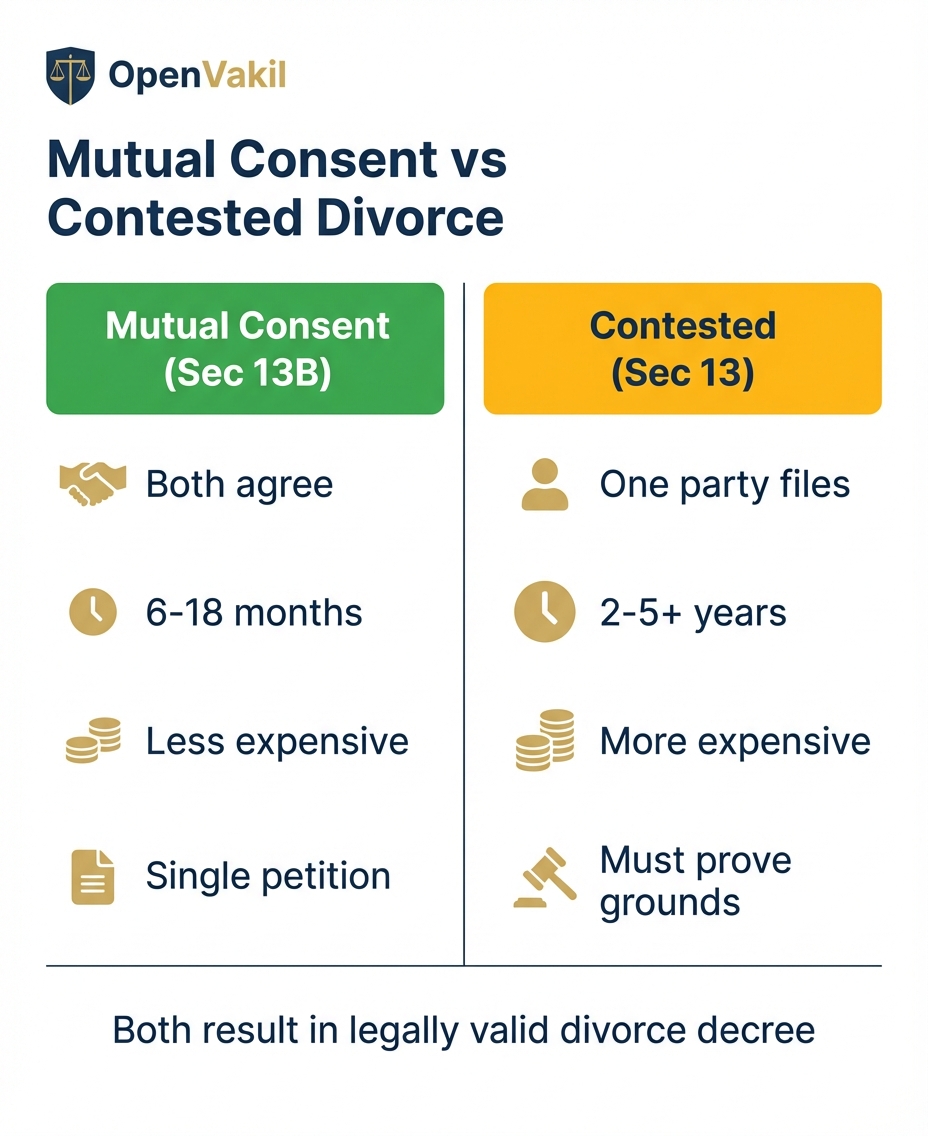
The distinction between mutual consent divorce and contested divorce is fundamental to understanding the divorce process in India. The type of divorce determines not only the procedure and timeline but also the nature and content of the legal notice that precedes it.
Mutual Consent Divorce — Section 13B
Section 13B of the Hindu Marriage Act (and corresponding provisions in other personal laws) allows both spouses to jointly petition for divorce when they mutually agree that the marriage has irretrievably broken down. The key requirements are:
- Mutual agreement: Both spouses must genuinely consent to the divorce. There must be no coercion, fraud, or undue influence.
- Living separately: The spouses must have been living separately for a period of one year or more before filing the joint petition. "Living separately" means not living together as husband and wife — it does not necessarily require living in different houses.
- Joint petition: Both parties file a joint petition before the Family Court stating that they have been unable to live together and have mutually agreed that the marriage should be dissolved.
- Cooling-off period: After the first motion (filing), the court grants a cooling-off period of six months (but not exceeding 18 months) before the second motion. During this period, either party can withdraw consent. However, the Supreme Court in Amardeep Singh v. Harveen Kaur (2017) held that the six-month cooling-off period can be waived by the court if it is satisfied that the parties have genuinely settled all disputes.
- Second motion: After the cooling-off period, both parties appear before the court and confirm that they still wish to proceed with the divorce. If both parties confirm, the court passes the decree of divorce.
In mutual consent divorce cases, the legal notice typically serves as a formal invitation to begin settlement discussions — addressing terms of alimony, child custody, property division, and other matters — rather than as an adversarial document.
Contested Divorce
A contested divorce occurs when one spouse files a divorce petition and the other spouse opposes it. The petitioner must prove the alleged ground(s) for divorce before the court. Contested divorces are significantly more complex, time-consuming, and expensive than mutual consent divorces. Key aspects include:
- Burden of proof: The petitioner must provide evidence — including witness testimony, documentary proof, medical reports, police complaints, and other material — to establish the ground(s) for divorce on a preponderance of probabilities.
- Timeline: Contested divorces in India can take anywhere from 2 to 10 years or more, depending on the complexity of the case, the court's docket, and appeals.
- Interim relief: During the pendency of proceedings, either spouse can apply for interim maintenance (Section 24 of the Hindu Marriage Act), custody of children, or injunctions to protect shared assets.
- Mediation and settlement: The Family Courts Act, 1984 mandates that the court must first attempt settlement and conciliation before proceeding to trial. Many contested cases are eventually resolved through court-annexed mediation.
In contested divorce cases, the legal notice is a more assertive and detailed document that lays out the specific grounds, facts, and evidence relied upon, and warns the respondent that formal proceedings will follow if the matter is not resolved.
Key Differences at a Glance
- Consent: Mutual consent requires agreement from both spouses; contested divorce is initiated unilaterally.
- Timeline: Mutual consent divorce typically takes 6 to 18 months; contested divorce can take 2 to 10+ years.
- Cost: Mutual consent divorce is significantly less expensive as it avoids prolonged litigation.
- Emotional toll: Mutual consent proceedings are less adversarial and psychologically less taxing for both parties and children.
- Evidence: Mutual consent requires no proof of specific grounds; contested divorce requires the petitioner to prove the alleged ground(s).
- Outcome certainty: Mutual consent divorce almost always results in a decree; contested divorce outcomes are uncertain and depend on evidence and judicial discretion.
Converting Contested Divorce to Mutual Consent
Even after filing a contested divorce petition, spouses can at any stage agree to convert the proceedings into a mutual consent divorce under Section 13B. This is a common outcome when court-directed mediation succeeds. If both parties reach an agreement on alimony, custody, and property, the contested petition is withdrawn and a joint petition under Section 13B is filed, significantly expediting the process.
When Should You Send a Divorce Legal Notice?
The timing and circumstances under which you send a divorce legal notice can significantly affect the outcome of your case. While the decision to seek divorce is deeply personal, certain situations make sending a legal notice particularly strategic and important:
- Persistent cruelty or domestic violence: If you are experiencing physical violence, emotional abuse, dowry harassment, or other forms of cruelty, a legal notice serves as documented evidence and puts the abusive spouse on formal notice. It also strengthens any related proceedings under the Protection of Women from Domestic Violence Act, 2005.
- Prolonged desertion: If your spouse has abandoned you without reasonable cause for two or more years, a legal notice formally establishes the timeline and your willingness to continue the marriage (which the deserting spouse has rejected).
- Failed reconciliation attempts: When informal discussions, family interventions, and counselling have all failed to resolve marital differences, a legal notice escalates the matter to a formal legal plane.
- Adultery or infidelity: If you have evidence of your spouse's extramarital relationship and wish to seek divorce on this ground, the legal notice documents your awareness and provides an opportunity for the respondent to respond before court proceedings begin.
- Initiating mutual consent discussions: Even in amicable separations, a legal notice helps formalise the beginning of settlement discussions and ensures both parties take the process seriously.
- Protecting financial interests: If you suspect your spouse may dissipate marital assets, hide income, or transfer property to defeat your maintenance or property claims, a legal notice creates a documented starting point and can be followed by applications for injunction in court.
- When the spouse is unresponsive: If your spouse refuses to engage in any meaningful communication about the separation, a legal notice compels a response within a specified timeframe.
Domestic Violence: Seek Immediate Protection
If you are facing domestic violence, do not rely solely on a legal notice. File a complaint under the Protection of Women from Domestic Violence Act, 2005 to obtain a protection order, residence order, and monetary relief. You can also call the Women Helpline (181) or file a police complaint under Section 498A of the Indian Penal Code. A legal notice for divorce can proceed alongside these protective measures.
Ready to Take the First Step?
OpenVakil helps you draft a comprehensive, legally sound divorce legal notice tailored to your specific circumstances. Answer a few questions about your situation and receive a professional notice ready to send through your advocate.
Create Your Divorce Legal NoticeEssential Elements of a Divorce Legal Notice
A divorce legal notice must be carefully drafted to include all necessary elements. An incomplete or poorly drafted notice can undermine your credibility and weaken your legal position. The following elements are essential:
- Details of the sender (client): Full legal name, address, contact details, and the capacity in which the notice is being sent (i.e., as the husband or wife in the marriage).
- Details of the recipient (spouse): Full legal name, current residential address, and any alternative address where the spouse may be served. If the spouse's address is unknown, the last known address should be used.
- Details of the advocate: Name, enrolment number, address, and contact details of the advocate sending the notice on behalf of the client.
- Marriage details: Date, place, and manner of solemnisation of the marriage (e.g., Hindu rites, registered under Special Marriage Act), marriage registration number (if registered), and the personal law or statute under which the marriage was performed.
- Factual narrative: A chronological, detailed account of the marriage — including the initial period, birth of children (if any), the onset of marital problems, specific incidents relied upon as grounds for divorce, and the current state of the relationship. Each material fact should be stated clearly, with approximate dates and details.
- Grounds for divorce: The specific legal ground(s) under the applicable personal law on which divorce is sought — for example, cruelty under Section 13(1)(ia), desertion under Section 13(1)(ib), or adultery under Section 13(1)(i) of the Hindu Marriage Act. Reference the precise statutory provision.
- Attempts at reconciliation: A brief account of any efforts made to save the marriage — counselling sessions, family interventions, written communications — and why these attempts have been unsuccessful.
- Relief sought: Clearly state the specific relief demanded — whether it is divorce, maintenance/alimony, child custody, return of stridhan (wife's property), division of jointly held assets, or other reliefs. Be specific about amounts and terms wherever possible.
- Proposed settlement terms (if applicable): In cases aimed at mutual consent, the notice may propose specific terms regarding maintenance amount, child custody arrangement, property division, and other matters for negotiation.
- Deadline for response: A specific timeframe (typically 15 to 30 days from the date of receipt) within which the recipient must respond to the notice.
- Consequences of non-response: A clear statement that failure to respond or comply within the specified period will result in the sender filing a divorce petition before the appropriate Family Court without further notice.
Tone Matters
A divorce legal notice should be firm, factual, and professional. Avoid using inflammatory language, personal insults, or emotional accusations. The notice is a legal document that may be presented before the court — an intemperate tone can reflect poorly on the sender and may even be used against them. Let the facts speak for themselves.
Step-by-Step Process for Sending a Divorce Notice
The process of sending a divorce legal notice involves several carefully sequenced steps. Following this process methodically ensures that your notice is legally sound and strategically effective:
- Consult a family law advocate: Before any other step, consult an advocate who specialises in family and matrimonial law. Discuss your situation, share all relevant facts (even those that may seem unfavourable), and seek advice on the applicable personal law, grounds for divorce, and the most appropriate strategy for your case.
- Gather all relevant documents: Compile your marriage certificate, photographs of the marriage ceremony, birth certificates of children, property documents, financial records (salary slips, bank statements, tax returns), medical records (if cruelty or mental health is relevant), police complaints (if any), written communications (emails, messages, letters), and any other evidence that supports your case.
- Identify the applicable law and grounds: Based on your religion and the manner of marriage, identify whether the Hindu Marriage Act, Special Marriage Act, Muslim personal law, Indian Divorce Act, or Parsi Marriage and Divorce Act applies. Then identify the specific ground(s) for divorce that apply to your situation.
- Draft the legal notice: Your advocate (or a platform like OpenVakil) will draft a comprehensive legal notice incorporating all the essential elements discussed above. Review the draft carefully, verify all facts and dates, and approve the final version before it is sent.
- Send the notice via registered post with acknowledgment due (AD): The notice must be dispatched through registered post or speed post with AD to the spouse's residential address (and any other known address). This provides legally admissible proof of dispatch and delivery. Retain the postal receipt and the AD card when returned.
- Send a copy via email or courier (optional but recommended): In addition to registered post, sending a copy of the notice via email (with read receipt) or reputed courier service provides additional proof and ensures faster delivery.
- Retain copies for your records: Keep at least two copies of the signed notice, the postal receipts, the courier tracking details, and the AD card. These will be required when filing the divorce petition.
- Wait for the response: Allow the full period specified in the notice (typically 15 to 30 days from the date of receipt, not the date of dispatch) for the spouse to respond. Your advocate should review any response received and advise you on the next steps.
Jurisdiction for Filing the Divorce Petition
Under the Hindu Marriage Act (Section 19), a divorce petition can be filed before the Family Court or District Court within whose jurisdiction: (a) the marriage was solemnised, (b) the respondent resides at the time of filing, (c) the parties last resided together, or (d) the petitioner resides (in case the wife is the petitioner). Choose the most convenient and strategically advantageous jurisdiction.
Legal Framework Governing Divorce in India
India's legal framework for divorce is a complex tapestry of religion-specific personal laws and secular legislation. Understanding this framework is essential for drafting a legally accurate divorce notice:
- Hindu Marriage Act, 1955: Applies to Hindus, Buddhists, Jains, and Sikhs. Provides for both contested divorce (Section 13) and mutual consent divorce (Section 13B). Also governs judicial separation (Section 10), restitution of conjugal rights (Section 9), and maintenance pendente lite (Section 24).
- Special Marriage Act, 1954: Applies to civil marriages regardless of religion. Grounds for divorce under Section 27; mutual consent under Section 28. This Act is particularly relevant for inter-religious marriages.
- Dissolution of Muslim Marriages Act, 1939: Provides Muslim women with judicial remedies for divorce on specified grounds under Section 2.
- Muslim Women (Protection of Rights on Marriage) Act, 2019: Criminalises instant triple talaq and provides for maintenance and custody rights.
- Indian Divorce Act, 1869: Governs divorce among Christians. Amended in 2001 to provide mutual consent divorce under Section 10A.
- Parsi Marriage and Divorce Act, 1936: Governs divorce among Parsis under Section 32.
- Family Courts Act, 1984: Establishes Family Courts with exclusive jurisdiction over matrimonial disputes, including divorce, maintenance, child custody, and property. Mandates conciliation and mediation before trial.
- Protection of Women from Domestic Violence Act, 2005: Provides civil remedies — protection orders, residence orders, monetary relief, and custody orders — to women facing domestic violence. Often invoked alongside divorce proceedings.
- Hindu Minority and Guardianship Act, 1956: Governs custody and guardianship of Hindu minor children, establishing the father as the natural guardian and the mother as the natural guardian of children below five years.
- Guardians and Wards Act, 1890: The secular legislation governing custody and guardianship applicable across all religions. The paramount consideration is the welfare of the child.
In matters concerning the custody of minor children, the paramount consideration is the welfare and best interests of the child. The wishes of the parents, their financial capacity, and moral character are relevant, but the child's physical, emotional, educational, and social well-being must be the court's primary concern.
— Gaurav Nagpal v. Sumedha Nagpal, (2009) 1 SCC 42
What Happens After Sending the Notice?
The period following the dispatch of a divorce legal notice is critical. The recipient's response (or lack thereof) will shape the entire trajectory of the divorce proceedings. Here are the possible outcomes:
- Agreement to mutual consent divorce: The most favourable outcome is when the recipient agrees to proceed with a mutual consent divorce. Both parties (through their advocates) then negotiate the terms — alimony, child custody, property division, and other matters — and file a joint petition under Section 13B. This path is the fastest and least acrimonious.
- Counter-notice or reply disputing claims: The recipient may engage an advocate and send a detailed reply denying the allegations, presenting their own version of facts, or making counter-allegations. This reply is an important document — it reveals the respondent's legal position and anticipated defence, which helps the sender's advocate prepare for court proceedings.
- Negotiation and settlement: Even in contested situations, the exchange of legal notices often opens a channel for negotiation. The advocates may engage in discussions to reach a settlement on contentious issues like alimony quantum, custody arrangements, or property division, potentially converting the matter to a mutual consent divorce.
- No response from the recipient: If the recipient does not respond within the specified timeframe, the sender's advocate will typically proceed to file the divorce petition. The non-response is placed on record as evidence that the respondent was given an opportunity to resolve the matter amicably and chose not to engage. Courts view this unfavourably for the non-responding party.
- Reconciliation: In some cases, the receipt of a legal notice serves as a wake-up call that prompts genuine efforts at reconciliation. If both parties wish to give the marriage another chance, the proceedings can be paused or withdrawn at any stage.
Regardless of the outcome, the legal notice establishes a formal, documented starting point for the divorce process. Every subsequent legal step — from filing the petition to seeking interim relief — can reference this notice as evidence of the sender's good-faith attempt to resolve the matter outside of court.
Important Considerations: Child Custody, Alimony & Property
Divorce involves far more than the dissolution of the marital bond. Three critical ancillary issues — child custody, alimony, and property division — often dominate the divorce process and must be carefully addressed in the legal notice and subsequent proceedings.
Child Custody
Child custody is often the most emotionally charged aspect of divorce. Indian law recognises the following types of custody arrangements:
- Physical custody: The child resides with one parent (the custodial parent) while the other parent (the non-custodial parent) has visitation rights.
- Joint custody: Both parents share physical custody, with the child spending substantial time with each parent. While joint custody is not explicitly provided for in Indian statutes, courts have increasingly granted it in the best interests of the child.
- Sole custody: One parent has exclusive custody rights, and the other parent may have limited or supervised visitation. This is typically ordered when one parent is deemed unfit.
- Legal guardianship: The right to make important decisions about the child's education, health, and welfare. This can be shared even when physical custody is with one parent.
Under the Hindu Minority and Guardianship Act, 1956, the father is the natural guardian of a Hindu minor child, while the mother is the natural guardian of children below five years of age. However, courts have consistently held that the welfare of the child is the paramount consideration and have awarded custody to the parent best suited to serve the child's interests, regardless of these default provisions. The Guardians and Wards Act, 1890 applies across all religions and similarly prioritises the child's welfare.
Alimony and Maintenance
Indian law provides for two types of maintenance in divorce proceedings:
- Maintenance pendente lite (Section 24, Hindu Marriage Act): Interim maintenance payable during the pendency of divorce proceedings. Either spouse who has no independent income sufficient for self-support can claim maintenance pendente lite along with litigation expenses.
- Permanent alimony and maintenance (Section 25, Hindu Marriage Act): Post-divorce maintenance that may be awarded as a lump sum or a monthly amount. The court considers factors including the respondent's income and assets, the applicant's income and earning capacity, the standard of living during the marriage, the duration of the marriage, the age and health of both parties, and the applicant's contribution to the family.
- Maintenance under Section 125 CrPC (now Section 144 BNSS): A wife (including a divorced wife who has not remarried) can claim maintenance under this provision regardless of religion. The order can be passed by a Magistrate's court and is typically faster than divorce court proceedings.
The Supreme Court has held that maintenance should enable the applicant to live with dignity and in a manner as close as possible to the standard of living enjoyed during the marriage. The quantum is determined on a case-by-case basis, and courts increasingly consider the earning potential of both spouses, especially in cases where the wife is educated and employable.
Property Division
Unlike many Western jurisdictions, India does not have a community property or equitable distribution regime for marital property. The general principles governing property division in Indian divorce are:
- Separate property: Property acquired by either spouse in their individual name, through their own earnings, or through inheritance, remains the individual property of that spouse. There is no automatic right of the other spouse to a share in individually owned property.
- Stridhan: Under Hindu law, stridhan refers to property given to the wife — before, during, or after marriage — by her parents, relatives, friends, or husband. Stridhan is the absolute property of the wife, and she is entitled to its return upon divorce. The husband has no right over stridhan.
- Jointly acquired property: Property purchased jointly by both spouses during the marriage is divided based on the respective contributions of each spouse. Courts will examine the source of funds, whose name the property is registered in, and other relevant circumstances.
- Matrimonial home: The right to reside in the shared matrimonial home is a separate right that may be granted to the wife (and children) regardless of who owns the property, particularly under the Protection of Women from Domestic Violence Act, 2005.
Wife's Right to Stridhan
The Supreme Court has repeatedly affirmed that stridhan is the absolute property of the wife. In Pratibha Rani v. Suraj Kumar (1985), the Court held that the husband has no right over the wife's stridhan and that any misappropriation of stridhan by the husband or his family amounts to criminal breach of trust. If your stridhan has been withheld, you should specifically demand its return in the legal notice.
Common Mistakes to Avoid
Divorce proceedings are fraught with emotional and legal pitfalls. Avoiding these common mistakes can significantly strengthen your position and expedite the process:
- Sending the notice without consulting a lawyer: A divorce legal notice has significant legal implications. Template-based or self-drafted notices often contain errors, omit critical provisions, or use inappropriate language that can be exploited by the other side. Always engage a qualified family law advocate.
- Providing incomplete or inaccurate facts: Omitting material facts or exaggerating incidents undermines your credibility before the court. Include all relevant facts accurately, even those that may appear unfavourable — your advocate can frame them appropriately.
- Using inflammatory or threatening language: The notice is a legal document, not a vehicle for emotional venting. Abusive, defamatory, or threatening language can result in a counter-complaint for defamation or criminal intimidation and reflects poorly on the sender before the court.
- Failing to address ancillary issues: A notice that focuses solely on divorce without addressing custody, maintenance, stridhan, and property division is incomplete. These issues should be raised early to establish your position and facilitate settlement discussions.
- Not preserving evidence before sending the notice: Once the notice is sent, the other spouse may destroy or conceal evidence. Before dispatching the notice, secure copies of all relevant documents, including financial records, property documents, communications, and photographs.
- Ignoring the response deadline: If you receive a reply notice, respond within the time specified. Ignoring the reply or delaying your response can be construed as a lack of seriousness or an implicit acceptance of the respondent's claims.
- Discussing the notice publicly: Divorce is a private matter. Sharing the contents of the legal notice on social media, with friends, or in public forums can expose you to defamation claims and may prejudice the court against you.
- Not sending the notice to the correct address: If the notice is sent to the wrong address and is not delivered, it has no legal effect. Send the notice to every known address of the spouse — residential, office, and parental home — to ensure delivery.
- Rushing to file the petition without waiting for a response: Give the other party the full time period specified in the notice. Filing a petition prematurely can be seen as an act of bad faith and may delay proceedings.
- Neglecting to consider mediation: Many couples who initially seek contested divorce eventually resolve their disputes through mediation. Be open to mediation at every stage — it saves time, money, and emotional energy.
Beware of Filing False Cases
While divorce legal notices and petitions are legitimate legal tools, filing false complaints (such as fabricated allegations of dowry harassment under Section 498A IPC or domestic violence under the DV Act) is a criminal offence. The Supreme Court has repeatedly cautioned against the misuse of these provisions. Filing false cases can result in criminal prosecution for perjury, contempt, and the dismissal of your own claims. Always ensure that every allegation in your notice is truthful and supported by evidence.
How OpenVakil Helps
Navigating the divorce process in India can be overwhelming, especially when you are dealing with emotional upheaval and the complexities of different personal laws. OpenVakil simplifies the process of drafting a comprehensive, legally sound divorce legal notice, making professional legal support accessible, affordable, and convenient.
- AI-powered, personalised drafting: Answer a series of straightforward questions about your marriage, the issues you have faced, the grounds for divorce, and the relief you seek. OpenVakil's AI generates a detailed legal notice tailored to your specific situation, referencing the correct personal law and statutory provisions.
- Applicable across all personal laws: Whether your marriage is governed by the Hindu Marriage Act, Special Marriage Act, Muslim personal law, Indian Divorce Act, or Parsi Marriage and Divorce Act, OpenVakil ensures that your notice cites the correct legal framework and grounds.
- Comprehensive coverage of ancillary issues: Your notice will not only address the divorce itself but also lay the groundwork for custody, maintenance, stridhan recovery, and property-related claims — ensuring no critical issue is overlooked.
- Professional, court-ready language: The notice is drafted in the professional, measured tone expected in legal practice — firm and assertive without being inflammatory. It is ready to be reviewed and dispatched by your advocate.
- Fast, affordable, and confidential: Receive your draft notice in minutes at a fraction of the cost of a traditional legal consultation. Your information is treated with the highest standards of confidentiality.
- Guidance for next steps: Beyond the notice, OpenVakil helps you understand the divorce timeline, identify the correct court for filing, and prepare for the proceedings ahead.
Whether you are seeking a mutual consent divorce and need a notice to formalise settlement discussions, or you are preparing for a contested divorce and need a notice that documents your grounds and puts the other party on record, OpenVakil provides the tools and expertise to take the first step with confidence.
Draft Your Divorce Legal Notice with OpenVakil
Take the first step toward a resolution. Create a professionally drafted, legally accurate divorce legal notice tailored to your specific situation. Answer a few questions and get your notice in minutes — comprehensive, confidential, and ready to send.
Get Started Now