Evicting a tenant in India is not as simple as asking them to leave. Indian law provides strong protections for tenants, and landlords must follow a precise legal process to reclaim their property. A tenant eviction notice is the critical first step in this process. If you are a landlord dealing with a difficult tenant situation, understanding the legal framework around eviction notices can save you months of delays and potential legal trouble.
This comprehensive guide walks you through everything you need to know about the eviction notice process in India -- from the legal grounds for eviction and notice period requirements to drafting the notice, filing an eviction suit, and understanding state-specific variations.
What Is a Tenant Eviction Notice?
A tenant eviction notice is a formal written communication from a landlord to a tenant, requesting the tenant to vacate the rented premises within a specified period. It is a mandatory legal prerequisite before a landlord can file an eviction suit in court. Without serving a valid eviction notice, any subsequent legal proceedings may be dismissed outright.
The eviction notice serves multiple purposes: it formally communicates the landlord's intention to terminate the tenancy, it gives the tenant a fair opportunity to either comply or rectify the breach (such as paying overdue rent), and it establishes a legal record that the landlord followed due process before approaching the court.
Why Is an Eviction Notice Legally Required?
Under Indian law, a landlord cannot directly file an eviction petition in court without first serving a written notice to the tenant. Section 106 of the Transfer of Property Act, 1882, mandates that a lease of immovable property can only be terminated after proper notice. State-specific Rent Control Acts impose additional requirements. Failure to serve notice renders any eviction suit legally defective.
Legal Grounds for Eviction in India
Indian law does not allow landlords to evict tenants arbitrarily. You must have a legally recognized ground for eviction. While the specific grounds vary slightly from state to state under their respective Rent Control Acts, the following are the most commonly accepted reasons across India.
Non-Payment of Rent
This is the most common ground for eviction. If a tenant has defaulted on rent payments for a continuous period (typically two months or more, depending on the state), the landlord can issue an eviction notice. Under most Rent Control Acts, the tenant is given an opportunity to pay the arrears within the notice period. If they fail to do so, the landlord can proceed with an eviction petition.
Subletting Without Consent
If a tenant sublets the entire property or any part of it to a third party without the landlord's written consent, this constitutes a valid ground for eviction. Subletting without permission is treated as a serious breach of the tenancy agreement under both the Transfer of Property Act and most state Rent Control Acts.
Misuse of Property
A landlord can seek eviction if the tenant uses the premises for a purpose other than what was agreed upon in the rental agreement. For example, if a residential property is being used for commercial purposes, or if the tenant is conducting illegal activities on the premises. Similarly, causing material damage to the property beyond normal wear and tear is grounds for eviction.
Bona Fide Personal Use by Landlord
Most Rent Control Acts allow a landlord to seek eviction if they genuinely require the property for their own use or for the use of their immediate family members. The landlord must prove that the need is bona fide (genuine) and not a pretext to evict the tenant for other reasons. Courts scrutinize such claims carefully, and the landlord may need to demonstrate that they do not have alternative accommodation.
Expiry of Lease Agreement
When a lease agreement has expired and the landlord does not wish to renew it, they can issue an eviction notice. However, under many state Rent Control Acts, a tenant who continues to pay rent after lease expiry may acquire the status of a statutory tenant, making eviction more complex. In such cases, the landlord must still establish one of the recognized grounds for eviction.
Structural Repairs or Demolition
If the rented property requires major structural repairs or reconstruction that cannot be carried out while the tenant is in occupation, the landlord can seek eviction. Some states also allow eviction if the building has been condemned by the municipal authorities as unsafe for habitation. The landlord may be required to offer the tenant the right of first refusal to re-occupy the property after repairs are completed.
Need to Send an Eviction Notice?
Draft a legally compliant tenant eviction notice in minutes with OpenVakil. Our AI-powered platform ensures your notice meets all legal requirements under Indian law.
Draft Your Eviction NoticeRelevant Laws Governing Tenant Eviction
Tenant eviction in India is governed by a combination of central legislation and state-specific statutes. Understanding the applicable legal framework is essential for drafting an enforceable eviction notice.
Transfer of Property Act, 1882 (Section 106)
Section 106 of the Transfer of Property Act, 1882 is the foundational provision for lease termination in India. It states that a lease of immovable property for agricultural or manufacturing purposes is deemed to be a lease from year to year, terminable by six months' notice. For any other purpose, the lease is deemed to be a lease from month to month, terminable by fifteen days' notice expiring with the end of a month of the tenancy.
The notice must be served in writing and must clearly express the landlord's intention to terminate the tenancy. Section 106 applies as the default rule, but its provisions can be overridden by the terms of a specific lease agreement or by state Rent Control Acts where applicable.
In the absence of a contract or local law to the contrary, a lease of immovable property for any purpose other than agricultural or manufacturing shall be deemed to be a lease from month to month, terminable on the part of either lessor or lessee, by fifteen days' notice.
— Section 106, Transfer of Property Act, 1882
State-Specific Rent Control Acts
Most Indian states have enacted their own Rent Control Acts that provide additional protections to tenants and impose specific conditions on landlords seeking eviction. These acts typically override Section 106 of the Transfer of Property Act in the areas where they apply. Key state legislations include:
- Delhi Rent Control Act, 1958 -- Applies to premises with rent below a specified threshold in Delhi.
- Maharashtra Rent Control Act, 1999 -- Governs tenancies in Maharashtra, replacing the older Bombay Rents Act.
- Karnataka Rent Act, 1999 (previously Karnataka Rent Control Act, 2001) -- Regulates landlord-tenant relationships in Karnataka.
- Tamil Nadu Buildings (Lease and Rent Control) Act, 1960 -- Applies to tenancies in Tamil Nadu.
- West Bengal Premises Tenancy Act, 1997 -- Governs rental premises in West Bengal.
- Uttar Pradesh Urban Buildings (Regulation of Letting, Rent and Eviction) Act, 1972 -- Regulates tenancies in urban areas of UP.
Rent Control Acts Override General Law
Where a state Rent Control Act applies, its provisions take precedence over Section 106 of the Transfer of Property Act. This means that even if Section 106 requires only 15 days' notice, the Rent Control Act may require a longer notice period or additional conditions before eviction can proceed. Always check the applicable Rent Control Act for your state before issuing an eviction notice.
Notice Period Requirements
The notice period for a tenant eviction notice in India depends on the type of tenancy, the terms of the lease agreement, and the applicable state law. Here are the general rules:
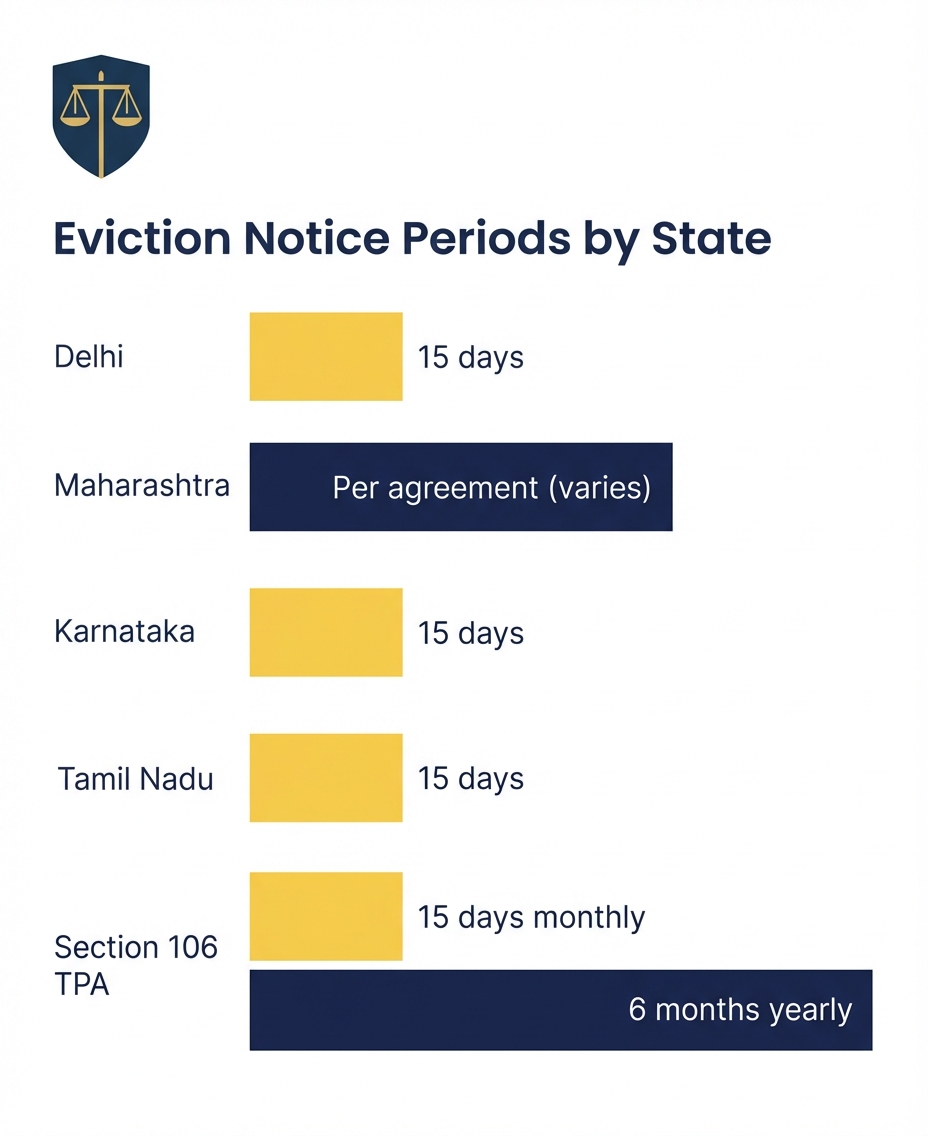
- Month-to-month tenancy (general): 15 days' notice, expiring at the end of a month of tenancy, as per Section 106 of the Transfer of Property Act.
- Agricultural or manufacturing lease: 6 months' notice, expiring at the end of a year of tenancy.
- Contractual tenancy: As specified in the lease agreement. If the agreement specifies a notice period (e.g., 30 days, 60 days, or 90 days), that period must be followed.
- Under state Rent Control Acts: Varies by state. For example, the Delhi Rent Control Act requires one month's notice, while some states may require a longer period.
Always Check Your Lease Agreement First
If your rental agreement specifies a notice period, that contractual period generally takes precedence over the statutory default of 15 days. Many modern rental agreements in India specify 30 days or even 60 days as the notice period. Review your agreement carefully before sending an eviction notice.
Key Elements of an Eviction Notice
A well-drafted eviction notice must contain specific information to be legally valid. Missing any of these elements could render the notice defective and delay the eviction process. The following are the essential components of a tenant eviction notice:
- Full name and address of the landlord (the sender of the notice).
- Full name and address of the tenant (the recipient of the notice).
- Description of the rented property -- complete address, floor number, area, and any identifying details.
- Details of the tenancy -- date of commencement, monthly rent amount, and reference to the lease/rental agreement if any.
- Ground(s) for eviction -- clearly state the specific legal reason(s) for seeking eviction (e.g., non-payment of rent, subletting, personal use).
- Demand or request -- clearly state what you want the tenant to do (vacate the premises, pay arrears, stop unauthorized use, etc.).
- Notice period -- specify the time period within which the tenant must comply (e.g., 15 days, 30 days).
- Consequences of non-compliance -- state that legal proceedings will be initiated if the tenant fails to comply within the notice period.
- Date and signature of the landlord or their authorized advocate.
- Method of service -- the notice should be sent via Registered Post with Acknowledgement Due (RPAD) or through a lawyer via registered post/courier.
Step-by-Step Process to Evict a Tenant Legally
Evicting a tenant in India involves a structured legal process. Skipping any step can result in delays or dismissal of your case. Follow these steps carefully:
- Review the lease agreement: Check the terms of the rental agreement, including the notice period, grounds for termination, and any dispute resolution clauses.
- Identify the legal ground for eviction: Determine which legally recognized ground applies to your situation (non-payment, subletting, personal use, etc.).
- Draft the eviction notice: Prepare a comprehensive eviction notice covering all essential elements listed above. It is advisable to have an advocate draft or review the notice.
- Serve the notice via Registered Post (RPAD): Send the notice through Registered Post with Acknowledgement Due to the tenant's address. Keep the postal receipt and acknowledgement card as proof of service.
- Wait for the notice period to expire: Allow the full notice period to pass. During this time, the tenant may comply, negotiate, or respond with objections.
- Attempt negotiation or mediation (optional): If the tenant responds, consider resolving the matter amicably through negotiation or mediation before proceeding to court.
- File an eviction petition in court: If the tenant fails to vacate after the notice period expires, file an eviction suit in the appropriate civil court or Rent Controller's court.
- Attend court hearings: Present your case, including the eviction notice, proof of service, rental agreement, and evidence supporting your ground for eviction.
- Obtain a court order: If the court finds merit in your petition, it will pass an eviction order directing the tenant to vacate.
- Execute the court order: If the tenant still refuses to vacate, you can apply for execution of the court order through the court, which may involve the police assisting in the eviction.
What Landlords Should NOT Do
Frustration with a tenant who refuses to vacate can lead landlords to take matters into their own hands. However, self-help eviction is illegal in India and can expose the landlord to criminal liability. Here is what you must avoid:
- Forcible entry or lockout: Physically removing the tenant, changing locks, or barricading the premises is a criminal offence under Sections 441-448 of the Bharatiya Nyaya Sanhita (BNS) (previously IPC).
- Cutting off utilities: Disconnecting electricity, water, or gas supply to force the tenant out is illegal and can result in a criminal complaint against the landlord.
- Harassment or intimidation: Threatening the tenant, their family, or using goons to intimidate them into leaving is a criminal offence.
- Removing the tenant's belongings: Taking or disposing of the tenant's property without a court order is illegal and can lead to charges of theft or criminal mischief.
- Entering the premises without consent: A landlord does not have the right to enter the rented premises without the tenant's permission during the tenancy period, except in emergencies.
Illegal Eviction Can Backfire Seriously
If a landlord resorts to illegal eviction tactics, the tenant can file a criminal complaint for trespass, criminal intimidation, or mischief. The tenant may also file a civil suit for damages and seek an injunction restraining the landlord from interfering with their possession. In many cases, courts have directed landlords to restore possession to illegally evicted tenants and pay compensation.
Tenant's Rights and How to Respond
Tenants in India enjoy substantial legal protection, especially under state Rent Control Acts. If you are a tenant who has received an eviction notice, you have the following rights and options:
- Right to receive proper notice: The eviction notice must comply with all legal requirements. If the notice is defective (wrong notice period, improper service, or vague grounds), the tenant can challenge it.
- Right to cure the breach: In cases of non-payment of rent, most Rent Control Acts give the tenant an opportunity to pay the arrears within the notice period or before the court, which can prevent eviction.
- Right to contest the eviction: The tenant can send a reply to the eviction notice through their advocate, disputing the grounds for eviction and presenting their side.
- Right to protection under Rent Control Act: If the premises fall under the applicable Rent Control Act, the tenant enjoys enhanced protections, and the landlord must prove the ground for eviction before the Rent Controller.
- Right against illegal eviction: If the landlord attempts to forcibly evict the tenant, the tenant can approach the police or the court for immediate relief.
- Right to fair hearing: In eviction proceedings, the tenant has the right to present their defence, cross-examine the landlord's witnesses, and produce their own evidence.
If you receive an eviction notice, it is critical to respond promptly. Ignoring the notice does not prevent the landlord from proceeding with legal action. A timely reply through an advocate can open the door to negotiation and potentially resolve the dispute without litigation.
Filing an Eviction Suit If the Tenant Doesn't Vacate
If the tenant does not vacate the premises after the notice period expires and negotiations have failed, the landlord's next step is to file an eviction petition in the appropriate court. The procedure and the court where you file depends on the applicable law:
- Under Rent Control Acts: File the eviction petition before the Rent Controller or the designated Rent Court in your jurisdiction. These are specialized forums that handle landlord-tenant disputes expeditiously.
- Under the Transfer of Property Act: If the Rent Control Act does not apply (e.g., the rent exceeds the threshold, or the property is in an area not covered), file a civil suit for eviction in the appropriate civil court.
- Summary eviction suits: In some states, summary procedures are available for straightforward cases like non-payment of rent, which can significantly reduce the time to get an eviction order.
When filing the eviction suit, you will need to submit the original eviction notice, the postal receipt and acknowledgement (proof of service), a copy of the rental agreement, evidence supporting the ground for eviction (such as rent receipts showing non-payment), and any reply received from the tenant. Court fees vary by state and the value of the claim.
Eviction proceedings in Indian courts can take anywhere from 6 months to several years, depending on the complexity of the case, the court's workload, and whether the tenant contests the proceedings. It is advisable to engage an experienced property lawyer to handle the litigation.
State-Specific Variations
The eviction process and requirements vary significantly across Indian states. Here are the key differences in major states:
Delhi
The Delhi Rent Control Act, 1958 applies to premises where the monthly rent does not exceed Rs. 3,500 (or Rs. 10,000 for certain categories). For premises with higher rents, the general provisions of the Transfer of Property Act apply. Under the Delhi Act, the landlord must file an eviction petition before the Rent Controller. Recognized grounds include non-payment of rent, subletting, misuse, bona fide personal requirement, and the landlord's need to carry out repairs. The Act mandates that before eviction on the ground of non-payment, the tenant must be given an opportunity to pay arrears within a specified period.
Maharashtra
The Maharashtra Rent Control Act, 1999 applies across the state and covers both residential and commercial premises. It provides for eviction on grounds similar to other states, including non-payment of rent, subletting, causing nuisance, and bona fide requirement. A unique feature is the provision for recovery of possession for repairs where the landlord must provide alternative accommodation or the tenant has the first right to re-enter. The Act establishes a Rent Court and Rent Tribunal for expedited proceedings. Tenants in Mumbai particularly enjoy strong protections under this Act, and eviction cases here can be notably protracted.
Karnataka
The Karnataka Rent Act, 1999 governs tenancies in the state. It applies to all premises let for residential or commercial purposes. Grounds for eviction include non-payment of rent for two consecutive months, subletting, material alteration of the premises, and bona fide personal need. The landlord must apply to the Rent Authority for an eviction order. The Act also provides for an appellate authority to hear appeals against the Rent Authority's decisions. In Bengaluru, where the rental market is dynamic, the Act plays a significant role in resolving disputes.
Tamil Nadu
The Tamil Nadu Buildings (Lease and Rent Control) Act, 1960 is one of the older rent control legislations in India. It provides strong tenant protections and applies to buildings and parts of buildings in the state. The Act allows eviction on grounds such as non-payment of rent, subletting, denial of the landlord's title, and bona fide requirement for personal occupation. Eviction petitions must be filed before the Rent Controller. The Act has been criticized for being overly protective of tenants, and there have been discussions about reform.
Model Tenancy Act, 2021
The Central Government introduced the Model Tenancy Act, 2021 to modernize India's rental laws. It recommends establishing Rent Authorities and Rent Courts for faster dispute resolution, mandates written tenancy agreements, and proposes balanced rights for both landlords and tenants. However, since land and tenancy are State subjects under the Constitution, individual states must adopt the Act. As of now, adoption has been slow, and most states continue to operate under their existing Rent Control Acts.
Tips for Landlords
Navigating the eviction process can be stressful and time-consuming. Here are some practical tips to protect your interests and ensure a smoother process:
- Always have a written rental agreement: A comprehensive, registered rental agreement is your strongest evidence in any eviction proceeding. Ensure it clearly specifies the rent, notice period, permitted use, and grounds for termination.
- Collect rent through traceable methods: Use bank transfers, UPI, or cheques instead of cash. This creates a clear paper trail of payment history that is invaluable if you need to prove non-payment.
- Conduct thorough tenant verification: Before renting out your property, verify the tenant's identity, employment, and references. Register the tenancy with the local police station where required.
- Maintain records of all communication: Keep copies of all notices, letters, emails, and messages exchanged with the tenant. Document any breaches of the agreement with photographs or videos where applicable.
- Serve the eviction notice correctly: Always send the notice via Registered Post with Acknowledgement Due (RPAD). Keep the postal receipt, the acknowledgement card, and a copy of the notice.
- Do not delay legal action: If the tenant does not comply with the notice, file the eviction petition promptly. Delays can be perceived as acquiescence and may weaken your case.
- Engage a competent property lawyer: Eviction cases involve procedural technicalities that can trip up even well-intentioned landlords. An experienced lawyer can help you avoid pitfalls and navigate the process efficiently.
- Consider mediation before litigation: Court cases can take years. If possible, attempt mediation or negotiation. Sometimes offering a reasonable settlement (like a few months' time to find alternative accommodation) can resolve the matter quickly.
Document Everything
In eviction disputes, evidence wins cases. Photograph the property condition at the start and end of tenancy, keep copies of all rent receipts, maintain a log of any complaints or breaches, and always communicate in writing. This documentation can make the difference between a successful eviction petition and a prolonged legal battle.
How OpenVakil Helps with Eviction Notices
Drafting a legally sound eviction notice requires knowledge of the applicable laws, proper formatting, and precise language. Many landlords struggle with this process, leading to defective notices that delay eviction proceedings by months. OpenVakil simplifies this entire process.
With OpenVakil's AI-powered legal notice platform, you can generate a professionally drafted tenant eviction notice in minutes. Simply provide the details of your tenancy, the ground for eviction, and the relevant information -- our platform will produce a comprehensive notice that complies with the Transfer of Property Act and applicable state Rent Control provisions.
- Legally accurate: Every notice is drafted based on current Indian tenancy laws, ensuring compliance with Section 106 of the Transfer of Property Act and relevant Rent Control Acts.
- State-specific customization: Our platform accounts for state-specific variations in notice requirements, ensuring your notice meets local legal standards.
- Fast and affordable: Generate your eviction notice in minutes at a fraction of the cost of hiring a lawyer for drafting alone.
- Easy to use: No legal knowledge required. Our guided process asks you the right questions and generates the notice for you.
- Download and send: Download your completed notice as a PDF, ready to be sent via Registered Post to your tenant.
Whether you are dealing with a tenant who has stopped paying rent, is subletting your property without permission, or simply refuses to vacate after the lease has expired, OpenVakil gives you the legal tools to take the first step towards reclaiming your property -- the right way.
Draft Your Tenant Eviction Notice Now
Stop worrying about legal formalities. Use OpenVakil to create a professionally drafted, legally compliant eviction notice in minutes. Start the legal process to reclaim your property today.
Get Started for Free