Social media has given everyone a voice — but it has also given bad actors a powerful weapon. From defamatory posts on Instagram and X (formerly Twitter) to fake Google reviews, morphed images on WhatsApp groups, and coordinated trolling campaigns on YouTube, online defamation and social media harassment have become a pervasive threat for influencers, content creators, professionals, business owners, and everyday individuals in India. A single viral post containing false allegations can destroy a reputation that took decades to build, cost you clients and opportunities, and cause severe emotional distress.
The good news is that Indian law provides robust remedies. A well-drafted legal notice for online defamation is the critical first step in asserting your rights, compelling the offender to remove harmful content, and laying the groundwork for criminal prosecution or civil litigation. This comprehensive guide covers the legal framework — including the Indian Penal Code (IPC) Sections 499–500, the Bharatiya Nyaya Sanhita (BNS) Sections 356–357, the Information Technology Act, 2000, and the IT (Intermediary Guidelines) Rules, 2021 — along with platform-specific reporting strategies for Instagram, X, YouTube, and LinkedIn, evidence preservation best practices, and the step-by-step process for taking effective legal action.
What Is Online Defamation and How Does It Differ from Offline Defamation?
Online defamation (also called cyber defamation) occurs when a false statement of fact is published on a digital platform — such as a social media post, comment, review, blog, video, podcast, or messaging group — that harms the reputation of the person it targets. Under Indian law, the core legal definition remains the same as offline defamation: whoever, by words spoken or intended to be read, or by signs or visible representations, makes or publishes any imputation concerning any person, intending to harm or knowing that such imputation will harm the reputation of that person, commits defamation (Section 499 IPC / Section 356 BNS).
However, online defamation differs from offline defamation in several critical ways. First, reach and speed: a defamatory social media post can go viral within minutes, reaching millions of people across the country and the world, whereas a defamatory newspaper article is limited to the publication's circulation. Second, permanence: digital content is indexed by search engines, cached, screenshotted, and shared indefinitely, making it virtually impossible to fully erase once it gains traction. Third, anonymity: offenders frequently use fake accounts, pseudonyms, or VPNs to hide their identity, creating unique challenges for identification and legal action. Fourth, cross-platform amplification: a defamatory post on X can be screenshotted and shared on Instagram, which is then picked up by YouTube commentary channels and WhatsApp groups, exponentially multiplying the damage.
Indian courts treat online defamation as libel (written defamation) because digital content exists in a permanent or semi-permanent form. This is significant because libel is actionable per se under Indian tort law — the victim does not need to prove specific financial loss, as damage to reputation is presumed from the act of publication itself.
Online Defamation Is Libel, Not Slander
Indian courts have consistently held that defamatory content published on the internet — including social media posts, emails, blog articles, and online reviews — constitutes libel rather than slander because it exists in a fixed, permanent form. This classification is advantageous for victims because libel is actionable per se: you do not need to prove actual monetary loss to claim damages.
Types of Social Media Harassment and Online Defamation
Online defamation and social media harassment take many forms. Understanding the specific type of harassment you are facing is essential for invoking the correct legal provisions and choosing the most effective remedy.
Fake Profiles and Impersonation
Creating a fake social media profile using another person's name, photographs, or personal details is a common form of online harassment. The impersonator may post offensive content, send harassing messages, or engage in fraud while pretending to be the victim. This causes direct reputational damage because third parties attribute the fake account's behaviour to the real person. Under Indian law, online impersonation is punishable under Section 66C of the IT Act (identity theft — imprisonment up to 3 years and fine up to Rs. 1 lakh) and Section 66D (cheating by personation using a computer resource — imprisonment up to 3 years and fine up to Rs. 1 lakh). Additionally, if the impersonation results in defamatory content being attributed to the victim, Section 356 BNS (defamation) applies.
Defamatory Posts and Fake Reviews
This is the most common category of online defamation. It includes false accusations posted on Instagram stories, defamatory tweets or threads on X, malicious YouTube videos making unsubstantiated claims, fabricated one-star Google reviews designed to destroy a business, LinkedIn posts containing false allegations about professional misconduct, and defamatory blog articles or forum posts. The key legal test is whether the statement is a false statement of fact (as opposed to a genuine opinion) and whether it was published with the intention to harm or with knowledge that it would harm the victim's reputation. Fake reviews are particularly damaging for businesses, doctors, lawyers, restaurants, and service professionals whose livelihood depends on online reputation.
Doxxing (Publishing Private Information)
Doxxing refers to the malicious publication of a person's private information — such as home address, phone number, Aadhaar number, workplace details, or family members' identities — on social media or public forums with the intent to harass, intimidate, or endanger the victim. While India does not yet have a specific anti-doxxing statute, doxxing can be prosecuted under multiple existing provisions: Section 66E of the IT Act (violation of privacy — imprisonment up to 3 years), Section 72 of the IT Act (breach of confidentiality), Section 351 BNS (criminal intimidation) if the doxxing is accompanied by threats, and the victim's right to privacy under Article 21 of the Constitution as recognised in K.S. Puttaswamy v. Union of India (2017).
Morphed Images and Deepfakes
The creation and circulation of morphed images — where a person's face is superimposed onto another body, typically in a sexual or degrading context — is an increasingly common form of online harassment, particularly targeting women. With advances in AI, deepfake technology has made it possible to create convincing fake videos. Under Indian law, publishing or transmitting morphed obscene images is punishable under Section 67 of the IT Act (obscene content in electronic form — first conviction: imprisonment up to 3 years and fine up to Rs. 5 lakh) and Section 67A (sexually explicit content in electronic form — first conviction: imprisonment up to 5 years and fine up to Rs. 10 lakh). If the morphed images constitute defamation, Section 356 BNS applies in addition to these IT Act provisions.
Cyberstalking
Cyberstalking involves the repeated use of electronic communication to follow, monitor, threaten, or harass a person, causing fear or distress. This includes obsessively commenting on every social media post, sending persistent unwanted direct messages, tracking a person's online activity across platforms, creating multiple accounts to circumvent blocks, and issuing threats through anonymous accounts. Cyberstalking is punishable under Section 354D BNS (stalking — first conviction: imprisonment up to 3 years and fine; second conviction: imprisonment up to 5 years and fine). When combined with defamatory content, the offender faces charges under both the stalking and defamation provisions.
Coordinated Trolling Campaigns
Coordinated trolling campaigns involve organised groups of individuals — sometimes using automated bot accounts — targeting a person with a sustained barrage of abusive, threatening, or defamatory messages across multiple platforms. These campaigns are designed to overwhelm the victim, suppress their online presence, and cause maximum reputational and psychological harm. While individual trolling comments may seem trivial, the cumulative effect of a coordinated campaign can amount to criminal intimidation (Section 351 BNS), defamation (Section 356 BNS), and intentional insult with intent to provoke breach of peace (Section 352 BNS). The organiser of such a campaign can be held liable as the instigator under Section 45 BNS (abetment).
Section 66A Was Struck Down
The Supreme Court of India in Shreya Singhal v. Union of India (2015) struck down Section 66A of the IT Act as unconstitutional because it was vague and overbroad. This section, which penalised sending "offensive" or "menacing" messages through electronic communication, is no longer in force. Despite this, many police stations across India continue to register cases under Section 66A. Any legal notice citing Section 66A would be legally incorrect and would undermine your credibility. Always cite the valid, current provisions discussed in this guide.
Legal Framework for Online Defamation in India
The legal framework for addressing online defamation in India draws from three primary sources: the criminal defamation provisions under the IPC/BNS, the Information Technology Act, 2000, and the IT (Intermediary Guidelines and Digital Media Ethics Code) Rules, 2021. Together, these laws provide both criminal and civil remedies against offenders and impose obligations on social media platforms to act on complaints.
IPC Sections 499-500 and BNS Sections 356-357
The substantive law of criminal defamation in India is contained in Sections 499–502 of the Indian Penal Code, 1860, now replaced by Sections 356–359 of the Bharatiya Nyaya Sanhita (BNS), 2023 (effective 1 July 2024). The key provisions are:
- Section 499 IPC / Section 356 BNS (Defamation): Defines defamation and includes ten exceptions — including truth published for public good, fair comment on public conduct, opinion on the merits of a case decided by a court, and good-faith censure of a public servant's conduct.
- Section 500 IPC / Section 357 BNS (Punishment): Defamation is punishable with simple imprisonment up to two years, or fine, or both. This applies equally to online and offline defamation.
- Section 501 IPC / Section 358 BNS: Specifically punishes any person who prints or engraves matter knowing or having good reason to believe it to be defamatory — relevant for website operators or blog hosts who knowingly allow defamatory content.
- Section 502 IPC / Section 359 BNS: Punishes the sale of any material containing defamatory matter — potentially applicable to platforms that monetise user-generated defamatory content.
Criminal defamation is a non-cognizable, bailable, and compoundable offence. The aggrieved person must file a private complaint before a Magistrate under Section 199 of the Code of Criminal Procedure (CrPC) / Section 223 of the Bharatiya Nagarik Suraksha Sanhita (BNSS). The complaint must be filed within the limitation period of three years from the date of the defamatory publication. The Supreme Court upheld the constitutional validity of criminal defamation in Subramanian Swamy v. Union of India (2016), affirming that the right to reputation is a fundamental right under Article 21 of the Constitution.
Information Technology Act, 2000
The Information Technology Act, 2000 (as amended in 2008) provides additional criminal and civil remedies specifically relevant to online defamation and social media harassment:
- Section 66C — Identity Theft: Fraudulently using another person's electronic signature, password, or unique identification feature. Imprisonment up to 3 years and fine up to Rs. 1 lakh.
- Section 66D — Cheating by Personation: Using a computer resource to impersonate another person for cheating. Imprisonment up to 3 years and fine up to Rs. 1 lakh.
- Section 66E — Violation of Privacy: Capturing, publishing, or transmitting images of a person's private area without consent. Imprisonment up to 3 years and/or fine up to Rs. 2 lakh.
- Section 67 — Obscene Content: Publishing or transmitting obscene material in electronic form. First conviction: imprisonment up to 3 years and fine up to Rs. 5 lakh.
- Section 67A — Sexually Explicit Content: Publishing or transmitting sexually explicit material. First conviction: imprisonment up to 5 years and fine up to Rs. 10 lakh.
- Section 79 — Intermediary Liability: Provides a safe harbour for platforms (intermediaries) from liability for third-party content, provided they comply with due diligence requirements. If a platform fails to act on a valid takedown request, it loses safe harbour protection and can be held directly liable for the defamatory content.
Intermediary Guidelines and Digital Media Ethics Code Rules, 2021
The Information Technology (Intermediary Guidelines and Digital Media Ethics Code) Rules, 2021 (as amended in 2023) are the most important secondary legislation for victims of online defamation seeking content removal from social media platforms. Key provisions include:
- Grievance Officer Appointment: Every significant social media intermediary (SSMI) — including Instagram/Meta, X, YouTube/Google, and LinkedIn — must appoint a resident Indian Grievance Officer who is responsible for receiving and resolving user complaints.
- Complaint Acknowledgement: The Grievance Officer must acknowledge a complaint within 24 hours of receiving it.
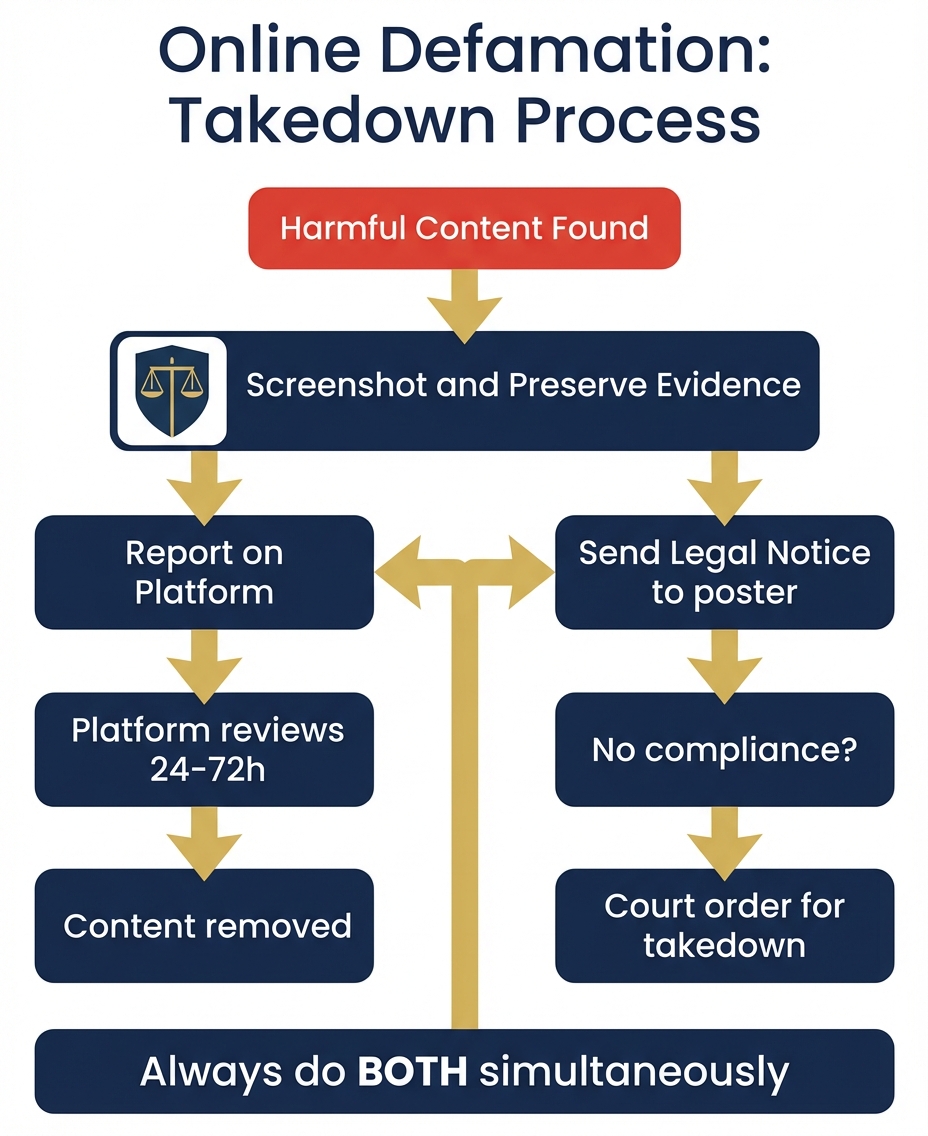
- Resolution Timeline: The complaint must be resolved within 15 days of receipt. For content that relates to the exposure of private areas, sexually explicit material, or impersonation (including morphed images), the platform must remove the content within 72 hours of receiving the complaint.
- Compliance Report: SSMIs must publish a monthly compliance report detailing the number of complaints received, action taken, and average resolution time.
- Safe Harbour Conditional: Under Rule 7, intermediaries that fail to observe due diligence — including the obligations above — lose the safe harbour protection of Section 79 of the IT Act and can be held liable for third-party content on their platforms.
- Government Appellate Mechanism: The 2023 amendments introduced a Grievance Appellate Committee (GAC) to which users can appeal if dissatisfied with the platform's resolution. The GAC must resolve appeals within 30 days.
Use the Grievance Officer Route First
Before filing a court case against a social media platform, always send a formal complaint to the platform's designated Grievance Officer with full details and evidence of the defamatory content. This serves two purposes: (a) it creates a documented legal trail showing the platform was put on notice, and (b) if the platform fails to act within the stipulated 15-day (or 72-hour) timeline, it loses safe harbour protection under Section 79 of the IT Act, significantly strengthening your case in court.
Civil vs. Criminal Defamation: Choosing Your Path
India is one of the few countries that treats defamation as both a civil wrong (tort) and a criminal offence. Understanding the differences between these two paths is essential for deciding the best strategy for your case:
- Criminal Defamation (BNS Section 356–357): Filed as a private complaint before a Magistrate. The prosecution must prove the offence beyond reasonable doubt. If convicted, the offender faces up to 2 years imprisonment and/or fine. This route is suitable when you want to establish a criminal record against the offender and deter future misconduct. The process can be lengthy, but the threat of criminal prosecution is a powerful deterrent.
- Civil Defamation (Law of Torts): Filed as a civil suit in the District Court or High Court. The plaintiff must prove the case on the balance of probabilities (a lower standard of proof). Remedies include monetary damages (compensation), permanent injunction (restraining further publication), and court-ordered retraction and apology. This route is preferable when your primary objective is to stop the defamatory content, obtain financial compensation, and secure an injunction.
- Pursuing Both Simultaneously: You can file both a criminal complaint and a civil suit for the same defamatory act. Many practitioners recommend this dual approach for serious online defamation cases, as the criminal complaint creates pressure on the offender while the civil suit allows you to seek interim injunctive relief for immediate content takedown.
For online defamation specifically, the civil route combined with an interim injunction application is often the most effective strategy because it allows you to obtain a court order directing platforms to take down the content while the case is pending. The criminal route, while powerful, does not directly result in content removal unless the Magistrate passes specific orders.
Facing Online Defamation? Take Legal Action Now
OpenVakil's AI-powered platform helps you draft a professional legal notice for online defamation in minutes. Whether it is a defamatory Instagram post, a fake review, or a coordinated trolling campaign, get a lawyer-reviewed notice ready to send to the offender and the platform.
Draft Your Defamation NoticeWhen to Send a Legal Notice for Online Defamation
A legal notice should be sent as soon as you identify defamatory or harassing content about you online. Timing is critical for the following reasons:
- Limiting the viral spread: The longer defamatory content stays online, the more it is shared, screenshotted, and indexed by search engines. A prompt notice demanding removal can limit the damage.
- Preserving your limitation period: The limitation period for a civil defamation suit is one year from the date of publication (Article 75, Limitation Act, 1963). For criminal defamation, it is three years. Sending a notice early preserves your options.
- Triggering platform obligations: Sending a formal complaint to the platform's Grievance Officer starts the clock on the 15-day resolution timeline (or 72 hours for intimate images and impersonation) under the IT Intermediary Guidelines Rules, 2021.
- Creating a legal trail: A legal notice creates formal, documented evidence of your demand for retraction and removal. If the matter proceeds to court, the notice — and the offender's response or silence — becomes a crucial part of the record.
- Demonstrating seriousness: Many online defamers assume their victims will not take legal action. A formal legal notice from an advocate signals that you are prepared to pursue the matter in court, which often leads to a swift resolution.
You should send a legal notice when: someone has posted false statements of fact about you on social media (not merely opinions or fair criticism); fake reviews are damaging your business; a fake profile is impersonating you; someone is cyberstalking you despite your attempts to block them; morphed images or deepfakes of you are being circulated; a coordinated trolling campaign is targeting you; or a platform has failed to act on your legitimate content removal request.
Who to Send the Legal Notice To
Depending on the circumstances, your legal notice may need to be addressed to one or more of the following parties:
- The Individual Offender: If you know the identity of the person who posted the defamatory content, the primary notice should be addressed directly to them. Include their full name, known address, and any identifying details (social media handle, email address).
- The Social Media Platform / Intermediary: A separate notice should be sent to the platform's designated Grievance Officer (as required under the IT Intermediary Guidelines Rules, 2021), demanding takedown of the specific content and disclosure of the offender's identity and account details (where the offender is anonymous). Address the notice to the Grievance Officer by name, referencing their published contact details on the platform's website.
- Website or Blog Operators: If the defamatory content is published on a blog, news website, or forum, send the notice to the website owner, editor, or hosting service. For websites hosted outside India, the notice may be addressed to the domain registrar or the hosting provider.
- Search Engines: If defamatory content appears prominently in Google search results, you can send a takedown notice to Google under the right to be forgotten principle and/or seek a court order directing de-indexing of the URLs.
Identifying Anonymous Users
One of the biggest challenges in online defamation cases is that the offender often uses a fake name, pseudonym, or anonymous account. Indian law provides several mechanisms to unmask anonymous defamers:
- File a complaint with the Cyber Crime Cell: The police have the authority to issue notices to social media platforms requiring disclosure of account registration details, IP addresses, device information, and login records associated with the anonymous account. File an FIR or complaint at cybercrime.gov.in or your local Cyber Crime Police Station.
- Court order for disclosure (Norwich Pharmacal Order): File an application before the appropriate court seeking an order directing the social media platform to disclose the identity of the anonymous account holder. Indian courts have adopted the Norwich Pharmacal principle, which allows courts to order innocent third parties (such as platforms) to disclose information necessary to identify a wrongdoer.
- IT Intermediary Guidelines, Rule 4(2): Significant social media intermediaries are required to enable the identification of the first originator of information when ordered by a court or a competent authority. This is particularly relevant for content that has been widely circulated.
- Demand to the platform's Grievance Officer: While platforms generally resist disclosing user data voluntarily, a formal legal demand citing the IT Rules and Section 79 of the IT Act — coupled with a warning that non-disclosure will result in the platform losing safe harbour protection — can sometimes yield results.
Key Elements of an Online Defamation Legal Notice
A well-drafted legal notice for online defamation must contain the following elements to be legally effective and strategically persuasive:
- Sender's Details: Full name, address, and contact information of the victim (through their advocate). The notice should be on the advocate's letterhead with their name, enrolment number, and contact details.
- Recipient's Details: Full name and address of the defamer (if known), and/or the name and address of the platform's Grievance Officer.
- Subject Line: A clear, specific subject such as "Legal Notice for Defamation and Content Removal under Sections 356-357 BNS, Section 79 IT Act, and IT Intermediary Guidelines Rules, 2021."
- Identification of Defamatory Content: Precise details of the defamatory content — including the exact URLs, the platform name, the username/handle of the offender, the date and time of publication, and a verbatim reproduction (or detailed description) of the defamatory statement. Attach annotated screenshots as annexures.
- Statement of Falsity: A clear explanation of why each defamatory statement is false, supported by facts and, where available, documentary evidence.
- Description of Harm: The specific harm caused — loss of clients, damage to professional reputation, mental distress, loss of income, social ostracism, or harm to business goodwill. Quantify financial losses where possible.
- Legal Provisions Invoked: Cite the applicable sections: Section 356–357 BNS (criminal defamation), the relevant IT Act sections (66C, 66D, 66E, 67, 67A as applicable), Section 79 IT Act (intermediary liability), and the IT Intermediary Guidelines Rules, 2021 (for platform takedown obligations). For civil remedies, reference the law of torts and your right to seek damages and injunction.
- Specific Demands: (a) Immediate removal of all defamatory content from all platforms; (b) a public retraction and apology in the same medium; (c) an undertaking not to repeat the defamatory statements; (d) compensation for damages suffered; and (e) disclosure of the offender's identity (if sending to a platform regarding an anonymous account).
- Deadline for Compliance: A reasonable timeline — typically 15 days from receipt of the notice. For urgent matters (morphed images, ongoing harassment), demand compliance within 48 to 72 hours.
- Consequences of Non-Compliance: A clear warning that failure to comply will result in filing a criminal complaint for defamation before the Magistrate under Section 223 BNSS, a civil suit for damages and permanent injunction, a complaint with the Cyber Crime Cell, and a complaint to the Grievance Appellate Committee (for platforms). State that all legal costs will be borne by the recipient.
Step-by-Step Process for Sending the Notice
Follow this process to take effective legal action against online defamation:
- Preserve All Evidence Immediately: Before doing anything else, take full-page screenshots of every defamatory post, comment, review, or message. Capture the URL, the offender's profile page, the date and time stamps, the number of likes/shares/views, and any associated comments. Use screen recording for stories, reels, and live videos that may disappear. Save everything to multiple storage locations.
- Avoid Engaging the Offender Publicly: Do not respond to the defamatory content with counter-allegations, threats, or emotional posts. Any public engagement can be used against you, may alert the offender to delete evidence, and could expose you to a counter-claim for defamation.
- Identify the Offender and Relevant Platforms: Determine whether the offender's real identity is known. Note down all platforms where the defamatory content has been published or shared. Identify the designated Grievance Officer for each platform.
- Consult a Lawyer or Use OpenVakil: Engage an advocate experienced in cyber and defamation law, or use OpenVakil's AI-assisted platform to draft a legally sound notice. Provide all evidence, explain the harm suffered, and specify the relief you are seeking.
- Draft Separate Notices if Needed: You may need to draft (a) a notice to the individual offender demanding retraction, apology, and compensation; and (b) a separate notice to the platform's Grievance Officer demanding content takedown and account-holder disclosure under the IT Intermediary Guidelines Rules.
- Dispatch the Notice: Send the notice to the offender via registered post with acknowledgement due (AD) and via email. Send the notice to the platform's Grievance Officer via the official complaint email published on the platform's website, with a hard copy by registered post to their Indian office.
- File Platform-Level Complaints: In parallel with the legal notice, use the platform's built-in reporting mechanism to report the defamatory content for removal. This creates an additional documented trail.
- File a Complaint at cybercrime.gov.in: For serious cases involving criminal harassment, morphed images, impersonation, or cyberstalking, file a complaint on the National Cyber Crime Reporting Portal (cybercrime.gov.in) or visit your local Cyber Crime Police Station to file an FIR.
- Monitor Response and Escalate: Track the delivery of your notice and the platform's response. If the offender does not comply within the stipulated deadline, or if the platform fails to act within 15 days (or 72 hours for intimate content), proceed with filing a criminal complaint before the Magistrate and/or a civil suit for damages and injunction.
The right to reputation is an integral part of the right to life under Article 21 of the Constitution. A person's good name is the immediate jewel of his soul. It is the purest treasure and the most precious perfume of life.
— Subramanian Swamy v. Union of India, (2016) 7 SCC 221
Platform-Specific Reporting and Takedown Actions
Each social media platform has its own reporting mechanisms and community guidelines. Understanding the platform-specific process can help you get defamatory content taken down faster, even before or alongside the legal notice process.
Instagram and Meta Platforms
Instagram (owned by Meta) is one of the most common platforms for online defamation, particularly targeting influencers and content creators through defamatory stories, reel comments, and fake accounts. To report defamatory content on Instagram: (a) use the in-app reporting tool by tapping the three dots on the post and selecting "Report"; (b) for impersonation, use the dedicated impersonation reporting form available on the Instagram Help Centre; (c) for IP-related takedowns or defamation, email the complaint to Meta's designated Grievance Officer for India as published on their transparency page. Meta's India Grievance Officer contact is available at Meta's Indian compliance page. In your complaint to the Grievance Officer, cite the specific IT Intermediary Guidelines Rules provisions and demand action within the stipulated timelines. Meta typically acknowledges complaints within 24 hours and resolves them within 15 days, though resolution for privacy-related content (morphed images, impersonation) should occur within 72 hours.
X (formerly Twitter)
X (formerly Twitter) is frequently used for public defamation, trolling campaigns, and targeted harassment through quote tweets, threads, and trending hashtags. To report defamatory content on X: (a) use the in-app reporting tool by tapping the three dots on the tweet and selecting "Report post"; (b) for more detailed complaints, use the X Help Centre reporting forms for abusive behaviour, impersonation, or private information; (c) send a formal legal complaint to X's designated Grievance Officer for India via the email address published on their transparency report. X is required under Indian law to appoint a resident Indian Grievance Officer. Include the specific tweet URLs, the offending account handle, detailed grounds for removal, and a demand for disclosure of account-holder information if the account is anonymous. Note that X's policies on content moderation have evolved significantly; if X does not act on your complaint within 15 days, document this non-compliance as it strengthens your case for platform liability under Section 79 of the IT Act.
YouTube and Google
YouTube defamation often takes the form of malicious commentary videos, false accusation vlogs, or defamatory comments on videos. Google reviews are another common vector — fake one-star reviews with fabricated complaints can devastate businesses, restaurants, doctors, and service professionals. To take action: (a) for YouTube videos, use the in-app "Report" button below the video and select the relevant violation category; for detailed legal complaints, use Google's Legal Removal Request form specifically designed for defamation and court order compliance; (b) for Google reviews, flag the review from your Google Business Profile and submit a complaint through the Google Business support channel; (c) send a formal complaint to Google India's designated Grievance Officer with full details, evidence, and legal citations. Google also has a Legal Removal Request process for de-indexing defamatory web pages from search results. If the defamatory content is hosted on a third-party website but appears prominently in Google Search, you can request de-indexing after obtaining a court order.
LinkedIn defamation is particularly damaging for professionals because the platform is specifically associated with career and business credibility. Defamatory LinkedIn posts, comments, or messages accusing someone of professional misconduct, fraud, or incompetence can directly cost them job opportunities, clients, and partnerships. To report: (a) use the in-app reporting option on the post or profile; (b) file a detailed complaint with LinkedIn's Grievance Officer for India via the contact details published on their help page; (c) for severe cases, use LinkedIn's legal request form to demand content removal and account-holder disclosure. LinkedIn generally responds to Indian legal complaints within 15 days as required by the IT Intermediary Guidelines Rules.
Interim Relief: Seeking Injunctions Against Online Defamation
Given the viral nature of the internet, waiting for a full trial to conclude before obtaining content removal is often impractical. Indian courts provide interim relief in the form of temporary injunctions that can order the offender and/or the platform to take down defamatory content immediately, even before the final hearing. The key legal provisions are:
- Order XXXIX, Rules 1 and 2 of the Code of Civil Procedure (CPC): Allow a court to grant a temporary injunction in a civil suit to prevent the defendant from continuing the defamatory publication pending trial. The court considers three factors: (a) whether the plaintiff has established a prima facie case; (b) whether the balance of convenience favours the plaintiff; and (c) whether the plaintiff would suffer irreparable injury without the injunction.
- Section 151 CPC (Inherent Powers): Courts can exercise inherent powers to pass orders necessary for the ends of justice, including ordering content removal from platforms that are not party to the suit.
- High Court Writ Jurisdiction (Article 226): In cases involving fundamental rights violations (right to reputation under Article 21, right to privacy), the High Court can be approached directly for interim relief through a writ petition.
- Injunction Against Unknown Persons (John Doe Orders): Indian courts have granted John Doe (Ashok Kumar) injunctions in intellectual property and defamation cases, which bind all persons — whether named or unnamed — from publishing or circulating the defamatory content. This is particularly useful when the defamer is anonymous.
When seeking an interim injunction for online defamation, it is critical to demonstrate urgency and irreparable harm. Courts are more likely to grant injunctions when the content involves morphed intimate images, false criminal accusations, threats to life or safety, or significant ongoing business damage. Your application should include all preserved evidence, the legal notice sent to the offender and platform, and proof of the platform's failure to act (if applicable).
Bonnard Rule and Prior Restraint
Indian courts have adopted the Bonnard rule from English law, which holds that courts should be cautious about granting injunctions that amount to prior restraint on speech. However, this rule does not apply where the defamatory nature of the content is clear, the defendant has no credible defence of truth or fair comment, and the plaintiff would suffer irreparable harm. In practice, Indian courts have increasingly been willing to grant interim injunctions in online defamation cases given the speed and irreversibility of viral content.
Tips for Preserving Digital Evidence
Digital evidence is the foundation of any online defamation case. Improperly preserved evidence can be challenged as unreliable, tampered, or inadmissible. Follow these best practices to ensure your evidence holds up in court:
- Take Full-Page Screenshots Immediately: Capture the entire post or page, ensuring the URL bar, date/time, the offender's username, the post content, and engagement metrics (likes, shares, comments) are all visible. Use the device's native screenshot function.
- Record Videos of Dynamic Content: For Instagram Stories, Reels, live videos, X Spaces, and YouTube livestreams that may disappear, use screen recording to capture the content in real time. Ensure the recording shows the URL, platform interface, and timestamp.
- Archive Web Pages: Use web archiving tools like the Wayback Machine (web.archive.org) or Archive.today to create an independent, timestamped archive of the defamatory web page. This provides a third-party-verified record that cannot be disputed.
- Save Email Headers and Metadata: If the defamation involves emails, save the complete email with full headers (showing originating IP address, mail servers, and timestamps). Most email clients allow you to download the original source file.
- Download Chat Transcripts: For harassment through Instagram DMs, WhatsApp messages, or other messaging platforms, use the platform's built-in export/download feature to create a complete record of the conversation.
- Obtain a Section 65B / Section 63 BSA Certificate: For digital evidence to be admissible in Indian courts, it must be accompanied by a certificate under Section 65B of the Indian Evidence Act, 1872 (now Section 63 of the Bharatiya Sakshya Adhiniyam, 2023). This certificate, signed by a person responsible for the computer or device, attests that the electronic record is a faithful reproduction. Without this certificate, the evidence may be declared inadmissible, as held by the Supreme Court in Anvar P.V. v. P.K. Basheer (2014).
- Maintain Chain of Custody: Store the original evidence files (screenshots, recordings, exported chats) on multiple devices or cloud storage. Do not edit, crop, annotate, or modify the original files in any way. Create a separate set of annotated copies if you need to mark specific content for reference.
- Engage a Cyber Forensic Expert for Serious Cases: In cases involving significant financial stakes, high-profile individuals, or evidence that may be disputed, consider engaging a certified cyber forensic expert to create forensic images, verify authenticity, and provide expert testimony.
Never Modify Original Evidence
Adding highlights, arrows, text annotations, or any other markings to your original screenshots or recordings can raise serious questions about authenticity and admissibility. Always keep the originals pristine and untouched. If you need to annotate evidence for your lawyer or for court submissions, create clearly labelled copies and present both the original and annotated versions.
Get Your Online Defamation Notice Drafted Today
Whether you are an influencer targeted by trolls, a business hit by fake reviews, or an individual whose reputation is under attack, OpenVakil makes it easy to take legal action. Answer a few guided questions, and our AI engine drafts a comprehensive notice citing the correct BNS, IT Act, and Intermediary Guidelines provisions. Every notice is reviewed by experienced cyber law professionals.
Start Your Notice NowHow OpenVakil Helps with Online Defamation Notices
Online defamation cases require a unique combination of legal expertise, digital platform knowledge, and evidence handling skills. Unlike traditional defamation matters, they involve navigating platform-specific reporting systems, citing the correct IT Act and Intermediary Guidelines provisions, addressing anonymous offenders, and ensuring digital evidence meets the admissibility requirements of Section 63 of the Bharatiya Sakshya Adhiniyam. OpenVakil is built specifically to handle this complexity.
- AI-Powered Drafting for Online Defamation: Our platform generates a detailed, legally accurate notice tailored to the specific type of online defamation you are facing — whether it is fake reviews, defamatory social media posts, morphed images, impersonation, cyberstalking, or trolling campaigns. Simply answer guided questions about the offence, the platform, the harm suffered, and the relief you seek.
- Correct and Current Legal Citations: Our AI engine cites only valid, current legal provisions — BNS Sections 356–357 (not outdated IPC references), the relevant IT Act sections, and the 2021 Intermediary Guidelines Rules (as amended in 2023). We never cite struck-down provisions like Section 66A.
- Platform-Specific Notice Variants: We generate separate notices addressed to (a) the individual offender and (b) the platform's Grievance Officer, with platform-specific references to Instagram/Meta, X, YouTube/Google, or LinkedIn compliance obligations.
- Lawyer-Reviewed Quality: Every notice generated on OpenVakil is reviewed by legal professionals experienced in cyber law, defamation, and digital rights to ensure factual accuracy, legal precision, and persuasive tone.
- Evidence Preservation Guidance: Receive step-by-step guidance on how to preserve your digital evidence, obtain a Section 65B/Section 63 BSA certificate, and build a strong evidentiary foundation for your case.
- End-to-End Support: From drafting and dispatching the notice to guidance on filing an FIR at the Cyber Crime Cell, reporting on cybercrime.gov.in, complaining to the Grievance Appellate Committee, and pursuing interim injunctions — OpenVakil supports you at every stage.
- Affordable and Transparent: Access expert-quality online defamation legal notices at a fraction of the cost of traditional law firms. No hidden charges, no ambiguous billing — you know exactly what you are paying for before you begin.
Online defamation can feel overwhelming — the content spreads faster than you can respond, the offender hides behind anonymity, and platforms often seem unresponsive to complaints. But Indian law provides powerful tools to fight back. The BNS defamation provisions, the IT Act, and the Intermediary Guidelines Rules create a comprehensive framework that holds both offenders and platforms accountable. A professionally drafted legal notice is your first and most important step in this process.
Whether you are an influencer dealing with a smear campaign, a doctor fighting fake reviews, a professional targeted by a disgruntled ex-employee on LinkedIn, or a private individual whose morphed images are being circulated — do not suffer in silence. Take the first step today. Preserve your evidence, send a legal notice, and assert your right to reputation. With OpenVakil, you do not need to navigate the legal system alone — our platform and legal team will guide you from the first notice to the final resolution.